

How Ac SDKP Peptide inhibits tissue fibrosis and maintains a stable balance of tissue microenvironment in the body
Ac-SDKP Peptide is an artificially synthesized endogenous tetrapeptide research powder raw material. It relies on solid-phase peptide synthesis, multi-stage chromatography purification, impurity removal and desalination, and vacuum freeze-drying processes to prepare high-purity powder products. Each batch of raw materials is strictly tested for peptide chain integrity, impurity residue, and heavy metal content to ensure stable biological activity in different batches. The fluctuation range of experimental data collected is very small. Under long-term inflammatory stimulation and abnormal damage repair, human tissues are prone to excessive activity of fibroblasts, continuous accumulation of large amounts of collagen substances, slowly occupying normal tissue space and damaging the microenvironment structure inside organs, commonly known as tissue fibrosis problems. Many ordinary tissue repair materials on the market can only temporarily alleviate surface inflammation and cannot control excessive proliferation of fibroblasts from the root. Once intervention is stopped, collagen continues to accumulate and tissue hardening damage will continue to worsen, making it difficult to maintain long-term stable tissue homeostasis. Ac-SDKP Peptide can simulate the endogenous peptide signals present in the human body, regulate the growth rhythm of fibroblasts, reduce excessive collagen deposition, alleviate persistent inflammation, and assist in the growth of new microvessels. It also protects the normal structure of tissues from multiple dimensions and delays the fibrosis process.
The physicochemical properties of tetrapeptides and the construction of a basic system for regulating tissue homeostasis
Ac-SDKP Peptide, as a short chain tetrapeptide, is composed of acetylated serine, aspartic acid, lysine, and proline molecules connected in sequence. The short peptide has a small molecular weight and good water solubility, making it a widely used standard experimental material in tissue microenvironment, organ fibrosis, and injury repair research scenarios. Long chain peptides often have large molecular volumes and are difficult to penetrate cell barriers. They are easily cleaved by various proteases in the body fluid environment, leading to a rapid decline in activity and making them difficult to use in long-term tissue injury intervention experiments. Ac-SDKP Peptide is a naturally occurring short peptide fragment in the body, with a compact molecular structure that makes it easier to penetrate the outer barrier of cells and enter the interior to exert signal regulation. Although it is still slowly degraded by specific enzymes, its mode of action is more in line with the physiological regulation signals inherent in the human body, and it has a stronger ability to simulate the real internal environment.
In terms of the physical and chemical quality of the finished product, the appearance of Ac-SDKP Peptide freeze-dried powder is white to light white powder, and the dry powder state is not easy to absorb moisture and agglomerate. Under the condition of low-temperature and dark sealed storage, the peptide chain structure can be kept intact for a long time, and the purity and activity differences between batches are small. It is suitable for large-scale parallel experiments, long-term animal modeling, high-throughput activity screening and other refined scientific research projects. This raw material can be directly dissolved in neutral buffer, cell culture medium, and tissue simulation medium. The dissolved solution is clear and transparent, without precipitation, flocs, or agglomerated particles. It can accurately prepare gradient concentration systems, avoid experimental errors caused by uneven dissolution and inaccurate effective concentration, reduce false positive or false negative results, ensure the uniformity of all experimental variables, and make scientific research conclusions rigorous and reliable.
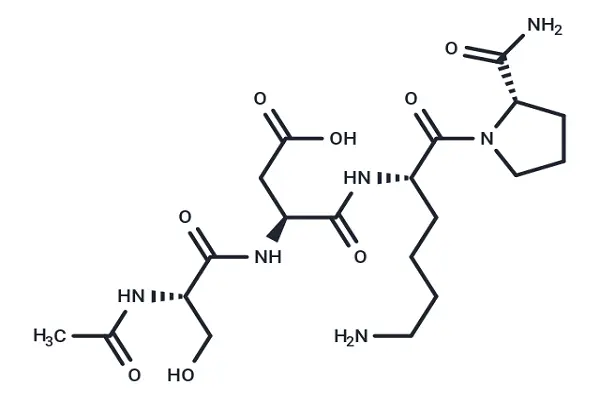
In terms of molecular recognition specificity, Ac-SDKP Peptide does not indiscriminately inhibit the growth of all cells, but only selectively regulates overactivated fibroblasts and macrophages, without arbitrarily interfering with the basic growth metabolism of normal somatic cells. Many tissue conditioning ingredients have broad targets, which not only inhibit fiber proliferation, but also damage normal repair cells, hinder normal wound healing, and interfere with experimental results. Ac-SDKP Peptide Peptide only regulates abnormally activated cell signaling pathways, protects the physiological functions of normal cells, distinguishes pathological hyperplasia from normal tissue repair, and is more in line with the natural laws of human injury repair.
In terms of formula development adaptability, the Ac-SDKP Peptide short peptide structure has good potential for modification and compounding. The pure free Ac-SDKP Peptide will gradually be degraded by enzymes in the body fluid environment, and its duration of action is limited. Researchers often use liposomes, protein protective carriers, and sustained-release excipients for encapsulation modification to prolong its residence time in the lesion and improve tissue enrichment effect. At the same time, it can be combined with anti-inflammatory, antioxidant, and vascular protective experimental materials to simulate composite tissue injury intervention plans, providing sufficient experimental data support for the early development of organ protection and anti fibrosis composite formulas. It is an indispensable core material in the field of tissue homeostasis research.
Targeted regulation of fibrosis signaling pathway to reduce abnormal collagen accumulation
The core root cause of tissue fibrosis is the continuous activation of signaling pathways after tissue damage, which induces a large number of fibroblasts to transform and continuously synthesize matrix substances such as collagen and fibronectin. Excessive collagen accumulates layer by layer, gradually making soft normal tissues stiff and organ function impaired, forming a vicious cycle of "tissue damage inflammation activation fibroblast activation collagen massive deposition tissue hardening injury aggravation". Many ordinary repair materials can only simply alleviate inflammation symptoms and cannot block internal fibrosis signals. Even if inflammation is alleviated in the short term, fibroblasts continue to synthesize collagen, and fibrosis lesions continue to progress. The problem of imbalanced homeostasis cannot be fundamentally improved.
The core functional logic of Ac-SDKP Peptide is to inhibit overactivated fibrotic pathways through signal regulation, reduce abnormal fibroblast proliferation, and decrease excessive collagen production from the source. After chronic tissue damage, a type of pro fibrotic signaling molecule is released in the body, which continuously stimulates fibroblasts to transform into strong secreting myofibroblasts and produce a large amount of collagen. After entering cells, Ac-SDKP Peptide can weaken the transmission intensity of this pro fibrotic signal, reduce the ability of cells to synthesize collagen, prevent the continuous deposition of fibrous matrix in tissue gaps, avoid normal tissue being replaced by fibrous scar tissue, and protect the original structural morphology of organs.
At the level of organ protection, Ac SDKP Peptide is suitable for studying fibrosis related models in multiple organs such as the heart, kidneys, and lungs. Long term inflammation or pressure damage can gradually lead to the accumulation of interstitial collagen in organs, a decrease in organ elasticity, and a gradual decline in work ability. Ac-SDKP Peptide can reduce collagen deposition in the interstitium of organs, inhibit cell transformation to fibrotic phenotype, alleviate scar like changes inside organs, and maintain the basic structural integrity of organ tissues. It does not directly change basic physiological indicators such as blood pressure, and its main function is focused on the remodeling of the internal matrix of tissues, specifically targeting the hardening lesions caused by tissue repair disorders. The regulation mode is specific, making it convenient for researchers to study the mechanism of fibrosis lesions separately, without being interfered with by factors such as blood pressure fluctuations in experimental results.
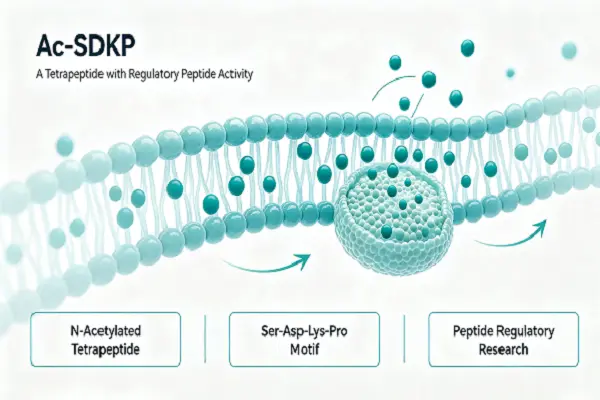
In the long-term intervention scenario of chronic injury, the advantages of Ac-SDKP Peptide are more prominent. Fibrosis is a slowly progressing disease, and short-term intervention is difficult to see significant improvement in tissue structure, requiring long-term treatment that lasts for several weeks. The mild endogenous regulatory mode of Ac-SDKP Peptide is suitable for long-term continuous drug intervention, fully recording the changes in the entire process of "signal inhibition collagen reduction tissue sclerosis relief microenvironment recovery", and truly reproducing the process of chronic organ damage repair in the human body, providing complete and continuous experimental data support for fibrosis mechanism research and organ protection material screening.
Relieve chronic inflammatory stress, rebuild damaged tissue microenvironment homeostasis
Organizational fibrosis and chronic inflammation are intertwined, and persistent low-grade inflammation is an important driving force behind the worsening of fibrosis. After tissue damage, immune cells continue to aggregate and release large amounts of inflammatory factors, repeatedly stimulating surrounding cells and continuously activating pro fibrotic signals. Most ordinary anti-inflammatory materials can only reduce the level of inflammatory factors at once. Once intervention is stopped, immune cells will be reactivated, inflammation will resurface, and continue to drive fibrosis, making it difficult to rebuild tissue homeostasis. Ac-SDKP Peptide can simultaneously regulate the activation status of immune cells, alleviate persistent inflammatory stimuli, cut off the mutually reinforcing cycle between inflammation and fibrosis, and achieve simultaneous anti-inflammatory and anti fibrotic effects.
Ac-SDKP Peptide can regulate the activation direction of macrophages, reduce the number of pro-inflammatory macrophages, and decrease the outward release of inflammatory factors. Macrophages are the core immune cells after tissue damage, and overactivated macrophages continue to release inflammatory signals, constantly stimulating fibroblasts. Ac SDKP Peptide can inhibit excessive proliferation and migration of macrophages, reduce the release of inflammatory factors, weaken local persistent inflammatory stimulation, break the state of sustained inflammation activation, and avoid repeated inflammation stimulation induced fibrosis. This regulation does not directly eliminate immune cells, but rather calms down overly excited immune responses, allowing them to return to normal repair levels without completely shutting down the body's normal immune defense capabilities.
The stable state of the organizational microenvironment is maintained by the levels of inflammation, cell proliferation, matrix metabolism, and microcirculation. Chronic inflammation can increase the level of oxidative stress within tissues, damage endothelial cells, impair microcirculation, hinder nutrient delivery, make damaged tissues more difficult to repair, and further exacerbate the disease. Ac-SDKP Peptide not only reduces inflammation, but also protects endothelial cells, assists in the growth of new microvessels, and improves microcirculation in damaged areas. The gradual growth of new small blood vessels can improve local blood supply and oxygen supply, provide basic conditions for tissue repair, help the damaged microenvironment slowly restore balance, and achieve multi-level stability maintenance of "controlling inflammation, inhibiting fibers, and repairing microcirculation".
In many injury repair related experiments, inflammation and fibrosis are often mixed together, making it difficult to distinguish the respective roles of the two factors. Ac-SDKP Peptide can simultaneously act on two pathways, facilitating researchers to study the linkage between inflammation and fibrosis, and analyzing the development logic of chronic tissue lesions. In models of chronic organ injury, silicosis pulmonary fibrosis, renal interstitial injury, and chronic myocardial injury, it can be used to observe the changes in fibrosis progression after inflammation subsides, and clarify the development chain of lesions.
Adapt to multiple types of scientific research models, clarify the application scenarios of raw materials and scientific research limitations
As a benchmark research material for endogenous short peptides, Ac SDKP Peptide is suitable for research scenarios related to organ fibrosis, chronic tissue injury, inflammatory microenvironment, angiogenesis, and hematopoietic cell regulation. It is a core control material for in vitro cell fibrosis experiments, animal organ injury modeling, tissue remodeling mechanism exploration, screening of new anti fibrotic active materials, and development of tissue protection composite formulas. With high experimental stability and good data reproducibility, it is a commonly used basic experimental material in the field of tissue homeostasis research.
In vitro cell experiments, Ac-SDKP Peptide has good water solubility and high biocompatibility, and can accurately prepare gradient concentrations for research on fibroblast proliferation experiments, collagen secretion detection, macrophage activation models, endothelial cell angiogenesis testing, peptide stability evaluation, etc. Within the effective experimental concentration range, it will not directly kill normal cells or interfere with the survival of basal cells. It can clearly observe the regulatory effects of peptides on fibroblasts, immune cells, and endothelial cells, compare the differences in the effects of short peptides with other anti fibrotic materials, and improve the accuracy of cell level mechanism research.
In animal whole tissue injury model experiments, Ac SDKP Peptide is adapted to various classic scientific research models such as myocardial fibrosis model, renal interstitial fibrosis model, pulmonary fibrosis model, skin scar hyperplasia model, chronic inflammatory tissue injury model, etc. Based on the characteristics of mild endogenous regulation, it is suitable for long-term continuous intervention, observing changes in collagen content, inflammatory indicators, histopathological morphology, and microvascular density of animal organs, fully simulating the process of chronic organ injury and remodeling in the human body, and suitable for high-end scientific research scenarios such as organ protection, anti fibrotic efficacy evaluation, and tissue microenvironment repair.

In the field of raw material screening and formula development, Ac SDKP Peptide is often used as a positive control benchmark to unify the evaluation criteria for anti fibrotic raw materials. Researchers compared the newly developed active ingredient with Ac SDKP Peptide to compare their effects in inhibiting collagen deposition, relieving inflammation, and protecting tissues. They quickly identified the potential of the new active substance and efficiently screened for components with tissue homeostasis protection potential. At the same time, it has excellent compatibility and can be used together with antioxidant, anti-inflammatory, and reparative materials to develop composite tissue protection formulas and optimize the overall anti fibrosis and stability effects of the formula.
Although Ac-SDKP Peptide has outstanding research value, there are clear research boundaries and usage limitations. Firstly, it is suitable for chronic and progressive tissue fibrosis injury models, relying on long-term signal regulation to slowly improve tissue matrix. It is not suitable for acute explosive severe tissue injury models, and short-term experiments may be misjudged as ineffective. Secondly, there is a strict dose window, with low doses having weak regulatory effects and high doses excessively inhibiting cell proliferation and interfering with normal wound repair. Therefore, it is necessary to explore the appropriate concentration gradient. Thirdly, short peptides are easily degraded by proteases in the body, and aqueous solutions should not be stored for long periods of time. Their activity rapidly decreases when exposed to light and heat, and they must be prepared and used immediately, and stored at low temperatures and away from light.
Conclusion
Ac-SDKP Peptide, as an artificially synthesized endogenous tetrapeptide research material, can inhibit abnormal activation of fibroblasts, reduce excessive collagen deposition, alleviate chronic low-grade inflammation, assist in angiogenesis, multi-dimensional block fibrosis progression, and maintain tissue microenvironment homeostasis balance due to its good water solubility, cell penetration ability, and multi-target regulation characteristics. Unlike ordinary single anti-inflammatory materials, it balances fibrosis regulation and inflammation relief, intervenes in chronic tissue damage from the cellular signaling level, and is more in line with the physiological characteristics of chronic organ remodeling in the human body. It is a high-quality experimental material for studying tissue fibrosis mechanisms, building chronic organ injury models, and developing new tissue protection formulas. But this raw material has clear boundaries for scientific research and can only be used for basic laboratory research. It is strictly prohibited for human use, and its activity is greatly affected by temperature, light, solution storage time, and concentration. Experimental operations need to be standardized and controlled.
Xi'an Faithful BioTech Co., Ltd. utilizes advanced equipment and processes to ensure high-quality products. Our Ac-SDKP Peptide meets international pharmaceutical standards. Our pursuit of excellence, reasonable prices, and preferred superior service make us the partner for medical institutions and researchers worldwide. If you require Ac-SDKP Peptide research or production,Please contact us Click email: allen@faithfulbio.com Or WhatsApp: +86 13137770562.
FAQ
Q1: What is the core difference between Ac SDKP Peptide and regular anti-inflammatory and reparative ingredients?
A: Most ordinary repair materials can only alleviate surface inflammation and cannot block collagen deposition. Fibrosis is is prone to continue developing after discontinuation of medication. Ac SDKP Peptide can directly regulate the fibrotic signaling pathway, reduce excessive secretion of collagen by fibroblasts, alleviate chronic inflammation, and balance tissue matrix remodeling, thereby slowing down tissue sclerosis from the root.
Q2: Can the tissue homeostasis effect be maintained in the long term after discontinuing Ac SDKP Peptide?
A: After the raw materials are gradually degraded by proteases, their regulatory effects on fibrosis signals and immune cells will gradually diminish. If the triggering factors of tissue damage persist, fibrotic lesions will progress slowly again, which is only suitable for laboratory continuous intervention studies and has no long-term therapeutic effect on the human body.
Q3: Can Ac SDKP Peptide be directly used to treat organ fibrosis diseases?
A: Absolutely not allowed. This product is a laboratory specific scientific research peptide raw material, without human safety use standards, clinical application qualifications, and risks of immune disorders, abnormal cell metabolism, etc. If used without authorization, it does not belong to finished drugs.
References
- Rhaleb N E. N-acetyl-seryl-aspartyl-lysyl-proline and tissue fibrosis signal regulation[J]. Hypertension,2002.
- Peng H. Antifibrotic effect of Ac-SDKP in hypertensive cardiac remodeling model[J]. Hypertension,2003.
- Hrenak J. Biological function of endogenous tetrapeptide Ac-SDKP in multi-organ injury[J]. Current Pharmaceutical Design,2015.
- Conte E. Ac-SDKP modulates macrophage polarization and pulmonary fibrosis progression[J]. Respiratory Research,2016.
- Srivastava S. Renal interstitial fibrosis intervention by Ac-SDKP peptide in diabetic injury model[J]. Journal of Nephrology,2020.
- Li Q. Formulation optimization and enzyme degradation characteristics of short peptide Ac-SDKP[J]. Peptides,2023.
- Zhang L. Precellular safety evaluation of tissue protective tetrapeptide raw materials[J]. Regulatory Toxicology and Pharmacology,2024.