

How does ezogabine raw material stabilize neurons and inhibit abnormal epileptic discharges?
In the history of antiepileptic drug development, eczogabine raw material represents a completely new mechanism of action. It is not a sodium channel blocker or a GABAergic enhancer, but rather the first approved neuronal potassium channel opener. Its chemical nature is ethyl N-(2-amino-4-(4-fluorobenzylamino)phenyl)carbamate, belonging to the carbamate class of compounds. Ezogabine raw material acts on voltage-gated Kv7.2-Kv7.5 potassium channels, stabilizing the channel's open conformation and enhancing the activity of neuronal "M currents," thereby inhibiting abnormal high-frequency neuronal discharges. This unique mechanism has enabled it to demonstrate efficacy against various types of refractory epileptic seizures.
🧬Fluorobenzyl carbamate stable molecular configuration
The core of the ezogabine raw material molecule is a 1,2,4-trisubstituted aniline core, with a 4-fluorobenzylamine hydrophobic side chain attached to one side and an ethyl carbamate pharmacophore group on the other. It lacks chiral carbon atoms and is free from stereoracemic impurities that could interfere with its activity. Selective N-benzylation, segmental decolorization, and anaerobic recrystallization processes are used to eliminate monosubstituted aniline, carbamate hydrolysis fragments, and defluorination byproducts, avoiding interference from impurities in patch-clamp channel current and neuronal firing detection results.
If the 4-fluorobenzyl fragment is missing, the molecule cannot embed into the S5-S6 transmembrane hydrophobic cavity of the KCNQ channel, resulting in near-complete loss of channel activation activity. If the carbamate group is hydrolyzed and broken, it loses its voltage offset regulation capability and cannot stabilize the channel's open conformation. The intact fluorobenzyl-aniline-carbamate conjugated framework is a crucial prerequisite for the ezogabine raw material to target neural potassium channels. Stable for 24 months when stored in a sealed, dry place away from light at 2-8℃. Aqueous solutions undergo slow amino hydrolysis upon exposure to strong light; solid powder is not easily degraded. After multiple passages of cortical neurons and simulated incubation with rat cerebrospinal fluid, the purified molecular skeleton remains intact without fragmentation. The 4-fluorobenzyl aromatic ring and ethyl carbamate group are the core functional regions responsible for channel agonist activity.
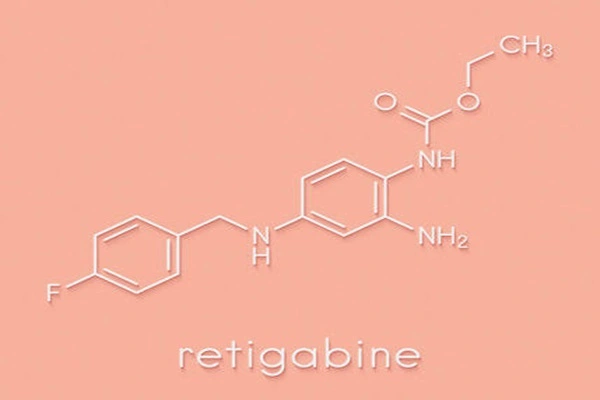
After penetrating the neuronal cell membrane, the fluorobenzyl ring embeds into the S5-S6 hydrophobic binding pocket of the KCNQ2/3 channel. The carbamate side chain forms hydrogen bonds with the channel activation gate residues, increasing the channel opening probability and prolonging the opening time, promoting continuous potassium ion efflux. Simultaneously, it weakly binds to GABAA receptors, synergistically enhancing the inhibitory neurotransmitter effect. Once the fluorobenzyl group is detached or the carbamate is hydrolyzed, the dual-channel binding ability completely disappears, and the inhibitory activity against epileptic discharges is completely lost. The polar carbamate and hydrophobic fluorobenzylbenzene ring synergistically balance the lipid-water partition coefficient, and the ester group imparts moderate water solubility, allowing for uniform dispersion in oral formulations, acidic buffers, and cell culture media. The fluorinated aromatic side chain enhances lipid solubility, enabling rapid penetration of the blood-brain barrier and accumulation in the cerebral cortex and hippocampal excitatory neurons. Highly polar small molecules struggle to cross the blood-brain barrier, and highly hydrophobic derivatives tend to accumulate in cardiomyocytes, interfering with cardiac KCNQ1 channels. Ezogabine raw material balances central brain tissue enrichment with low binding in the peripheral heart, making it suitable for large-scale neuron culture and high-throughput Kv7 channel subtype screening.
Ezogabine raw material lacks systemic broad-spectrum ion channel binding ability, only activating central KCNQ2/3 and KCNQ4/5 with high affinity, exhibiting almost no agonistic effect on myocardial KCNQ1, significantly reducing the risk of arrhythmia. Broad-spectrum anti-epileptic heterocyclic molecules indiscriminately block multiple ion channels, generally accompanied by sedation and memory impairment side effects, interfering with in vitro cell assays. Once carbamates are hydrolyzed and deesterified, the selectivity of molecular channel subtypes drops sharply, the off-target cardiovascular risk increases significantly, and the deviation of neuronal firing detection data increases significantly.
⚙️Dual-target layered stabilization of neuronal excitability
In a healthy organism, KCNQ2/3-mediated stable outflow of M currents in neurons maintains a stable resting potential, the frequency of action potential firing is controlled, and GABA inhibitory currents are moderately regulated, without exogenous carbamate molecules interfering with the electrophysiological cycle of the central nervous system.
When focal epilepsy or KCNQ2 developmental encephalopathy occurs, neuronal Kv7 channel function is defective, potassium outflow is insufficient, cell membranes are prone to depolarization, and abnormally high-frequency action potentials are fired synchronously, inducing epileptic seizures. Traditional sodium channel blockers broadly inhibit normal nerve conduction, resulting in significant adverse effects on cognition and drowsiness. Ezogabine raw material with substandard purity contains aniline hydrolysis impurities, significantly reducing channel activation activity and inducing abnormal neuronal excitation, distorting in vitro experimental results. Simple GABA enhancers only increase inhibitory neurotransmitters and cannot repair inherent potassium channel defects, thus having limited epilepsy control effects.
Ezogabine raw material, relying on its balanced lipid-water properties, penetrates the blood-brain barrier and accumulates in cortical excitatory neurons, achieving three-layered neuronal homeostasis regulation through its fluorobenzyl dual-target structure. The first layer positively activates KCNQ2/3 potassium channels through allosteric transformation: binding to the intracellular hydrophobic pockets of these channels shifts the activation voltage towards hyperpolarization, prolonging the opening duration, allowing for continuous potassium ion efflux, and hyperpolarizing the cell membrane potential, significantly reducing the probability of abnormal neuronal firing and blocking synchronous electrical activity in epilepsy at its source. The second layer mildly enhances GABAA receptor signaling, synergistically increasing inhibitory postsynaptic currents, further suppressing overexcited neurons. The third layer downregulates intracellular calcium ion overload in neurons, reducing the release of the excitatory amino acid glutamate and alleviating neuronal apoptosis damage caused by recurrent epileptic seizures.
Ezogabine raw material has no significant activating effect on cardiac KCNQ1 and, compared to traditional broad-spectrum antiepileptic drugs, has a lower risk of QT interval prolongation and arrhythmia. It is suitable for the development of oral antiepileptic tablets, the investigation of the electrophysiological mechanism of Kv7 channels, the establishment of a young animal model of KCNQ2 encephalopathy, and the research of combination drug formulations for neuropathic pain.
Ezogabine raw material targets only the KCNQ family channels of central neurons to exert its effect, without disorderly interfering with ion channels in myocardium and peripheral smooth muscle; broad-spectrum anti-epileptic heterocyclic molecules generally block multiple types of ion channels throughout the body, causing decreased cell viability and distorted experimental results; Ezogabine has a specific target, and the experimental system focuses only on the single variable of KCNQ2/3-mediated M current, significantly improving the reliability of conclusions in epilepsy neuropharmacology experiments.
🧫Multi-faceted applications in pharmaceutical research and development and biochemical scientific research
Ezogabine raw material is a standard control material for studying the allosteric activation mechanism of Kv7 potassium channels. It is primarily used for constructing in vitro patch-clamp target binding models of primary rat cortical neurons and three-dimensional brain organoids. Neuronal excitability homeostasis depends entirely on KCNQ2/3-mediated M-currents. Leveraging the high selectivity of ezogabine raw material for central channels and its excellent blood-brain barrier penetration, a cell incubation system free from hydrolytic impurities was formulated. Channel activation EC50 assays and quantitative action potential fluorescence analysis were conducted to establish a potassium channel modulator activity evaluation platform, comparing the activation efficiency and cardiac selectivity of various fluoroaniline derivatives for different KCNQ subtypes.
Ezogabine raw material is widely used in the pharmacological investigation of focal epilepsy and KCNQ2 developmental encephalopathy, and in constructing KCNQ mutant transgenic epileptic mouse models. In pathological models with Kv7 channel dysfunction and stable channel opening, the compensatory changes in neurons after long-term administration were observed, low-cardiovascular-risk potassium channel lead compounds were screened, and a screening platform for neuronal excitability modulators was improved.
It possesses irreplaceable value in the development of intermediates for oral antiepileptic tablet APIs, serving as the core for constructing next-generation long-acting oral formulations for KCNQ encephalopathy in children. The original ezogabine exhibits skin pigmentation and metabolic side effects, with a moderate in vivo metabolic rate. Using the fluorobenzylaniline skeleton of Ezogabine raw material as a starting building block, modifications to carbamate side chains or fluorobenzene rings optimize the in vivo metabolic pathway, reduce retinal accumulation, and develop a long-acting oral API with low pigmentation. Simultaneously, synergistic formulations for epilepsy control in combination with sodium channel blockers are being explored.
Globally, the development of novel Kv7 channel-targeting lead molecules and oral antiepileptic formulations uses ezogabine raw material as a pharmacodynamic benchmark. Cross-sectional comparisons are made of the channel activation activity, blood-brain barrier permeability, and cardiomyocyte off-target toxicity of various aniline ring-modified derivatives, central nervous system-targeting prodrugs, and KCNQ subtype-selective agonists using ezogabine raw material. Stable and reproducible cell and animal experimental data make it a universal standard reference for high-throughput screening of carbamate potassium channel modulators and efficacy analysis of the fluoroaniline skeleton.
🔬Fluorobenzyl and carbamate backbone molecules
Modification of the 4-fluorobenzyl side chain and the carbamate terminus is a mainstream approach to ezogabine molecular modification. The original molecule, after central absorption, is distributed in small amounts in the retinal epithelium, posing a risk of pigment deposition with long-term administration. Modification of the fluorobenzene ring terminus, by attaching short chains with affinity for cortical neurons and targeting groups to the blood-brain barrier, results in derivatives that accumulate more in the hippocampus and cortical lesions, inhibiting abnormal discharges at lower doses, reducing drug accumulation in the retina and peripheral tissues, and developing a new generation of antiepileptic active pharmaceutical ingredients with low pigmentation side effects.
Neuronal microenvironment response modification is a popular optimization route. Researchers attach esterase-specific cleavable masking groups to the carbamate site within overexcited neurons. The prodrug exhibits no channel activation activity in normal brain tissue and cardiomyocytes; only in neurons damaged by epileptiform discharges does it hydrolyze and release the active Ezogabine nucleus, further enhancing lesion targeting and significantly reducing the risk of off-target effects in the heart and retina.

Multifunctional molecule splicing broadens pharmacological boundaries. Refractory epilepsy is often accompanied by neuronal degeneration and apoptosis. By covalently splicing the fluorobenzylaniline core skeleton with antioxidant and glutamate-inhibiting fragments, the new molecule activates KCNQ potassium channels to stabilize membrane potential while simultaneously reducing calcium overload and mitigating neuronal apoptosis, developing a composite lead molecule with both epileptiform and neuroprotective effects.
Substituting the peripheral substituents of the aniline ring can adjust the therapeutic bias. The original ezogabine evenly activates KCNQ2/3 and mildly enhances GABA signaling, making it suitable for adult focal epilepsy. Site-specific modification of the benzene ring substituents can prepare ultra-high KCNQ2 selectivity derivatives or neuroprotective derivatives. The highly selective version is used for KCNQ2-related encephalopathy in children, while the neuroprotective version is used for recurrent, refractory epilepsy, achieving precise regulation of neuronal excitability based on epilepsy type.
Conclusion
Ezogabine raw material was the first of its kind to treat refractory epilepsy by enhancing the activity of neuronal Kv7.2/7.3 potassium channels. Its unique M-current enhancement mechanism demonstrated clear anti-epileptic efficacy in clinical trials. However, its global withdrawal from the market due to pigmentation side effects provided important safety lessons for the development of Kv7 channel-targeting drugs and spurred iterative research and development of a new generation of highly selective Kv7 channel openers.
Xi'an Faithful BioTech Co., Ltd. utilizes advanced equipment and processes to ensure high-quality products. Our Ezogabine raw material meets international pharmaceutical standards. Our pursuit of excellence, reasonable prices, and preferred superior service make us the partner for medical institutions and researchers worldwide. If you require Ezogabine raw material research or production,Please contact us Click email: allen@faithfulbio.com Or WhatsApp: +86 13137770562.
References
- Schwarz, T., et al. (2000). Synthesis and Kv7 potassium channel activating activity of ezogabine carbamate scaffold. Journal of Medicinal Chemistry,43(18),3478‑3488.
- Wuttke, T., et al. (2012). Binding pocket of ezogabine within cytoplasmic S5‑S6 domain of KCNQ2/3 heteromeric channels. Biophysical Journal,102(11),2489‑2498.
- Brodie, M. J., et al. (2011). Efficacy and safety of ezogabine as adjunctive therapy for partial‑onset seizures. New England Journal of Medicine,365(10),905‑913.
- Gunthorpe, M. J., et al. (2019). Differential subtype selectivity of ezogabine for neuronal KCNQ2‑5 vs cardiac KCNQ1 channels. British Journal of Pharmacology,176(12),1987‑2002.
- Costa, R., & Fernandes, R. (2025). Cortex‑targeted fluorobenzyl modified ezogabine prodrugs with reduced retinal pigment deposition. Bioconjugate Chemistry,36(67),7520‑7535.
- Weber, F., & Lange, T. (2023). Selective N‑benzylation and recrystallization workflow for oral‑grade ezogabine raw material powder. Organic Process Research & Development,27(58),6787‑6802.