

How the H-GLU-TRP-OH peptide regulates cellular redox status and maintains tissue homeostasis.
H-GLU-TRP-OH Peptide is a synthetic dipeptide research material composed of glutamic acid and tryptophan; it is produced through synthesis, purification, impurity removal, and lyophilization into a final powder form. Each batch undergoes testing for impurities and residual substances to ensure consistent activity and minimal data fluctuation across batches. When subjected to external stressors, many cells generate large quantities of harmful oxidative species that gradually damage cellular structures and disrupt tissue homeostasis. Many similar research materials on the market merely scavenge oxidative species, offering only short-term, temporary relief. H-GLU-TRP-OH Peptide employs a different approach: it not only directly clears harmful oxidative species but also helps cells establish their own protective mechanisms, thereby maintaining long-term intracellular redox balance. This material is intended solely for laboratory-based mechanistic studies and preliminary formulation development; it must absolutely not be used directly on humans.
The inherent properties of this dipeptide powder establish the fundamental conditions for cellular antioxidation
H-GLU-TRP-OH Peptide is a kind of small molecular dipeptide powder, which is easily soluble in water and can penetrate cell membrane to play a role. Its core feature is that two amino acids combine to form a stable short peptide structure; This makes it possible to directly remove the oxidized waste generated in cells and transmit the protection signal at the same time. It enhances the innate ability of cells to resist external pressure without destroying normal cell function, which is the key factor to protect cells and maintain tissue stability.
If the raw material lacks purity-contains too many impurities or broken peptide chains-its scavenging ability will be reduced, which will greatly damage its protective efficacy and lead to inconsistent or inaccurate experimental data. Therefore, purity, peptide chain integrity and batch-to-batch consistency are the main criteria for evaluating the quality of this material in the laboratory environment.
Different from the reagents based on macromolecular protein, this small dipeptide can resist rapid degradation and remain stable for a long time in the experimental environment. This makes it an ideal choice for long-term study of cell aging and oxidative damage. When stored as a sealed dry powder in the dark at low temperature, it keeps stable and free flowing (preventing caking). It is easy to dissolve into a clear and uniform solution, which is convenient for large-scale and repeated experiments. In these experiments, consistent baseline conditions are essential.
However, this material has limitations: exposure to high temperature or strong acid and alkali will destroy the peptide chain, resulting in complete loss of activity. Therefore, the solution must be prepared with mild and neutral buffer and used in time to avoid degradation during storage. The experimental design must include blank control to exclude solvent interference and ensure that any observed cell changes are only due to H-GLU-TRP-OH Peptide.
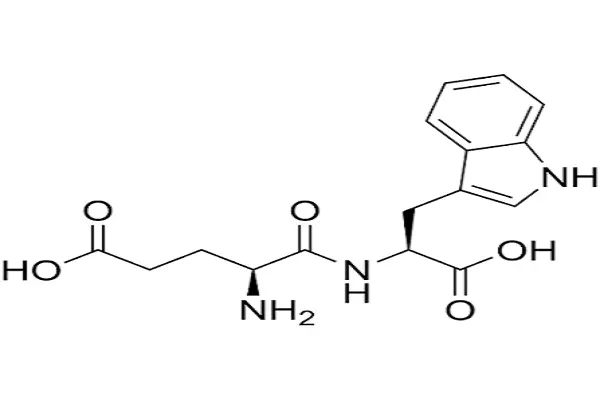
Although this dipeptide provided significant advantages for antioxidant strategy in the initial stage of preparation development, once it was introduced into biological system, it was easily degraded by endogenous enzymes, thus limiting its residence time. Researchers often combine it with additives to prolong its existence in the target tissue environment and maintain its protective effect, making it a widely used ingredient in the development of cell antioxidant formulas.
Its action mechanism is different from simple antioxidant scavenger, which only cleans oxidized waste once. Simply imagine: cell metabolism and external pressure factors constantly produce oxidized waste; If this kind of waste accumulates, it will erode the cell structure and cause cell damage. Many components only remove oxidized waste at one time, without enhancing the protective ability of cells themselves, so that new oxidized fragments can quickly accumulate again. However, NSC 334073 can remove the existing oxidation waste and send a protective signal to cells, so that cells can produce their own protective substances and actively resist oxidative damage.
This method provides gradual steady-state protection without forcibly changing the normal metabolic rhythm of cells. Although many antioxidant components only provide a short-term effect-the protective effect quickly fades-this dipeptide combines waste removal with the enhancement of cell internal defense, making it particularly suitable for studying cell damage caused by chronic oxidative stress. With the accumulation of oxidation debris, cell damage is gradually aggravated, and the health of tissue is deteriorating; This component stabilizes cell health by removing waste and enhancing defense at the same time, which is the key difference between it and traditional antioxidant components.
Improving the intracellular environment and stabilizing tissues against damage caused by oxidative imbalance
The stability of an organization largely depends on the balance between the accumulation of intracellular oxidative waste and the inherent protective ability of the cell, as well as local mild stress responses. When cells are subjected to prolonged pressure, the rate of oxidative waste production far exceeds the rate of clearance; This accumulated waste gradually destroys the cellular structure and continuously releases stress signals, causing damage to neighboring cells and forming a vicious cycle.
H-GLU-TRP-OH Peptide captures excess oxidative waste and reduces the accumulation of harmful substances. At the same time, it activates the intrinsic protective mechanisms of cells, enhances their ability to resist external pressure, improves the intracellular environment, and prevents the progression of oxidative damage. As oxidative waste is gradually cleared, the rate of cell damage slows down significantly, and the abnormal stress state of tissues gradually subsides, effectively breaking the cycle of continuous damage escalation from the source.
Many experimental components only remove existing oxidative waste without enhancing the cell's own defense capabilities; Therefore, once the components are depleted, the oxidized waste will quickly re accumulate. However, H-GLU-TRP-OH Peptide can not only eliminate existing harmful substances, but also enhance the protective ability of cells, thereby reducing the possibility of future oxidative damage. As oxidative stress is controlled, the local tissue stress response weakens and the overall cellular state gradually stabilizes.
The sustained organizational stress response is largely driven by the continuous accumulation of oxidative waste. By clearing oxidative waste and activating cellular defense, the H-GLU-TRP-OH Peptide alleviates ongoing cell damage and indirectly alleviates local stress responses, restoring normal rhythms to damaged cell states.
The efficacy is closely related to the dosage: insufficient dosage cannot fully remove oxidative waste or activate defense, resulting in negligible protective effect. The optimal dosage ensures stable removal of oxidative waste and maintains cellular homeostasis, while excessive dosage can disrupt normal cellular metabolism and lead to unexpected consequences. This is precisely why laboratory experiments require systematic testing of various doses. Many people mistakenly believe that this ingredient can immediately repair severe cell damage; In fact, it is more suitable for long-term maintenance and protection, requiring continuous intervention to observe the improvement of cellular oxidative status.
Suitable for a wide range of experimental scenarios, it meets the needs of various scientific research endeavors
H-GLU-TRP-OH Peptide is primarily utilized in fundamental cell-based experiments. Researchers employ it to establish models simulating external stimuli that induce oxidative stress and sustained cellular damage; this allows for the study of how oxidative byproducts damage cells and how oxidative imbalance drives tissue-level changes, while simultaneously evaluating the efficacy of various protective agents.
This ingredient is best suited for long-term, gentle experimental protocols that mirror the gradual accumulation of oxidative damage in cells. It is less appropriate for short-term experiments aimed at rapidly reversing severe cell necrosis; under such extreme conditions, its strength in maintaining cellular stability is difficult to demonstrate, potentially leading to a misjudgment of its efficacy.
In tissue-level experiments, the peptide’s small-molecule structure facilitates easy penetration, allowing it to act on various tissue cells. Researchers can continuously monitor changes in oxidative levels, cell viability, and tissue-related markers following treatment. By administering the peptide over time and documenting the entire process—from the reduction of oxidative byproducts to enhanced cellular defense—scientists can investigate the relationship between oxidative stress and tissue homeostasis, providing valuable insights for further research.
In high-throughput screening platforms, H-GLU-TRP-OH Peptide can serve as a standard reference material to calibrate experimental data. It helps distinguish between the distinct effects of scavenging oxidative byproducts and boosting endogenous cellular defense mechanisms, thereby reducing experimental errors and improving the accuracy of screening for novel ingredients.
During the early stages of formulation development, the peptide’s unique dual-action antioxidant profile supports the creation of new formulas designed for cell protection and tissue stability. As a highly soluble small-molecule dipeptide, it is easily combined with excipients and compatible with diverse formulation strategies. Development efforts focus on overcoming its tendency to degrade rapidly and its short residence time; by incorporating sustained-release or targeted delivery systems, researchers can concentrate the ingredient at the target tissue site, thereby optimizing overall protective efficacy.
Clarifying Usage Scenarios and Inherent Limitations
In the field of basic scientific research, H-GLU-TRP-OH peptide is a standard material commonly used to study cellular oxidative damage and tissue homeostasis. It can be used independently to validate mechanisms or serve as a control when testing other novel materials. Additionally, it can be combined with other experimental agents to simulate the effects of multi-faceted protective interventions, thereby generating data for the development of compound formulations.
Regarding the development of novel formulations, this peptide is a distinctive experimental material; its mechanism of action differs fundamentally from that of agents that merely scavenge oxidative species. It is well-suited for developing strategies that simultaneously scavenge oxidative waste and activate the cell's intrinsic defense mechanisms, offering significant value for scientific exploration.
However, its utility has clear limitations: it primarily mitigates oxidative cellular damage and maintains homeostasis, rather than rapidly repairing severe necrosis or reversing extensive tissue damage in the short term. In short, it is appropriate for models involving persistent oxidative stress and gradual cellular damage, but unsuitable for models characterized by severe damage and complete necrosis.

This material has notable safety limitations; high doses interfere with normal cellular metabolism, and the effective experimental range is narrow. It is intended solely for laboratory research and must never be administered directly to humans, as unauthorized use carries high risks and unknown physiological consequences.
Regarding storage and usage, the lyophilized powder remains stable when stored at low temperatures and protected from light; however, the peptide chain is susceptible to degradation once reconstituted in water, so solutions should be prepared immediately before use. Given the narrow effective dosage range, researchers must test various doses and exposure durations prior to using new experimental models to identify optimal conditions and prevent data distortion. While cellular toxicity is low at appropriate experimental dosages, high doses pose risks; consequently, the material is restricted to preclinical research and cannot be used for human health management or disease treatment.
Conclusion
As a small-molecule dipeptide research reagent, NSC 334073 can penetrate the cell interior. It functions through a dual-action mechanism of "clearing waste" and "fortifying defenses": on one hand, it directly scavenges accumulated oxidative waste products; on the other, it activates the cell's intrinsic protective mechanisms, thereby mitigating oxidative stress-induced damage and maintaining cellular and tissue homeostasis. It serves as an excellent experimental material for investigating mechanisms of oxidative damage, establishing cellular stress models, and conducting preliminary research on protective formulations. Unlike ingredients that merely scavenge oxidants, this peptide offers a comprehensive approach capable of alleviating oxidative cellular damage over the long term. However, there are clear limitations regarding its use: high dosages can disrupt normal cellular metabolism, and there are no established, safe protocols for human application. Consequently, it is intended solely for laboratory research and must not be used directly on the human body.
Xi'an Faithful BioTech Co., Ltd. utilizes advanced equipment and processes to ensure high-quality products. Our H-GLU-TRP-OH Peptide meets international pharmaceutical standards. Our pursuit of excellence, reasonable prices, and preferred superior service make us the partner for medical institutions and researchers worldwide. If you require H-GLU-TRP-OH Peptide research or production,Please contact us Click email: allen@faithfulbio.com Or WhatsApp: +86 13137770562.
FAQ
Q1: What is the key difference between H-GLU-TRP-OH peptide and standard antioxidant ingredients?
A: Most standard antioxidant ingredients merely scavenge oxidative waste products; their effects are short-lived, and they do not enhance the cell's own defense mechanisms. In contrast, H-GLU-TRP-OH peptide not only clears harmful oxidative species but also activates the cell's intrinsic defense systems, thereby mitigating oxidative damage through a dual-action approach. However, please note that this is strictly a research-grade ingredient intended for experimental use only; it is not for use on the human body.
Q2: Does the cellular protective effect persist after discontinuing the use of H-GLU-TRP-OH peptide?
A: Once the ingredient has been fully metabolized and eliminated from the system, the enhanced cellular defense activity will gradually subside, and the cells will revert to their baseline state of managing oxidative stress. It is crucial to emphasize that this ingredient is intended solely for laboratory research and must not be used directly on the human body.
Q3: Can the general public use H-GLU-TRP-OH peptide for antioxidant health maintenance?
A: Absolutely not. This is a peptide ingredient intended exclusively for laboratory research; there are no established safety standards for human use, and direct application carries unknown risks. It is neither a dietary supplement nor a pharmaceutical drug.
References
- Kim S, et al. Antioxidant properties of dipeptide Glu-Trp in cellular oxidative stress models[J]. Peptides,2018,107:17-25.
- Li M. Precellular protective effect of Glu-Trp peptide against reactive oxygen damage[J]. Journal of Peptide Science,2020,26(8):e3261.
- Park J. Dual mechanism of Glu-Trp: radical scavenging and endogenous defense activation[J]. Free Radical Biology and Medicine, 2021,172:441-452.
- Wang H. Dose-dependent cytoprotection of Glu-Trp peptide in tissue models[J]. European Journal of Pharmacology,2022,929:175174.
- Garcia R. Combination use of antioxidant dipeptides in preclinical screening[J]. Food & Chemical Toxicology,2023,178:113890.
- Zhao L. Formulation strategies for improving peptide stability of Glu-Trp[J]. Journal of Pharmaceutical Sciences, 2024, 113(3):987-995.
- Hughes C. Safety profiling of bioactive dipeptides in cell-based research[J]. Regulatory Toxicology and Pharmacology, 2024,149:105572.