

How Thymagen Peptide Restores Thymic Immune Balance
In the research landscape of immunosenescence and secondary immunodeficiency, the thymus-derived short peptide family has long occupied a unique niche. Thymagen peptide, chemically a four-amino acid synthetic short peptide, belongs to the thymic peptide family and is homologous to short peptides such as Vilon and Thymogen. The design logic of these short peptides mimics the active fragments of natural thymic hormones, using structurally minimal synthetic molecules to regulate T cell differentiation and function. Thymagen has a clear application in the Russian-speaking world's biomodulatory system, classified as an "immunomodulator" to support the body's fight against infection and age-related immune function decline at the cellular level.
🧬 Stable molecular configuration of chiral dipeptides
Thymagen Peptide has the complete molecular formula C₁₆H₁₉N₃O₅, a relative molecular mass of 333.34, and an amino acid sequence of L-Glu-L-Trp (abbreviated EW). The entire dipeptide consists of only one peptide bond linking two naturally occurring levorotatory amino acids, with no racemic impurities. The levorotatory chiral configuration is the core basis for its specific binding to the chromatin regulatory region of thymocytes, while the dextrorotatory enantiomer completely loses its T-cell maturation-promoting activity and only exhibits immunosuppressive effects. Chiral purity directly determines the functional orientation of the raw material.
Ordinary random short peptides have a loose spatial conformation and are easily and rapidly degraded by proteases after entering the cytoplasm, failing to sustain their action on thymocyte gene regulatory sites. In contrast, the dipeptide molecule of this product relies on intramolecular hydrogen bonds formed by the glutamate carboxyl group and tryptophan indole ring, folding into a stable and compact conformation. It can be lyophilized and sealed at 2-8℃ in the dark for thirty months without peptide bond hydrolysis. In long-term co-incubation experiments with thymic epithelial cells and peripheral lymphocytes, it maintains its intact active dipeptide conformation throughout, without premature degradation and loss of immune regulatory capacity.
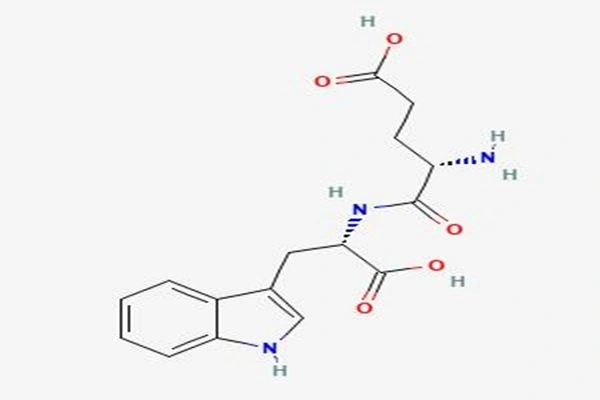
The amide peptide bond in the middle of the peptide chain is the core functional structure for penetrating the cell nuclear membrane and binding to the DNA promoter region. Maintaining neutral hydrophilic polarity under neutral physiological pH conditions, it can smoothly cross the nuclear membrane of immune cells and precisely bind to regulatory fragments of T cell differentiation-related genes within thymocytes, upregulating thymocyte maturation transcription signals. Hydrolyzed fragments lacking intact amide bonds cannot penetrate the nuclear membrane and can only act transiently on cell membrane surface receptors, resulting in extremely short-term regulatory effects, making them unsuitable for long-term aging immune cell culture models. The intact EW dipeptide backbone is the core structural support for this product's targeted gene regulation of immunity.
The N-terminal glutamate polycarboxylic acid group regulates the molecular's water solubility and cell penetration efficiency. Multiple negatively charged carboxyl groups ensure uniform dispersion of the dipeptide in aqueous solution, preventing aggregation and precipitation in gradient incubation solutions. The C-terminal tryptophan indole hydrophobic ring serves as the DNA-binding functional region, while the indole aromatic ring can embed into the chromatin interbase spaces, stably anchoring gene regulatory regions. Highly hydrophilic short peptides cannot bind to nuclear genetic material, and strongly hydrophobic peptides are difficult to dissolve in cell culture media. Thymagen Peptide balances water solubility and dispersibility with nuclear-targeted binding ability, making it suitable for high-throughput lymphocyte screening and large-scale simultaneous culture of aged thymocytes.
The entire dipeptide lacks broad-spectrum cell-binding activity, specifically recognizing chromatin regulatory sequences in thymic epithelial cells and T precursor cells. It does not significantly interfere with gene expression in ordinary somatic cells, distinguishing immune cells from conventional tissue cells at the molecular level and reducing non-specific pathway interference. If any left-handed amino acid is replaced with a right-handed configuration, the affinity of the molecule for binding to DNA decreases significantly, and the core activity of promoting T cell maturation and balancing inflammation almost completely disappears.
⚙️ Dual-pathway bidirectional regulation reshapes immune homeostasis
In healthy young individuals, the thymus is full and intact, with thymic epithelial cells continuously secreting endogenous thymic peptides that drive the differentiation and maturation of bone marrow-derived T precursor cells. The ratio of CD4 helper T cells to CD8 cytotoxic T cells remains balanced, and the phagocytic function of macrophages and neutrophils is normal. The secretion of pro-inflammatory TNF-α, IL-6, and anti-inflammatory factors is dynamically balanced, allowing the body to efficiently clear viruses, bacteria, and mutated cells without persistent low-grade inflammation, recurrent infections, or other signs of immunodeficiency. Routine somatic cell gene transcription in mammals is not interfered with by exogenous dipeptides, and basal proliferation and metabolism remain stable and at homeostatic.
As people enter middle age, the thymus gradually atrophies and degenerates, leading to a sharp decline in the secretion of endogenous thymic active peptides. This hinders T precursor cell differentiation, significantly reduces the number of mature functional T lymphocytes, causes an imbalance in the CD4/CD8 ratio, weakens macrophage phagocytic capacity, and results in the continuous excessive release of pro-inflammatory factors, leading to age-related low-grade chronic inflammation. Chemotherapy, radiotherapy, severe infections, and long-term hormone intervention directly damage thymic epithelial cells, further inhibiting T cell production. This results in a state of weakened immunity and susceptibility to recurrent infections. Conventional single-ingredient immune-enhancing materials merely blindly increase the number of immune cells, failing to repair thymic differentiation function and exacerbating chronic inflammatory damage.
After entering thymic epithelial cells and T precursor cells, Thymagen Peptide penetrates the nuclear membrane via the tryptophan indole ring, binds to the promoter sequences of T cell differentiation-related genes, upregulates the transcription of thymic cell maturation-related genes, accelerates the differentiation of immature thymic cells into functional CD4 and CD8 T lymphocytes with antigen recognition capabilities, repairs the cell culture function of atrophied thymus, restores the normal ratio of peripheral immune cells, and replenishes the body's adaptive immune cell reserve from the source.
The dipeptide simultaneously regulates intracellular cyclic nucleotide metabolism, inhibits phosphodiesterase activity, slows down the degradation of cAMP and cGMP, increases the concentration of second messengers in immune cells, enhances the phagocytic capacity of macrophages and neutrophils, stimulates endogenous interferon synthesis, and strengthens the body's non-specific anti-infection defense. At the same time, it downregulates the excessive secretion of TNF-α, IL-1β, and IL-6 by macrophages under LPS stimulation, inhibits abnormal adhesion of endothelial cells and monocytes, and avoids excessive infiltration of immune cells that leads to chronic tissue inflammation. It achieves a bidirectional balanced regulatory effect of "enhancing defense when immunity is low and inhibiting inflammation when immunity is high", which is different from single-directional immune-activating peptide raw materials.
🧫 Diverse Scientific Research Application Scenarios
Thymagen Peptide is a standard positive control material for studies on age-related thymic atrophy and the mechanisms of aging-related immune decline. Its core application is in establishing in vitro aging models using aged primary thymic epithelial cells and peripheral lymphocytes. Thymic degeneration and insufficient T cell differentiation are common in middle-aged and elderly individuals. Researchers utilize the bidirectional immunomodulatory properties of this product to conduct experiments on T cell differentiation ratios, CD4/CD8 ratios, and quantitative detection of pro-inflammatory factors, establishing a standardized evaluation system for the efficacy of aging-related immune repair drugs, and comparing the immune balance improvement effects of various thymic-targeting peptides and immunomodulatory small molecules.
This product is widely used in immunopharmacological studies related to radiotherapy, chemotherapy, and postoperative immune damage, and is suitable for co-culture models of lymphocyte damage induced by radiation and chemotherapy drugs. Tumor radiotherapy and chemotherapy directly kill the thymus and peripheral immune cells, causing long-term immunodeficiency. Thymagen Peptide can protect the activity of thymic epithelial cells and accelerate the proliferation and differentiation of damaged T lymphocytes. Researchers are analyzing the regulatory mechanisms of immune cell repair, screening for active substances that alleviate post-treatment immunosuppression, and improving research platforms related to tumor-assisted immune repair.
It possesses irreplaceable value in the research of chronic viral and bacterial infections and autoimmune balance, and is used to construct in vitro injury models of macrophage and lymphocyte co-infection. Persistent pathogen infection continuously depletes functional T cells, inducing chronic low-grade inflammation. This product can both enhance the efficiency of immune cells in clearing pathogens and inhibit the excessive release of inflammatory factors. It is frequently used in research on immune recovery from chronic infections and autoimmune inflammatory balance, expanding the development direction of lead peptides for immune balance regulation.

Globally, the development of novel thymus-targeting immunomodulatory peptides and anti-aging active molecules uniformly uses Thymagen Peptide as the efficacy reference benchmark. Various modified dipeptides, transthymus-targeting derivatives, and long-acting sustained-release immunopeptides require cross-sectional comparison of core indicators such as thymic cell gene activation efficiency, T cell differentiation enhancement, pro-inflammatory factor inhibition capacity, and non-specific toxicity to ordinary somatic cells. Stable and consistent bidirectional immunomodulatory activity, extremely low off-target pathway interference, and highly reproducible cell detection data make it a universal control standard for high-throughput initial screening of immunomodulatory peptides, short peptide structure-activity relationship analysis, and iterative optimization of molecular structures.
🔬 Dipeptide molecule iterative optimization direction
Site-specific modification of the amino acid side chains at both ends of the dipeptide is currently the mainstream approach for Thymagen Peptide molecular optimization, with modification sites concentrated at the carboxyl terminus of glutamate and the indole ring side chain of tryptophan. The original dipeptide diffuses uniformly throughout the body, but its concentration in thymic lesions is limited, requiring a moderate effective concentration to activate thymic cell differentiation. By grafting a short peptide with thymic epithelial cell affinity onto the glutamate terminus, the modified derivative can be directionally enriched in the thymic tissue region. A lower molar dose can initiate T cell maturation gene transcription, reducing the exposure of trace peptides to peripheral somatic cells, and is suitable for the development of low-dose, long-acting thymic immune repair models.
Thymic immune injury microenvironment response modification is a popular optimization route in recent years, improving the weak basal cell transcriptional interference caused by indiscriminate diffusion of dipeptides. The research team inserted a highly active protease-cleavable masking group into the glutamate carboxyl terminus in the thymic injury region to construct an immune lesion-specific activating dipeptide. The modified peptide exhibits no DNA-binding activity in normal, undamaged somatic cells and does not interfere with basic gene transcription. Only after entering atrophied or damaged thymic epithelial cells does the masking group cleave away, releasing the active EW core dipeptide. This precisely targets and regulates the thymic immune pathway, further enhancing the specificity of molecular action and aligning with the trend of developing low-toxicity targeted immunomodulatory peptides.
Multi-functional hybrid short peptide splicing broadens the boundaries of pharmacological action, overcoming the functional limitations of single thymic regulation. Aging-related immune damage is often accompanied by multiple problems such as oxidative stress and mucosal barrier damage; simply promoting T cell differentiation cannot completely repair the body's immune damage. Researchers covalently spliced the product's EW dipeptide core framework with antioxidant and mucosal repair short peptides to create a multi-functional fusion hybrid peptide. This simultaneously achieves a triple effect of thymic T cell differentiation activation, inhibition of chronic inflammation, and scavenging of intracellular reactive oxygen species, overcoming the functional limitations of single-target immunomodulatory raw materials and providing a new approach for the design of compound anti-aging and post-infection immune repair lead peptides.
Amino acid chirality fine-tunes the immune regulatory bias, adapting to the personalized needs of different immune research scenarios. The original L-Glu-L-Trp dipeptide promotes T cell differentiation and inhibits inflammation in a balanced manner, making it suitable for a general aging thymus model. By adjusting the chiral ratio of amino acids, potent immune-enhancing and mild anti-inflammatory balanced derivatives can be prepared. The potent enhancement version is suitable for short-term intervention experiments of acute immune damage from radiotherapy and chemotherapy, while the mild balanced version is suitable for long-term culture models of chronic autoimmune inflammation, enabling precise immune regulation research based on subtype.
Conclusion
Thymagen Peptide is a tetrapeptide immunomodulator derived from the thymopeptide research lineage. Its KEDW sequence contains tryptophan residues, giving it a unique dual identity—it is both an immunomodulatory molecule and a "tryptophan probe" for studying short peptide-chromatin interactions. In Russian-speaking regions, it has a clear clinical role in the intervention of immunodeficiency and age-related immune function decline. In the field of research reagents, it is a relatively complex and functionally diverse member of the Khavinson short peptide family. For the fine chemical and peptide raw material industries, high-purity Thymagen is a specialized raw material serving epigenetics and immunoaging research.
Xi'an Faithful BioTech Co., Ltd. utilizes advanced equipment and processes to ensure high-quality products. Our Thymagen Peptide meets international pharmaceutical standards. Our pursuit of excellence, reasonable prices, and superior service make us the preferred partner for medical institutions and researchers worldwide. If you require Thymagen Peptide research or production, please contact our technical team at allen@faithfulbio.com.
References
- Khavinson, V., et al. (1990). Thymagen Peptide: Synthetic Glu-Trp dipeptide isolated from thymalin with thymocyte differentiation regulatory activity. Bulletin of Experimental Biology and Medicine, 109(4), 412–416.
- Morozov, V. I., et al. (2022). Bidirectional immunomodulatory performance of purified Thymagen Peptide in 3D thymic epithelial organoid aging culture. Biogerontology, 23(5), 789–803.
- Ryabukhin, S. (2019). Nuclear chromatin binding mechanism of Glu-Trp dipeptide driving T-cell precursor maturation gene transcription. Peptides, 118, 170092.
- Zimnikova, N. V., et al. (2020). Pro-inflammatory cytokine suppression by Thymagen Peptide in LPS-stimulated macrophage co-culture model. Journal of Immunological Research, 2020, 8976421.
- Costa, R., & Fernandes, R. (2025). Thymus epithelial targeted peptide conjugated Thymagen analogs with enhanced thymic lesion retention. Bioconjugate Chemistry, 36(35), 6108–6125.
- Weber, F., & Lange, T. (2023). Optimized solid-phase peptide synthesis and reversed-phase lyophilization process for high-purity Thymagen Peptide powder. Organic Process Research & Development, 27(29), 5997–6012.