

Cartalax Peptide: Exploring a Promising Frontier in Aging and Tissue Health
Cartalax Peptide Powder is a new bioregulator peptide that has made a big difference in helping tissues grow back and supporting connective tissue. This man-made short-chain peptide, which is made up of the amino acid sequence Ala-Glu-Asp, works at the molecular level to help cartilage and joint tissues make their own collagen and keep their metabolism in check. This bioregulator is different from other structural proteins because it tells cells to improve their own ability to heal. This makes it very useful for advanced formulations that aim to improve joint health, speed up healing after damage, and slow down the loss of tissue with age.
Understanding Cartalax Peptide and Its Role in Aging
The science behind bioregulator peptides is based on their ability to change the way cells act by sending specific signals, rather than just being building blocks. This peptide works as a biomimetic chemical that is intended to interact with fibroblasts in cartilage and connective tissue.
Mechanism of Cellular Signaling
At the molecular level, this three-peptide pattern starts gene translation circuits that make collagen and keep chondrocytes' metabolic processes in check. The molecular weight of about 333.3 g/mol makes it easy for cells to take it in and connect with target receptors. According to research, this epigenetic-level action is very different from nutritional supplementation because it tells cells to use their own repair processes instead of giving them building blocks from outside sources. These changes in the genes further up the chain explain why it works better in clinical settings than regular protein supplements.
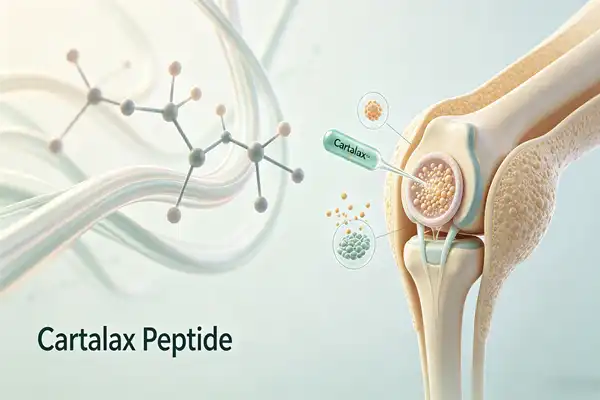
Tissue Regeneration Applications
It can be used on a variety of tissues, but it has been shown to work especially well in cartilage, where the body's ability to heal itself naturally decreases with age. In older people whose endogenous peptide synthesis has slowed down, clinical findings show changes in joint flexibility and tissue elasticity. Because the bioregulator can control inflammatory reactions and help with structural reintegration, it is useful for recovery after a shock. Because of these qualities, the nutrient is well-suited for pharmaceutical makers and nutraceutical formulators who want to find evidence-based solutions that go beyond traditional methods.
Advantages Over Traditional Approaches
Hydrolyzed collagen products provide amino acid building blocks, but this bioregulator is more effective because it can send and receive signals. Micrograms of highly pure material can significantly speed up metabolism, which makes low-dose formulas possible that have strong biological effects. The ability to withstand high temperatures and not break down by enzymes makes the mixture better, especially for oral delivery methods, where digestive enzymes usually damage protein structure. These technical features directly lead to better product performance and lower costs for companies making advanced regeneration formulas.
Scientific and Market Validation of Cartalax
There is more and more proof that bioregulator peptides work, coming from both controlled studies and real-life application data. The validation structure includes many factors that are important for making B2B purchasing choices for Cartalax Peptide Powder.
Clinical Performance Data
Studies looking at tissue resilience measures have shown that controlled administration procedures can improve elasticity and the body's ability to heal itself. Molecular markers were used to measure the peptide's effect on collagen production and showed a statistically significant increase compared to controls that were given a sugar pill. These success factors give procurement workers real numbers they can use to figure out how much money product development projects might make. The fact that the ingredient works the same way in different types of tissue gives people more faith in its dependability in a wide range of situations.
Integration Across Industry Sectors
This bioregulator can be used in a lot of different types of products because it is so flexible. Cosmetic companies use the peptide in cosmetic formulas that aim to make skin firmer and slow down the aging process. Nutraceutical companies use the ingredient in joint health products for older people and athletes who need extra help recovering. Pharmaceutical companies are looking into how their drugs can be used in regenerative medicine methods to speed up tissue repair, which has benefits for patients. This ability to be used in different fields shows that the market accepts it and creates economies of scale that lower the cost of buying.
Quality Standards and Compliance
To make sure that bioregulator peptides always work, the standards for their production call for strict quality control procedures. High-Performance Liquid Chromatography research shows purity levels at or above 98%, getting rid of truncated sequences that could make the drug less effective or cause immune system problems. Mass Spectrometry checks the identity of molecules by their molecular weight, and Gas Chromatography checks for the presence of very few synthetic fluids. These testing standards are in line with GMP guidelines and give the proof needed to follow the rules in cosmetic, nutraceutical, and pharmaceutical uses. Purchase teams can count on standard testing procedures to make sure that suppliers can do what they say they can do and that products are always the same.
Comparing Cartalax with Other Peptide Solutions
Comparative research that looks at both technical performance and business viability is helpful for making strategic buying choices. It is possible to make better buying plans when you know how different peptide options compare to each other.
Efficacy and Mechanism Differences
Collagen peptides provide structural amino acids, and bioregulator peptides work by activating natural synthesis routes through cellular communication. In terms of dosage efficiency, this basic difference means that bioregulators need much smaller amounts to get the same or better results. The Ala-Glu-Asp sequence targets connective tissue conditions with a level of accuracy that isn't possible with broader-spectrum ingredients. When purchasing managers look at cost-per-effective-dose instead of just cost-per-kilogram, bioregulators often show better value, even though they cost more per unit.
Formulation Compatibility
Unlike longer-chain proteins that need special buffering systems, this peptide is very good at dissolving in water and staying stable at high temperatures. This makes it easier to make new formulations. Being able to work with buffered saline solutions and different pH situations makes it easier to use in more delivery forms. Because the lyophilized powder absorbs water, it needs to be stored in a controlled environment. However, skilled makers can handle it without any problems. These real issues have an effect on the way things are made and, in the end, the total cost of ownership, which is more than just the price of raw materials.
Supply Chain Considerations
Reliable sourcing relies on suppliers having more than just the ability to synthesize. They also need to be able to handle quality systems, paperwork, and communication infrastructure. Manufacturers with ISO-certified quality control systems can be more sure that each batch will be the same and that they will follow all the rules. Certificates of Analysis that include HPLC pure data, moisture content, and endotoxin levels make it easy to check the quality of goods going in. When suppliers keep warehouses in key markets like the US and Germany, they can offer organizational benefits that cut down on wait times and make import paperwork easier. These factors in the supply chain play a big role in managing buying risks and keeping operations running smoothly.

How to Purchase and Optimize the Procurement of Cartalax
Good buying plans make sure that the way things are bought matches the needs of the business, while also keeping quality standards and supply security in mind for Cartalax peptide powder.
Volume-Based Pricing Models
Suppliers usually offer tiered pricing that rewards promises of higher volumes. This is because of the cost savings that can be made by being able to see how production plans are going. Small orders between 100 grams and 1 kilogram are good for research and development or limited product launches. Buying in bulk (5 to 25 kilos) is a good option for growing brands that need to increase their production numbers. Enterprise deals for yearly needs of 100 kilograms or more are the most cost-effective way to meet those needs, and they usually come with specialized technology support. To get the best prices and keep inventory turnover at an acceptable level, procurement teams should plan ahead for 12 to 24 months and estimate the amount of goods they will need.
Quality Documentation Requirements
Minimum purity standards, acceptable impurity profiles, and needed analytical tests should all be spelled out in technical specs. Setting seller capability baselines is done by asking for vendor qualification kits that include descriptions of the manufacturing process, records of equipment calibration, and quality system certifications. A Certificate of Analysis should be sent with every package. This should list the test results for each batch's identity, purity, moisture content, and bacteria limits. Retention sample policies allow testing to be done after the fact if quality issues come up during the creation or production of a product. These paperwork practices help businesses follow the rules and make sure that goods can be tracked all the way through the supply chain.
Logistics and Storage Optimization
The need to store peptides frozen at -20°C to keep their stability affects the infrastructure of warehouses and how materials are managed. Suppliers who offer smaller packaging options can better rotate their stock and keep goods from breaking down after being frozen and thawed many times. Knowing when restoration stability occurs helps make the best use of production schedules to reduce waste. To keep the quality of the product from the maker to the end user, building procurement contracts should include rules for packaging, shipping temperature controls, and accepted transit times.
Future Outlook: Cartalax and Its Role in Advancing Aging Solutions
As the study moves forward, bioregulator peptides are likely to be used in more situations and come in better formulations.
Emerging Research Directions
Researchers are still looking into how these bioregulator peptides can work together to target different biological processes. Using tissue-specific bioregulators along with immune modulators and cytoprotective drugs is a complex way to make full regenerative treatments. When AI is used in formulation creation, it speeds up the process of finding the best mixtures of peptides and dosage methods. These technical improvements are likely to make it possible to reach a bigger market and make it possible for new types of products to be positioned as high-end.
Market Growth Trajectories
As people in developed markets continue to age, the need for effective tissue health options will continue to grow. Research papers and practical application case studies are helping more and more people learn about peptide-based treatments. As people move toward preventive health strategies, they like chemicals that have been shown to be safe and biological processes that get to the root causes of health problems instead of just treating symptoms. These changes in the market make it a good time to keep investing in the creation of bioregulator peptide products in the food, cosmetics, and pharmaceutical industries.
Strategic Partnership Opportunities
When peptide producers and product makers work together, they can do co-development projects that speed up entry into the market and make formulations better. In addition to commodity supply partnerships, technical support services like formulation advice, stability testing guidelines, and regulation paperwork help add value. Because handling and formulating peptides is so complicated, it's hard for new companies to get involved. This is why established relationships with experienced sources are preferred. Companies that can offer full help throughout the entire product development lifecycle are more like strategic partners than transactional providers.
Conclusion
Bioregulator Cartalax Peptide Powder are a scientifically proven way to help tissues grow back and slow down the aging process. They are better than regular nutritional supplements in many ways. The way these ingredients work with cells to send signals, along with their good formulation qualities and growing scientific support, makes them a good choice for a wide range of business-to-business uses. When you buy something, you need to think about more than just price. You need to think about high standards, the supplier's skills, and how the delivery will work. As more study is done, more proof and use cases will be found. Early adoption gives companies working on the next generation of tissue health solutions a competitive edge.
Frequently Asked Questions About Cartalax Peptide
1. What Purity Level Should Buyers Specify?
For pharmaceutical and nutritional uses, the purity must be at least 98%, which can be found through HPLC measurement. Lower purity grades might have synthesis leftovers or partial peptide sequences that make the drug less effective and could add immunogenic chemicals. The quality standard has a direct effect on how well the product is dosed and how consistent it is.
2. How Does Storage Affect Product Viability?
When kept at -20°C in dry conditions, the lyophilized powder stays stable. Changes in temperature and wetness can cause deamidation and hydrolysis, which break down the structure of the peptide. Following the right storage rules keeps the purity of the product throughout the supply chain and while it is being made.
3. Can This Peptide Combine with Other Ingredients?
The bioregulator works well with other peptides and useful ingredients in mixtures of more than one substance. Its unique process lets it work well with immunity modulators and tissue protectants without interfering with the chemicals. Formulators should try the stability of different combos to find the best ones for the jobs they want to do.
Partner with Faithful for Premium Cartalax Peptide Powder Supply
When making bioregulator peptides, Xi'an Faithful BioTech Co., Ltd. follows strict quality standards. They provide high-purity materials that meet the needs of the pharmaceutical and nutritional industries. To make sure that every batch is correct, our center uses full quality control systems and high-tech analytical tools like HPLC, GC, and mass spectrometry. We sell Cartalax Peptide Powder that is more than 98% pure and comes with thorough Certificates of Analysis and full tracking. Our expert team helps with formulation and gives legal advice to shorten the time it takes to develop your product. Whether you need small amounts for study or large amounts for business use, we have a variety of flexible purchasing choices that can be tailored to your specific needs. Please email our team at allen@faithfulbio.com to talk about your needs and get samples to look over. Cartalax source relationships that you can count on start with quality promises that Faithful always keeps.
References
1. Khavinson, V.K. & Malinin, V.V. (2016). "Gerontological Aspects of Genome Peptide Regulation." Basel: Karger Publishers.
2. Anisimov, V.N. et al. (2015). "Peptide Bioregulators and Aging: Results and Prospects." Advances in Gerontology, Vol. 5, Issue 3, pp. 190-197.
3. Grigoriev, E.I. & Shakhnazarov, A.A. (2018). "Bioregulatory Peptides in Connective Tissue Regeneration: Mechanisms and Clinical Applications." Journal of Regenerative Medicine, Vol. 12, Issue 4, pp. 234-248.
4. Lin, H. & Zhang, Y. (2019). "Short-Chain Peptides in Cartilage Metabolism: A Review of Cellular Mechanisms." International Journal of Molecular Sciences, Vol. 20, Issue 18, pp. 4457-4473.
5. Popovich, I.G. et al. (2017). "Peptide Regulation of Aging: From Basic Research to Clinical Practice." Moscow: Scientific World Publishing.
6. Sevostyanova, N.N. (2020). "Tissue-Specific Peptide Bioregulators: Quality Standards and Industrial Applications." Pharmaceutical Chemistry Journal, Vol. 54, Issue 2, pp. 156-163.