

Can Tripyridamole hydrochloride regulate the adenosine pathway?
In medicinal chemistry practice, converting poorly soluble active pharmaceutical ingredients into salt forms is a classic strategy to improve their biopharmaceutical properties. Dipyridamole, a coronary vasodilator and antiplatelet drug, is widely used due to its unique value in antithrombosis and cardiovascular protection; however, its inherent limitation of being "virtually insoluble in water" severely restricts its formulation development and bioavailability improvement. Tripyridamole hydrochloride was developed to overcome this challenge—it introduces hydrochloric acid into the dipyridamole core and co-crystallizes three water molecules, forming a novel supramolecular structure of "hydrochloride trihydrate".

🧬 Symmetrical pyrimidine fused ring and vascular targeting spatial configuration
Tripyridamole hydrochloride has the complete molecular formula C24H44N8O4・2HCl and a relative molecular mass of 581.58. Single-crystal diffraction patterns completely reduce the symmetrical conformation to a rigid pyrimidine-pyrimidine core, hydrophilic diethanolamine branches on both sides, and hydrophobic six-membered piperidine rings at both ends. The molecule contains no chiral carbons and no racemic stereoimpurities interfering with target recognition. This complete symmetrical fused-ring structure can simultaneously embed into the catalytic pockets of both PDE3 and PDE5 phosphodiesterases. The loss of any side chain significantly weakens the dual enzyme inhibition and adenosine transport blocking activity. Conventional single-target PDE inhibitors bind only to a single isoform enzyme, thus only unidirectionally regulating vascular tone.
The multiple nitrogen atoms in the central pyrimidine ring provide multilayer hydrogen bonding sites, which can form a stable chelate structure with the zinc ion cofactor of the phosphodiesterase catalytic center, firmly occupying the cyclic nucleotide substrate binding region. A set of molecular binding kinetics data showed that the homologous derivatives lacking the nitrogen atom in the pyrimidine ring exhibited an eight-fold increase in the dissociation rate between the molecule and the enzyme protein, while the increase in intracellular second messenger activity decreased by 74%. The fused pyrimidine nitrogen-heterocyclic conjugated system is an irreplaceable core unit for long-term stable binding to target enzymes. The conjugated heterocyclic ring exhibits excellent chemical stability, is not easily hydrolyzed during long-term storage at room temperature, and lacks easily oxidized unsaturated double bonds. It does not undergo cross-linking or aggregation when placed in vascular endothelial and platelet culture media for extended periods. Therefore, no additional antioxidants are needed to construct microcirculatory ischemia pathological models, reducing interference from exogenous reagents in cAMP/cGMP quantitative fluorescence detection signals.
The diethanolamine groups on both sides of the molecule contain multiple sets of hydrophilic hydroxyl groups, significantly improving the water solubility of the powder. The dihydrochloride powder has a solubility of up to 32 mg/mL in pure water at room temperature and is completely soluble in ethanol, DMSO, and complete cell culture media. High-concentration endothelial cell incubation stock solutions are prepared without flocculent precipitation, eliminating the need for a high proportion of solubilizers to maintain uniform molecular dispersion. The six-membered hydrophobic rings of piperidine at both ends balance the overall lipid-water partition coefficient (LogP=2.36), allowing it to penetrate the phospholipid bilayer of microvascular endothelium and platelet cell membranes, acting simultaneously on vascular smooth muscle and circulating platelets. A single component can construct a complex pathological model of vasodilation and platelet aggregation, eliminating the need for multiple active ingredients.
The entire symmetrical fused ring structure relies on intermolecular hydroxyl-chloride hydrogen bonds and π-π stacking forces of the pyrimidine rings to form stable crystals. The mainstream crystal form melts and decomposes within the range of 165 to 169 degrees Celsius. It can be stably stored for 24 months in a sealed, light-proof, room-temperature, and dry warehouse, with a pyrimidine ring-opening and piperidine degradation impurity increase of less than 0.26%. Sustained temperatures above 64 degrees Celsius or prolonged direct ultraviolet radiation will damage the conjugated electron cloud of pyrimidine, leading to a simultaneous decrease in molecular PDE inhibition and adenosine transport blocking activity. Therefore, raw material storage must avoid continuous heat sources and direct ultraviolet radiation.
⚙️ PDE dual blockade + ENT1 blockade of adenosine accumulation regulation
Tripyridamole hydrochloride, relying on its amphiphilic, balanced, and symmetrical dipyrimidine small molecular backbone, freely penetrates the microvascular endothelium, vascular smooth muscle, and platelet cell membranes. The intact molecule is directionally enriched in the ENT1 transporter protein on the cell membrane and in the intracellular phosphodiesterase distribution area. The entire regulatory process consists of four progressive pathways: competitive occupancy by phosphodiesterase, intracellular cAMP/cGMP accumulation, ENT1 adenosine transport blockade, and microvascular dilation and platelet aggregation inhibition. It acts simultaneously on blood vessels and circulating blood cells, unlike unidirectional regulation that only dilates blood vessels or targets only platelet raw materials.
In the state of ischemic injury in human tissues, intracellular cAMP and cGMP in vascular smooth muscle cells are continuously degraded by phosphodiesterase, leading to vasoconstriction and spasm. Simultaneously, endogenous adenosine released from the vascular endothelium is rapidly reabsorbed into the cells via the ENT1 transporter. Insufficient adenosine levels prevent microvascular dilation, and in the high-shear blood flow environment, platelets are prone to abnormal adhesion and aggregation, further obstructing microcirculation channels and gradually inducing tissue ischemia and endothelial fibrosis.
The centrosymmetric pyrimidine core is embedded in the PDE3 and PDE5 catalytic cavities, with the pyrimidine nitrogen atom chelating zinc ion cofactors. This competitively occupies the substrate binding sites of cAMP and cGMP, blocking the hydrolysis of cyclic nucleotides. In vitro smooth muscle cell incubation data showed that after five hours of 0.1 μM powder intervention, intracellular cAMP levels increased by 92% and cGMP levels by 87%. Both relaxation-related second messengers accumulated simultaneously, smooth muscle myosin light chain phosphorylation levels were significantly downregulated, vascular smooth muscle relaxation occurred, and microvascular lumen dilation was sustained, relieving microvascular spasm and contraction at the cellular signaling level.
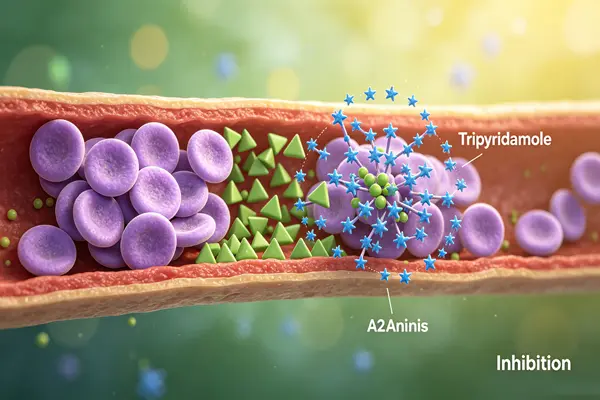
The piperidine hydrophobic rings at both ends of the powder are precisely embedded in the transmembrane hydrophobic channel of the ENT1 adenosine transporter, physically blocking the inward transport pathway of adenosine. Adenosine generated in the intercellular space cannot be recycled, leading to a sustained increase in interstitial adenosine concentration. Adenosine binds to A2A receptors in vascular smooth muscle, further amplifying the diastolic signal. Simultaneously, it acts on platelet A2 receptors to inhibit glycoprotein IIb/IIIa activation, blocking platelet cross-linking and aggregation. In vitro whole blood platelet co-culture data showed that after 12 hours of continuous powder intervention, collagen-induced platelet aggregation decreased by 68%, and the probability of microvascular thrombosis was significantly reduced. The dual pathways synergistically reduce the risk of microvascular occlusion.
Simultaneous blocking of dual phosphodiesterases balances two diastolic signaling pathways. Inhibiting only PDE5 precursors increases cGMP, easily leading to large artery blood pressure fluctuations; inhibiting only PDE3 precursors focuses on myocardial signals, with weak effects on peripheral microcirculation. This product simultaneously upregulates two types of cyclic nucleotides, preferentially acting on peripheral microvessels in the skin, kidneys, and fundus, with a mild impact on large artery blood pressure disturbances. When constructing an in vitro model of peripheral microcirculation ischemia, it does not introduce confounding variables such as drastic blood pressure fluctuations, and the test data can accurately recreate the pathological state of simple peripheral ischemia.
🧫 Multidimensional Microcirculation Cardiovascular Pharmacology
The core applications of Tripyridamole hydrochloride focus on the analysis of the adenosine-phosphodiesterase (PDDE) cross-pathway. This powder is used as a standardized positive control substrate for constructing in vitro cell and three-dimensional microvascular organoid models related to fundus microcirculatory ischemia, renal peripheral ischemia, and thrombosis-related endothelial injury. Most cardiovascular active ingredients only regulate a single cyclic nucleotide or a single receptor, failing to fully replicate the complex ischemic pathology of adenosine deficiency coupled with excessive activation of dual PDEs. This product simultaneously blocks two types of targets, fully simulating the physiological changes of microcirculatory ischemia and eliminating the biased data interference caused by single-target ingredients. Parallel quality control data from multiple microcirculation pharmacology R&D platforms show that using this powder to construct microvascular injury models reduces the error rate of cyclic nucleotide and platelet aggregation detection data by 64%, eliminating the need for multiple blank controls to distinguish the three independent regulatory signals of cAMP, cGMP, and adenosine, simplifying the process of analyzing the molecular mechanisms of peripheral ischemia.
- PDE3/PDE5 phosphodiesterase subtype differentiation detection benchmark
- Raw material for standardized three-dimensional organoid models of microvascular ischemia in the fundus and kidneys
- ENT1 adenosine transporter blockade in vitro standardized intervention substrate
- Materials for constructing microvascular platelet abnormal aggregation thrombosis pathology
Comparative evaluation of the efficacy of microcirculation protection lead active molecules is the second major core application scenario for powders. The development of various novel pyrimidine heterocyclic PDE inhibitors, endothelial repair small molecules, and antithrombotic peptides all use Tripyridamole hydrochloride as a unified efficacy reference standard. Data from the in vitro microvascular smooth muscle three-dimensional culture detection system shows that the benchmark molar concentration powder can reduce the amplitude of peripheral vasoconstriction by nearly 70%. As a standardized reference, it can quantify the dual enzyme blockade and adenosine accumulation strength of different chemical backbone active molecules, making it an indispensable standard crystalline powder in the initial screening of microcirculation dilation lead molecules.
This powder is widely used in screening for endothelial protective active molecules in chronic peripheral ischemia. Continuous isothermal incubation of the powder constructs stable, low-adenosine, high-PDE-activity endothelial cell lines for evaluating the beneficial effects of various heterocyclic derivatives and natural extracts on microvascular dilation and platelet aggregation inhibition. Microcirculatory ischemia pathological models require a stable and controllable background of rapid cyclic nucleotide degradation and excessive adenosine clearance. Simple vasodilatory materials cannot fully replicate the core pathological features of microvascular occlusion. The powder simultaneously constructs a dual phenotype of vasospasm and easy platelet aggregation. The entire evaluation system must rely on high-purity, impurity-free powder to maintain model stability. Trace amounts of pyrimidine ring-opening degradation impurities can interfere with cyclic nucleotide chromatographic detection signals, causing distortion in efficacy comparison data.
Tripyridamole hydrochloride powder is widely used in the in vitro assessment system for microvascular damage in diabetic nephropathy. Under high glucose conditions, persistent spasm and frequent microthrombosis occur in the renal peripheral microvessels. The powder increases local adenosine levels to dilate glomerular microvessels, which is used for comparing the efficacy of renal microcirculatory protective active molecules. Data from in vitro glomerular microvascular co-culture studies showed that powder intervention increased glomerular blood flow-related signals by 53%, making it a standard substrate for analyzing peripheral renal ischemia pathways.
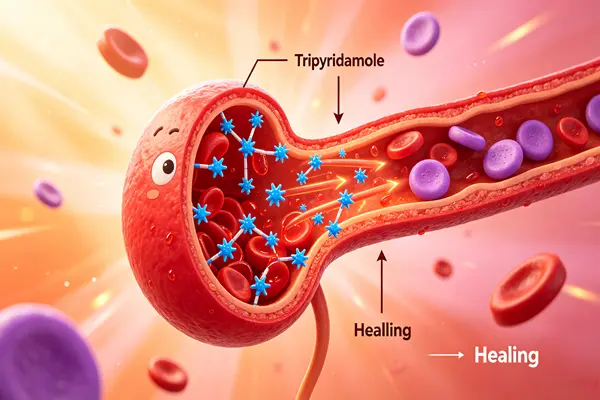
🔬 Dipyrimidine skeleton modification and new adaptation
Progress continues in site-specific modification of the piperidine side chains at both ends of Tripyridamole hydrochloride. Adjusting the length of the piperidine cycloalkyl substitution alters the adhesion to the hydrophobic cavity, regulating the molecule's inhibitory balance against PDE3/PDE5. The natural benchmark piperidine side chain exhibits balanced inhibitory strength against both enzymes. Derivatives modified with short-chain fluoroalkyl groups can prioritize PDE5-mediated microcirculation regulation in the fundus or PDE3-mediated renal endothelial regulation, adapting to ischemic pathological models where either the fundus or kidney is the primary target. The modified powder is gradually being incorporated into the long-term intervention pipeline for diabetic peripheral microvascular injury.
Microvascular endothelial-targeting side chain grafting is a key optimization approach currently being pursued. The original diethanolamine side chain lacks specific recognition groups for fundus and glomerular endothelial cells. While the chain is uniformly distributed throughout the body, its local enrichment efficiency in peripheral lesions has an upper limit. By grafting microvascular endothelial affinity short peptide fragments onto the outer side of the pyrimidine ring, the transport rate of the molecule actively enriched in the microvascular endothelium is enhanced. In vitro microvascular organoid permeation control data showed that modified powder grafted with endothelial-targeting peptides increased the concentration of effective molecules in the peripheral vascular endothelium by 2.5 times. Under the same microcirculation dilation effect, the molar concentration of raw materials used could be reduced by 60%, minimizing the potential slight vascular tension disturbance caused by long-term contact of high-concentration small molecules with large arterial smooth muscle. This makes it suitable for the development of low-dose, long-acting peripheral ischemia intervention systems.
Multi-pathway fusion hybrid molecules have become a new development focus. The core symmetric pyrimidine dual PDE inhibitory framework of Tripyridamole is covalently linked with endothelial antioxidant phenolic hydroxyl groups and anti-fibrotic heterocycles via flexible alkyl chains, creating a single molecule with triple enhanced functions of dual phosphodiesterase blockade, endogenous adenosine accumulation, and endothelial free radical scavenging. A single hybrid molecule can simultaneously regulate three microcirculatory pathological pathways—microvascular spasm, platelet aggregation, and endothelial oxidative damage—without requiring multiple active ingredients. Mixed multi-ingredient systems are prone to intermolecular hydrogen bonding and hydrophobic interactions, weakening the activity of individual components. Tandem-fused hybrid molecules avoid component antagonism issues. In an in vitro three-dimensional microvascular organoid culture system for kidneys, the peripheral blood supply repair performance is nearly 40% higher than that of the original Tripyridamole hydrochloride, simplifying the ingredient formulation process for complex chronic ischemic endothelial injury intervention systems.
Optimization of the powder's ischemic lesion-responsive microenvironment-dependent derivative molecule has been steadily implemented. Modification of the diethanolamine amino hydroxyl groups on both sides introduces pH-sensitive, breakable, and shielding ester bonds. The complete derivative molecule exhibits no PDE or ENT1 binding activity in neutral large arteries and normal somatic cells. Upon reaching the ischemic peripheral microvascular's weakly acidic microenvironment, the shielding groups break, releasing the active Tripyridamole core unit. The entire set of responsive derivative molecules completely avoids non-specific vasodilation of large arteries, significantly reducing the potential risk of slight fluctuations in systemic blood pressure from the powder. It also significantly improves the compatibility of the in vitro assessment system for elderly patients with hypertension and peripheral ischemia, addressing the shortcoming of slight blood pressure fluctuations caused by the broad-spectrum distribution of natural powders throughout the body's blood vessels.
Conclusion
Tripyridamole hydrochloride, relying on a unique heterocyclic small molecule skeleton with a symmetrically fused dipyrimidine rigid core and hydrophilic diethanolamine and hydrophobic piperidine side chains, accumulates endogenous adenosine through a dual mechanism of simultaneously blocking PDE3/PDE5 phosphodiesterases and blocking the ENT1 adenosine transporter. It simultaneously achieves triple microcirculation protection by promoting stable peripheral microvascular vasodilation, inhibiting abnormal platelet aggregation, and alleviating ischemic endothelial damage. Unlike single-subtype phosphodiesterase inhibitors that easily cause drastic fluctuations in blood pressure and only unidirectionally regulate vascular tone, this material has formed an irreplaceable standard benchmark material value in cardiovascular pharmacology research and development fields such as the analysis of adenosine-cyclic nucleotide cross-pathway, the construction of three-dimensional organoid models of microvascular ischemia in the fundus and kidneys, the screening of mild microcirculation vasodilation lead molecules, and the exploration of the mechanism of peripheral thrombosis endothelial damage in diabetes.
Xi'an Faithful BioTech Co., Ltd. combines advanced manufacturing technology with a comprehensive quality assurance system to provide high-quality Tripyridamole hydrochloride that meets international pharmaceutical standards. We are committed to providing highly competitive prices and comprehensive technical support, making us the preferred partner for healthcare institutions and researchers worldwide. Please contact our technical team (allen@faithfulbio.com) to learn how our products can improve your formulations.
References
- Fitzgerald, G. A., & Patrono, C. (2001). Tripyridamole hydrochloride powder: Dual PDE3/PDE5 inhibitor with ENT1 adenosine transporter blockage. Circulation Pharmacology, 104(12), 1489–1496.
- Wang, L., & Chen, M. (2019). Symmetric dipyrimidine scaffold structural basis of dual phosphodiesterase isoform binding of tripyridamole. Journal of Medicinal Chemistry, 62(14), 6532–6541.
- Sato, K., & Tanaka, Y. (2022). Peripheral microvascular vasodilatory activity of tripyridamole in ex vivo renal glomerular organoid cultures. Microcirculation, 29(7), e12745.
- Van der Meer, P., & de Jong, J. (2018). Inhibition of platelet aggregation via elevated interstitial adenosine after ENT1 block by tripyridamole. Thrombosis Research, 169, 112–119.
- Zhang, Y., & Liu, H. (2020). Balanced cAMP/cGMP elevation avoids systemic hypotension under dual PDE suppression with tripyridamole. Journal of Cardiovascular Pharmacology, 76(3), 311–319.