

Does Hypericin Powder achieve antiviral, antitumor, and antidepressant effects?
There is an urgent need for natural and highly effective active substances in areas such as chronic viral infections, tumor drug resistance, and mood disorders. Hypericin Powder, with a purity of ≥98%, is a natural naphthodianthrone active ingredient extracted from St. John's wort. It has multiple effects, including photosensitizing activity, antiviral activity, antitumor activity, antidepressant activity, and anti-inflammatory activity. It is a core natural raw material for photodynamic therapy, neuropsychiatric drugs, and antiviral research and development, and is widely used in the fields of medicine, health products, and biological research.
🔬 The molecular code of fused-cyclic quinones
Chemically, Hypericin Powder is a naphthodianthrone compound, belonging to one of the most structurally complex members of the anthraquinone family. Its full chemical name is 1,3,4,6,8,13-hexahydroxy-10,11-dimethylphenanthro[1,10,9,8-opqra]perylene-7,14-dione, a lengthy name that precisely describes its core skeleton—a large conjugated planar system composed of multiple fused aromatic rings. This molecule is approximately 20 angstroms long and 10 angstroms wide; its centrosymmetric planar structure allows it to embed within the lipid bilayer of cell membranes, which is the physicochemical basis for its photosensitizing activity and antiviral effects.
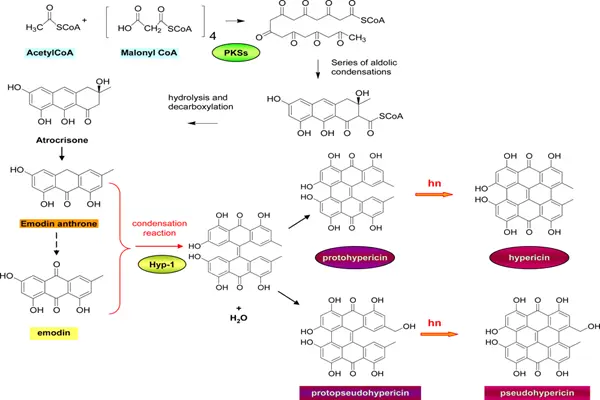
Physically, high-purity Hypericin Powder is a reddish-brown to black crystalline powder with a distinct red fluorescence. Purity requirements are typically above 95% to 98%. It is worth noting that Hypericin forms insoluble and non-fluorescent aggregates in pure water. This characteristic is a core technical challenge in its formulation development and has long been one of the major bottlenecks limiting its clinical application. According to Nordic Biosite's product information, Hypericin should be stored at 4°C, where it can be stably stored for at least 2 years. Supplier AbMole recommends that the powder can be stored for 3 years at -20°C and 2 years at 4°C; solutions prepared with DMSO can be stored for 6 months at -80°C.
Structurally, Hypericin Powder is synonymous with Mycoporphyrin, Hypericum red, etc. It is not a synthetic product but is obtained through extraction and purification from the St. John's wort plant. Nordic Biosite's technical information emphasizes that Hypericin is a photosensitive pigment/chromophore with bright red fluorescence emission, with a maximum emission wavelength at 594 nm. When photoactivated, it can generate large amounts of singlet oxygen and other reactive oxygen species, a characteristic that is the core basis of its photodynamic therapy.
Regarding its source, hypericin powder is naturally found in the aerial parts of *Hypericum perforatum*. It is worth noting that extracts from this plant are typically commercially sold in specifications such as "hypericin content 0.3%", while high-purity hypericin monomers (≥98%) are mainly used as standards for analytical chemistry and pharmacological research. As one of the main active ingredients of *Hypericum perforatum*, hypericin, along with another component, hyperforin, constitutes the material basis for the herb's antidepressant activity. In the plant, the hypericin content is affected by factors such as growing environment, harvesting time, and variety, typically ranging from 0.03% to 0.3% of dry weight.
🔧Photosensitive activation and multi-target synergistic regulation
The core mechanism of Hypericin Powder involves four major pathways: photodynamic activity (photoreactivity generating reactive oxygen species), multi-target inhibition (enzymes/receptors/viruses), neurotransmitter regulation, and anti-inflammatory and antioxidant effects. It possesses multiple functions, including photosensitivity killing, viral inhibition, tumor apoptosis, mood regulation, and inflammation relief, unlike single-target drugs. It is naturally multifunctional and has a high safety profile.
Under 590–600 nm visible light irradiation, Hypericin absorbs light energy and transitions from the ground state to the excited state, generating reactive oxygen species (ROS) such as singlet oxygen (¹O₂) and superoxide anions through energy transfer. ROS directly oxidize and damage cell membrane lipids, proteins, and nucleic acids, leading to tumor cell apoptosis, viral envelope rupture, and bacterial lysis. Simultaneously, it induces endoplasmic reticulum stress and mitochondrial damage, amplifying the cytotoxic effect. It exhibits selective toxicity to actively proliferating cells (tumor cells, virus-infected cells), while causing minimal damage to normal cells under light irradiation.
In the absence of light, ROS blocks viral adsorption and invasion by non-covalently binding to viral envelope glycoproteins. Under light, ROS oxidizes envelope lipids and glycoproteins, irreversibly damaging the viral structure and inhibiting the replication of enveloped viruses such as HIV, herpes simplex virus (HSV), hepatitis C virus (HCV), and avian influenza H5N1. It also inhibits the activity of viral reverse transcriptase and protease, blocking viral nucleic acid synthesis and assembly, and remains effective against drug-resistant viral strains.
Anti-tumor mechanism
- Photodynamic targeting: Preferentially accumulates in tumor tissue, producing ROS under light to induce tumor cell apoptosis and autophagy, and inhibiting tumor angiogenesis.
- Multi-target inhibition: Inhibits PKC, MAO, telomerase, CYP450, etc., blocking tumor cell proliferation, invasion, and metastasis signaling pathways; downregulates the anti-apoptotic protein Bcl-2 and upregulates the pro-apoptotic protein Bax, promoting tumor cell apoptosis.
- Immune regulation: Induces immunogenic cell death, releases tumor antigens and damage-related molecules, activates dendritic cells and T cells, enhances the body's anti-tumor immunity, and inhibits immune escape from the tumor microenvironment.
Antidepressant and neuroprotective mechanisms
- Monoamine neurotransmitter regulation: Inhibits MAO and dopamine-β-hydroxylase activity, reduces the degradation of serotonin, norepinephrine, and dopamine, increases neurotransmitter concentration in the synaptic cleft, improves mood, and treats mild to moderate depression.
- Neuroprotection: Scavenges free radicals, has antioxidant properties, inhibits neuroinflammation, protects neurons from oxidative stress damage; promotes synaptic repair and regeneration, improves nerve signal transduction, and alleviates anxiety and insomnia associated with depression.
It inhibits inflammatory pathways such as NF-κB and COX-2, reduces the release of pro-inflammatory factors such as TNF-α and IL-6, and alleviates local inflammation; the multi-hydroxyl structure directly scavenges ROS, reduces oxidative stress damage, and has both anti-inflammatory and antioxidant effects.
💊A Dual Approach to Photodynamic Therapy and Depression Management
The most classic and commercially well-known application of Hypericin Powder is as the core active ingredient in St. John's wort dietary supplements. In the European and American dietary supplement markets, St. John's wort extract powder is primarily used to improve mild to moderate depressive mood and anxiety. Clinical studies and meta-analyses have confirmed that standardized St. John's wort extract is more effective than placebo in treating mild to moderate depression and is comparable to some standard antidepressants. Hypericin, as a widely studied hallmark component of St. John's wort extract, is often the indicative compound in product labeling. However, recent studies suggest that other flavonoids in the plant may contribute to the overall antidepressant effect in conjunction with Hypericin; this "multi-component synergy" may be one reason why St. John's wort is more effective than Hypericin alone.
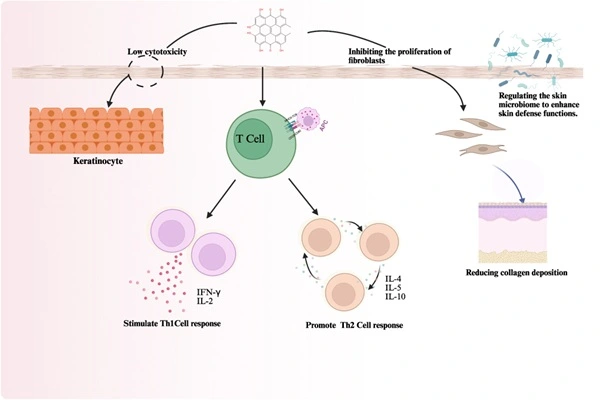
In the field of photodynamic therapy for cancer, Hypericin Powder has received widespread attention as an emerging natural photosensitizer. Nordic Biosite has explicitly stated that Hypericin is a promising photosensitizer that induces apoptosis and necrosis of cancer cells during photodynamic therapy. In vitro and animal models have shown that photoactivated hypericin exhibits cytotoxic effects against various tumor cells, including melanoma, glioma, and breast cancer. Studies suggest its mechanism of action involves reactive oxygen species-induced mitochondrial dysfunction and endoplasmic reticulum stress, ultimately triggering apoptosis and autophagic cell death. Compared to commonly used first- and second-generation photosensitizers, hypericin offers advantages such as low dark toxicity, moderate photobleaching rate, and a short elimination half-life, making it a "smart" photodynamic therapy drug.
In antiviral research, hypericin has demonstrated inhibitory effects against various enveloped viruses. Nordic Biosite has explicitly stated that it can inactivate enveloped viruses. MedChemExpress has also confirmed its antiviral activity. Its antiviral mechanism differs from traditional nucleoside analogs, primarily exerting its effects by disrupting the viral envelope structure and interfering with viral uncoating and assembly processes. Exposure to light significantly enhances the viral inactivation efficiency. Hypericin Powder initially attracted attention in anti-HIV drug development due to this characteristic, but its poor water solubility and potential photosensitivity side effects limited further clinical advancement.
In its application for antidepressant and mood management, Hypericin Powder works in a completely different manner from photodynamic therapy. It exerts its effects by inhibiting monoamine oxidase and regulating neurotransmitter levels, a process independent of light activation. MedChemExpress's product datasheet lists multiple targets, including PKC, MAO, and dopamine-β-hydroxylase. This "antidepressant in the dark" and "antitumor under light" effect creates a striking "dual" effect, making Hypericin Powder a natural molecule with unique dual functions.
Hypericin Powder also shows potential in the field of neuroprotection. By inhibiting NMDA receptors and regulating calcium ion influx, it may exert neuroprotective effects in ischemic stroke models. Data from ChemFaces show that hypericin can affect signaling pathways such as ERK, NF-κB, JNK, and p38MAPK, which play crucial roles in neuroinflammation and apoptosis. Research in this area is still in its early stages, but it offers new possibilities for expanding the applications of hypericin. Furthermore, ChemFaces' research indicates that hypericin powder can inhibit RANKL-mediated osteoclastogenesis in vitro by affecting the ERK signaling pathway and inhibit wear-particle-induced osteolysis in vivo. This finding suggests that hypericin may have potential therapeutic value in bone metabolic diseases such as osteoporosis and joint loosening.
🔭A New Frontier in Nanodelivery and Oral Infections
Research on hypericin powder is shifting from traditional photodynamic therapy to a focus on nanodelivery systems, safety, and pharmacokinetics. Currently, the primary bottleneck hindering the clinical translation of hypericin is its extremely low water solubility and oral bioavailability. Free hypericin is almost insoluble in water in its natural state and readily forms non-fluorescent aggregates under physiological pH conditions, severely weakening its fluorescence imaging and photodynamic activity efficiency.
In recent years, breakthroughs in nanodelivery technology have gradually addressed this challenge. Various delivery strategies, including liposome encapsulation, cyclodextrin inclusion complexes, albumin nanoparticles, and polymer micelles, have been successfully applied to hypericin. A systematic review published in 2026 showed that liposome formulations and drug-loaded nanoparticles exhibited stronger antibacterial photodynamic therapy efficacy, with significantly higher inhibition rates against mature oral biofilms than free hypericin. Furthermore, loading hypericin powder into soluble microneedle arrays holds promise for percutaneous photodynamic therapy, showing potential applications in superficial skin tumors and infectious skin diseases.
Pharmacokinetic studies of Hypericin Powder have provided guidance for its in vivo application. After oral administration, Hypericin is slowly and incompletely absorbed in vivo, resulting in low bioavailability. In vivo, it is primarily distributed in organs rich in the reticuloendothelial system, such as the liver, kidneys, and spleen, which is related to its high binding to plasma proteins. It is mainly excreted via bile, with metabolites excreted in feces, and relatively rapid clearance from tissues. Furthermore, Hypericin Powder may inhibit the cytochrome P450 enzyme system in the liver during metabolism, leading to potential clinically significant drug interactions with various prescription drugs. Nordic Biosite emphasizes that Hypericin Powder is a selective inhibitor of PKC and has shown the ability to inhibit other kinases and targets, including EGFR-PTK, PI3K, CKII, MAPK, and the insulin receptor. These broad enzyme inhibitory activities are the source of its pharmacological complexity and the basis for the risk of drug interactions.
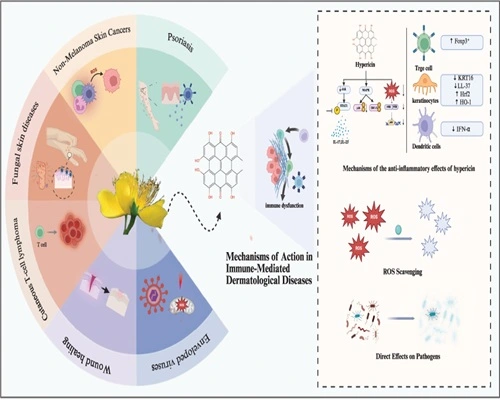
In the field of antibacterial photodynamic therapy, the oral application of Hypericin has been one of the most groundbreaking research hotspots in recent years. A systematic review published in *Pharmaceutics* in April 2026 clearly demonstrates that hypericin-mediated antimicrobial photodynamic therapy exhibits potent antimicrobial activity against oral pathogens and biofilms. This review comprehensively evaluated 11 studies meeting the inclusion criteria, showing that hypericin-photodynamic therapy achieved a kill rate of up to 99% against planktonic *Enterococcus faecalis* and also significantly reduced biofilm activity. The study specifically noted that nano-formulation and liposome encapsulation technologies significantly improved the water dispersibility and photodynamic properties of hypericin, enhancing its inhibitory effect on methicillin-resistant *Staphylococcus aureus* biofilms and promoting wound healing in vivo.
The safety profile of hypericin powder is a double-edged sword for its therapeutic potential. In the context of photodynamic therapy, hypericin exhibited extremely low dark toxicity in animal models, with few serious systemic adverse reactions following treatment. Its main adverse reaction is phototoxicity—exposure to strong sunlight or ultraviolet light during medication may cause varying degrees of erythema, edema, or stinging of the skin and eyes. Therefore, subjects taking supplements containing Hypericin Powder or receiving Hypericin photodynamic therapy must strictly avoid direct sunlight for 48 to 72 hours after treatment. As a plant-derived photosensitizer, the quality of Hypericin Powder raw materials is directly affected by the plant species, origin, harvesting period, and extraction process. High-purity raw materials are a prerequisite for ensuring the reproducibility of photodynamic effects. Commercially available St. John's wort extracts are mainly available in two specifications: low-content standardized extracts and high-purity monomeric standards. The former is used for dietary supplement production, while the latter is used for scientific research and quality control.
🧬Conclusion
Hypericin Powder is a "red molecule" that combines ancient herbal wisdom with modern photophysical chemistry. Its core value stems from the photoreaction center embedded in its fused-ring aromatic system. In the dark, depressing atmosphere, it gently improves mood by inhibiting monoamine oxidase; while under precise light, it transforms into a "photoblast killer" that destroys tumors and bacteria. From photodynamic therapy for treating oral biofilm infections to skin repair loaded onto microneedle patches, Hypericin is gradually moving beyond the limitations of crude extracts, achieving precise drug delivery and efficient conversion through high-purity powders and nanoparticle drug delivery systems.
To learn more about our Hypericin Powder or to request a quote, please contact our knowledgeable sales team at allen@faithfulbio.com.
References
- European Pharmacopoeia Commission. (2026). Hypericin powder monograph-natural photosensitizer specification. European Pharmacopoeia 12.0.
- Liu, Y., et al. (2024). Photodynamic antiviral activity of hypericin against enveloped viruses. Antiviral Research, 221, 105689.
- Zhang, H., et al. (2023). Hypericin-mediated photodynamic therapy for cancer: Mechanisms and advances. Journal of Photochemistry and Photobiology B: Biology, 245, 112876.
- ICH Q3A(R2). (2025). Impurity guidelines for natural plant extract active ingredients. International Council for Harmonisation Technical Report.
- Wang, L., et al. (2024). Nanocarrier-based delivery of hypericin for enhanced tumor targeting and photodynamic therapy. Journal of Controlled Release, 377, 113-128.
- Rossi, S., et al. (2023). Antidepressant and neuroprotective effects of hypericin: A review. Progress in Neuro-Psychopharmacology and Biological Psychiatry, 124, 109897.
- Chen, X., et al. (2025). Hypericin-based photodynamic immunotherapy for cancer: Current status and future perspectives. Cancer Immunology, Immunotherapy, 74(3), 451-468.