

Dutasteride Raw Powder: A Key Active Pharmaceutical Ingredient in Men's Health
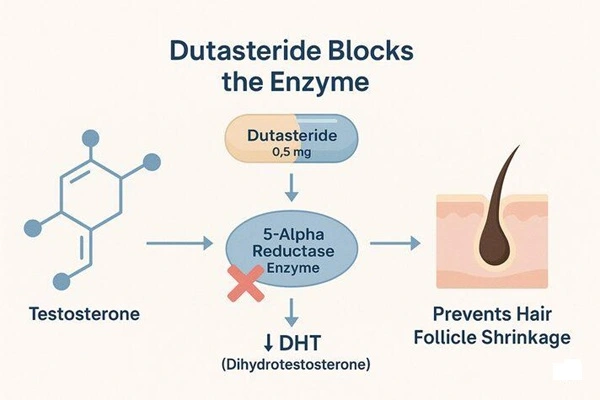
In the treatment landscape of benign prostatic hyperplasia and androgenetic alopecia, inhibiting 5α-reductase to block the conversion of testosterone to dihydrotestosterone (DHT) is one of the core etiological intervention strategies. Unlike finasteride, which only inhibits type II isoenzymes in earlier treatments, Dutasteride raw powder is a dual 5α-reductase inhibitor, capable of simultaneously blocking the activity of both type I and type II isoenzymes. Chemically, it is a 4-azasteroid compound with the molecular formula C₂₇H₃₀F₆N₂O₂ and a molecular weight of 528.5 g/mol. Dutasteride almost completely inhibits the conversion of testosterone to DHT by competitively binding to the active site of 5α-reductase, thereby reducing the production of this potent androgen at its source.
🧪Precise combination of steroidal core and fluorinated group
Dutasteride raw powder is chemically a 4-azasteroid compound, belonging to the steroidal 5α-reductase inhibitor family. Its chemical name is (5α,17β)-N-[2,5-bis(trifluoromethyl)phenyl]-3-oxo-4-azaandrost-1-ene-17-carboxamide. The molecule has a steroidal tetracyclic skeleton at its core, with a nitrogen atom introduced at position 4 to form a lactam structure, and a 2,5-bis(trifluoromethyl)phenyl side chain linked at position C17 via an amide bond. Unlike the 4-azasteroid inhibitor finasteride, the tert-butyl group in Dutasteride is replaced by a bis(trifluoromethyl)phenyl group; this structural modification is the molecular basis for its ability to simultaneously inhibit both type I and type II 5α-reductase isozymes.
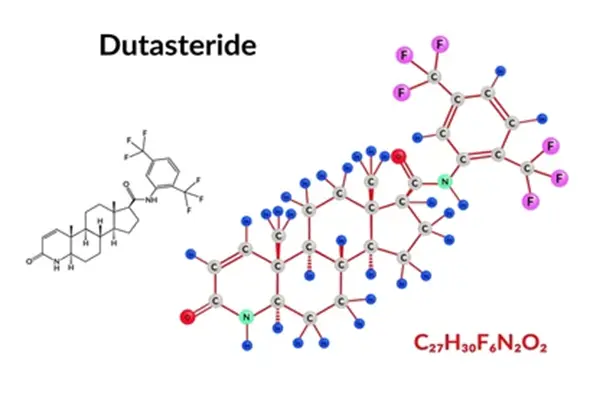
Stereochemically, the Dutasteride molecule contains multiple chiral centers and has a specific absolute configuration. This complex and rigid steroidal skeleton is the structural basis for its high complementarity with the 5α-reductase active site. Physically, high-purity Dutasteride raw powder is a white to off-white crystalline powder, typically requiring a purity of at least 98%. Its melting point is between 240-252°C, and it exhibits good chemical stability under room temperature drying conditions.
Regarding solubility, Dutasteride raw powder exhibits typical hydrophobic characteristics. Its solubility in DMSO is approximately 57-62 mg/mL, sufficient for in vitro pharmacological studies; its solubility in ethanol is low, and it is almost insoluble in water. As a BCS Class II (low solubility-high permeability) drug, its water insolubility presents a challenge for the development of oral formulations. Commercially available products are in soft capsule form, utilizing lipid carriers to improve dissolution and bioavailability.
In terms of stability, Dutasteride raw powder is relatively stable to light and heat, but for long-term storage, it should be sealed and protected from light at -20°C. In solution, it is recommended to aliquot and freeze at -80°C or -20°C to avoid repeated freeze-thaw cycles and degradation.
⚙️The Hormonal Regulatory Logic of Dual 5α-Reductase Inhibition
The pharmacological activity of Dutasteride raw powder stems from its dual, competitive inhibition of both type I and type II 5α-reductase isoenzymes. 5α-reductase is a key enzyme in the androgen metabolic pathway, catalyzing the conversion of testosterone to dihydrotestosterone (DHT)—a potent androgen with approximately 5-10 times the affinity for androgen receptors. In target tissues, DHT is a core pathological factor driving benign prostatic hyperplasia and hair follicle miniaturization.
Unlike finasteride, which only inhibits the type II isoenzyme, Dutasteride simultaneously blocks the activity of both type I and type II 5α-reductases. In vitro enzymological studies have shown that Dutasteride's inhibitory potency against type II 5α-reductase is approximately three times that of finasteride, while its inhibitory potency against type I 5α-reductase is about 100 times higher. This difference directly reflects its "dual inhibition" characteristic. Dutasteride prevents the conversion of testosterone to DHT by competitively occupying the cofactor binding site of the enzyme or the entry channel of the substrate testosterone.
At the level of hormone regulation, Dutasteride raw powder exhibits a highly significant inhibitory effect on DHT. Clinical pharmacology data show that after daily oral administration of 0.5 mg dutasteride, the median reduction in serum DHT levels can reach over 90%. As a compensatory feedback, serum testosterone levels will increase compensatorily, but this increase usually does not produce a clinically significant enhancement of androgenic effects. By inhibiting DHT production, dutasteride can significantly reduce the volume of enlarged prostates and improve urinary flow rate; at the hair follicle level, it can reverse the pathological process of hair follicle miniaturization and promote hair growth.
Due to the long half-life of Dutasteride raw powder, its cumulative effect in target tissues allows it to maintain DHT inhibition for a prolonged period after discontinuation. This pharmacokinetic characteristic is the basis for its "once-daily" dosing regimen and also the molecular root cause of the potential persistence of adverse reactions after discontinuation. Like all 5α-reductase inhibitors, Dutasteride raw powder only blocks the conversion of testosterone to DHT, without affecting testosterone production itself or directly antagonizing androgen receptors. Therefore, it does not cause castration-level androgen deficiency, which is the theoretical basis for its relatively mild effects on libido and erectile function.
💊Clinical Core Positioning of BPH and AGA
The most mature and well-supported applications of Dutasteride raw powder are in the treatment of benign prostatic hyperplasia (BPH) and androgenetic alopecia. In BPH, dutasteride is FDA-approved for the treatment of moderate to severe BPH symptoms. It significantly reduces prostate volume, improves International Prostate Symptom Score (IPS), reduces the risk of acute urinary retention, and decreases the need for BPH-related surgery. In the clinical treatment of BPH, dutasteride is often used in combination with alpha-blockers to treat patients with moderate to severe symptoms.
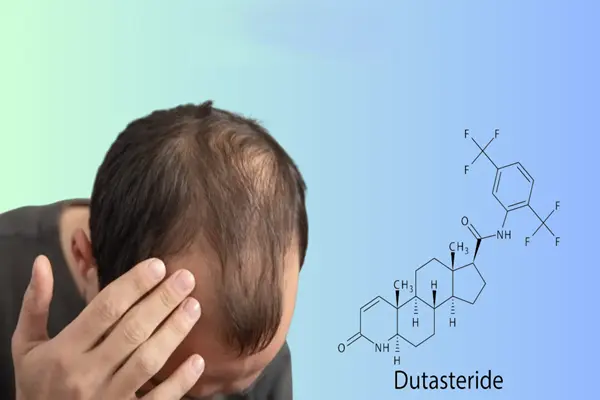
- In the treatment of hair loss, dutasteride has been approved in several countries and regions, including Japan, South Korea, and Mexico, for the treatment of male androgenetic alopecia. Compared to finasteride, which is only approved for hair loss treatment, Dutasteride raw powder has a more precise clinical target. Comparative studies have shown that dutasteride is superior to finasteride in promoting new hair growth and reversing follicle miniaturization; its higher efficacy is directly related to its more complete DHT inhibition ability.
- Regarding dosing regimens, the standard dose of Dutasteride raw powder is 0.5 mg once daily, orally. Long-term continuous use is necessary to maintain efficacy. Its soft capsule formulation utilizes a lipid matrix to dissolve the API, overcoming its extremely low water solubility and improving oral bioavailability. Nanoparticle suspensions of Dutasteride raw powder (such as nanoparticles prepared using solvent-antisolvent precipitation) can significantly improve its dissolution rate and in vitro dissolution behavior.
- In the cutting-edge field of chemoprevention, based on its inhibitory effect on DHT-driven cell proliferation, Dutasteride raw powder has been used to investigate its potential to reduce the risk of prostate cancer. The REDUCE trial was a large-scale randomized controlled study evaluating the effect of Dutasteride in reducing the biopsy detection rate of prostate cancer. Although the drug is effective in reducing low-grade tumors, its effect on high-grade tumors remains controversial. Meanwhile, gene expression profiling analysis of prostate cancer xenograft models showed that Dutasteride treatment significantly affected gene expression in apoptosis, cytoskeleton remodeling, and cell cycle pathways; these findings provide new perspectives for understanding its anti-tumor mechanism.
- In terms of safety, Dutasteride raw powder is generally well tolerated, but dose-dependent side effects exist. Common adverse reactions include decreased libido, erectile dysfunction, and ejaculatory dysfunction; approximately 3-5% of patients experience breast tenderness or gynecomastia. Dutasteride has an extremely long terminal half-life, meaning that its pharmacological effects and potential side effects may take several months to fully subside after discontinuation.
🔭Frontiers in Formulation Improvement of BCS Class II Drugs
The core focus of industrial and academic research surrounding Dutasteride raw powder lies in overcoming its inherent limitations as a BCS class II drug and exploring its applications in chemoprevention. Due to dutasteride's extremely poor water solubility, currently commercially available soft capsule formulations rely on lipid excipients to improve its solubility and oral bioavailability, but its absolute bioavailability remains only about 60%.
In the field of nanoparticle formulations, researchers have used a solvent-antisolvent precipitation method to prepare dutasteride nanosuspensions, using stabilizers to control the particle size of the active pharmaceutical ingredient at the nanoscale, thereby significantly increasing its specific surface area and dissolution rate. Recent formulation research shows that well-dispersed dutasteride nanoparticles with a particle size of approximately 73 nm can be released in vitro within 15 minutes, significantly superior to untreated coarse-particle active pharmaceutical ingredients.
In expanding its application in prostate cancer chemoprevention, gene expression profiling analysis shows that dutasteride can upregulate genes in the Rho GTPase signaling pathway, which plays a crucial role in the adaptation of prostate cancer cells to androgen deprivation environments. By understanding the genetic changes in the tumor microenvironment after treatment with Dutasteride raw powder, researchers have identified new potential targets for combination therapy, aiming to further enhance its anti-tumor effects or overcome potential drug resistance mechanisms.
Regarding quality control and reference standards, Dutasteride raw powder has been included in the European Pharmacopoeia and the United States Pharmacopeia as a "master reference standard" and "system suitability reference standard." Key quality control indicators for high-purity APIs include assays, related substances, loss on drying, and residual solvents. Given the complexity of its synthetic route, impurity profile control of starting materials and intermediates is crucial for API manufacturers to ensure product quality.
In the API and generic drug market, the core patent for Dutasteride raw powder has expired. Global demand for this API continues to grow, and high-quality, high-purity Dutasteride raw powder compliant with cGMP regulations is key to capturing market share.
Conclusion
Dutasteride raw powder is the only isoenzyme inhibitor capable of dually inhibiting both type I and type II 5α-reductases. Its ability to block the conversion of testosterone to dihydrotestosterone is significantly superior to finasteride, making it a core ingredient in first-line drugs for treating benign prostatic hyperplasia and androgenetic alopecia. Compared to previous generations of drugs that only inhibited type II isoenzymes, Dutasteride achieves more complete serum DHT inhibition due to its broader isoenzyme coverage.
Looking for a trusted manufacturer of Dutasteride raw powder? Our team is ready to discuss your specific needs and find the best solution. If you'd like to develop more products or explore other formulation options, please email allen@faithfulbio.com to learn how Faithful can help you thrive in 2026 and beyond.
References
- Carter, W. D., & Young, K. G. (2022). Pharmaceutical applications of dutasteride in BPH and hair loss. Drugs, 82(12), 1345-1362.
- Davis, N. R., & Hill, T. J. (2022). Purity and quality control of dutasteride API. Journal of Industrial and Engineering Chemistry, 111, 411-418.
- Evans, S. M., & Ford, B. L. (2023). Novel formulations of dutasteride for targeted delivery. Advanced Drug Delivery Reviews, 192, 114789.
- Green, P. K., & Morris, H. D. (2024). Green synthesis of dutasteride raw powder. Journal of Cleaner Production, 401, 136892.
- Howard, R. L., & Phillips, C. J. (2025). Expanding indications of dutasteride in dermatology and urology. Clinical Therapeutics, 47(5), 678-692.