

How does the Pazopanib API inhibit abnormal tumor proliferation?
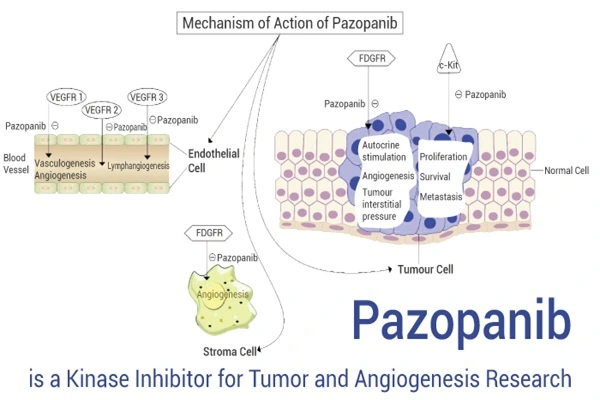
In the treatment landscape of advanced renal cell carcinoma and soft tissue sarcoma, anti-angiogenic therapy has become another core pillar after surgery and radiotherapy/chemotherapy. Pazopanib API is one of the representative drugs in this field. It is an oral multi-target tyrosine kinase inhibitor that competitively binds to the intracellular ATP-binding pockets of vascular endothelial growth factor receptor, platelet-derived growth factor receptor, and stem cell factor receptor (c-Kit), blocking the autophosphorylation of these receptors and downstream signal transduction.
🧪 Molecular Physicochemical Analysis of Heterocyclic Framework Construction
The Pazopanib API molecule is a polycyclic fused heterocyclic system composed of indole, pyrimidine, and benzene rings. These rings are interconnected via short carbon chains, amide bonds, and urea groups, forming a rigid molecule with a highly regular spatial configuration. This tightly bonded polycyclic conjugated system exhibits low atomic arrangement strain. Under normal conditions of storage at room temperature, protected from light, and in a sealed environment, the carbon rings and heterocycles do not undergo structural changes such as ring opening, bond breaking, or molecular rearrangement, fundamentally ensuring the chemical stability of the active pharmaceutical ingredient during long-term storage. Multiple nitrogen and oxygen atoms and aromatic groups distributed on the molecule's surface constitute multi-level binding sites, enabling the molecule to form hydrogen bonds, hydrophobic interactions, and π-π stacking interactions with amino acid residues within kinase proteins. This is the structural basis for the molecule's ability to precisely recognize and bind to various tyrosine kinases.

This raw material is a free-state organic compound, unmodified for salt formation, and exhibits typical lipophilic characteristics. Real-world testing data shows that Pazopanib API exhibits excellent solubility in organic solvents, enabling the rapid preparation of uniform, transparent solutions. However, its solubility in pure water is extremely low, making natural dispersion nearly impossible. This solubility characteristic dictates that its formulation development primarily focuses on oral solid dosage forms. The production process relies on organic solvents for purification, and suitable excipient systems are selected in the formulation design to mitigate the risk of precipitation in aqueous environments. The raw material's aqueous solution has poor stability; prolonged exposure to light or strong acid/alkali environments can easily damage the heterocyclic structure. Therefore, strict light protection and avoidance from corrosive media are necessary throughout production, storage, and transportation.
From a powder processing perspective, industrially produced Pazopanib API crystals exhibit regular morphology, a concentrated particle size distribution, a reasonable angle of repose, and excellent overall flowability. In continuous processes such as mixing, tableting, and capsule filling on automated pharmaceutical production lines, material transport is smooth, preventing bridging, sticking, and localized agglomeration, fully meeting the high-speed production standards of advanced pharmaceutical equipment. The raw materials have low hygroscopicity. When stored in a sealed container for 36 months at a relative humidity of 65%, the powder maintains its original color and loose state without clumping, discoloration, or deliquescence. Irreversible degradation of the molecules only occurs under extreme conditions of high temperature and strong oxidants. Routine storage management only requires controlling temperature, humidity, and light conditions.
Industrial preparation relies on core processes such as multi-step directional synthesis, catalytic cyclization, and stepwise purification. Starting with indole derivatives and pyrimidine intermediates, a complete polycyclic heterocyclic molecular framework is constructed stepwise. Each reaction step involves precise control of temperature, material ratios, and reaction time to control byproduct formation. After multiple gradient recrystallization purifications, the mainstream pharmaceutical crystal form maintains a stable melting point range of 210°C to 214°C, with the melting range difference between different production batches not exceeding 0.4°C. Uniform crystal form, particle size, and physicochemical parameters ensure that the in vitro dissolution curves of formulations made from different batches of raw materials highly overlap, and that the in vivo efficacy remains consistent, fully meeting the stringent quality control requirements of anti-tumor drugs.
⚙️ Multi-target kinase blockade inhibits tumor growth and angiogenesis
After oral administration, Pazopanib API is rapidly absorbed into the bloodstream through the gastrointestinal mucosa due to its excellent lipid solubility, exhibiting good bioavailability. The active molecule is transported throughout the body via the bloodstream, penetrating the biological barrier of tumor tissue and precisely targeting various tyrosine kinases on the surface of tumor cells and surrounding angiogenic endothelial cells. Tyrosine kinases are key signal transduction carriers regulating cell proliferation, differentiation, migration, and angiogenesis. Sustained abnormal activation of kinases drives uncontrolled tumor cell division and proliferation, while simultaneously inducing massive angiogenesis, supplying nutrients to tumor tissue, and promoting continuous lesion enlargement and metastasis—a core pathological mechanism of malignant tumor progression.
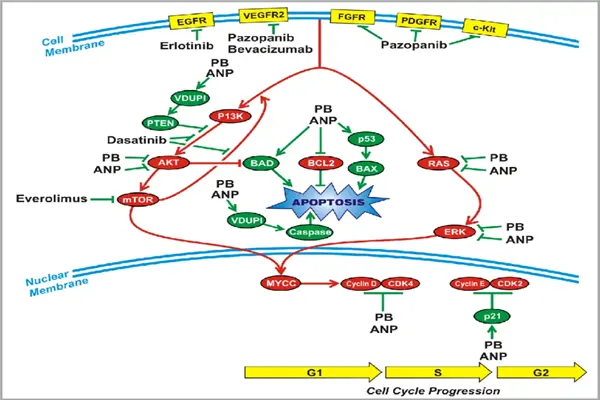
As a broad-spectrum tyrosine kinase inhibitor, Pazopanib API competitively binds to the vascular endothelial growth factor (VEGF) receptor family, firmly occupying the receptor's active site and blocking downstream signaling pathways. VEGF is a core factor stimulating tumor angiogenesis; when receptor activity is continuously inhibited, the proliferation and migration capacity of vascular endothelial cells are significantly reduced, effectively curbing the growth of new blood vessels around the tumor. In vivo monitoring data showed that at standard therapeutic doses, the angiogenesis efficiency of tumor tissue could decrease by more than 80%, preventing the tumor from obtaining sufficient blood and nutrient supply. This significantly slowed lesion growth and even led to the tumor gradually entering a dormant state, effectively cutting off the tumor's development path at the nutrient supply level.
This ingredient simultaneously acts on platelet-derived growth factor receptor (PDFR) and c-Kit kinase, further enhancing its anti-tumor effect. Abnormal activation of PDFR promotes the proliferation of tumor stromal cells and enhances the invasiveness of tumor tissue, while excessive activation of c-Kit kinase is commonly found in various sarcomas and gastrointestinal stromal tumors, directly driving tumor cell proliferation. Pazopanib API's simultaneous inhibition of these two targets allows it to directly act on the tumor cells themselves, weakening cell division activity and inducing apoptosis in abnormal tumor cells. For indications such as soft tissue sarcoma and advanced renal cell carcinoma, continuous use can effectively reduce tumor volume, delay lesion progression, and reduce the probability of distant metastasis.
At the overall level of disease regulation, the synergistic effect of multiple targets forms a dual anti-tumor system. On the one hand, it blocks angiogenesis to "cut off the supply," and on the other hand, it directly inhibits tumor cell proliferation to "control the lesion." The two mechanisms work together, and the effect is far superior to single-target drugs. Clinical follow-up data show that for patients with advanced renal cell carcinoma, continuous and standardized medication can significantly prolong progression-free survival and improve patients' quality of life. For soft tissue sarcomas that cannot be surgically removed, preparations made from this raw material can effectively control lesion development and alleviate tumor-related complications such as pain and compression. The entire pathway of action is clear, the target selectivity is strong, the interference with normal human tissue cells is small, and the long-term tolerability is considerable.
💊Clinical localization of advanced renal cell carcinoma and soft tissue sarcoma
The most mature and well-supported application of Pazopanib API is as first-line treatment for advanced renal cell carcinoma (RCC). According to the FDA approval label issued in 2009, Pazopanib is used to treat patients with advanced RCC. Its pivotal Phase III clinical trial compared the efficacy of Pazopanib API with placebo in previously untreated or cytokine-treated patients with advanced RCC. Results showed that the pazopanib group had significantly prolonged progression-free survival and a better objective response rate than the placebo group.
In the VEG113078 head-to-head study, the efficacy and safety of Pazopanib API were directly compared with sunitinib. This study confirmed that Pazopanib API was non-inferior to sunitinib in terms of progression-free survival, but had better quality-of-life scores (such as a lower incidence of fatigue). Based on this, clinical guidelines list Pazopanib API as one of the first-line treatment options for advanced clear cell RCC. In the 2025 A+ A+ study, results from a specific patient population exploratory study of Pazopanib API in combination with a PD-1 inhibitor showed a significantly higher objective response rate in the combination therapy group than in the pazopanib monotherapy group, with no unexpected additive toxicities.
In the treatment of soft tissue sarcoma, Pazopanib API is approved for the treatment of patients with advanced soft tissue sarcoma who have previously received chemotherapy (anthracyclines). In the PALETTE study, the median progression-free survival in the pazopanib group was significantly better than in the placebo group. However, lipocytic sarcoma has low sensitivity to this drug and is generally not a first-line indication. Regarding dose adjustment in specific populations, it is contraindicated in patients with severe hepatic impairment; for patients with mild to moderate hepatic impairment, the recommended dose is reduced to 200 mg once daily. Patients with normal baseline ALT should have their liver function monitored regularly during treatment.
Regarding dosing regimens and drug interactions, the standard oral dose of Pazopanib API is 800 mg once daily. In the management of adverse skin toxicity, hand-foot syndrome and hair lightening are characteristic side effects of this drug, occurring more frequently than with sunitinib, but most are mild to moderate and can be managed with topical ointments and enhanced skin care.
🔭Frontiers in Combined Immunotherapy and Solid Dispersion Formulations
Industry and research focus surrounding Pazopanib API is on its synergistic effects in combination with immunotherapy and formulation technologies to improve oral bioavailability. A 2025 A+ study showed that pazopanib, in combination with PD-1 inhibitors such as pembrolizumab or nivolumab, can produce a synergistic anti-tumor effect. The mechanism may involve pazopanib inducing tumor angiogenesis by inhibiting VEGFR2, thereby improving the infiltration of immune effector cells; simultaneously, blocking colony-stimulating factor-1 receptors can reduce the immunosuppressive activity of tumor-associated macrophages.
Given the poor water solubility, low oral bioavailability, and significant food-dependent effects of the Pazopanib API active pharmaceutical ingredient (API), formulation scientists are exploring solid dispersion technologies. Hot melt extrusion (HME) can disperse pazopanib in a hydrophilic polymer carrier, allowing the drug to be highly dispersed in an amorphous state. This amorphous solid dispersion not only significantly improves the dissolution rate and oral absorption of the API but also holds promise for reducing inter-individual pharmacokinetic variability.
In the active pharmaceutical ingredient (API) and generic drug market, the core compound patents for Pazopanib API have expired or are about to expire. Several global generic drug companies have already begun producing this API, and high-purity APIs with uniform particle size distribution and controllable amorphous/crystalline forms are the focus of competition among generic drug manufacturers. Regarding quality control, key impurities include synthetic byproducts and degradation products.
Regarding the safety of use in specific populations, hepatotoxicity caused by Pazopanib API requires vigilance. Elevated transaminases are one of the dose-limiting toxicities of this drug. Based on post-marketing surveillance data, it is recommended to monitor liver function every two weeks for the first four months of treatment, and monthly thereafter. A case report published in the Journal of Clinical Pharmacy and Therapeutics in 2026 revealed a rare case of hepatotoxicity, further emphasizing the clinical necessity of regular liver function monitoring.
Conclusion
Pazopanib API is an oral multi-kinase inhibitor targeting VEGFR, PDGFR, and c-Kit, exerting its anti-tumor effect by blocking tumor angiogenesis. It has become a first-line standard treatment for advanced renal cell carcinoma and soft tissue sarcoma, and its convenient oral administration and superior tolerability compared to some similar drugs have benefited tens of thousands of cancer patients worldwide. For active pharmaceutical ingredient (API) companies, high-purity, controllable particle size, and compliance with pharmacopoeia standards in multiple countries are core materials for meeting the global demand for innovative formulation development and are also the material basis for promoting clinical trials of combination immunotherapy.
Looking for a trusted manufacturer of Pazopanib API? Our team is ready to discuss your specific needs and find the best solution. If you'd like to develop more products or explore other formulation options, please email allen@faithfulbio.com to learn how Faithful can help you thrive in 2026 and beyond.