

How can Benzethonium chloride powder achieve broad-spectrum antibacterial protection?
Benzethonium chloride powder is a bis-quaternary ammonium salt cationic surfactant antibacterial raw material, prepared using fine chemical synthesis processes. After purification and recrystallization, a high-purity powder product is obtained. Benzethonium chloride powder possesses stable cationic groups, enabling it to target the phospholipid components of microbial cell membranes, disrupting membrane structure integrity and blocking microbial material transport and energy metabolism. It exhibits inhibitory effects on various microorganisms, including bacteria and fungi. Compared to single-chain quaternary ammonium salt raw materials, Benzethonium chloride powder has stronger adsorption capacity, better hard water resistance, and a wider range of applicable formulation systems. It is commonly used in the development of disinfectants, daily chemical preservatives, and pharmaceutical excipients. High-purity batches have controllable impurities and stable active ingredient content, meeting the quality standards for various formulation development and finished product processing.
🧩 Molecular Structure Supports Interfacial Adsorption and Membrane Binding Capabilities
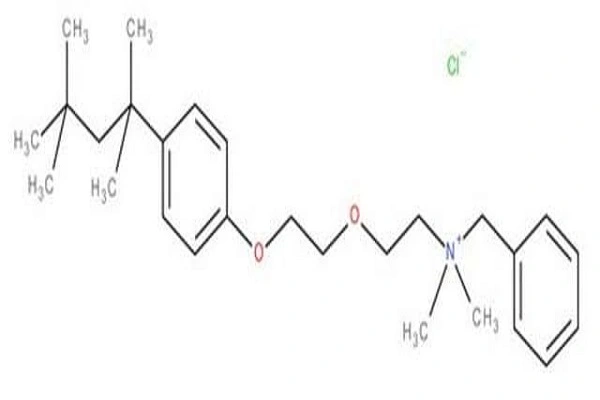
The complete Benzethonium chloride Powder molecule comprises two hydrophobic long alkyl chains, a quaternary ammonium cation hydrophilic head, and an ether bond backbone connecting them. The clear distribution of positive and negative charges forms a typical amphiphilic surfactant configuration. The cationic group is the core region for biological activity; it can stably dissociate in aqueous solution, allowing the molecular head to carry a positive charge. Since most phospholipids and proteins on the surface of microbial cell membranes carry a negative charge, Benzethonium chloride Powder can rapidly adsorb onto the outer wall of microorganisms through electrostatic attraction, achieving targeted attachment. Ordinary monoalkyl quaternary ammonium salts have only one hydrophobic chain, resulting in weaker membrane binding forces and easy detachment by organic matter in the water. The dual hydrophobic chain structure of Benzethonium chloride Powder can deepen the intercalation within the phospholipid bilayer, resulting in stronger adhesion.
The two long alkyl hydrophobic chains can embed into the hydrophobic regions inside the cell membrane, disrupting the originally ordered bilayer structure of the phospholipid molecules. Cell membranes maintain selective permeability through the orderly arrangement of phospholipids. When foreign hydrophobic chains intersect within them, the membrane layer loosens and cracks, disrupting the originally tight barrier structure. Ether bonds connecting the backbone provide good flexibility, allowing for adjustments to the molecular bending angle to accommodate differences in cell membrane thickness and phospholipid composition among various bacterial species, thus expanding the range of microorganisms that can be acted upon. Changes in alkyl chain length alter the hydrophobic properties of the molecule; chains that are too short struggle to penetrate the membrane structure, while chains that are too long reduce water solubility, hindering uniform dispersion in water-based formulations.
The level of purification directly determines the actual performance of Benzethonium chloride Powder. The synthesis process often leaves behind short-chain alkyl byproducts, unreacted intermediates, and inorganic salt impurities. These impurities lack long-lasting antibacterial capabilities and can alter the surface tension of the formulation, causing instability phenomena such as layering and turbidity. High-purity Benzethonium chloride powder undergoes multi-stage desalting and crystallization purification to remove byproduct impurities, ensuring consistent molecular structure across batches. This results in stable microbial inhibitory effects at the same addition ratio, facilitating the development and debugging of preservative formulations and disinfectants, and reducing performance fluctuations in finished products caused by different batches of raw materials.
Benzethonium chloride powder possesses balanced hydrophilic and hydrophobic distribution characteristics, making it suitable for dispersion in various solvent systems. This raw material is soluble in water and low-carbon alcohol solvents, can be compounded with nonionic additives, and is stable in weakly acidic to neutral environments. Many cationic antibacterial raw materials are only suitable for use within a narrow pH range, and precipitation occurs with slight changes in pH. Benzethonium chloride powder, however, tolerates a wider pH range and is less prone to precipitation under the pH conditions of conventional formulation processing, expanding the options for formulation development.
Benzethonium chloride powder does not require intracellular metabolic activation by microorganisms; after molecular adsorption and penetration of the cell membrane, it can directly initiate the membrane damage process. Some antibacterial agents need to enter the bacterial cell and rely on metabolic enzymes to convert them into active products to exert their effects. The speed of action is affected by the metabolic activity of the microorganisms, and dormant microorganisms are difficult to inhibit. Benzethonium chloride powder targets the outer layer of the cell membrane. It can disrupt the membrane structure and achieve rapid antibacterial protection regardless of whether the microorganisms are in an active proliferation phase or a dormant state. It is suitable for antiseptic and disinfection scenarios that require immediate action.
⚖️ Membrane Structure Damage Blocks Microbial Metabolism
Microbial cell membranes perform multiple core functions, including substance exchange, energy synthesis, and osmotic pressure maintenance. An intact phospholipid bilayer is fundamental for bacterial survival. When Benzethonium chloride powder adheres to the cell membrane surface via electrostatic adsorption, dialkyl chains continuously insert into the phospholipid layer, causing a sharp increase in membrane permeability. Intracellular potassium ions, ATP, and soluble nucleic acids continuously leak out. After the loss of these core intracellular active substances, the bacteria cannot maintain normal osmotic pressure, protoplasm continues to leak out, the basic metabolic chain gradually breaks down, and the microorganism loses its ability to proliferate, ultimately becoming inactive. This entire mechanism of action does not depend on specific enzyme targets, making it difficult for microorganisms to develop tolerance through single-point gene mutations, and long-term use is unlikely to lead to drug-resistant strains.
As membrane damage continues to worsen, respiratory chain-related proteins detach from the damaged membrane structure, forcibly interrupting oxidative phosphorylation. ATP is the direct energy carrier for microbial life activities; with energy synthesis halted, the bacteria cannot complete essential processes for proliferation, such as cell wall synthesis, nucleic acid replication, and protein translation, completely blocking colony expansion. Most antibacterial agents only inhibit the activity of a single metabolic enzyme. Microorganisms can compensate through metabolic pathways to bypass this inhibition. Benzethonium chloride powder, however, directly disrupts the cell membrane, a fundamental barrier, causing simultaneous damage to multiple metabolic pathways. Microorganisms lack effective compensatory mechanisms, resulting in a more stable and lasting antibacterial effect.

Benzethonium chloride powder exhibits subtle differences in its effects on Gram-positive and Gram-negative bacteria. The peptidoglycan layer of the outer cell wall of Gram-positive bacteria is loose, allowing cationic molecules to penetrate more easily. Gram-negative bacteria have a lipopolysaccharide outer membrane, forming a barrier that increases the difficulty of molecular penetration. In actual formulation development, a small amount of adjuvants can be added to enhance penetration efficiency, broaden the antibacterial coverage, and achieve simultaneous inhibition of both types of bacteria. Simultaneously, this agent also has a perturbation effect on the ergosterol structure of some fungal cell membranes, inhibiting fungal spore germination and hyphal extension, thus addressing the dual protection needs of bacteria and fungi.
The organic matter content in the system affects the effectiveness of Benzethonium chloride Powder. Negatively charged substances such as proteins and colloids compete with microorganisms for the binding of cationic molecules, reducing the effective concentration of raw materials that can act on the microorganisms. In high organic matter environments, the dosage needs to be adjusted appropriately to ensure that the free active molecules in the system remain above the effective threshold. This characteristic is also a key factor to consider in formulation development. The organic matter load should be estimated based on the application scenario of the finished product to design a reasonable dosage, avoiding preservative failure or increased irritation due to excessive raw materials.
The effect of Benzethonium chloride Powder is concentration-dependent. Low dosage primarily inhibits microbial proliferation, while high dosage achieves a stronger inactivation effect. Formulation development needs to differentiate between preservation and surface disinfection, setting corresponding dosage ranges. Furthermore, this raw material cannot be directly compounded with anionic surfactants; the interaction of anions and cations will form a precipitate complex, losing surface activity and antibacterial ability. Therefore, the formulation design stage needs to avoid the combination of anionic raw materials and prioritize the use of nonionic and amphoteric additives for system formulation.
🔋 Building a Long-Lasting Microbial Barrier in Multiple Scenarios
In pharmaceutical excipients and topical skin formulations, Benzethonium chloride powder is often added as a preservative and antimicrobial component to inhibit the invasion and reproduction of environmental microorganisms after the formulation is opened. During repeated use of liquid and cream formulations, bacteria and fungi can be introduced from the air and utensils, easily causing mold, turbidity, and spoilage of the finished product, shortening its shelf life. Adding an appropriate dose of Benzethonium chloride powder can continuously inhibit the proliferation of contaminating microorganisms, ensuring microbial compliance throughout the product's use, reducing the risk of infection from users coming into contact with contaminated formulations, while also ensuring controllable raw material irritation and suitability for mucosal topical formulation development.
Preservation in daily chemical and skin care formulations is an important application area for Benzethonium chloride powder. Washing and care products have high water content and rich nutrients, creating an environment where microorganisms can easily proliferate. Traditional preservative systems have limitations in application; some preservatives have limited tolerance to certain formulation systems or pose potential irritation risks. Benzethonium chloride powder, with its low dosage and long-lasting preservative effect, provides long-lasting protection in water-based serums and shampooing solutions, inhibiting the growth of mold, yeast, and various putrefactive bacteria, maintaining the physicochemical stability of the finished product, and preventing spoilage issues such as odor, layering, and discoloration.
Benzethonium chloride powder is used as an active ingredient in the development of environmental disinfection and surface disinfection agents, preparing surface disinfection sprays and wipes. For bacterial contamination of hard surfaces, this material can quickly adsorb bacteria and disrupt cell membranes, reducing the surface microbial load. Compared to chlorine-containing disinfectant materials, Benzethonium chloride powder is not highly corrosive, will not damage metals, plastics, or painted surfaces, and emits no irritating volatile gases, making it suitable for disinfection of various materials, including office equipment, medical device surfaces, and hard furniture surfaces.

In ophthalmic and nasal rinse solution excipient systems, compliant dosages of Benzethonium chloride powder can be used as an antibacterial adjuvant to control the proliferation of microorganisms in the rinse solution. These types of mucosal contact preparations have stringent requirements for raw material purity and impurity residue. High-purity Benzethonium chloride Powder meets excipient standards for heavy metals and harmful organic impurities, reducing the risk of mucosal irritation from impurities. The development of related preparations must strictly adhere to pharmacopoeia excipient specifications, controlling the upper limit of addition to ensure safe use.
Benzethonium chloride Powder compound preparations are also used in the field of disinfection of aquaculture and aquaculture equipment to inhibit bacteria in aquaculture tools and water contact equipment. This raw material is stably dispersed in water and does not readily degrade, continuously reducing the number of pathogens adhering to the surface of equipment and minimizing the risk of cross-transmission. During use, the total amount discharged into natural water bodies must be controlled to prevent excessive cationic substances from continuously entering the aquatic environment, complying with relevant discharge control regulations to balance antibacterial needs with ecological protection.
📋 Diverse Application Directions
Benzethonium chloride powder is widely used in preservative formulation development. Researchers can conduct antibacterial efficacy tests, determine the minimum inhibitory concentration against different bacterial species, establish preservative challenge testing systems, and verify the microbial control capabilities of formulations during long-term storage. Through gradient addition experiments, the optimal addition ratio that balances antibacterial effect, safety, and formulation stability can be determined, providing data support for the development of skincare and topical formulations. High-purity raw materials ensure the reproducibility of antibacterial test data.
In disinfectant formulation development, Benzethonium chloride powder is used in combination with moisturizing agents and solubilizers to prepare various dosage forms, including aqueous solutions, soluble powders, and wiping solutions. The agent system can adjust the uniformity of raw material dispersion, reduce surface tension, improve the spreadability of object surfaces, and allow active molecules to evenly cover the contact surface, improving disinfection efficiency. Formulation development also requires stability studies to assess the degradation of active ingredients during high and low temperature storage periods, ensuring that the finished product meets shelf-life performance standards and complies with relevant disinfectant product registration regulations.
In the development of pharmaceutical topical excipients, Benzethonium chloride powder is being researched and submitted as an antibacterial excipient, undergoing safety assessments, irritation tests, and microbial efficacy verification. Topical creams, wound irrigation solutions, and other formulations have stringent purity requirements for excipients, necessitating complete impurity profiles and physicochemical testing data. High-purity batches of raw materials must meet the full set of quality control documentation required for pharmacopoeia excipient applications, supporting compliant market entry.
In the development of compound antibacterial formulations, Benzethonium chloride powder is often used in combination with other non-antagonistic antibacterial raw materials to broaden the antibacterial spectrum, reduce the concentration of individual raw materials, and minimize potential irritation. Different active substances have different target sites; rational compounding can synergistically inhibit bacteria and fungi while reducing the dosage of individual raw materials. Early-stage compound development requires compatibility testing to confirm that the mixture of multiple raw materials will not precipitate, discolor, or become inactive before conducting a complete preservative challenge and safety assessment.
Benzethonium chloride powder is a cationic antibacterial raw material. Directly using the raw powder and arbitrarily preparing it can easily lead to excessive concentrations, causing skin and mucous membrane irritation. Furthermore, incorrect combination with anionic raw materials can cause system failure. Complete industrial-scale development requires formula optimization, safety assessment, and compliance registration before the finished product can be put into use. During processing, proper protective measures must be taken to avoid direct contact of high-concentration powder with the respiratory tract and skin, and strict adherence to the safety operating procedures for fine chemical raw materials is essential.
Conclusion
Benzethonium chloride powder, relying on its amphiphilic quaternary ammonium salt molecular structure, disrupts the phospholipid structure of microbial cell membranes through electrostatic adsorption, thereby blocking bacterial metabolism and proliferation and achieving a broad-spectrum antibacterial effect. Based on its stable physicochemical properties and broad compatibility, this raw material has mature applications in pharmaceutical excipient preservation, antibacterial agents in daily chemical formulations, and surface disinfection. With the continuous iteration of preservative and disinfectant formulation technologies, standardized high-purity Benzethonium chloride powder can continuously meet the needs of various downstream formulation development and industrial production.
Xi'an Faithful BioTech Co., Ltd. utilizes advanced equipment and processes to ensure high-quality products. Our Benzethonium chloride Powder meets international pharmaceutical standards. Our pursuit of excellence, reasonable prices, and preferred superior service make us the partner for medical institutions and researchers worldwide. If you require Benzethonium chloride Powder research or production,Please contact us Click email: allen@faithfulbio.com Or WhatsApp: +86 13137770562.
References
- Block, S. S. (2001). Disinfection, sterilization, and preservation. Lippincott Williams & Wilkins.
- Merianos, A. (2001). Quaternary ammonium antimicrobial compounds. Journal of Hospital Infection, 47(Suppl A), S23-S28.
- Russell, A. D. (2003). Mechanisms of antimicrobial action of antiseptics and disinfectants. Journal of Antimicrobial Chemotherapy, 51(3), 641-649.
- Paulus, W. (2008). Directory of microbicides for the protection of materials. Springer Netherlands.
- McDonnell, G., & Russell, A. D. (1999). Antiseptics and disinfectants: Activity, action, and resistance. Clinical Microbiology Reviews, 12(1), 147-179.
- Nair, M. S., & Varma, R. L. (2012). Benzethonium chloride: An overview of its antimicrobial applications. International Journal of Pharmaceutics, 434(1-2), 1-8.
- Sutton, S. V. W. (2011). Preservation of pharmaceuticals and cosmetics. CRC Press.