

How Crystagen peptide regulates thymocyte activity and maintains immune tissue homeostasis.
Crystagen peptide is a synthetic tripeptide research powder raw material with an amino acid sequence of H-Glu-Asp-Pro-OH. It belongs to the Khavinson system and is a thymus targeted biological regulatory short peptide. The powder product is obtained through solid-phase synthesis, purification, impurity removal, and freeze-drying treatment. Each batch of raw materials undergoes strict testing for impurities and residual substances to ensure stable activity across different batches, with minimal fluctuations in the collected data. The thymic tissue will gradually shrink with age, the proliferation activity of thymic epithelial cells will decrease, the apoptosis of thymic cells will increase, the maturation and differentiation of T lymphocytes will be hindered, the body's immune defense ability will continue to decline, inflammation regulation will be imbalanced, and the systemic immune homeostasis will be disrupted. Many immune related research materials on the market simply stimulate the proliferation of immune cells, which can easily lead to excessive activation of immune responses and induce persistent inflammation. Crystagen peptide has tissue targeting properties and can act on thymus related cells, regulating the proliferation and apoptosis of breast gland cells at the gene expression level, bidirectionally correcting immune cell function, and restoring the basic balance of the immune system.
Molecular Structure and Physicochemical Basis of Crystagen Peptide
Crystagen peptide is an artificially synthesized tripeptide composed of glutamic acid, aspartic acid, and proline connected in sequence. The small molecule short peptide structure can penetrate the cell membrane and further enter the nucleus, interacting with histones and chromatin to regulate the transcription of immune related genes. Compared with large molecule protein based immune active substances, Crystagen peptide has a smaller molecular weight and a simpler spatial conformation. It can stably maintain the peptide chain structure in a neutral physiological buffer system and is not easily degraded by proteases. It is suitable for building in vitro systems of thymocytes and lymphocytes. The combination of three amino acid residues endows Crystagen peptide with unique charge characteristics, allowing it to selectively recognize chromatin regions of thymic derived cells, which is also the structural basis for Crystagen peptide to specifically regulate thymic cells.
The appearance of Crystagen peptide freeze-dried powder is white to off white crystalline powder, with good water solubility, and can maintain biological activity for a long time after dissolution in neutral buffer solution. During the raw material production stage, solid-phase peptide synthesis technology is used, and multi-stage chromatography is used to purify and remove unreacted amino acids, short peptide fragments, heavy metals, and solvent residues. Each batch of Crystagen peptides undergoes purity and related substance testing to strictly control impurity levels and ensure that activity differences between batches are maintained within a low range. The finished product of Crystagen peptide needs to be protected from light, sealed, and stored at low temperatures. Repeated freeze-thaw cycles and high temperature environments can cause peptide chain hydrolysis and breakage, damage the complete molecular structure, and directly reduce biological activity. Strict control of environmental conditions is required during raw material storage and cell experiment operations.
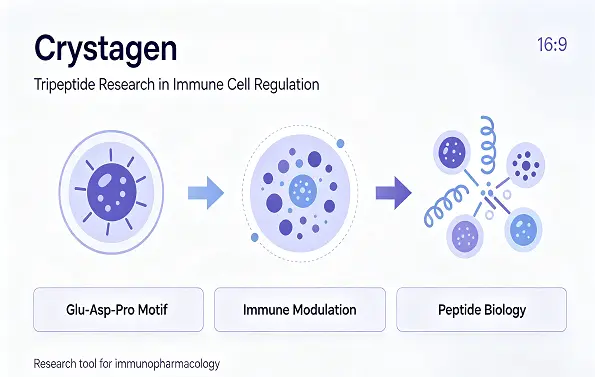
The biological activity of Crystagen peptide relies entirely on the complete tripeptide amino acid sequence. The use of a mixture of free amino acids such as glutamic acid, aspartic acid, and proline alone cannot replicate the regulatory effect of Crystagen peptide on thymocytes. Only when the three are fully connected to form an EDP tripeptide structure can it bind to nuclear histones, relax chromatin structure, and open transcription channels for thymocyte development related genes. This feature distinguishes Crystagen peptide from ordinary amino acid mixtures, and the complete peptide chain sequence is the core prerequisite for Crystagen peptide to exert immune regulatory effects. When configuring Crystagen peptide working solution in vitro, the aqueous solution will slowly undergo peptide bond hydrolysis over a long period of time, and the activity will gradually decline. Therefore, the principle of on-site preparation and use is generally followed to ensure the stable concentration of effective molecules in the system.
Crystagen peptide exhibits significant tissue bias and preferentially acts on thymic epithelial cells and thymic lymphocytes, with a significantly reduced intensity of action in other peripheral somatic cells. This tissue selectivity comes from the unique genetic environment within thymocytes. After Crystagen peptide enters the nucleus, it only regulates the transcription of genes related to thymocyte development and T cell differentiation, and does not indiscriminately activate gene expression in all somatic cells. This characteristic greatly reduces non-specific interference. In the immune aging related observation system, the dynamic changes of thymocyte proliferation, apoptosis, and T cell differentiation can be observed separately, reducing the data interference caused by other cells.
The mechanism of action of Crystagen peptide in regulating thymocyte activity
As age increases, thymic tissue continues to shrink, the proliferation ability of thymic epithelial cells decreases, the p53 apoptosis pathway inside thymic cells is continuously activated, a large number of immature thymic cells undergo apoptosis, the number of new T cells generated continues to decrease, and the body's immune reserve for recognizing pathogens continues to decline. After entering thymocytes, Crystagen peptide penetrates the nuclear membrane to reach the nucleus, binds to histones, changes chromatin condensation state, downregulates p53 protein expression level, reduces thymocyte apoptosis signal intensity, reduces programmed cell death, and increases the survival of thymocytes in aging state. In the ex vivo thymus tissue culture system, both juvenile and elderly thymus tissues can observe the anti apoptotic effect of Crystagen peptide, which alleviates the massive loss of thymocytes caused by aging.
Crystagen peptide can promote the proliferation of thymic epithelial cells and upregulate the synthesis of thymic cell differentiation related proteins. Thymic epithelial cells are the core components of the thymic microenvironment, responsible for inducing T lymphocyte differentiation and maturation. Insufficient epithelial cell numbers can directly block T cell development. Crystagen peptide activates thymic development related gene transcription by relaxing chromatin, enhances thymic epithelial cell proliferation activity, improves the internal microenvironment of the thymus, helps immature thymocytes differentiate into mature CD4+and CD8+T lymphocytes, and maintains the CD4+/CD8+cell ratio in a physiological balance range. With the recovery of mature T cell production, the basic ability of the body's immune recognition and immune response is improved, alleviating the immune function decline caused by immune aging.
Immune imbalance can be divided into two states. When the immune function is low, the body is unable to resist pathogen invasion, while excessive immune activation can release a large amount of pro-inflammatory cytokines, inducing chronic inflammatory damage. Crystagen peptide belongs to bidirectional immune regulatory substances, which do not simply enhance immunity or directly inhibit immunity. When the activity of immune cells is low, Crystagen peptide can enhance the proliferation ability of lymphocytes and strengthen the recognition ability of immune cells towards pathogens; When a large amount of inflammatory factors are released and the immune system is overactivated, Crystagen peptide can downregulate the secretion of pro-inflammatory factors such as IL-6 and TNF - α, calm the excessive inflammatory response, bring the immune status back to physiological baseline, and maintain the immune homeostasis of the body.

Crystagen peptide can also increase the expression level of antioxidant enzymes inside immune cells, and increase the content of superoxide dismutase and glutathione peroxidase. The metabolic process of thymocytes continues to produce oxidative free radicals. Under aging and radiation stimulation, free radicals accumulate in large quantities, attacking cell membranes and mitochondria, accelerating thymocyte apoptosis, and exacerbating thymic atrophy. After upregulating the antioxidant system activity, Crystagen peptide clears excess free radicals in cells, reduces oxidative stress damage, protects mitochondrial structural integrity, stabilizes thymocyte energy metabolism, reduces apoptosis induced by oxidative damage, and delays thymic tissue degeneration.
Research application areas for Crystagen peptide
The core application direction of Crystagen peptide is to build immune aging related systems and observe the regulatory effects of short peptides on thymic atrophy and T cell differentiation. Thymus atrophy and decreased T cell regeneration ability are the core characteristics of aging accompanied by immune decline. With the help of Crystagen peptides, thymic cell proliferation, apoptosis, and changes in T lymphocyte subpopulation ratios can be observed in vitro thymic tissue and thymic cell culture systems, and the complete signal chain of short peptide regulation of thymic aging can be sorted out, providing tool materials for exploring the basis of immune aging. The relevant observations are only for academic purposes and do not constitute any reference for clinical treatment plans.
Crystagen peptide can be used to build immune injury models and observe the repair process of the immune system after injury. Ionizing radiation, chemotherapy drugs, and severe infections can all cause thymus damage, inhibit T cell production, and induce secondary immunodeficiency. By using Crystagen peptides, it is possible to observe the survival of thymocytes, epithelial cell proliferation, and lymphocyte differentiation changes in cell and ex vivo tissue systems, evaluate the protective effect of short peptides on damaged thymic tissue, explore regulatory targets for immune damage repair, and provide reference for screening immunoprotective active substances.
Crystagen peptide is suitable for observing systems related to chronic inflammation and immune imbalance, exploring the molecular pathways of bidirectional immune regulation. In chronic inflammatory diseases, immune cells continuously release pro-inflammatory cytokines, disrupting the immune homeostasis. Crystagen peptide can be used to observe the dynamic changes in cytokine secretion in lymphocytes, compare the intervention strength of different concentrations of Crystagen peptide on the expression of pro-inflammatory and anti-inflammatory factors, study the intrinsic mechanism of bidirectional correction of immune response by short peptides, and help understand the regulatory logic of the immune system to maintain balance.
Crystagen peptide can be used to explore the basic mechanisms of short peptide biological regulation. Crystagen peptides belong to the Khavinson tissue-specific regulatory peptide family, which can interact with histones and chromatin to achieve tissue-specific gene regulation. Researchers use Crystagen peptides to study the binding mode between short peptides and chromatin, explore how short peptides selectively regulate thymocyte gene expression, compare the differences in the effects of other short peptides in the same series, improve the theoretical system of short peptide epigenetic regulation, and expand the exploration direction of bioactive short peptides.
Limitations and Safety Boundaries of Crystagen Peptide Use
Crystagen peptide can only be used in controlled laboratory in vitro systems, and the observed results are all from cellular and ex vivo thymic tissue systems, and cannot be directly equated with the effects within the human body. There is a huge difference between the in vitro cell culture medium environment and the complex physiological environment in vivo. There are blood circulation, multiple hormones, and immune cells inside the living body. Crystage peptides are hydrolyzed by proteases after entering the body, and the effective concentration and cell delivery efficiency will change. The thymus protection data obtained from in vitro measurements cannot be directly applied to in vivo treatment scenarios, let alone infer the effectiveness of human use.
The regulatory effect of Crystagen peptide is concentration dependent. Low concentrations cannot activate the corresponding gene regulatory pathways, while high concentrations may cause non-specific cellular effects and alter the basic physiological state of cells. At the same time, the effect of Crystagen peptide is affected by cell culture conditions, cell passage times, and tissue sampling age. The same concentration of Crystagen peptide on thymocytes from different sources can result in differences in observed proliferation and anti apoptotic effects. When conducting relevant observations, it is necessary to strictly fix all cultivation conditions, set up multiple parallel controls, and not rely on the results of a single concentration to determine the strength of activity, otherwise it is easy to produce data bias.

Most of the current observational data related to Crystagen peptide come from a single research system, and there are few publicly available independent and repeated validations. Its in vivo metabolic pathways, tissue distribution, and potential long-term effects are not fully understood. The exploration of Crystagen peptide is still in its early stages and has not undergone standardized clinical trials. The safe dosage and administration method for human use have not been confirmed, and there is no recognized effective human use regimen. It cannot be concluded solely based on in vitro observations that Crystagen peptide has the ability to repair the human thymus and enhance immunity.
Crystagen peptide only regulates the thymus and T cell pathways, and cannot directly reverse severe immune deficiencies that have already occurred, nor can it directly eliminate pathogens. The role of Crystagen peptide tends to regulate immune homeostasis, mainly improving thymocyte proliferation and regulating T cell differentiation. It does not have a direct reversal effect on severe immune failure that has already formed. If the model is severely damaged, using Crystagen peptide alone is difficult to reverse immune lesions and can only be used as a tool to observe changes in cellular level regulation. It cannot be used as an intervention for severe immune damage.
Conclusion
Crystagen peptide, as a synthetic tripeptide research material, can act on thymocytes through epigenetic regulation, inhibiting thymocyte apoptosis, promoting thymic epithelial cell proliferation, assisting T lymphocyte normal differentiation, and bidirectionally regulating the secretion of inflammatory factors to maintain immune tissue homeostasis. Crystagen peptides provide high-quality research tools for thymus aging, radiation-induced/drug-induced immune damage, chronic immune imbalance, and short peptide epigenetic regulation mechanisms.
Xi'an Faithful BioTech Co., Ltd. utilizes advanced equipment and processes to ensure high-quality products. Our Crystagen peptide meets international pharmaceutical standards. Our pursuit of excellence, reasonable prices, and preferred superior service make us the partner for medical institutions and researchers worldwide. If you require Crystagen peptide research or production,Please contact us Click email: allen@faithfulbio.com Or WhatsApp: +86 13137770562.
FAQ
Q1: What type of raw material is Crystagen peptide?
A: Crystagen peptide is a synthetic, thymus-targeting short peptide in lyophilized powder form intended for laboratory research purposes. It is not classified as a pharmaceutical or dietary supplement and is not permitted for direct use in humans.
Q2: How does Crystagen peptide differ from standard immunostimulatory research materials?
A: Standard immunostimulatory materials typically induce a unidirectional proliferation of immune cells, which can easily trigger excessive inflammation. In contrast, Crystagen peptide can enter the cell nucleus to regulate the expression of thymus-related genes; it bi-directionally modulates the immune response to restore immune status to its physiological baseline, functioning as a homeostasis-regulating short peptide.
Q3: Can Crystagen peptide be used directly for human immune modulation?
A: Absolutely not. Crystagen peptide is strictly a raw material for laboratory research. It has not undergone human clinical trials, nor have safe human dosages or administration protocols been established. Direct use entails significant unknown risks, and human use is strictly prohibited.
References
- Khavinson, V. K., & Morozov, V. I. (2002). Short peptides as regulators of thymus function and immune homeostasis. *Bulletin of Experimental Biology and Medicine*, 134(5), 472–476.
- Khavinson, V. K., & Malinin, V. L. (2011). Short peptides as epigenetic regulators of gene expression. *Biochemistry (Moscow)*, 76(11), 1209–1217.
- Fedoreyeva, L. I., Khavinson, V. K., & Vanyushin, B. F. (2011). Interaction of short bioregulatory peptides with histones and DNA. *Molecular Biology*, 45(6), 904–911.
- Khavinson, V. K., & Anisimov, V. N. (2006). Immunogeroprotective effects of synthetic tripeptide Crystagen in aged and irradiated animals. *Advances in Gerontology*, 19(2), 115–121.
- Linkova, N. S., & Khavinson, V. K. (2013). Tissue-specific peptide regulation of thymocyte apoptosis and proliferation. *Journal of Peptide Science*, 19(7), 428–435.
- Khavinson, V. K., et al. (2006). Correction of immunodeficiency in elderly patients with the synthetic peptide Crystagen. *Ter Arkh*, 78(8), 45–49.
- Anisimov, V. N., & Khavinson, V. K. (2010). Peptide bioregulators in aging research. *Ageing Research Reviews*, 9(3), 252–265.