
How did Nateglinide API become a "meal attacker" in sugar control?
Understand the "failure moment" of insulin secretion
When you enjoy a delicious meal, your body's blood sugar control system will start quietly. Insulin, the only hypoglycemic hormone in the body, will respond quickly and send blood sugar to cells smoothly. But for patients with type 2 diabetes, this "natural response" often fails. With its unique mechanism, it is playing a key role in "accurate sugar control during meals". Its core active ingredient, Nateglinide API, is an important "ammunition" behind this precise sugar control weapon.
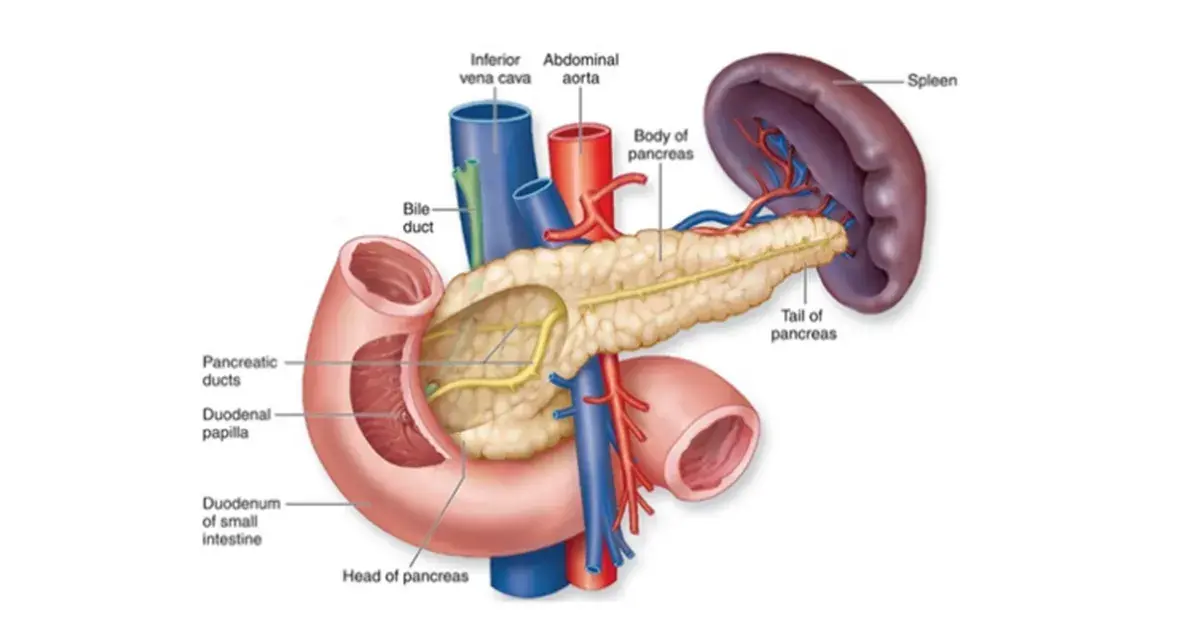
In healthy people, blood sugar regulation can be called a perfect "biphasic model": blood sugar rises rapidly after eating, and pancreatic β cells release a wave of rapid and transient insulin within 5-10 minutes, so as to control blood sugar as quickly as the vanguard; Subsequently, continuous and gentle insulin secretion maintains blood sugar stability. However, in the early stage of type 2 diabetes, it is this key "first phase" insulin secretion that is lost first. Insulin release becomes slow and slow, which leads to a sharp rise in postprandial blood sugar, forming "postprandial hyperglycemia", which is an important promoter of diabetic complications (especially cardiovascular diseases).
Nateglinide was originally designed to repair this "failure moment". It does not belong to traditional sulfonylurea or metformin, but belongs to "glinide" dietary blood glucose regulator. Its core mission is not to reduce blood sugar around the clock, but to act accurately, quickly and briefly after meals, simulating physiological early-phase insulin secretion. This feature makes it a unique and sharp "scalpel" in the arsenal of diabetes treatment.
Reveal the mechanism of action: how to accurately "knock" the door of insulin release?
1. Physiological switch: the way to regulate glucose
Under normal circumstances, glucose enters β cells and is metabolized to produce ATP. Channel closure leads to cell membrane depolarization, which in turn opens voltage-dependent calcium channels. The influx of calcium ions, like the final messenger, triggers the release of vesicles that store insulin. This is an indirect and slightly slower path that depends on glucose metabolism.
2. Nateglinia's "shortcut": directly close the door of the passage.
Its mechanism of action is subtle and direct. It doesn't need to wait for glucose metabolism to produce ATP, but like a special key, it quickly induces channel closure. This process bypasses the metabolic step, so the reaction speed is extremely fast.
3. Core features: fast, short and demanding.
Quick effect: perfectly match the curve of postprandial blood sugar rise.
Short action time: mainly covers the peak of blood sugar during meals. After that, insulin secretion quickly returned to the basic level.
Glucose dependence: Its secretagogue effect depends on a certain blood sugar level. When blood sugar is low, its effect of promoting insulin secretion is obviously weakened. This feature gives it a lower risk of hypoglycemia, because its "work" needs the "start signal" of blood sugar.
This characteristic of "working only when you see sugar (a certain concentration) and leaving work after eating" is exactly Nateglinide API. The origin of the title of "meal regulator"
Functional orientation: what role does it play in the map of diabetes treatment?
The preparation made of nateglinide API shows precise targeting function in clinical application, and its value mainly lies in:
1. Accurately combat postprandial hyperglycemia:
The main indication is to reduce postprandial blood sugar in patients with type 2 diabetes. It is an ideal first-line or early treatment choice for patients with postprandial hyperglycemia, especially those with fasting blood glucose basically reaching the standard and slightly elevated glycosylated hemoglobin.
It can effectively reduce the postprandial peak blood sugar, reduce the damage of "blood sugar fluctuation" to vascular endothelium, and has potential benefits for preventing cardiovascular complications.
2. The "good partner" of combination therapy:
Combined with metformin, which mainly reduces hepatic glucose output and improves insulin resistance, the mechanism is complementary, and it can fully cover fasting and postprandial blood glucose, which is a classic combination scheme.
In basic insulin therapy, it can be combined to control postprandial blood sugar, forming a "basic-meal" insulin supplement model.
3. Potential protection of β cell function:
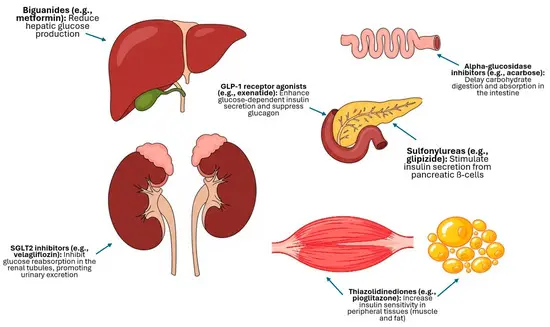
Some studies suggest that Nateglinide API may help to reduce the "sugar toxicity" and "lipid toxicity" of β cells by restoring the early rapid insulin secretion mode, so that the exhausted β cells can get a "more rational" working rhythm, which may delay their functional failure. However, this view still needs more long-term clinical evidence to support.
R&D process: the journey from scientific conception to "molecular entity"
The birth of nateglinide is a reflection and transcendence of biography.
1. Innovation of design concept:
In the 1980s, Japanese researchers devoted themselves to finding a compound that can quickly bind and dissociate with the receptor, thus achieving the ideal characteristics of "quick action and short action". After a lot of screening, phenylalanine derivative series came into view.
2. Structural Optimization and Chiral Challenge:
Its molecular structure contains two key parts:
In the process of research and development, chemists finally got the ideal molecule nateglinide through ingenious structural modification: it not only retains the effectiveness of binding to the receptor, but also significantly reduces the tightness of binding, realizing the characteristics of "fast forward and fast out".
3. Consideration of preparation research and development:
In order to make APIs work efficiently in the body, pharmaceutical scientists need to solve the problem of rapid dissolution and absorption. The raw material nateglinide has poor water solubility. By selecting suitable excipients (such as fillers and disintegrants) and optimizing the preparation process, at the same time, it is necessary to consider its stability and adopt moisture-proof packaging to ensure the quality within the validity period.
Industrialization of API: from laboratory to ton-scale production.
From gram-scale laboratory synthesis to ton-scale industrial production, its manufacturing is a systematic engineering that integrates organic chemistry, chemical engineering and quality control.
1. "Skynet" of quality control:
Purity is the lifeline for raw materials to enter the human body. The production of Nateglinide API follows the strict good manufacturing practice (GMP), and its quality control is multidimensional:
Related substances: All kinds of impurities that may be produced in the synthesis are detected and strictly controlled by high performance liquid chromatography (HPLC) and other precision instruments to ensure that the content of main components is higher than 99.5%.
Residual solvents: The organic solvents used in the production process must be removed to the maximum extent, and monitored by gas chromatography (GC) to ensure that the residual amount is far below the safety limit stipulated by the International Coordinating Council for Technical Requirements of Medicines for Human Use (ICH).
Particle size distribution: the particle size of API will affect the dissolution behavior of the preparation, so it needs to be controlled within a specific range.
Conclusion
It is not only a kind of white powder, but also a manifestation of therapeutic philosophy: with the least intervention, the most physiological repair can be achieved at the most needed moment. Today, with the increasing emphasis on individualization and accuracy in diabetes management, the concept of "blood sugar management during meals" represented by Nateglinide still shines with the light of science and wisdom.
For the API industry, the production of nateglinide is a comprehensive test of technology, quality and compliance. Every batch of high-quality APIs that meet international standards. These seemingly tiny API molecules are silently bearing great responsibilities and missions.
Xi'an Faithful BioTech Co., Ltd. combines cutting-edge production technology with comprehensive quality assurance to provide high-quality Nateglinide API that meets international pharmaceutical standards. Our commitment to excellent, competitive prices and technical support makes us the preferred partner of global healthcare providers and researchers. Please contact our technical team in sales11@faithfulbio.com to find out how our products can improve your formula.
This is a list of the names of the core scientific research documents that I referred to and relied on in the process of writing a soft article. These documents provide solid scientific evidence for the efficacy and mechanism mentioned in this paper.
- 《Journal of Pharmaceutical and Biomedical Analysis》
- 《International Journal of Pharmaceutics》
- 《Journal of Pharmaceutical Sciences》
- 《Goodman & Gilman‘s: The Pharmacological Basis of Therapeutics》
- 《Analytical Profiles of Drug Substances and Excipients》
- 《United States Pharmacopeia – USP-NF》 (USP Nateglinide Monograph)