
What is Deltorphin Peptide?
1. What is Deltorphin Peptide? -a "golden key" from nature
1. Wonderful discovery: the "analgesic medicine" in frog skin
Deltorphin Peptide: from frog skin toxin to the "golden key" of neuroscience
In the vast starry sky of biomedicine, polypeptide products are becoming the "third pillar" with its advantages of high specificity and low toxicity. In this new blue ocean, Deltorphin Peptide is undoubtedly a bright pearl. It is not only a "gold standard" tool for neuroscience research, but also a "star molecule" for developing new analgesic and antidepressant products.
In order to make you understand this complex scientific concept easily, we might as well imagine it as a "high-precision biological key". This key was originally found in the skin of the South American tree frog. It has a magical feature: it can be accurately inserted into the keyhole of the human nervous system, thus opening a series of physiological functions to regulate pain, mood and memory.
Next, we will unveil the mystery of this "key" and discuss its great potential in the industry in popular language.
It is not an invention of human beings, but a gift from nature. Scientists found that the skin secretion of Phyllomedusa bicolor in South America has strong biological activity. After separation and purification, they found two powerful peptides with similar structure: Dermorphin and Deltorphin.
Dermorphin is one of the strongest natural analgesic substances known.
Deltorphin: Although the analgesic effect is not as good as Dermorphin, it has an unparalleled advantage-extremely high selectivity.
2. Unique structure: Why is it so "single-minded"?
The reason why Deltorphin Peptide can become the "gold standard" for studying receptors stems from a special design in its molecular structure-D-type amino acids.
What is D-amino acid? In nature, most of the amino acids that make up protein are L-shaped (just like human left hand). However, in the second position of the sequence, it rarely uses the "D-type" amino acid (just like a human right hand).
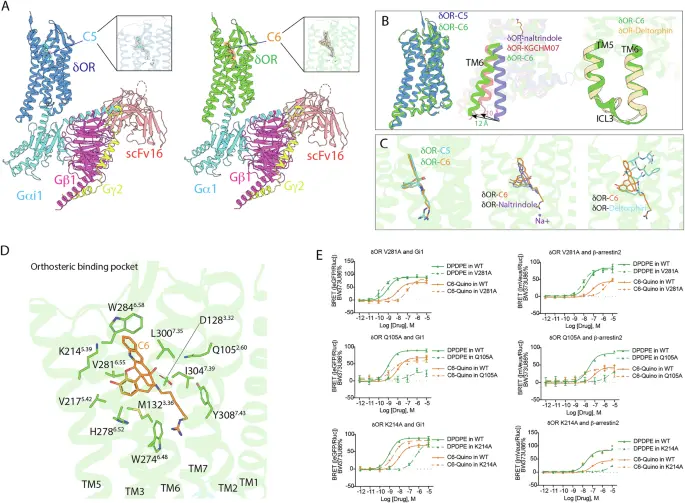
Magic brought by "mirror image": the introduction of this D-type amino acid is like adding a special "anti-counterfeiting tooth" to the key. It enables Deltorphin to be perfectly embedded in the pocket of the receptor, while avoiding the binding sites of different receptors perfectly. This structure not only endows it with high selectivity, but also gives it the ability to resist the degradation of protease in the human body, making its half-life in the body longer than that of ordinary peptides.
Second, how does Deltorphin Peptide work? -the "signal regulator" of the nervous system
To understand its function, we must first understand the "lock" it wants to open-the "pain and emotion regulator" of the body.
1. The body's "pain relief and happiness" system
Body "pain and mood regulator". It is mainly divided into three types:
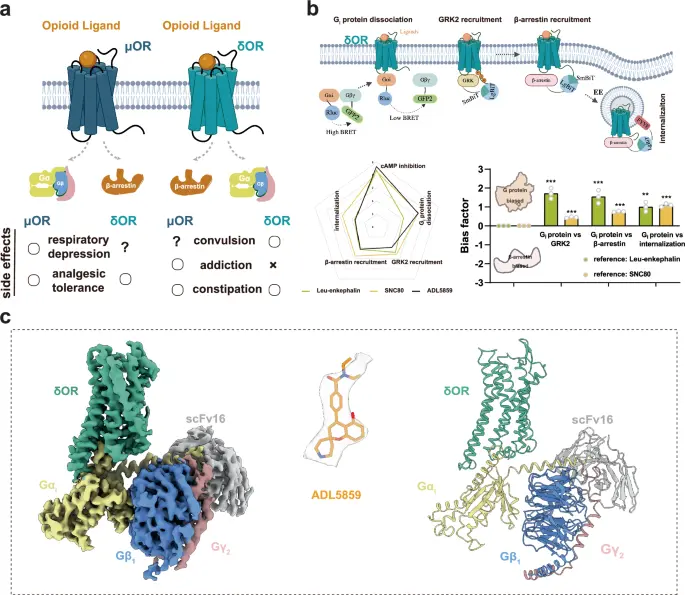
Mu Receptor: It is mainly responsible for powerful analgesia, but activating it can easily lead to respiratory depression, constipation and addiction.
Kappa Receptor: After activation, it will have analgesic and sedative effects, but sometimes it will also cause irritability.
Delta Receptor: This is the exclusive target of Deltorphin. It is mainly involved in mood regulation (anti-anxiety, anti-depression), neuroprotection and moderate-intensity analgesia.
2. Deltorphin's "unlocking" mechanism
When the "key" of Deltorphin is inserted into the "lock" of δ receptor, it will trigger a series of precise chain reactions:
Inhibition of "pain signal": it will activate G protein in cells, close calcium channels and reduce the release of pain neurotransmitters; At the same time, the potassium channel is opened to "calm down" nerve cells, thus blocking the transmission of pain signals.
Regulating "emotional switch": By regulating the release of neurotransmitters such as dopamine and serotonin, it can play a similar role to antidepressants and improve emotional state.
Protecting "brain cells": It has been proved to reduce the death of nerve cells and has neuroprotective effect in the model of cerebral ischemia or neurodegenerative diseases.
3. the industrial application of Deltorphin Peptide: a "generalist" from laboratory to clinic
In the biomedical industry, the value of Deltorphin Peptide is mainly reflected in the following three levels:
1. The "gold standard tool" in the field of scientific research
This is the most mature application of Deltorphin at present. In the laboratory of neuroscience and pharmacology, scientists need an "absolutely pure" tool to verify the function of δ receptor. Because of its 100% selectivity, it has become a "positive control" to verify the physiological function mediated by δ receptor.
Application scenario: When screening new town products, if the candidate products can activate δ receptor but not μ receptor like Deltorphin Peptide, it means that this new product may have the potential of "powerful analgesia but not addiction".
2. "Prototype molecules" of drug development
It provides a perfect "skeleton" for the design of finished drugs.
Structural optimization: Based on the sequence of Deltorphin , pharmaceutical companies have developed a variety of δ receptor agonist candidate products by chemical modification (such as PEGylation, cyclization and introduction of unnatural amino acids) to prolong its action time and improve its stability.
3. New hope for neuropsychiatric diseases
With the deepening of research, the role of δ receptor in emotional regulation has been paid more and more attention. Deltorphin Peptide and its analogues have shown good therapeutic effects on depression, anxiety and chronic neuropathic pain in preclinical studies. This provides a new treatment idea for those patients who have no effect on traditional antidepressant products.
conclusion
The story of Deltorphin Peptide is a typical case of "from nature to science, from science to industry". It has changed from a humble frog skin toxin to an indispensable research tool for neuroscientists, and is moving towards the next generation of safe analgesic products. The in-depth research and production of highly selective ligands such as it is not only related to scientific progress, but also to the ultimate pursuit of pain and emotional management.
With the continuous breakthrough of peptide synthesis technology, delivery technology and AI technology, we have reason to believe that this "golden key" from nature will open more unexpected doors in the future pharmaceutical industry.
Xi'an Faithful BioTech Co., Ltd. combines cutting-edge production technology with comprehensive quality assurance to provide high-quality Deltorphin Peptide that meets international pharmaceutical standards. Our commitment to excellent, competitive prices and technical support makes us the preferred partner of global healthcare providers and researchers. Please contact our technical team in sales11@faithfulbio.com to find out how our products can improve your formula.
This is a list of the names of the core scientific research documents that I referred to and relied on in the process of writing a soft article. These documents provide solid scientific evidence for the efficacy and mechanism mentioned in this paper.
- Erspamer, V., Melchiorri, P., Falconieri-Erspamer, G., et al. (1989). Deltorphins: a family of naturally occurring peptides with high affinity and selectivity for delta opioid binding sites.Proceedings of the National Academy of Sciences of the United States of America (PNAS), 86(13), 5188-5192
- Kreil, G., Barra, D., Simmaco, M., et al. (1989). Deltorphin, a novel amphibian skin peptide with high selectivity and affinity for delta opioid receptors.European Journal of Pharmacology, 162(1), 123-128.
- Richter, K., Egger, R., & Kreil, G. (1987). Dermorphin is encoded by a single gene in the skin of Phyllomedusa sauvagei and is present in a related form in the brain of the same species.Science, 238(4824), 200-202.
- Amiche, M., Sagan, S., Mor, A., et al. (1989). Dermenkephalin and deltorphin I reveal similarities within ligand-binding domains of mu- and delta-opioid receptors and an additional address subsite on the delta-receptor.Biochemical and Biophysical Research Communications, 163(2), 726-732.
- Salvadori, S., Sarto, G., & Tomatis, R. (1990). Structure-activity relationships of the delta-opioid-selective agonists, deltorphins.Journal of Medicinal Chemistry, 33(5), 1364-1370.
- Schiller, P. W., Weltrowska, G., Schmidt, R., et al. (1992). Differential stereochemical requirements of mu vs. delta opioid receptors for ligand binding and signal transduction: development of a class of potent and highly delta-selective peptide antagonists.Proceedings of the National Academy of Sciences of the United States of America (PNAS), 89(24), 11871-11875.
- Broccardo, M., & Improta, G. (1990). Antidiarrheal effect of deltorphin II, a highly selective delta opioid receptor agonist, in the rat.Peptides, 11(3), 591-594.
- Kramer, T. H., Davis, P., Hruby, V. J., et al. (1993). In vitro potency, affinity and agonist efficacy of highly selective delta opioid receptor ligands.Journal of Pharmacology and Experimental Therapeutics, 266(2), 577-584.
- Negri, L., Potenza, R. L., Corsi, R., & Melchiorri, P. (1991). Deltorphin, a novel amphibian skin peptide, increases social contacts in mice.Neuropeptides, 19(2), 93-99.
- Fiori, A., Cardelli, P., Negri, L., et al. (1997). Deltorphin transport across the blood-brain barrier.Proceedings of the National Academy of Sciences of the United States of America (PNAS), 94(17), 9469-9474.
- Thomas, S. A., & Abbruscato, T. J. (1996). Structure-activity relationships of a series of [D-Ala2]deltorphin I and II analogues; in vitro blood-brain barrier permeability and stability.Journal of Pharmacology and Experimental Therapeutics, 277(1), 136-145.
- Bodnar, R. J. (2010). Endogenous opiates and behavior: 2009.Peptides, 31(12), 2325-2359.
- Pasternak, G. W. (2014). Opioids and their receptors: Are we there yet?Neuropharmacology, 76(Pt B), 198-203.
- Corbett, A. D., Paterson, S. J., & Kosterlitz, H. W. (1993). Selectivity of ligands for opioid receptors.In Handbook of Experimental Pharmacology(Vol. 104, pp. 645-679).
- Hughes, J., Smith, T. W., Kosterlitz, H. W., et al. (1975). Identification of two related pentapeptides from the brain with potent opiate agonist activity.Nature, 258(5536), 577-580.