

How do Glycocholic acid API regulate lipid metabolism?
Glycocholic acid API is one of the most abundant conjugated bile acids in human bile, formed by the condensation of bile acids and glycine in the liver. Its molecular structure endows it with unique amphiphilicity—containing both a hydrophobic steroidal skeleton and hydrophilic carboxyl and hydroxyl groups, making it a natural biosurfactant. This characteristic has led to its increasingly important role in pharmaceutical formulations. As a solubilizer and absorption enhancer, Glycocholic acid API can encapsulate poorly soluble drugs into mixed micelles, significantly improving the bioavailability of active ingredients after oral and injectable administration. Simultaneously, glycocholic acid itself possesses anti-inflammatory, antioxidant, and antibacterial activities; however, in inflammatory bowel disease, it may accelerate disease progression by affecting intestinal stem cell function. This dual role makes it an active molecule worthy of further investigation.
🧬 The molecular code of glycyl-cholic acid coupling
The complete framework of Glycocholic acid API consists of a tetracyclic sterane structure and a glycine side chain. The rigid sterane ring forms a stable hydrophobic region, while the terminal glycine group forms a hydrophilic end, naturally constituting an amphiphilic molecular configuration. This unique structural arrangement allows Glycocholic acid API to spontaneously assemble into micelles in a liquid environment. This assembly behavior is unaffected by mild temperature fluctuations, and the aggregation ability remains stable across batches. The raw material purification process effectively removes structurally similar heterocholic acid components, preventing heteromeric molecules from interfering with micelle formation efficiency and ensuring consistent micro-assembly behavior across each batch of Glycocholic acid API.
The multiple hydroxyl groups distributed on the sterane ring further optimize the molecular polarity distribution. The hydroxyl sites can bind water molecules via hydrogen bonding, enhancing the solubility of Glycocholic acid API in neutral aqueous solutions. Common free bile acids have poor water solubility and often require an alkaline environment to dissolve fully. Glycocholic acid API, with its glycine branched chain, weakens pH dependence and maintains good solubility within a near-physiological pH range, significantly broadening its compatibility with various systems. This structural advantage reduces the need for additional additives in downstream formulations, minimizing the additional impact of excess excipients on biological systems.
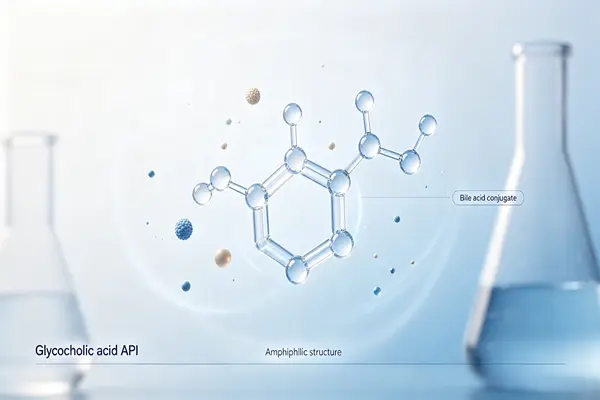
The rigidity of its molecular skeleton effectively slows down its own oxidative degradation. The tetracyclic sterane structure is less susceptible to attack by reactive free radicals. Compared to unsaturated fatty acid emulsifiers, Glycocholic acid API is less prone to oxidative degradation during long-term storage. Under proper sealed storage conditions, Glycocholic acid API can maintain its original molecular configuration for a long time without rapidly generating degradation impurities. This stable resistance to degradation reduces raw material loss, helps downstream production processes control costs, and is suitable for R&D units and manufacturing companies that require long-term storage of raw materials.
The amide bond in the side chain is the core structural site distinguishing Glycocholic acid API from free bile acids. This bond does not easily break through hydrolysis, only gradually decomposing under extreme acidic or alkaline conditions. Conventional biological culture and in vitro simulated digestion systems are insufficient to break this chemical bond, ensuring that Glycocholic acid API functions as a fully bound bile acid. If the amide bond breaks, the molecule transforms into free bile acid, altering its physicochemical properties and biological mechanism of action. Strict purification processes can remove hydrolysis products beforehand, avoiding such variables.
The spatial conformation directly determines the degree of lipid binding. Glycocholic acid API has a fixed stereoconfiguration, with hydroxyl groups forming a regular cavity structure, enabling precise encapsulation of lipid-soluble substances such as fatty acids and cholesterol. Artificially racemic bile acid derivatives have disordered cavity morphologies, significantly reducing the efficiency of lipid encapsulation. Standardized production yields Glycocholic acid API with a uniform stereoconfiguration and stable lipid encapsulation efficiency, allowing for reproducible observations in in vitro simulated lipid metabolism systems.
⚙️ Unique molecular conformation drives lipid metabolism regulation mechanism
After entering a liquid system, Glycocholic acid API spontaneously assembles into micelles due to its amphiphilic properties. Lipid-soluble cholesterol and triglyceride breakdown products can embed into the hydrophobic core of the micelles, achieving solubilization and dispersion of poorly soluble lipids. In aqueous solutions alone, lipids easily aggregate and precipitate, hindering transmembrane transport. The micelle carriers constructed with Glycocholic acid API can disperse small lipid molecules to the nanoscale, maintaining a uniform dispersion and ensuring the continuous advancement of lipid transport.
The cell membrane surface contains multiple transport recognition sites. Glycocholic acid API can reversibly bind to membrane surface proteins through its steroidal ring structure, facilitating the crossing of biological membrane barriers by lipids encapsulated within the micelles. Without the assistance of bile acid molecules, most neutral lipids struggle to penetrate the phospholipid bilayer autonomously, resulting in consistently low transport efficiency. Glycocholic acid API acts as a transport medium, opening channels for lipid molecule movement and maintaining the balance of lipid circulation within the organism.
Glycocholic acid APIs gently regulate lipid metabolism-related signaling processes. Upon contact with cells, their intact molecular structure gradually activates lipid metabolism-related signaling pathways, guiding cells to rationally absorb and utilize lipid precursors. Excessive exogenous lipids can easily lead to intracellular lipid accumulation and metabolic imbalance. Glycocholic acid APIs can assist cells in orderly lipid processing, preventing disordered lipid accumulation and maintaining intracellular lipid levels within a reasonable range.
In the intestinal environment, glycocholic acid APIs participate in the lipid digestion and dispersion process, promoting the thorough mixing of small lipid molecules after the breakdown of large fat molecules, increasing the probability of lipid capture by epithelial structures. In an environment lacking bound bile acids, lipid breakdown products tend to fuse together to form large lipid droplets, which are difficult to be fully absorbed and utilized. Glycocholic acid APIs continuously break down large lipid droplets into micro-dispersed units, continuously optimizing lipid absorption efficiency.
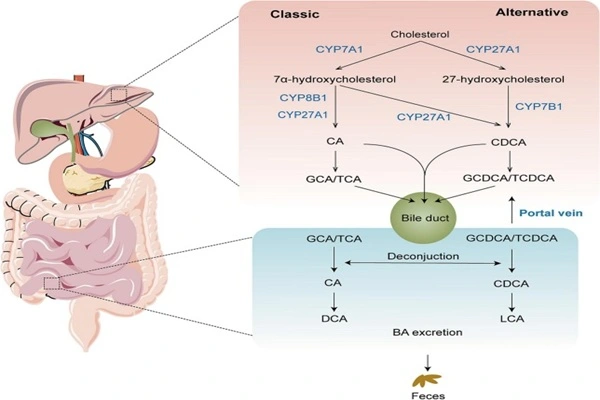
At the end of the metabolic cycle, glycocholic acid APIs can also participate in the regulation of cholesterol homeostasis, promoting the conversion and excretion of excess cholesterol and reducing abnormal cholesterol accumulation. Various sterol molecules have low solubility and are prone to depositing and forming aggregates. Glycocholic acid API improves cholesterol solubility by encapsulating it in micelles, which facilitates the smooth participation of excess sterols in circulation and excretion, thus maintaining overall lipid homeostasis.
🔬 Expanding application boundaries through diverse scenarios
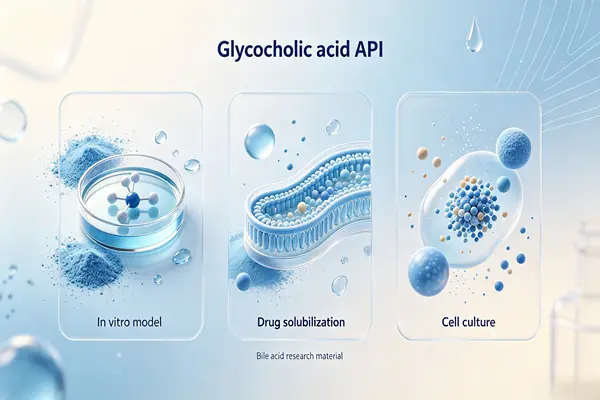
In vitro biomimicry systems are a core application of Glycocholic acid API. Researchers frequently use Glycocholic acid API to replicate the native intestinal bile acid environment when building in vitro intestinal lipid digestion models. Standardized Glycocholic acid API has low impurity levels, preventing the introduction of unknown active interfering substances and ensuring the entire simulation system closely resembles real physiological conditions, yielding stable and reliable data feedback. Many in vitro evaluation systems related to lipid absorption incorporate Glycocholic acid API as a basic formulation component.
In pharmaceutical excipients, Glycocholic acid API can be used as a solubilizing agent for poorly soluble drugs and to construct micellar delivery systems for lipid-soluble active molecules. Many small molecule drugs have extremely poor water solubility and low absorption and utilization rates after oral administration. Combining them with Glycocholic acid API to form mixed micelles can improve the solubility of active molecules and enhance drug transmembrane absorption. Delivery systems built using Glycocholic acid API exhibit good biocompatibility, are less likely to cause strong irritation, and are suitable for early formulation screening of oral formulations.
In the field of biochemical reagents, Glycocholic acid API is used to prepare various buffer solutions and cell culture reagents for establishing lipid metabolism-related cell culture environments. During long-term cell culture, a stable lipid supply environment is required. Adding standardized Glycocholic acid API can simulate the in vivo bile acid environment, allowing cells to maintain normal lipid metabolism rhythms, reducing the difference between the in vitro culture environment and the native in vivo environment, and optimizing cell growth.
The application of Glycocholic acid API can also be seen in the feed and nutrition research and development sector. Adding appropriate amounts of Glycocholic acid API can help improve the efficiency of animal bodies in utilizing dietary fat, reducing feed waste. Young animals have limited bile acid synthesis levels and weak fat digestion capabilities; reasonable supplementation with Glycocholic acid API can improve lipid digestion and absorption levels, supporting growth and development, making it an important raw material for the development of novel feed additives.
In the analytical chemistry industry, Glycocholic acid API can be used as a standard control raw material for the calibration of various bile acid detection methods. Natural biological samples contain various bile acid components. Chromatographic detection requires high-purity Glycocholic acid API standards for peak position comparison to quantitatively determine the amount of glycocholic acid in the sample. High-purity batches of Glycocholic acid API can continuously meet the standard procurement needs of testing laboratories.
📈 Process Iteration and Expansion: Development Direction of Glycocholic Acid API
Purification processes are continuously being upgraded, becoming a major development direction for Glycocholic acid API. Traditional extraction processes are prone to coexistence with various heterocholic acids. Optimization of multi-stage chromatography and continuous crystallization processes allows for efficient separation of isomer impurities, continuously increasing the purity of the final product. Higher purity Glycocholic acid API can meet the stringent requirements of early-stage drug development projects, opening up the high-end pharmaceutical raw material market and meeting the procurement standards of global pharmaceutical companies.
Targeted modification and derivatization are progressing steadily. Using Glycocholic acid API as a base, novel bile acid derivatives are synthesized by mildly modifying the hydroxyl sites. These modified derivatives can have their micellar assembly and targeted binding capabilities finely tuned, enabling the development of novel carrier molecules specifically for targeted delivery. Glycocholic acid API serves as a core starting material, supporting an entire pipeline for the development of bile acid derivatives and continuously producing novel functional molecules.
Green preparation routes are continuously being optimized. Traditional animal tissue extraction methods suffer from shortcomings such as fluctuating supply and significant batch-to-batch variations. Biosynthetic technologies are constantly being improved, with Glycocholic acid API being synthesized using microbial catalytic pathways. Novel synthetic routes can overcome the limitations of animal-derived raw material supply, stably and continuously producing target products, reducing the impact of batch fluctuations in raw materials, and simultaneously meeting the growing global demand for non-animal-derived raw materials.
The collaborative development of delivery systems continues to advance, with Glycocholic acid API being combined with polymeric carriers and liposomes to construct composite nanodelivery systems. The stability of single bile acid micelles is limited; composite systems can improve storage stability and extend the cycle time of active molecules. Developing composite carrier formulations around Glycocholic acid API is a popular approach in the research and development of orally poorly soluble drugs.
Quality control standards are being continuously refined, with a complete and comprehensive testing scheme established for Glycocholic acid API, detailing detection methods for various isomers and trace degradation products. With increasingly stringent entry barriers for pharmaceutical raw materials globally, a robust quality control scheme and complete testing data reports are fundamental requirements for entering overseas markets. Standardized and refined quality control models can help Glycocholic acid API establish overseas sales channels for biological reagents and active pharmaceutical ingredients.
Conclusion
The unique steroidal amphiphilic molecular structure endows Glycocholic acid API with the core capabilities of assembling micelles and mediating lipid transport. Leveraging its stable physicochemical properties and excellent biocompatibility, it covers numerous fields including in vitro model building, pharmaceutical excipients, and biochemical reagents. With the optimization of purification processes, the implementation of biosynthetic routes, and the continuous development of nanodelivery technologies, high-quality Glycocholic acid API will continue to provide stable raw material support for lipid metabolism-related R&D projects, constantly exploring new commercial application scenarios.
Xi'an Faithful BioTech Co., Ltd. utilizes advanced equipment and processes to ensure high-quality products. Our Glycocholic acid API meets international pharmaceutical standards. Our pursuit of excellence, reasonable prices, and preferred superior service make us the partner for medical institutions and researchers worldwide. If you require Glycocholic acid API research or production,Please contact us Click email: allen@faithfulbio.com Or WhatsApp: +86 13137770562.
References
- Alnouti, Y. (2020). Bile acid physiology and analytical methodology. Journal of Chromatography B, 1147, 122149.
- Hofmann, A. F. (2019). Bile acid micelles: Fundamental properties relevant to intestinal lipid absorption. Lipids, 54(8), 469–482.
- Monte, M. J., Marin, J. J., & Perez, M. J. (2021). Glycocholic acid in drug solubilization and oral delivery. European Journal of Pharmaceutical Sciences, 163, 105927.
- Russell, D. W. (2018). Biosynthesis and metabolism of bile acids. Physiological Reviews, 98(3), 1611–1648.
- Chen, L., & Wang, H. (2022). Application of conjugated bile acids in in vitro digestion models. Food Chemistry, 378, 132085.
- Axelson, M. (2020). Stereochemistry effects of bile acids on micelle formation. Journal of Colloid and Interface Science, 573, 312–321.
- Garcia-Calvo, C. (2019). Safety profile of glycocholic acid as pharmaceutical excipient. Regulatory Toxicology and Pharmacology, 107, 104412.