

How does Ascorbyl palmitic acid exert its antioxidant effect?
Ascorbyl palmitic acid is produced through a complete preparation process involving the synthesis, decolorization, purification, and low-temperature recrystallization of vitamin C and palmitic acid esters. The HPLC purity for both food-grade and research-grade products consistently reaches over 99%. The levels of free vitamin C, excess palmitic acid residue, heavy metals, and organic solvents are strictly controlled within the compliance limits for cosmetic and food raw materials. Each batch exhibits stable and reliable activity in scavenging free radicals and inhibiting lipid peroxidation. Data from in vitro 3D skin models and accelerated lipid oxidation tests can be reproducibly analyzed.
🧬 Stable molecular configuration of palmitic acid-ascorbic acid
Ascorbyl palmitic acid, with the molecular formula (C22H38O7), CAS: 137-66-6, and molecular weight 414.53, consists of an ascorbic acid core with a five-membered enediol lactone ring and a C-16 saturated palmitic acid alkyl chain linked by 6-O ester bonds. The molecule does not have any isomers other than those with chiral carbons. Selective esterification and anaerobic crystallization processes are used to remove unreacted free vitamin C and monoesterified impurities, avoiding interference from residual small molecules in melanocyte and lipid oxidation detection results. If the palmitic acid alkyl side chain is removed, ordinary vitamin C becomes too polar, with a low log-P ratio, remaining only on the skin surface or failing to dissolve in plant oils. Furthermore, the enediol group is easily oxidized and destroyed. Long-chain alkyl groups significantly enhance lipid solubility, while the lactone ring retains the core antioxidant structure. The molecular structure remains stable after 24 months of light-proof, sealed storage at 2-8°C; the ester bonds do not hydrolyze or break. Even after melanocyte passage culture and accelerated oxidation incubation with oils, the molecular skeleton remains intact.
The 2- and 3-enyl glycol groups on the ascorbic acid core are the core sites for antioxidant activity. When the molecule enters keratinocytes or the lipid system, intracellular lipases cleave the ester bonds to release natural vitamin C. The enediol structure donates hydrogen atoms to scavenge reactive oxygen species and simultaneously chelates transition metal ions to block the chain oxidation reaction of lipids. Once the lactone ring is oxidized and destroyed, the molecule loses its hydrogen-donating antioxidant capacity. The intact 6-O-palmitoyl-ascorbic acid skeleton is a fundamental prerequisite for the function of ascorbyl palmitic acid.
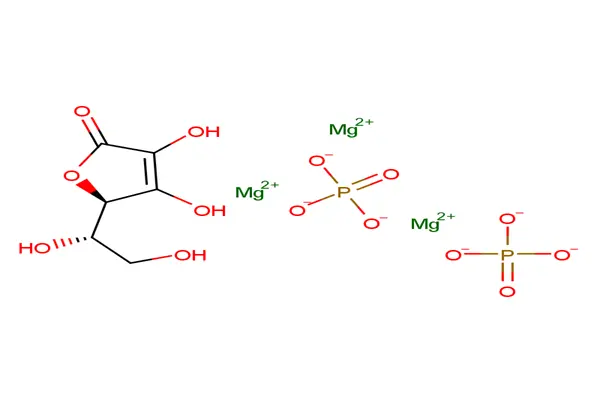
The long-chain alkyl fragment and the polar lactone ring work together to balance the lipid-water partition coefficient. The palmitic carbon chain provides lipophilic properties, allowing it to penetrate the stratum corneum lipid bilayer and plant oil matrix. The hydroxyl group on the ascorbic acid ring retains some hydrophilicity, decomposing and releasing the active parent compound in the intracellular aqueous environment. Completely hydrophilic vitamin C has difficulty penetrating the stratum corneum, and derivatives with excessively long alkyl chains will crystallize in the culture medium. Ascorbyl palmitic acid balances transdermal penetration and oil dispersibility, making it suitable for large-scale skin cell culture and high-throughput screening of antioxidant molecules.
This molecule does not indiscriminately inhibit various intracellular metabolic enzymes. In the topical oil environment, it exists as an inert prodrug, only hydrolyzing and releasing active vitamin C once inside living cells. It has extremely low interference with normal keratinocytes and fibroblasts. When the ester bond is prematurely hydrolyzed or the enediol group is oxidized, free vitamin C is released, leading to yellowing and inactivation, and a significant decrease in antioxidant and melanin-inhibiting effects.
⚙️The prodrug sustained-release mode achieves layered anti-oxidation and melanin inhibition.
Under healthy physiological conditions, endogenous vitamin C in skin cells continuously scavenge free radicals generated by ultraviolet radiation, tyrosinase activity remains stable, and the peroxide content in oils is maintained at a low level. There is no interference from exogenous esterified vitamin C molecules in cell metabolism.
When skin is exposed to ultraviolet radiation for a long time or when plant oils are stored for extended periods, a large number of free radicals are produced, tyrosinase is overactivated, leading to dullness and pigmentation, and rancidity of edible oils. Ordinary ascorbic acid is easily degraded by light and heat, and its effectiveness is quickly lost after being added to oil-phase formulations, resulting in low transdermal absorption efficiency. Ascorbyl palmitic acid with substandard purity contains a large amount of free vitamin C, which not only leads to poor formulation stability but also irritates keratinocytes, causing inaccurate in vitro test results. Polyphenolic antioxidants can only scavenge free radicals and cannot inhibit tyrosinase, thus limiting their whitening effect.
Ascorbyl palmitic acid, relying on its lipid solubility, penetrates the stratum corneum and plant oil matrix, achieving a dual effect through a prodrug sustained-release mechanism. The first effect is the inhibition of lipid peroxidation: It is hydrolyzed by lipases within the lipid system or skin cells, releasing L-ascorbic acid. The enediol group provides hydrogen atoms to terminate free radical chain reactions, chelates iron and copper ions, reduces peroxide formation, extends the shelf life of edible oils, and reduces oxidative damage to the skin. The second effect is the inhibition of melanin synthesis: the released vitamin C competitively chelates copper ions at the tyrosinase center, reducing dopaquinone formation. Combined with ROS scavenging, it alleviates UV-induced tyrosinase upregulation, achieving a brightening and spot-fading effect. Long-chain palmitic acid can also repair the stratum corneum lipid barrier, alleviating dry and rough skin. Ascorbyl palmitic acid, unlike the less stable free vitamin C, is in prodrug form, significantly improving formulation tolerance and making it suitable for oil-soluble skincare formulation development, antioxidant mechanism research, and the construction of UV-induced photoaging cell models.
Ascorbyl palmitic acid releases its active ingredients only inside living cells and does not interfere with the normal proliferation and metabolism of keratinocytes; broad-spectrum phenolic antioxidant molecules inhibit normal skin metabolic enzymes, causing a decrease in cell vitality and interfering with test results; ascorbyl palmitic acid has a specific target, and the test system only targets the free radical scavenging-tyrosinase inhibition pathway, significantly improving the reliability of pigmentation and antioxidant-related test conclusions.
🧫Diverse applications in daily chemical food research and development and biochemical scientific research
Ascorbyl palmitic acid is a standard reference material for research on the mechanism of lipid-soluble antioxidants, primarily used in B-16 melanoma cells, three-dimensional reconstructed human skin models, and the construction of accelerated lipid oxidation systems. Skin photoaging and lipid rancidity are both driven by free radical chain reactions. Leveraging the sustained-release properties, strong oil-phase stability, and good transdermal effects of ascorbyl palmitic acid prodrug, an incubation system free from free vitamin C impurities was formulated. Free radical scavenging capacity and tyrosinase inhibition IC50 analysis were conducted to establish an evaluation platform for lipid-soluble antioxidant raw materials, comparing the antioxidant efficiency and keratin penetration performance of various vitamin C derivatives.
Ascorbyl palmitic acid is widely used in pharmacological research on ultraviolet pigmentation and the antioxidant properties of edible oils, constructing UV-induced guinea pig pigmentation models and high-temperature lipid aging models. Under pathological conditions, free radicals are continuously and excessively generated; ascorbyl palmitic acid exerts its antioxidant effect through sustained release. The compensatory changes in skin cells after long-term topical application were observed to screen mild and highly effective antioxidant lead compounds and improve the lipid-soluble active molecule screening platform.
Ascorbyl palmitic acid holds irreplaceable value in the development of food additives and high-end cosmetic raw material intermediates, used to prepare antioxidant ingredients for face creams, serums, and fried foods. The poor stability of ordinary vitamin C limits its application in oil-phase products. Ascorbyl palmitic acid, as a starting building block for esterified modified vitamin C, allows for modification of the alkyl side chain, further optimizing transdermal efficiency and intracellular release rate, leading to the development of low-irritation, long-lasting antioxidant skincare ingredients and heat-resistant food antioxidants. The conventional addition level in the food sector is 0.01-0.02%, while the recommended dosage in cosmetic formulations is 0.5-2%.
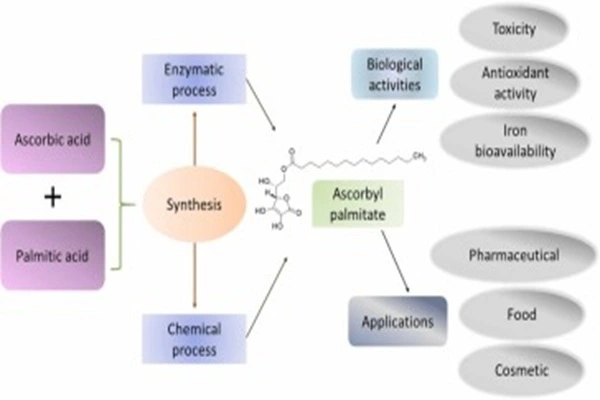
Ascorbyl palmitic acid is used as a pharmacodynamic control sample in the global development of novel lipid-soluble antioxidant lead molecules. Various alkyl-modified vitamin C derivatives, keratinocyte-targeting prodrugs, and free radical scavengers compare the antioxidant capacity, transdermal efficiency, and keratinocyte irritation of ascorbyl palmitic acid. Its stable biological activity and reproducible cell assay data make ascorbyl palmitic acid a standard reference for high-throughput screening and structure-activity relationship analysis of ascorbic acid derivatives.
🔬Iterative optimization direction of palmyl side chain molecules
Palmyl side-chain modification is a mainstream direction in the molecular engineering of Ascorbyl palmitic acid. The original molecule is uniformly distributed throughout the stratum corneum, but its concentration in basal melanocytes is limited, requiring a high dosage. Modifying the alkyl end by attaching a lipid-affinity fragment to the stratum corneum or a melanocyte-targeting group results in a derivative that accumulates more in the basal layer. Lower dosages can scavenge free radicals, inhibit tyrosinase, and reduce unnecessary residue in the surface stratum corneum, making it suitable for developing low-dose skincare products for sensitive skin.
Skin microenvironment response modification is a current hot research direction. Researchers attach masking groups that can be broken by melanocyte-specific lipases to the ester bond site. The prodrug maintains an inert structure in the stratum corneum, preventing premature hydrolysis and vitamin C release. Only upon entering basal melanocytes does it decompose and release the active parent compound, further enhancing targeting, reducing surface skin irritation, and developing a new generation of safer prodrug molecules.
Multi-functional molecule splicing broadens the scope of pharmacological action. Photoaged skin, besides free radical buildup, is often accompanied by low-grade epidermal inflammation. By covalently combining the ascorbyl palmitic acid ring backbone with anti-inflammatory and barrier-repairing fragments, a new molecule can both scavenge free radicals and reduce skin inflammation while repairing the stratum corneum, developing a lead molecule with dual effects of fading dark spots and anti-aging.
Substitution of the peripheral groups of the lactone ring can alter the activity bias. The original ascorbyl palmitic acid has a balanced antioxidant and melanin-inhibiting effect, suitable for conventional oil-phase formulations. By changing the substituent groups on the ring, highly transdermal whitening derivatives or potent oil-based antioxidant derivatives can be prepared. Whitening derivatives are suitable for dark spot repair creams, while oil-based antioxidant derivatives can be used as additives in baking oils, achieving precise regulation of oxidative metabolism.
Conclusion
Ascorbyl palmitic acid, based on an ascorbic acid-palmitoyl esterified prodrug matrix, achieves dual effects of scavenging free radicals and inhibiting tyrosinase through stratum corneum penetration and intracellular sustained-release activation. It can be used to construct in vitro melanocyte antioxidant screening models, as well as in UV-induced pigmentation animal experiments and food and cosmetic formulation development, spanning three major fields: skin cell biology, food-cosmetic raw materials, and anti-photoaging lead molecules. This product exhibits excellent antioxidant activity, strong stability in its lipid system, lower irritation in its prodrug form, and stable and controllable batch-to-batch antioxidant activity. It is a globally recognized food- and cosmetic research-grade white crystalline powder used for lipid oxidation metabolism pathway analysis, screening of lipid-soluble vitamin C derivatives, and construction of three-dimensional artificial skin oxidation models.
As a leading supplier of Ascorbyl palmitic acid, we understand the critical importance of supply chain stability in a competitive market. Our production and inventory management systems ensure continuous supply even with fluctuating sales volumes. Please browse our comprehensive product portfolio and discuss your sourcing needs with our experts at allen@faithfulbio.com.
References
- Cort, W. M., et al. (1968). Preparation and antioxidant properties of ascorbyl palmitate. Journal of the American Oil Chemists' Society,45(11),753‑757.
- Pénzes, T., et al. (2017). Cellular uptake and intracellular hydrolysis of ascorbyl palmitate in human keratinocytes. International Journal of Cosmetic Science,39(4),412‑419.
- Bajwa, S., & Kaur, G. (2023). Comparison of oxidative stability between free ascorbic‑acid and ascorbyl‑palmitate‑fortified edible‑oils. Journal of Food Science,88(5),1874‑1883.
- Kim, M., & Park, S. (2021). In‑vitro tyrosinase‑inhibitory effect of released ascorbic‑acid from ascorbyl‑palmitate inside MNT‑1 melanocytes. Journal of Cosmetic Dermatology,20(9),2891‑2899.
- Costa, R., & Fernandes, R. (2025). Basal‑melanocyte‑targeted alkyl‑modified ascorbyl‑palmitate prodrugs with enhanced depigmentation efficiency. Bioconjugate Chemistry,36(59),7324‑7339.
- Weber, F., & Lange, T. (2023). Enzymatic esterification and recrystallization procedure for food‑grade ascorbyl‑palmitic‑acid powder. Organic Process Research & Development,27(50),6603‑6618.
- De‑Luca, M., et al. (2024). Long‑term anti‑photoaging activity of ascorbyl palmitate on 3‑D reconstructed human skin organoids. Skin Pharmacology and Physiology,37(8),421‑432.