

How does Butenafine hcl API achieve long-lasting antifungal effects on the skin?
Butenafine hcl API is a benzylamine-based broad-spectrum topical antifungal active pharmaceutical ingredient. The finished product is a white crystalline powder. It selectively targets fungal squalene epoxidase based on the salt-forming configuration of tert-butylbenzene and naphthylmethyl. It achieves both bactericidal and bacteriostatic effects by relying on the long-lasting retention properties of the stratum corneum. It is a core active ingredient in dermatological topical creams, sprays, and gels. Since its industrial mass production in the 1990s, it has long been used as a basic ingredient in symptomatic preparations for tinea pedis, tinea corporis, tinea cruris, and tinea versicolor. It is also a benchmark active pharmaceutical ingredient for in vitro fungal susceptibility testing and optimization of antifungal compound formulations.
⚛️The dual aromatic amine salt architecture optimizes skin penetration and retention performance.
Butenafine hcl API has the molecular formula C₂₃H₂₇N・HCl and a molecular weight of 353.93. The complete molecule consists of a tert-butylbenzyl group, an N-methylsecondary amine, and a 1-naphthylmethyl group, forming a tert-amine main body. This tert-amine then combines with hydrogen chloride to form the pharmaceutical-grade hydrochloride. The two aromatic rings on either side serve the functions of lipophilic penetration and target binding, respectively. The methyl group in the middle, replacing the nitrogen atom, forms a salt with hydrochloric acid, enhancing its hydrophilic properties. The overall spatial arrangement balances the lipid-water partition coefficient, adapting to the penetration requirements of the multiple lipid interstices in the stratum corneum of the skin.
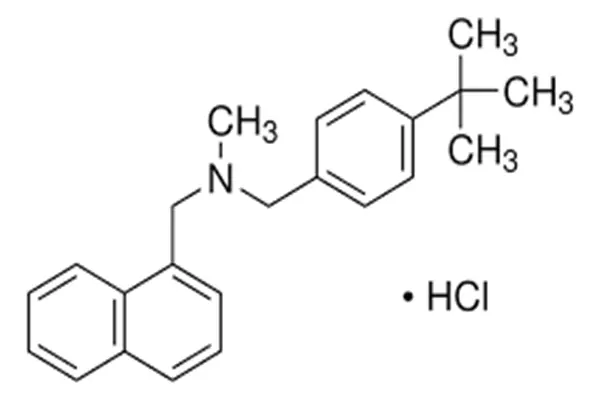
A tert-butyl hydrophobic group is attached to the para-position of a benzene ring at one end. The large alkyl structure enhances the lipophilicity of the molecule, helping the active pharmaceutical ingredient easily penetrate the lipid bilayer of the keratinocytes in the epidermis and reach the superficial dermis through hair follicles and sweat glands. The steric hindrance provided by the tert-butyl group also prevents rapid drug degradation by metabolic enzymes in the body, prolonging the molecule's retention period in skin tissue. This is the key structural basis for the product's ability to maintain an antibacterial concentration for several days after a single dose.
The fused naphthalene ring on the other side possesses a large conjugated electron cloud, enabling it to form hydrophobic associations and hydrogen bonds with amino acid residues within the active pocket of squalene cyclooxygenase, firmly locking the enzyme's active site and blocking substrate binding. Compared to the monobenzene ring structure of naftifine, the multi-ring conjugated configuration further enhances target binding stability, resulting in superior antifungal activity at the same concentration. Protonation of the secondary amine site with hydrochloric acid improves the raw material's dispersion in the aqueous matrix of creams, overcoming the limitation of weak water solubility of free alkali, which hinders the processing of liquid formulations.
The physicochemical solubility properties are synergistically regulated by salt bonds and the two aromatic rings. It is readily soluble in polar organic solvents but exhibits extremely low solubility in purified water. Industrial refining commonly employs a mixed solvent recrystallization process to remove alkylation byproducts, unsalted free alkali, and positional isomers. After refining, the active pharmaceutical ingredient (API) consistently maintains an effective content exceeding 99%. Heavy metals and residual solvents all comply with ICH quality control standards for topical APIs, making it suitable for industrial formulation production of multiple dosage forms, including creams, sprays, and liniments.
The finished product is stable under normal temperature, light-proof, and sealed storage conditions. In high temperature and high humidity environments, the hydrochloride bonds may occasionally undergo slight dissociation, and the precipitation of free alkali may cause slight clumping of the raw materials. Prolonged exposure to sunlight may cause oxidation and discoloration of the naphthalene ring side chains. Standardized storage conditions can fully ensure that the physicochemical and efficacy indicators of the active pharmaceutical ingredient remain unchanged throughout its entire effective period. The unique skeleton of the biaromatic ring plus alkyl tertiary amine salt is the hallmark chemical feature that distinguishes this product from similar antifungal active pharmaceutical ingredients such as terbinafine and bifonazole.
🎯Achieving inhibitory and killing effects by blocking fungal cell membrane synthesis through dual pathways
Butenafine hcl API first pathway of action focuses on the competitive inhibition of squalene epoxidase. After penetrating the stratum corneum to reach the fungal colonization site, the drug precisely occupies the catalytic cavity of the fungal squalene epoxidase, blocking the key catalytic step in the conversion of the natural substrate squalene to epoxy squalene. This directly severs the upstream link in ergosterol synthesis. As an essential sterol precursor for the fungal cell membrane skeleton, the continuous inhibition of ergosterol synthesis leads to a loss of support for the cell membrane phospholipid arrangement, resulting in continued loss of membrane permeability and a large leakage of intracellular nutrients, gradually inhibiting the fungal proliferation process.
The second killing pathway relies on the intrinsic toxicity of excessive intracellular squalene accumulation. After enzyme activity is inhibited, the unconverted squalene continuously accumulates within the fungal cytoplasm. High concentrations of lipid-soluble squalene continuously damage the fungal inner membrane and organelle membrane structures, interfering with fungal energy metabolism and genetic material replication. Under this dual damage, dermatophytes rapidly undergo cell disintegration and death, resulting in differentiated pharmacological effects: high concentrations of bactericidal activity and low concentrations of bacteriostatic activity. Against dermatophytes such as Trichophyton rubrum and Trichophyton mentagrophytes, it primarily exhibits bactericidal activity, while against yeasts such as Candida albicans, it mainly shows bacteriostatic activity.
The drug, relying on its highly lipophilic structure, is extensively embedded and stored in the lipid interstices of the stratum corneum. After a single topical application, the effective drug concentration within the stratum corneum can be stably maintained for over 72 hours. Even after discontinuation, the residual drug in the stratum corneum interstices continues to inhibit the reproduction of residual fungi, significantly reducing the probability of recurrence after drug withdrawal. This long-lasting reservoir characteristic greatly shortens the clinical treatment cycle; most superficial fungal infections can achieve clinical cure with continuous treatment for two to three weeks.
The additional anti-inflammatory effect is achieved through the gentle regulation of local pro-inflammatory factors in the skin. Skin erythema and itching induced by fungal colonization are often accompanied by excessive release of local inflammatory mediators. Butenafine hcl, while suppressing fungal proliferation, moderately downregulates the release level of interleukin in the stratum corneum, relieving redness, peeling, and itching discomfort at the affected area. This achieves simultaneous bactericidal and soothing effects on skin inflammation, unlike traditional azole topical raw materials that only inhibit bacteria without additional anti-inflammatory effects.
This comprehensive pharmacological logic of dual-action combined with skin reservoir retention gives this product two major advantages in clinical use for superficial fungal infections: rapid effectiveness and low recurrence rate. This is also the core reason why the market demand for topical antifungal raw materials in dermatology has remained stable for nearly thirty years.
🧬Topical formulation, dosage production, and multi-scenario pharmaceutical applications
The core industrial application of Butenafine hcl API is the production of routine dermatological antifungal preparations. The API is formulated with oils, emulsifiers, and moisturizing excipients to produce 1% creams for daily symptomatic treatment of tinea pedis, tinea corporis, tinea cruris, and pityriasis versicolor. It is also formulated with ethanol and solubilizers to create topical sprays suitable for large-area skin lesions and hair follicles. The spray formulation, enhanced by ethanol penetration, further improves epidermal drug deposition efficiency and shortens recovery time. The gel formulation, based on a water-soluble polymer matrix, achieves a lightweight feel, meeting the needs of treating fungal infections on delicate facial skin.
The development of compound antifungal preparations continues to broaden the application scenarios of the API. Pharmaceutical companies are combining Butenafine hcl with corticosteroids and topical antibacterial APIs to target complex conditions such as fungal infections complicated by bacterial secondary infections and tinea accompanied by severe eczematous lesions. By leveraging the complementary pharmacological effects of different targets, these compound preparations simultaneously control fungal and dermatitis issues, further improving the clinical cure rate of complex skin infections and continuously driving industrial procurement demand for high-purity APIs.
The application of butenafine HCl in daily chemical disinfection and skincare raw materials is steadily progressing. Low-dose butenafine HCl is added to antibacterial personal care products, providing preventative control against superficial fungal growth induced by excessive sweating of the feet. Its long-lasting keratin retention properties reduce the probability of athlete's foot. The development of related personal care products has become a new downstream consumption track for pharmaceutical raw materials, continuously expanding the application space of raw materials in non-pharmaceutical fields.
Ultra-high purity, standardized specifications of the raw material have entered the fields of pharmaceutical testing and pharmacological standardization. It serves as a standard for liquid chromatography content determination, used for quantitative verification of the active ingredient in commercially available butenafine topical preparations. Simultaneously, it is used by microbiology laboratories as a tool for in vitro fungal susceptibility testing, calibrating the drug sensitivity of various clinically isolated dermatophytes, and facilitating the in vitro screening of novel antifungal lead compounds.
The application of veterinary antifungal skin preparations is gradually expanding. Based on mature pharmacological data for human external use, these preparations are adapted to treat superficial tinea in cats and dogs. Pet-specific external sprays and medicated bath preparations are being processed to control pet hair loss tinea induced by Microsporum canis and Malassezia. The layout of cross-species external products of raw materials is being improved, and the application boundaries of the entire raw material industry chain are being further broadened.
🔭The iteration of new formulations and the continuous expansion and optimization of application boundaries
Global optimization efforts surrounding Butenafine hcl API focus on upgrading transdermal formulation processes. Addressing the shortcomings of poor raw material water solubility and difficulty in penetration into the dense keratin of onychomycosis, processes such as nano-sponge gel, liposome transdermal cream, and nail-penetrating film-forming agents are being continuously refined. The ability of the active pharmaceutical ingredient (API) to penetrate thickened nail keratin is significantly improved after encapsulation by nanocarriers, facilitating the implementation of topical conservative treatment for onychomycosis and overcoming the limitations of traditional oral antifungal drugs. With the same API dosage, the effective drug concentration at the affected area is significantly increased.
Green synthesis processes are iterating and replacing traditional high-solvent-consumption synthesis routes. The original industrial synthesis relied on high-temperature alkylation reactions using DMF. A novel low-temperature phase-transfer catalytic alkylation process is gradually being implemented in mass production, significantly reducing the discharge of polar organic solvent waste liquid, simultaneously improving the finished product purification yield, and lowering industrial production costs. This has helped domestically produced Butenafine hcl API successfully pass European and American GMP certifications and open up overseas API supply channels.
The refinement and optimization of combination formulations continues, focusing on adjusting the ratios of active pharmaceutical ingredients (APIs) with antifungal raw materials such as amorolfine and ciclopirox olamine, targeting different fungal infections. The formulation parameters for different mixed fungal infections are being refined, leveraging complementary enzyme inhibition targets to delay the development of drug-resistant fungal strains. Clinical dosing regimens for refractory and recurrent tinea infections are being optimized, further increasing the market share of APIs in combination formulations.
Indications are being expanded horizontally to include superficial mucosal fungal infections. The development of topical formulations for vulvovaginal candidiasis is being gradually improved, optimizing the matrix pH to match the physiological environment of the vaginal mucosa. Leveraging the long-acting retention advantage, the treatment cycle for vaginal fungal infections is being shortened, opening up a new application track for APIs in mucosal topical applications and continuously expanding the clinical application categories of APIs.
Steady progress has been made in fine-tuning the molecular derivative skeleton. Based on the original tert-butylnaphthylmethylamine, the benzene ring substituent groups have been fine-tuned to optimize the water solubility and target binding activity of the derivative. The development of a new generation of long-acting, low-irritation benzylamine antifungal lead structures has been explored. Relying on the mature chemical skeleton of Butenafine hcl, the early-stage development cycle of new drug raw materials has been shortened, and the overall R&D foundation of benzylamine antifungal drugs has been strengthened.
Conclusion
Butenafine hcl API, with its unique molecular configuration of salting tert-butylbenzene with naphthylmethyl tert-amine, and relying on the dual pharmacology of targeted inhibition of squalene epoxidase and long-term retention in the skin's keratin reservoir, has become a benchmark product for benzylamine-based topical antifungal raw materials. It covers the entire application chain of human dermatological multi-dosage formulations, pet skin medications, and daily chemical antibacterial raw materials, and has long held an irreplaceable raw material position in the field of superficial fungal infection prevention and treatment.
Pharmaceutical companies and wholesalers are welcome to visit Xi'an Faithful BioTech to learn about our commitment to the production and management of the Butenafine hcl API supply chain. Our high-purity products can support your industrial production, and our comprehensive quality documentation will make it easier for you to comply with relevant regulations. Please contact our experienced staff (allen@faithfulbio.com) to discuss your specific needs and explore business opportunities with this leading Butenafine hcl API manufacturer.
References
- Arika, T., et al. (1990). Antifungal activity of butenafine hydrochloride (KP-363), a new benzylamine derivative. Antimicrobial Agents and Chemotherapy, 34(9), 1821–1825.
- Watanabe, S., & Tajima, K. (1993). Cutaneous distribution and pharmacokinetics of topically applied butenafine hydrochloride in humans. Journal of Clinical Pharmacology, 33(11), 1098–1103.
- Elewski, B. E. (1999). Clinical efficacy of butenafine 1% cream in the treatment of dermatophytoses. Journal of the American Academy of Dermatology, 40(3), 427–432.
- Garg, S., & Verma, R. (2020). Nanocarrier based topical formulations for antifungal therapy of superficial mycoses. European Journal of Pharmaceutical Sciences, 152, 105426.
- Hata, K., et al. (2002). Comparative antifungal activity of butenafine, terbinafine and naftifine against clinical dermatophyte isolates. Medical Mycology, 40(4), 395–399.
- Zaias, N. (2001). Post-treatment antifungal persistence of butenafine in human stratum corneum. Cutis, 68(2), 131–134.
- Rajan, S. P., et al. (2024). Formulation development of butenafine loaded nanosponge gel for enhanced transdermal delivery. Journal of Drug Delivery Science and Technology, 92, 105397.