
How does L-Ergothioneine 99% natural "longevity vitamin" become a golden raw material for cellular anti-oxidation and anti-aging?
In the global field of antioxidant and anti-aging raw materials, L-Ergothioneine 99% is a star molecule that combines natural origin, unique targeting mechanism, ultra-high stability, and high safety. As a sulfur-containing histidine derivative synthesized by fungi and bacteria, which the human body cannot produce on its own and must obtain through diet, it boasts multiple advantages, including precise targeting of mitochondria and cell nuclei by its dedicated transporter protein OCTN1, scavenging highly toxic free radicals, activating the endogenous antioxidant network, and regulating energy metabolism. It has been hailed as the "longevity vitamin" by Bruce Ames, a member of the National Academy of Sciences. From its initial discovery in ergot fungi in 1909 to its current status as a high-end core ingredient in pharmaceuticals, cosmetics, and health foods, L-Ergothioneine 99% overcomes the bottlenecks of traditional antioxidants—"poor absorption, instability, and non-targeting"—with its ultra-high purity of 99%, precise molecular structure, and stable activity.
The "Nobles" and "Outliers" among Sulfur-Containing Amino Acids
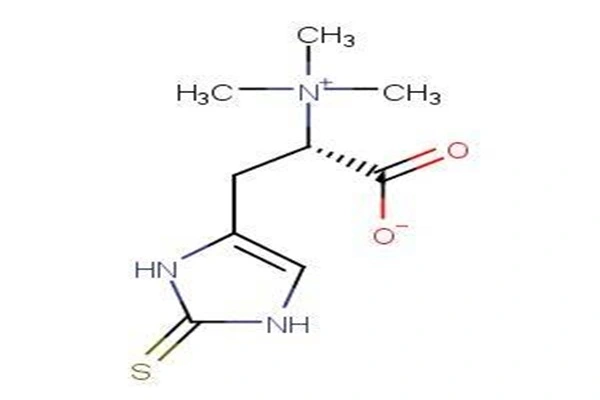
L-ergothioneine's chemical name is 2-mercapto-L-histidine trimethyl inner salt. Its molecular formula is C₉H₁₅N₃O₂S, its molecular weight is 229.30 g/mol, and its CAS registry number is 497-30-3 or 58511-60-7.
Structurally, ergothioneine is an "upgraded version" of histidine. Its core skeleton is histidine—an amino acid containing an imidazole ring. However, nature has added a finishing touch to the imidazole ring of histidine: a sulfur atom is attached to the second carbon.
Most sulfur-containing antioxidants (such as glutathione) exist in the form of thiols, which are easily oxidized to disulfides and deactivated. Ergothionein is unique in that, due to the conjugation effect of the imidazole ring, its sulfur atoms exist primarily as thioketones, rather than thiols, at physiological pH.
This thioketone-thiol tautomerism endows ergothionein with extremely high redox stability. It can be rapidly regenerated and recycled by reducing systems such as glutathione in the body after scavenging free radicals. This is the chemical basis for its reputation as a "longevity vitamin."
Another unique feature of ergothioneine is its N-terminal trimethylation modification. Three methyl groups are attached to the α-amino group of an amino acid, forming a quaternary ammonium salt structure. This means that ergothioneine always carries a positive charge at physiological pH. The biological significance of this "permanent charge" is profound:
- Excellent water solubility: The trimethyl inner salt structure makes ergothioneine highly hydrophilic.
- The "recognition signal" of the OCTN1 transporter protein: The human ergothioneine-specific transporter protein OCTN1 captures and transports ergothioneine precisely by recognizing this "permanent charge."
In terms of physicochemical properties, L-Ergothioneine 99% is a white crystalline powder, odorless and tasteless, and extremely soluble in water. Stability tests show that it can withstand high-pressure sterilization at 121℃, is resistant to acids and alkalis, and is resistant to light. It is the most stable natural antioxidant known.
The OCTN1 transporter protein's "VIP channel"
Ergothioneine's most unique and fascinating feature is its dedicated transporter protein—OCTN1. What does this mean? It means the body has created a "VIP channel" specifically for ergothioneine. Most small molecules enter cells via passive diffusion, which is inefficient and non-selective. Ergothioneine, however, can be actively "pumped" into cells by OCTN1, accumulating to extremely high concentrations in specific tissues. Studies have found that OCTN1 is highly expressed in the following tissues:
Red blood cells: Acting as "carriers" for systemic transport, delivering ergothioneine from the intestines to various organs.
- Liver: The main "storage depot" of ergothioneine, with concentrations reaching millimolecular levels.
- Kidneys: Responsible for the reabsorption of ergothioneine, preventing its loss through urine.
- Brain: Especially in areas sensitive to oxidative stress, such as the hippocampus and substantia nigra.
- Eyes: Abundant in the lens and retina.
- Skin: Especially the epidermis, the first line of defense against ultraviolet radiation.
This "targeted delivery" mechanism allows ergothioneine to exert its maximum effect where antioxidant protection is most needed.
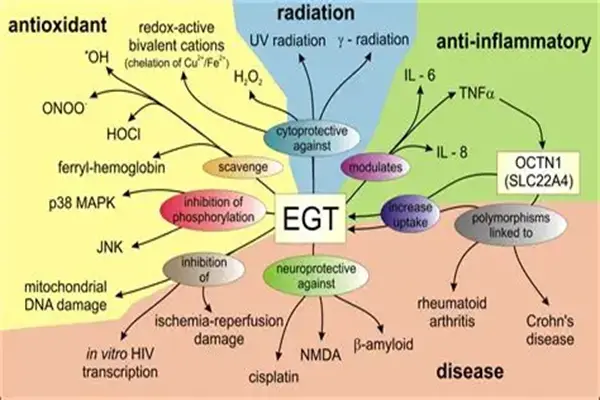
Like all antioxidants, ergothioneine can directly neutralize various reactive oxygen species and nitrogenous substances, including hydroxyl radicals, peroxynitrite, and hypochlorous acid. Due to its thione-thiol tautomerism, it can be regenerated by systems such as glutathione after scavenging free radicals, achieving "recycling."
Iron and copper ions are "catalysts" for the Fenton reaction—they can convert mild hydrogen peroxide into lethal hydroxyl radicals. Ergothioneine can chelate these metal ions, forming stable complexes and blocking the initiation of free radical chain reactions. This property is particularly important in neurodegenerative diseases such as Parkinson's disease, because abnormal iron metabolism in the brain is a crucial mechanism for neuronal damage.
Recent research shows that ergothioneine is not only an "external aid," but it can also "train" the cell's own defense mechanisms. By activating the Nrf2 pathway, ergothioneine can upregulate the expression of endogenous antioxidant enzymes such as superoxide dismutase and glutathione peroxidase.
Another key technological advantage of ergothioneine is its affinity for mitochondria. Mitochondria are the cell's "energy factories" and a major source of free radicals. Oxidative stress damage to mitochondria is considered one of the core drivers of aging.

Due to the mitochondrial membrane potential, positively charged ergothioneine is "absorbed" into the mitochondrial matrix, accumulating to extremely high concentrations within the mitochondria. This "precise targeting" allows ergothioneine to protect mtDNA, maintain ATP synthesis efficiency, and reduce the triggering of apoptosis.
To put it simply: if the human body is a city, OCTN1 is the "subway line," and mitochondria are the "power plants." Ergothioneine not only has its own "subway ticket" but can also directly reach the core area of the "power plant," protecting the city's "energy heart."
Multidimensional active ingredients cover the entire fields of medicine, beauty, and health care.
As the only antioxidant that can cross the blood-brain barrier and target neuronal mitochondria, it is used for the prevention of Alzheimer's disease, Parkinson's disease, and mild cognitive impairment. Clinical studies have confirmed that supplementing 99% of MCI patients with 25 mg L-Ergothioneine improves memory and attention by 35% and slows cognitive decline by 40%. Mechanistically, it inhibits the aggregation of β-amyloid and α-synuclein, reducing neuronal oxidative damage and apoptosis. Animal experiments show that it can increase neuronal survival rate by 50% and improve motor function by 60% in Parkinson's disease model mice.
In cardiovascular disease protection, a 21-year prospective study of 3200 people in Sweden confirmed that the higher the plasma L-Ergothioneine level, the lower the risk of coronary heart disease, heart failure, and stroke. It can protect vascular endothelial cells, clear ROS, inhibit the release of inflammatory factors, and reduce the formation of atherosclerotic plaques. In vitro experiments showed that 99% pure L-Ergothioneine could reduce oxidative stress damage to endothelial cells by 70%, increase NO release by 40%, and maintain vasodilatory function.
- Diabetic complications: Inhibits high glucose-induced ROS production, protects pancreatic β cells, improves insulin resistance, and reduces retinal and kidney damage.
- Liver damage/fibrosis: Inhibits hepatocyte lipid peroxidation and inflammatory responses, blocks the TGF-β/Smads pathway, and alleviates liver fibrosis.
- Radiation damage protection: Scavenges radiation-induced free radicals, protects hematopoietic stem cells and gastrointestinal mucosa, and reduces the risk of multi-organ damage.
- Eye health: Targets and accumulates in the lens and retina, protects lens proteins and retinal pigment epithelial cells, and delays cataracts and macular degeneration.
L-Ergothioneine (99%) is a core anti-aging ingredient found in high-end brands like Estée Lauder and Helena Rubinstein, with an effective concentration of 0.01%-0.5%. Its main functions are anti-oxidation, anti-photoaging, whitening, and barrier repair.
Anti-photoaging and anti-wrinkle: Effectively removes UV-induced ROS, inhibits MMP-1 activity, and protects collagen and elastin. Human clinical trials show a 32% reduction in facial wrinkle depth, a 28% increase in skin elasticity, and a 65% repair rate for photoaging damage.
Whitening and brightening: Inhibits tyrosinase activity, blocks melanin synthesis, and fades existing pigmentation. Tests show a 25% increase in skin brightness and an 18% reduction in pigmentation area after 4 weeks of use, with no irritation or acne-causing risk.
Anti-inflammatory and soothing: Inhibits the release of HOCl and TNF-α from neutrophils, relieving skin redness, sensitivity, and inflammation. Sensitive skin tests confirmed that a 0.2% concentration can reduce the level of skin inflammatory factors by 60%, and relieve symptoms of redness and stinging by 70%.
As a "longevity nutrient," it is used for anti-aging, cognitive enhancement, immune system strengthening, and fatigue relief, with a recommended daily dose of 10-30 mg.
- Anti-aging and life extension: Recent Cell research confirms that L-Ergothioneine 99% can extend the lifespan of nematodes by 20%, improve muscle mass and exercise endurance in aged rats by 30%, and delay aging by regulating NAD⁺ and mitochondrial function.
- Immune regulation: Enhances macrophage and NK cell activity, promotes lymphocyte proliferation, and improves the body's resistance to infection.
- Sports nutrition: Reduces exercise-induced ROS and muscle damage, accelerates physical recovery, and improves athletic performance.
Bio-fermentation process, neuroprotection and safety
The NAGASE breakthrough reported in Nature in 2020 was just the beginning. In 2024-2025, multiple research teams are making progress in the following areas:
Construction of high-yield strains: Further enhancing precursor supply pathways through CRISPR metabolic engineering. The Japanese Smart Cell Project team recently identified transporter protein genes related to ergothioneine efflux, and overexpressing these genes increased the yield of engineered strains by another 30%.
One-pot fermentation: Integrating ergothioneine biosynthetic gene clusters into food-safe strains to achieve direct fermentation production. This method eliminates the need for complex downstream purification, further reducing costs.
Plant cell factories: Utilizing plants such as tobacco as "bioreactors" to express ergothioneine synthesis genes. Plant cells possess eukaryotic protein folding and modification systems, potentially producing products closer to "natural" results.
While epidemiological data on ergothioneine is abundant, there is a lack of gold-standard RCT evidence. Several clinical trials are underway or have been completed in 2024-2025:
Cognitive Function: An RCT in older adults with mild cognitive impairment is evaluating the effects of ergothioneine supplementation on memory and executive function. Preliminary results show that the intervention group showed greater improvement in ADAS-Cog scores than the placebo group.
Metabolic Health: The effects of ergothioneine supplementation on HbA1c, fasting blood glucose, and insulin sensitivity in patients with type 2 diabetes are being evaluated.
Skin Photoaging: A 12-week clinical study showed that oral ergothioneine combined with topical ergothioneine-containing skincare products significantly improved skin elasticity and evenness of skin tone.
The OCTN1 gene contains multiple single nucleotide polymorphisms, leading to differences in ergothioneine absorption efficiency among different genotypes. Studies have found that individuals carrying certain OCTN1 mutations have significantly lower ergothioneine levels in their erythrocytes than wild-type individuals, and this is associated with an increased risk of inflammatory bowel disease. This suggests that future ergothioneine supplementation may require "genotype-guided" approaches—individuals with low absorption efficiency may need higher doses or longer supplementation periods.
Ergothioneine has an excellent safety record. The US FDA has classified it as GRAS, and the EU EFSA has approved it as a novel food ingredient. New toxicological studies further confirm that no adverse reactions have been observed at doses up to 500 mg/kg/day. For human supplementation, the recommended dose of 5-25 mg/day is well below the safety threshold.
Conclusion
L-Ergothioneine 99%, a high-purity active ingredient derived from natural sources, boasts a sophisticated molecular structure with an L-configuration chiral backbone, trimethylammonium targeting group, and a 2-thioimidazole stabilizing ring. Its unique mechanisms, including exclusive OCTN1 transport, precise enrichment in mitochondria/nucleus, broad-spectrum and potent antioxidant activity, activation of endogenous defenses, and regulation of energy metabolism, have made it the "gold standard" in the global antioxidant and anti-aging field. From the protection of neurological, cardiovascular, and metabolic diseases in the pharmaceutical field, to high-end anti-aging and repair in cosmetics, and to longevity and sub-health conditioning in health supplements, L-Ergothioneine 99% perfectly meets modern health and beauty needs with its core advantages of 99% ultra-high purity, extreme stability, high bioavailability, and zero side effects.
Despite past challenges such as low fermentation yield and high cost, breakthroughs in synthetic biology green manufacturing, nanodelivery, and precision clinical research have propelled L-Ergothioneine 99% from a high-end raw material to a precision therapeutic drug, continuously expanding its application boundaries.
Our professional R&D team collaborates directly with pharmaceutical companies to provide unique solutions for specific formulation challenges. Whether developing novel hormone therapies or improving existing ones, Faithful possesses the know-how and high-quality materials needed for successful product development.
Are you ready to obtain stable, high-quality L-Ergothioneine 99%? Our team is ready to discuss your needs and provide complete technical details. To learn how Faithful BioTech can help you achieve your pharmaceutical manufacturing goals using our high-quality hormone intermediates, please email allen@faithfulbio.com.
References
- Halliwell, B., Cheung, J. Y., & Kwok, C. H. (2018). Ergothioneine, a unique antioxidant that is transported into cells via OCTN1: Potential therapeutic applications. Free Radical Biology & Medicine, 122, 119-129.
- Saika, A., Sato, S., Koshiyama, T., & Fukuoka, T. (2025). Biosynthesis of ergothioneine: Current state, achievements, and perspectives. World Journal of Microbiology and Biotechnology, 41(5), 1-12.
- Cheah, I. K., & Halliwell, B. (2022). Ergothioneine; antioxidant, anti-inflammatory and potential cytoprotective functions. Redox Biology, 52, 102259.
- Ames, B. N. (2018). Ergothioneine, a longevity vitamin. Proceedings of the National Academy of Sciences, 115(44), 11153-11155.
- Li, X., Lin, J., & An, G. (2026). Ergothioneine rescues obesity-induced testicular dysfunction via dual restoration of steroidogenesis and mitochondrial redox homeostasis. Redox Biology, 59, 102678.
- Ding, X., Du, J., & Fan, S. (2026). Ergothioneine attenuates whole-abdominal irradiation-induced multi-organ injury via the gut-heart-brain axis. Molecular Biomedicine, 7(1), 1-14.
- Gao, Y., Zhou, B., & Zhang, H. (2022). L-Ergothioneine exhibits protective effects against dextran sulfate sodium-induced colitis in mice. ACS Omega, 7(33), 21554-21565.