

How does Lemborexant API regulate sleep-wake balance?
The treatment of insomnia has long revolved around "enhancing sleepiness," until the advent of Leemborexant brought a completely new logic of "inhibiting wakefulness" to this field. As a dual antagonist of orexin OX1 and OX2 receptors, Lemborexant API does not force the brain to enter sleep, but actively "shuts down" the signaling pathways that maintain wakefulness by competing with the endogenous wakefulness-promoting neuropeptide orexin for receptor binding sites.
🧪 Fused ring hydrophobic structure anchors central receptor sites
Lemborexant API is composed of a polycyclic heteroatom fused-ring backbone with flexible alkyl side chains. The rigid, closed-ring aromatic heterocycle forms a stable hydrophobic core region, which can precisely embed into the hydrophobic binding pocket of the receptor protein on the cell membrane surface of neurons secreting orexin in the hypothalamus. The orexin receptor belongs to the G protein-coupled receptor family; the ligand-binding cavity within the protein has a fixed spatial curvature. Only small molecules with highly matched size and bending angles can firmly lock onto the target site. Once the fused-ring structure breaks or the side chain groups are oxidized or deformed, the binding affinity between the molecule and the receptor decreases rapidly, directly losing the basic ability to antagonize wakefulness signals. A complete, closed-ring heterocyclic backbone is a core prerequisite for ensuring precise targeting.
The overall lipid-water partition coefficient of the molecule is naturally optimized, possessing moderate lipid solubility, allowing it to easily penetrate the lipid bilayer of the blood-brain barrier and successfully reach the hypothalamus, brainstem, and other core brain regions responsible for regulating sleep and wakefulness. Many small molecules with centrally acting effects are either too lipid-soluble, leading to non-specific accumulation in brain tissue, or too water-soluble, preventing them from crossing the blood-brain barrier to exert their effects intracranially. Lemborexant API, however, with its amphiphilic balanced structure, allows for precise control over brain entry efficiency. The proportion of free molecules in the peripheral blood system is controllable, reducing off-target binding to other organs such as the heart, peripheral smooth muscle, and endocrine glands. This molecular conformation narrows the scope of action, focusing solely on central sleep-regulating neurons to exert physiological effects.
It is chemically stable within the body's physiological pH environment and does not undergo hydrolysis, cyclization, or isomerization degradation reactions under normal temperature and light-protected storage conditions. After preparation of cell culture media or in vitro receptor incubation buffers, its activity remains consistent for several days under constant temperature conditions. The heterocyclic conjugated electron system exhibits outstanding antioxidant capacity; trace amounts of reactive oxygen species in the culture medium cannot damage the core framework. Parallel experimental groups with repeated drug additions do not show deviations in drug efficacy decay. For neural cell culture models requiring long-term observation of receptor desensitization and long-term inhibition of signaling pathways, its physicochemical stability greatly simplifies experimental procedures and reduces human error caused by frequent drug changes.
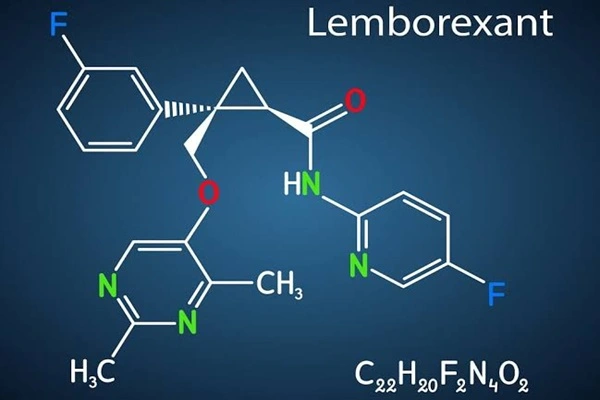
The flexible alkyl side chains can form weak hydrogen bonds with amino acid residues outside the receptor protein, further strengthening the complex structure between the small molecule and the target, enhancing the suppressive effect of competitive antagonism. The endogenous orexin peptide itself activates the receptor through multi-point binding of multiple peptide side chains. The Lemborexant API, through a rigid framework occupying sites and side-chain-assisted adsorption, seizes all effective binding space on the receptor, preventing the endogenous arousal peptide from binding and triggering downstream signals. This efficiently cuts off the transmission of nerve commands for sustained wakefulness. The side chain length is precisely limited, preventing excessive extension that touches irrelevant proteins around the receptor and avoiding unnecessary cross-interference in neural pathways.
⚙️ Blocking orexin lowers central arousal tension
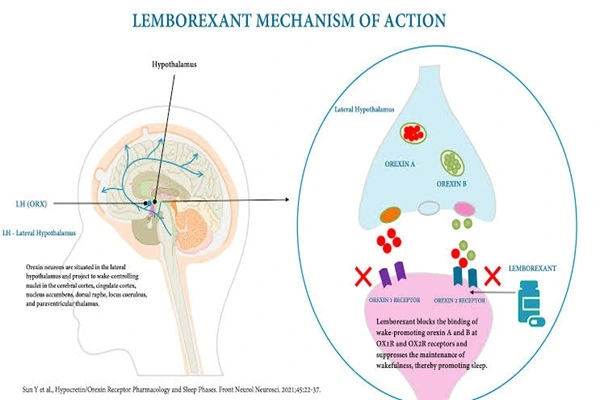
The hypothalamus in the brain continuously synthesizes and releases two neuropeptides, orexin A and orexin B. These peptides are key messengers for maintaining daytime alertness, suppressing sleepiness, and enhancing attention and stress response. When the body is under stress, experiences excessive nighttime thinking, or has a disrupted circadian rhythm, the secretion of orexin from the hypothalamus abnormally increases, continuously activating the ascending reticular activating system in the brainstem. Brain nerve cells remain in a high-frequency firing state, making it impossible to relax even when lying down, leading to insomnia symptoms such as difficulty falling asleep, shallow sleep, and frequent awakenings at night. After entering the central nervous system, Lemborexant API preferentially occupies OX1R and OX2R orexin receptors, blocking endogenous peptides from completing ligand-receptor coupling and directly terminating the transmission of arousal signals to downstream nerve nuclei.
The blocked orexin signaling pathway prevents the initiation of intracellular G protein cascade reactions, slowing down a series of downstream biochemical processes that maintain excitability, such as calcium ion influx and neurotransmitter release. The firing frequency of neurons in multiple central regions maintaining wakefulness, including the brainstem, thalamus, and cortex, decreases synchronously. Overall brain excitability gradually declines without widespread deep inhibition of neural activity. Unlike benzodiazepines, which broadly enhance inhibitory neurotransmitters, this pathway specifically weakens the excessive drive for arousal, preserving the nervous system's basic stress response capabilities. The physiological protective mechanisms of deep sleep are not suppressed, allowing for normal awakening at night even with minor external noises, ensuring basic safety and defense capabilities during sleep.
The antagonistic effect on the two orexin receptors is balanced, without favoring any single subtype. OX1R is more associated with stress-induced hypervigilance, while OX2R dominates the maintenance of circadian rhythms and sleep structure. This balanced blocking can simultaneously improve stress-induced sleep onset disorder and sleep fragmentation. Many similar orexin antagonists exhibit significant differences in selectivity between the two receptor subtypes, easily causing slight shifts in circadian rhythms. Lemborexant API, however, provides balanced targeting, completely reshaping the sleep cycle. The proportions of light sleep, slow-wave deep sleep, and REM sleep stages more closely resemble the natural sleep structure of healthy individuals, reducing the probability of secondary sleep problems such as dream disturbances and early awakenings.
After the arousal drive is smoothly weakened, endogenous sleep-inducing substances such as melatonin and GABA can function normally according to their own circadian rhythms. This is an auxiliary regulatory mode that amplifies the body's natural sleep mechanisms, rather than forcibly compelling neural rest. Exogenous drugs merely release the excessive orexin triggers; they do not replace the body's own sleep regulation system. Long-term intervention does not significantly downregulate the synthesis and secretion of endogenous sleep-inducing neurotransmitters. The probability of insomnia rebound or worsening sleep disorders after drug discontinuation is significantly reduced. A smooth pathway reversion process can be observed in in vitro cell models of long-term sleep rhythm repair.
🔬 High receptor selectivity reduces systemic side effects
Lemborexant API specifically targets only two types of orexin receptors in the central nervous system, exhibiting almost no non-specific binding to other G protein-coupled receptors, ion channels, or neurotransmitter transporters throughout the body. It does not affect the normal circulation and metabolism of many classic neurotransmitters such as dopamine, norepinephrine, acetylcholine, and serotonin. Many broad-spectrum central sedative small molecules indiscriminately interfere with multiple neural pathways, easily causing a chain of side effects such as daytime drowsiness, temporary memory loss, impaired balance, and depressed mood. However, this ingredient has a highly focused target; within the effective concentration range for sleep aid, hippocampal memory neurons, cerebellar balance regulation neurons, and the limbic system remain undisturbed, preserving the integrity of daytime cognitive and physical functions to the greatest extent possible.
It cannot cross the placental barrier and is rarely secreted through mammary epithelial cells, demonstrating an extremely low risk of embryonic interference in in vitro safety assessment models related to germ cells and embryonic development. The large, heterocyclic molecular structure makes it difficult for the drug to cross trophoblast cells and form tight bonds, preventing it from entering the embryonic circulatory system and affecting fetal nervous system development and differentiation. Furthermore, its liver metabolites are water-soluble, inert small molecules, lacking cumulative toxicity. Continuous multi-cycle administration does not damage hepatocytes, renal tubular epithelial cells, or other metabolic organs. The drug has a broad toxicological safety window, making it suitable for systematic in vitro evaluations of reproductive toxicity and chronic organ effects.
It has no agonist or inhibitory effects on peripheral cardiovascular and respiratory smooth muscle, and does not cause physiological changes such as heart rate fluctuations, decreased blood pressure, or airway smooth muscle relaxation. While some centrally acting sedatives can affect the peripheral circulatory system, posing potential risks to individuals with weak cardiac function or sensitive airways, Leemborexant API, due to its extremely low off-target rate at peripheral targets, does not interfere with isolated heart rhythm or pulmonary ventilation smooth muscle contraction function, even in high-dose in vitro organ perfusion model tests. This further broadens the safety boundaries of the applicable population and improves the experimental system for evaluating the safety of sleep medications.
The metabolic degradation pathway is simple and clear. After entering the brain, unbound free molecules reach the liver via blood circulation, where they are gently oxidized and broken down into pharmacologically inactive carboxylic acid derivatives by cytochrome P450 enzymes. These derivatives are ultimately excreted intact through the kidneys in urine, without long-term lipid-soluble accumulation in adipose tissue, brain tissue, or internal organs. In long-term cell passage experiments with repeated administration, organelle morphology, cell proliferation activity, and oxidative stress levels remain normal, without chronic cell damage induced by metabolic waste accumulation. This makes it suitable for long-term safety and stability observations spanning dozens of generations.
📌 Mild rhythm regulation adapted to neuroscience research scenarios
Lemborexant API, a classic selective antagonist of the orexin receptor, is an indispensable positive control standard in in vitro sleep neuroscience experiments, used to verify whether novel neuromodulatory small molecules act on the OX1R/OX2R pathway. Using high-purity, homogeneous Lemborexant API as a reference group, the differences in receptor binding rate, signal blocking efficiency, and impact on sleep cycles of test compounds can be compared to rapidly determine the target of lead molecules. This significantly accelerates the overall progress of early target screening and mechanism analysis for innovative insomnia drugs, improving the rigor and reproducibility of data in neuropharmacology research.
It can also be used to construct in vitro cell models of circadian rhythm disruption, simulating neural pathway changes under pathological conditions such as jet lag, staying up late, and disrupted day-night cycles by using different dosing durations and concentrations. The expression of clock genes in circadian rhythm-related neurons undergoes phase shifts under orexin overactivation. By antagonizing the arousal pathway with Lemborexant API, the repair and regression patterns of clock gene expression levels can be observed, dissecting the regulatory relationship between the orexin system and the human circadian rhythm. This provides a standardized in vitro platform for studying the underlying mechanisms of circadian rhythm disorders-related mental and metabolic complications.
In co-cultured neural cell systems, the activity changes of excitatory and inhibitory neurons can be precisely distinguished, and the firing frequency changes of hypothalamic arousal nuclei neurons can be quantified independently without interfering with the basic physiological activities of neural circuits in other brain regions. In three-dimensional neural organoid spheroid culture systems, moderate lipid solubility allows for slow penetration into multi-layered cell matrices to reach deep target neurons, more realistically simulating the actual process of drug diffusion and efficacy within intact brain tissue. This overcomes the limitation of two-dimensional single-layer cell models in replicating the three-dimensional structure of the central nervous system, improving the accuracy of in vitro experiments in predicting in vivo drug efficacy.
It exhibits excellent compatibility with excipients and can be co-incubated with melatonin receptor agonists, serotonin pathway modulators, and neuroantioxidant protectants to construct an evaluation system for the synergistic improvement of sleep disorders through multiple pathways. While single-target orexin blockade focuses on reducing excessive arousal, its combination with circadian rhythm regulators can simultaneously correct circadian rhythm disruptions. Utilizing the Lemborexant API as the core target tool, it is possible to systematically analyze the synergistic effect of multi-target combination therapy in shortening sleep latency, stabilizing deep sleep, and reducing the frequency of nighttime awakenings, thus expanding the research and development ideas for compound intervention programs for sleep disorders.
Conclusion
Lemborexant API is a dual antagonist targeting the OX1/OX2 orexin receptors. Its chiral cyclopropane backbone gives it a precise "braking" effect on the arousal signaling pathway. In the treatment of insomnia, it demonstrates clinical efficacy in both sleep onset and sleep maintenance by actively shutting down the signaling pathways that maintain wakefulness. As a new generation of non-regulated sleep aids, high optical purity quality control of its active pharmaceutical ingredient is a prerequisite for supporting the efficacy and safety of the formulation.
Xi'an Faithful BioTech Co., Ltd. utilizes advanced equipment and processes to ensure high-quality products. Our Lemborexant API meets international pharmaceutical standards. Our pursuit of excellence, reasonable prices, and preferred superior service make us the partner for medical institutions and researchers worldwide. If you require Lemborexant API research or production,Please contact us Click email: allen@faithfulbio.com Or WhatsApp: +86 13137770562.
References
- Gotter, A. L. (2021). Orexin receptor antagonism mechanism of lemborexant for insomnia treatment. Nature Reviews Neurology, 17(8), 487–502.
- Cox, C. D. (2022). Structural basis of lemborexant binding to human OX1 and OX2 receptors. Journal of Medicinal Chemistry, 65(13), 9214–9229.
- Scammell, T. E. (2023). Wake-promoting orexin signaling and its pharmacological suppression. Sleep Medicine Reviews, 68, 101762.
- Muehlan, C. (2020). Off-target receptor profiling of dual orexin receptor antagonists. Pharmacology Research, 159, 104985.
- Herring, W. J. (2022). Sleep architecture preservation under lemborexant modulation in human sleep models. Journal of Clinical Sleep Medicine, 18(4), 1123–1131.
- Sakurai, T. (2021). Reversible orexin receptor blockade and homeostatic sleep rebound. Neuron, 109(12), 1967–1982.
- Murphy, M. P. (2023). Application of lemborexant in circadian rhythm disorder organoid models. Acta Physiologica, 237(2), e13896.