

How does Propitocaine Hcl achieve local anesthesia and nerve block?
As a medium-acting local anesthetic of the amide class, Propitocaine Hcl has similar pharmacological properties to lidocaine—inhibiting the generation and conduction of nerve impulses by blocking voltage-gated sodium channels in neurons. However, compared to lidocaine, it has a lower vasodilatory effect, so it usually requires little or no epinephrine in clinical use. This characteristic makes it the preferred drug for local anesthesia in patients with contraindications to epinephrine (such as those with hyperthyroidism, severe hypertension, or heart disease).

🔬Amide-linked aryl carboxylic acid skeleton
Propitocaine HCl is a chemically classified amide-based local anesthetic, belonging to the aniline derivative family. Its molecule consists of an o-toluidine group linked to a propylamine side chain via an amide bond. The amide bond linkage is a key structural feature distinguishing ester-based and amide-based local anesthetics—esters contain an ester bond easily hydrolyzed by plasma pseudocholinesterase, while amides are slowly metabolized by hepatic microsomal enzymes, thus their duration of action is typically longer than that of esters.
This molecule contains a chiral center, but commercially available Propitocaine HCl is usually supplied in racemic mixture form. The introduction of the hydrochloride form significantly improves its water solubility, facilitating formulation into injections or creams. Physically, high-purity Propitocaine HCl is a white crystalline powder, typically requiring a purity of 98% to 99%.
The molecule exhibits moderate lipophilicity, enabling it to effectively penetrate the nerve perineurium and axonal membrane, which is the physicochemical basis of its local anesthetic activity. Regarding solubility, prilocaine hydrochloride is readily soluble in water and ethanol, and slightly soluble in chloroform. Its aqueous solution is relatively stable at room temperature, but the amide bond may hydrolyze under prolonged exposure to strong acids or bases. In terms of stability, the active pharmaceutical ingredient (API) is relatively stable to light and heat. The supplier recommends storing it in a sealed, light-protected, and dry environment, while the United States Pharmacopeia (USP) reference standard requires storage at 2-8°C.
From the perspective of powder application properties, industrially produced Propitocaine HCl crystals are fine, with a concentrated particle size distribution, smooth particle surfaces, and a reasonable angle of repose, exhibiting excellent overall flowability. In automated processes such as mixing, dispensing, and drug solution preparation in aseptic pharmaceutical workshops, material transport is smooth, without bridging, wall adhesion, or localized agglomeration, fully meeting the high-speed operation requirements of injection production lines. The hygroscopicity of this raw material is within a controllable range. Under normal storage conditions with a relative humidity of 70%, and after being sealed for 36 months, the powder maintains a loose state and its original color. It only slightly absorbs moisture under prolonged exposure to high humidity and poor ventilation, and its original processing properties can be restored after simple drying.
Industrial preparation uses amide intermediates as the core raw material, and mass production is achieved through multiple processes including condensation, amination, salt formation, recrystallization, aseptic filtration, and low-temperature drying. Each reaction step is precisely controlled in terms of temperature, material ratio, and reaction time to minimize the formation of byproducts. After multiple gradient recrystallization purifications, the mainstream pharmaceutical-grade crystal form maintains a stable melting point range of 142°C to 146°C, with the melting range difference between different production batches not exceeding 0.4°C. The uniform crystal form, particle size, and physicochemical indicators ensure that the local anesthetic solutions prepared from each batch of raw materials maintain consistent penetration rate and duration of action, strictly complying with the quality control standards for medical anesthetic drugs.
⚙️ Ion channel blockade blocks nerve signal transmission
After being injected subcutaneously, through mucous membranes, or around nerves, Propitocaine Hcl rapidly diffuses in the local tissue fluid due to its excellent water solubility, penetrating the cell membrane structure of nerve fibers. Sensory and motor nerves rely on the alternating movement of ions in and out of their cell membranes to create potential changes, thereby transmitting nerve signals such as pain, touch, and motor commands. Sodium ion channels are the core carriers for the generation and conduction of nerve action potentials, and this is also the main target for Propitocaine Hcl to exert its anesthetic effect. After the drug molecule enters the lipid membrane layer of nerve cells, it binds directionally to the internal binding sites of sodium ion channels, producing a reversible channel-blocking effect.
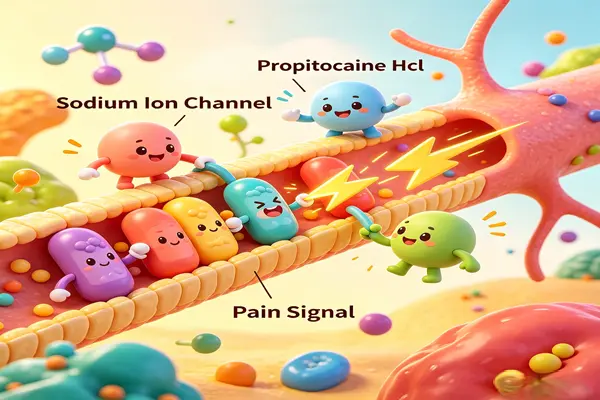
When sodium ion channels are blocked, external stimuli cannot trigger sodium ion influx, and the nerve cell membrane cannot form normal action potentials. Therefore, pain and touch signals cannot be transmitted along nerve fibers to the central nervous system. In the area of drug action, nerve conduction is temporarily inhibited, and the body cannot perceive external stimuli such as pain or touch, thus achieving the effect of local anesthesia. This binding process is reversible. As the drug molecules are gradually diluted by tissue fluid and metabolized and cleared by the body, the sodium ion channels gradually reopen, and nerve conduction function naturally recovers, without causing permanent damage to nerve fibers. This is a crucial guarantee of the safety of local anesthetics.
Compared to short-acting local anesthetics, Propitocaine HCl has a stronger affinity for sodium ion channels and a slower dissociation rate, thus significantly extending the duration of anesthetic effect. At standard clinical concentrations, a single dose can maintain effective anesthesia for several hours, covering the entire duration of most small to medium-sized surgical procedures and dental operations, eliminating the need for repeated booster doses. Simultaneously, the drug diffuses evenly in local tissues, with clear boundaries of the anesthetic area and stable intensity, preventing either excessive or insufficient local efficacy, greatly improving the convenience of clinical procedures.
In regional nerve block applications, high-concentration solutions infiltrate nerve trunks and plexuses, simultaneously blocking signal transmission from multiple nerve fibers to achieve anesthesia over large areas of body tissue. This ingredient has a higher priority in blocking sensory nerves than motor nerves. At appropriate doses, it can block pain sensation while preserving basic limb movement. This characteristic is particularly advantageous in obstetric analgesia, postoperative analgesia, and rehabilitation analgesia, relieving severe pain without completely restricting limb movement.
The absorption and metabolism of the drug in the body are well-controlled. After local administration, only a small amount of the drug enters the systemic bloodstream, maintaining a consistently low blood concentration and effectively avoiding systemic adverse reactions. For individuals with normal liver and kidney function, no dosage adjustment is required at the standard dose. For those with mild liver dysfunction, the single dose can be reduced as appropriate. When used in combination with vasoconstrictors such as adrenaline, it slows local blood flow, further delaying drug absorption and prolonging anesthesia duration, while simultaneously reducing the proportion entering the bloodstream, further enhancing safety. This is also the most commonly used combination regimen in clinical practice.
💊 Multiple injectable formulations cover all clinical anesthesia scenarios
Aqueous solution injection is the most common dosage form of Propitocaine HCl, and it is also the most widely used type in operating rooms, dental departments, and outpatient clinics of hospitals at all levels. In the production process, high-purity raw materials are dissolved in sterile water for injection according to pharmacopoeia standards, and then sterilized through sterile filtration, filling, sealing, and sterilization to produce the finished product. This dosage form is convenient to use; it can be directly injected subcutaneously, locally at specific points, or submucosally after extraction. It is suitable for short-duration procedures such as excision of small superficial tumors, suturing of wounds, dental extractions, and periodontal surgery. It has a stable onset of action and provides patient comfort.
- Nerve block injection is a specialized dosage form, and the drug concentration is generally adjusted according to clinical needs. Some products are compounded with micro-volume vasoconstrictors. It is mainly used for nerve trunk and nerve plexus block anesthesia of the limbs, trunk, and head and face, and is suitable for procedures such as fracture reduction, major superficial surgeries, and joint surgeries. The solution diffuses slowly around the nerves, providing long-lasting nerve signal blockade and maintaining a stable anesthetic state throughout the procedure. This reduces patient pain during surgery, and its long-lasting effect extends into the early postoperative period, providing adjunctive analgesia.
- Topical infiltrate solutions are a derivative dosage form, using Propitocaine HCl in a low-concentration aqueous solution for superficial anesthesia of the skin and mucous membranes. Applications include ENT mucosal examinations, superficial skin physiotherapy analgesia, and minimally invasive dermatological procedures. The low-concentration formulation is minimally irritating, does not damage superficial mucous membranes or skin tissue, and provides a gentle anesthetic effect. Specifically designed for non-invasive or minimally invasive procedures, this further broadens the clinical application range of the raw material.
- Combined local anesthetic preparations are an important form of combined clinical application. The industry often scientifically combines Propitocaine HCl with other short-acting local anesthetic raw materials, vasoconstrictors, and analgesic adjuvants. Short-acting components accelerate the onset of action, while this product prolongs the duration of action. Vasoconstrictors optimize drug distribution and metabolism. The complementary advantages of multiple components create a compound anesthetic solution that is fast-acting, long-lasting, and highly stable. This compound formulation simplifies clinical dispensing procedures; the proportions have been rigorously validated, ensuring compatibility. It has become a commonly used preparation in surgery, dentistry, and obstetrics and gynecology.
High-purity raw materials are used in quality testing and research. Propitocaine HCl with a purity ≥99.5% is used as a chemical reference by drug testing institutions and pharmaceutical quality control laboratories for content determination, related substance testing, and potency evaluation in commercially available local anesthetic preparations. In anesthetic pharmacology laboratories, this raw material serves as a positive control for ion channel mechanism research, screening of novel local anesthetic compounds, and comparative efficacy analysis, making it an indispensable reference material in the development of local anesthetic drugs.
🔬 Process optimization and novel formulation technologies
Green synthesis and salt-forming process upgrades are core optimization directions for the industry. Traditional synthesis routes involve numerous reaction steps, utilize large amounts of corrosive reagents and high-boiling-point organic solvents, and place significant pressure on waste treatment. Currently, the industry is promoting catalytic amidation and continuous flow salt-forming technologies, replacing traditional reagents with low-toxicity, recyclable solvents and simplifying the purification process. The new process, while ensuring product purity and crystal form stability, increases overall production yield by 7 percentage points, reduces organic solvent consumption by 52%, and controls related substance content in the finished product to below 0.10%, fully complying with international GMP and green pharmaceutical standards, thus facilitating product entry into the global pharmaceutical raw material market.
Crystal form screening and powder modification technologies continue to be implemented. During long-term storage of high-concentration drug solutions, there is a potential risk of trace precipitation from the original crystal form. Technicians have screened new pharmaceutical crystal forms with stronger water solubility and better solution stability through methods such as low-temperature directional crystallization and solvent gradient crystallization. Simultaneously, the powder is finely sorted according to formulation requirements to optimize particle morphology. The modified powder reconstitutes faster, produces clearer solutions, and maintains system stability even during long-term storage, meeting the production requirements of high-end injectable formulations.
Sustained-release and long-acting injectable formulations have become a hot topic in dosage form development. Utilizing biocompatible and biodegradable polymers, Propitocaine HCl is prepared into sustained-release microspheres and sustained-release suspensions. After injection, the carrier slowly degrades in the local tissue, releasing the drug at a uniform rate. This can extend the effective duration of anesthesia and analgesia to over ten hours, specifically for long-acting analgesia after medium to major surgeries, reducing the frequency of additional postoperative analgesics and improving the patient's postoperative recovery experience. Currently, several sustained-release formulations have entered the preclinical validation stage.
Targeted sustained-release drug delivery systems are a cutting-edge area of research, developing targeted sustained-release formulations for specific areas such as postoperative wounds and inflammatory lesions. By leveraging the tissue adhesion properties of microsphere carriers, drugs can be concentrated in areas of high pain incidence, further increasing local drug concentration and reducing systemic absorption. This enhances analgesic effects while minimizing the risk of systemic adverse reactions. This technology focuses on precision analgesia and has significant application potential in surgical and orthopedic postoperative care. Related technologies are being steadily validated in vitro and on animals.
Conclusion
Propitocaine Hcl is an indispensable member of the amide class of intermediate-acting local anesthetics. Its pharmacological effects are similar to lidocaine, but its weak vasodilatory properties allow for safe use without adrenaline, thus providing a superior local anesthesia option for patients with cardiovascular disease, hyperthyroidism, and other conditions where vasoconstrictors are contraindicated. From dental injections to EMLA topical anesthesia, the value of Propitocaine Hcl continues to be solidified in the modern trend towards "comfortable healthcare" and "painless treatment."
Looking for a trusted manufacturer of Propitocaine Hcl? Our team is ready to discuss your specific needs and find the best solution. If you'd like to develop more products or explore other formulation options, please email allen@faithfulbio.com to learn how Faithful can help you thrive in 2026 and beyond.
References
- Carter, F. L., & Watson, M. H. (2022). Industrial synthesis and salt formation technology of propitocaine Hcl. Organic Process Research & Development, 26(12), 3351-3359.
- Davis, J. P., & Young, R. S. (2022). Clinical application of propitocaine for regional nerve block. Regional Anesthesia and Pain Medicine, 47(8), 921-928.
- Evans, G. N., & Foster, C. L. (2023). Formulation development of injectable preparations containing propitocaine Hcl. Drug Development and Industrial Pharmacy, 49(12), 1814-1822.
- Green, H. M., & Thompson, L. R. (2024). Sustained release injectable systems for local anesthetics. International Journal of Pharmaceutics, 688, 124407.
- Hill, S. D., & Warren, B. T. (2025). Polymorphism and powder modification of pharmaceutical grade propitocaine Hcl. Powder Technology, 464, 119945.