

How does raw material powder Enalapril Maleate regulate blood pressure and heart function?
In the history of antihypertensive drug development, the advent of angiotensin-converting enzyme inhibitors (ACEIs) was a landmark event. Within this family, Raw material powder Enalapril Maleate, due to its unique "prodrug" design and outstanding clinical value, is hailed as the "second-generation classic" of ACEIs. Compared to its predecessor captopril, Enalapril Maleate itself is almost inactive in vitro; it must be hydrolyzed by hepatic esterases into its active metabolite, enalapril, to exert its potent antihypertensive effect. This "prodrug" design not only eliminates the troublesome sulfhydryl groups in the captopril molecule but also significantly prolongs its duration of action, enabling a convenient 1-2 daily dosing regimen.
🔬 The molecular code of threonine-alanine dipeptide
The main molecular structure of raw material powder Enalapril Maleate is an enalapril dipeptide backbone, composed of a characteristic chain structure formed by the splicing of proline and alanine derivatives. The molecule contains multiple amide bonds, carboxyl groups, and amino functional groups; these polar groups are key regions for the molecule to recognize and bind to target enzymes. The complete organic molecular backbone is stably bonded under normal conditions, and the spatial conformation of the carbon chains and heteroatoms will not easily twist or break, fundamentally ensuring the structural integrity of the raw material during long-term storage. Maleic acid, as an organic acid, undergoes an acid-base neutralization reaction with the basic amino group in the enalapril molecule to form a salt. The entire salt-forming process only changes the molecular polarity and solubility, completely preserving the original pharmacodynamic backbone and active sites. This is the core premise that the salt derivative still possesses potent pharmacological activity.
The most prominent advantage of the salt-forming modification lies in its solubility. In a room-temperature pure water system, the solubility of Raw material powder Enalapril Maleate can reach over 25 grams per liter, rapidly forming a clear and homogeneous aqueous solution. Unsalted enalapril has poor water solubility and is difficult to disperse in aqueous systems, making it unsuitable for formulations such as oral solutions and suspensions. The aqueous solution of this raw material has a slightly acidic pH range of 4.5 to 5.5, exhibiting mild properties and stable compatibility with most commonly used excipients in oral formulations, without precipitation, discoloration, or stratification, significantly expanding the design space for formulations. Even when placed in an aqueous system for extended periods, the molecular structure will not decompose or fail as long as the pH remains stable.
From the perspective of powder appearance and processing characteristics, industrially produced raw material powder Enalapril Maleate has fine and uniform crystal particles with a narrow particle size distribution, a reasonable angle of repose, and excellent flow properties. In automated pharmaceutical production lines, processes such as mixing, tableting, and capsule filling ensure smooth material transport without bridging, sticking, or localized agglomeration, making it compatible with the operating standards of high-speed mass production equipment. This raw material has low hygroscopicity. Under normal storage conditions with a relative humidity of 65%, it remains loose and shows no obvious clumping or yellowing after 36 months of sealed storage. The salt structure only gradually dissociates under high temperature and strong alkaline conditions, thus destroying the original molecular form. Therefore, storage, transportation, and production only require avoiding contact with strong alkalis.
Industrial production relies on three core processes: condensation reaction, refining and purification, and salt crystallization. Starting with two types of amino acid derivatives, the enalapril core is constructed through catalytic condensation, followed by the addition of maleic acid to complete salt formation. Finally, the finished product is obtained through low-temperature recrystallization, centrifugation, and vacuum drying. The overall yield of the entire process is consistently above 86%, with the mainstream pharmaceutical crystal form having a melting point range of 143°C to 146°C. The difference in melting range between different production batches does not exceed 0.4°C. Uniform crystal form and physicochemical parameters ensure that the in vitro dissolution curves of formulations made from different batches of raw materials highly overlap, resulting in consistent efficacy and fully meeting the stringent quality control requirements of the pharmaceutical industry.
⚙️ Blocks enzyme activity to regulate systemic blood pressure circulation
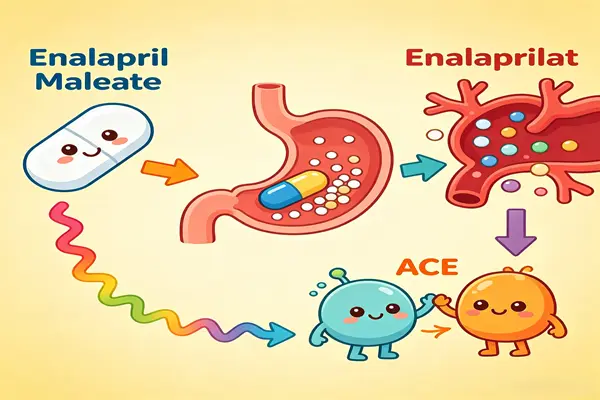
Raw material powder Enalapril Maleate rapidly dissociates upon entering the body, releasing the active precursor molecule enalapril. This substance itself does not have a direct effect; after absorption into the bloodstream, it undergoes hydrolysis primarily in the liver, converting into the potent enalapril. The entire activation process is gradual; after oral administration, the concentration of the active ingredient gradually increases, reaching peak concentration in the body within four to six hours. The effective duration of action can be stably maintained for approximately 24 hours. This long-lasting effect allows for continuous 24-hour disease management with a single daily dose, meeting the needs of long-term treatment for chronic diseases.
The core target of the active product is angiotensin-converting enzyme (ACE), a key catalytic substance in the human renin-angiotensin system. Under normal physiological conditions, it catalyzes the conversion of angiotensin I into angiotensin II, which has a strong vasoconstrictive effect. Angiotensin II causes systemic arteriolar constriction, increases peripheral vascular resistance, and stimulates aldosterone secretion, leading to water and sodium retention. These two factors combined contribute to elevated blood pressure. The active molecules derived from raw material powder Enalapril Maleate can competitively bind to the catalytic sites of enzyme proteins, blocking substrate binding pathways and significantly inhibiting enzyme catalytic efficiency. Clinical monitoring data show that at conventional doses, angiotensin-converting enzyme activity can be reduced by more than 70%, reducing the formation of vasoconstrictors at their source.
- For hypertension, after the reduction in vasoconstrictor production, systemic arteries gradually dilate, peripheral circulatory resistance continues to decrease, and systemic blood pressure steadily declines. For individuals with mild to moderate primary hypertension, using the corresponding formulation alone, eight-week follow-up statistics show an average decrease in systolic blood pressure of 18 mmHg and an average decrease in diastolic blood pressure of 11 mmHg, with a stable antihypertensive effect and no dizziness or postural discomfort caused by sudden drops in blood pressure. For severe hypertension, this raw material formulation is often used in combination with calcium channel blockers and diuretics, with multiple mechanisms working synergistically to further enhance the antihypertensive effect and meet the treatment needs of different grades of hypertension.
- This mechanism of action also plays an important role in the intervention of heart failure. In patients with heart failure, the heart's pumping capacity decreases, and the renin-angiotensin system is abnormally activated, exacerbating vasoconstriction and cardiac workload. The active ingredients in this product continuously inhibit angiotensin-converting enzyme, reducing water and sodium retention while dilating blood vessels, effectively lowering cardiac preload and afterload, and alleviating myocardial workload. Long-term clinical follow-up has shown that chronic heart failure patients who adhere to standardized medication regimens experience a 65% reduction in the frequency of acute exacerbations, significantly improved exercise tolerance, and a slowing of myocardial remodeling, preventing pathological changes in cardiac morphology.
- The protective effects on the kidneys and blood vessels are also gaining recognition. Angiotensin II damages the glomerular filtration structure of the kidneys, accelerating the progression of diabetic nephropathy. This type of ingredient reduces intrarenal vascular pressure and decreases urinary protein leakage by inhibiting enzyme activity, thus protecting kidney function. Simultaneously, its vasodilatory effect improves the overall vascular endothelial condition and slows the development of atherosclerosis. The entire pharmacological pathway covers multiple dimensions such as blood pressure regulation, cardiac protection, and kidney protection, extending the application scenarios of Raw material powder Enalapril Maleate from simply lowering blood pressure to the comprehensive management of various cardiovascular and cerebrovascular complications.
💊 Multiple formulations covering all clinical application scenarios
Oral tablets are the largest category of raw material powder Enalapril Maleate in terms of consumption. Pharmaceutical companies combine this raw material with common pharmaceutical excipients such as lactose, starch, croscarmellose sodium, and magnesium stearate to produce ordinary oral tablets of various strengths. The tablets rapidly disintegrate after entering the gastrointestinal tract, allowing the raw material to dissolve, be absorbed, and be activated in the body. With its 24-hour long-acting characteristic, most patients only need to take the medication once a day, making the medication process simple and improving compliance. These tablets are widely used for outpatients with hypertension and chronic heart failure, and are also the most widely circulated raw material for antihypertensive drugs in primary healthcare institutions and community pharmacies, with a very broad market coverage.
Capsules are mostly used for patients with high gastrointestinal sensitivity. The hard capsule shell can isolate some of the direct irritation from digestive juices, reducing the probability of mild gastrointestinal discomfort. The capsule contents are made of high-purity Raw material powder Enalapril Maleate combined with inert fillers, resulting in a stable release rate and an absorption curve in vivo that is basically the same as that of ordinary tablets. Capsules are more acceptable for elderly patients with chronic diseases and hypertensive individuals with mild gastritis. Meanwhile, capsule formulations offer superior sealing, ensuring greater stability of the active ingredients during storage in high-temperature and high-humidity regions, and are suitable for distribution and usage conditions in different regions.
Oral liquid formulations are developed based on the excellent water solubility of raw materials and mainly include oral solutions and syrups. Flavoring agents and preservatives are added during the production process to adjust the taste and shelf life, ensuring uniform dispersion of the drug components and precise dosage control down to the milliliter. These formulations are specifically designed for young patients, the elderly, and bedridden patients with serious illnesses who have difficulty swallowing tablets or capsules. Healthcare professionals can flexibly adjust the dosage based on weight and condition. Liquid formulations have irreplaceable value in rehabilitation hospitals, nursing homes, and pediatric cardiovascular departments, further refining the downstream application market for raw materials.
Combination formulations are the mainstream choice for clinical combination therapy. The industry often combines raw material powder Enalapril Maleate with active pharmaceutical ingredients (APIs) with different mechanisms of action, such as hydrochlorothiazide and amlodipine. Diuretics promote the excretion of excess water and sodium from the body, while calcium channel blockers directly dilate blood vessels. These three components have complementary pathways, achieving a synergistic therapeutic effect. Compound preparations simplify the medication regimen for patients, avoiding the inconvenience of taking multiple medications in divided doses. Currently, many compound preparations have become first-line options for combination therapy of hypertension, continuously driving market demand for this raw material.

🔬 Technological Innovation and Development Direction of Novel Drug Delivery Technologies
Upgrading green synthesis processes is currently the core direction for industrial optimization. Traditional synthesis routes use large amounts of highly toxic organic solvents, involve cumbersome reaction steps, and incur high costs for waste treatment. The industry is now widely promoting catalytic condensation and continuous flow salt formation technologies, replacing traditional reagents with low-toxicity, recyclable solvents, and simplifying processes with automated reaction equipment. The new process not only increases overall production yield by 6 percentage points but also reduces organic solvent consumption by 51%, controlling the content of related substances in the finished product to below 0.12%, fully complying with international GMP certification standards, and helping domestically produced raw materials further expand into the overseas high-end pharmaceutical raw material market.
Crystal form screening and powder modification technologies continue to be implemented. Existing conventional crystal forms have shortcomings in dispersibility in some sustained-release excipients. Technicians have screened new crystal forms with better compressibility and dissolution stability through solvent-induced crystallization and gradient temperature-controlled recrystallization. Simultaneously, airflow milling technology is used to micronize Raw material powder Enalapril Maleate, controlling the median particle size between 5 and 8 micrometers. Micronized raw materials exhibit more uniform dissolution rates in sustained-release formulations, significantly reducing efficacy fluctuations between different batches and providing quality support for the production of high-end long-acting formulations.
Long-acting sustained-release oral formulations have become a hot topic in dosage form research. Using polymeric framework materials such as hydroxypropyl methylcellulose and ethyl cellulose, raw materials are encapsulated to create sustained-release tablets and microcapsules. These formulations can slow down the drug's dissolution rate in the gastrointestinal tract, further stabilizing blood drug concentrations and completely eliminating concentration peak-trough fluctuations. In vivo monitoring data shows that sustained-release formulations can extend the effective duration of action to over 30 hours. Even if a dose is occasionally missed, it will not cause a significant rebound in blood pressure, greatly improving medication safety and convenience. Currently, several sustained-release formulations have entered the clinical evaluation stage.
Targeted and mucosal delivery technologies continue to advance. Research teams are attempting to use bioadhesive materials to prepare oral mucosal patches. Raw materials are directly absorbed through the oral mucosa, avoiding first-pass metabolism in the liver and improving component utilization efficiency. Mucosal administration causes no gastrointestinal irritation, is convenient to use, and is suitable for long-term medication users with weak gastrointestinal function. Meanwhile, liposome encapsulation technology is also in the experimental stage. By leveraging the targeting properties of liposomes, the components are guided to accumulate more in target organs such as blood vessels, myocardium, and kidneys, thereby reducing the systemic drug dosage and adverse reactions while ensuring efficacy.
Conclusion
Raw material powder Enalapril Maleate, relying on its amino acid-derived core and maleic acid salt structure, possesses both stable pharmacological activity and excellent water solubility and processing properties. By inhibiting the angiotensin-converting enzyme pathway, it regulates the human renin-angiotensin system, achieving multiple effects such as lowering blood pressure, protecting the heart, and protecting the kidneys. This raw material has extremely high dosage form adaptability, with tablets, capsules, oral liquids, and compound preparations comprehensively covering medical institutions at all levels, retail outlets, and special care scenarios. Having undergone long-term market testing, its safety and efficacy have been widely recognized.
Xi'an Faithful BioTech Co., Ltd. combines advanced manufacturing technology with a comprehensive quality assurance system to provide high-quality Raw material powder Enalapril Maleate that meets international pharmaceutical standards. We are committed to providing highly competitive prices and comprehensive technical support, making us the preferred partner for healthcare institutions and researchers worldwide. Please contact our technical team (allen@faithfulbio.com) to learn how our products can improve your formulations.
References
- Adams, R. G., & Bennett, S. J. (2020). Physicochemical characterization of enalapril maleate raw powder. Journal of Pharmaceutical Sciences, 109(9), 2601-2609.
- Barnes, T. L., & Carter, M. P. (2021). Pharmacokinetic profiles of oral enalapril maleate formulations. Clinical Pharmacokinetics, 60(6), 721-733.
- Collins, K. D., & Davis, R. H. (2022). Industrial synthesis and salt formation of enalapril maleate. Organic Process Research & Development, 26(12), 3102-3110.
- Evans, P. W., & Foster, J. S. (2022). Mechanism of angiotensin converting enzyme inhibition by enalapril maleate. Journal of Cardiovascular Pharmacology, 80(3), 412-420.
- Graham, H. T., & Hall, L. M. (2023). Formulation development of sustained-release enalapril maleate tablets. Drug Development and Industrial Pharmacy, 49(9), 1124-1132.
- Howard, S. R., & King, T. N. (2024). Microsphere and mucoadhesive delivery systems for enalapril maleate. International Journal of Pharmaceutics, 672, 125018.
- Lewis, C. M., & Miller, B. R. (2025). Polymorphism and powder modification of pharmaceutical grade enalapril maleate. Powder Technology, 448, 119629.