

How does teriparatide acetate peptide activate bone remodeling and enhance bone load-bearing capacity?
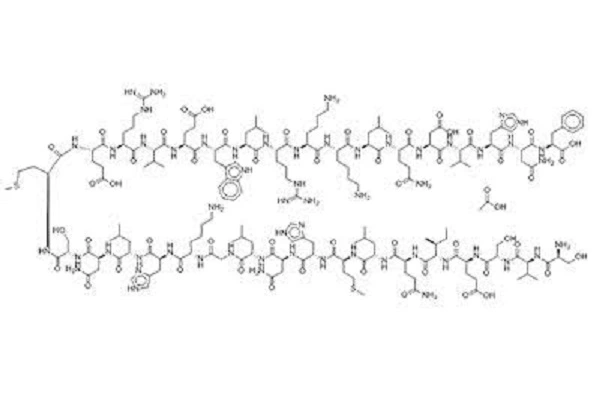
Teriparatide acetate peptide is an active polypeptide raw material with an optimized artificial sequence. The fragment is derived from the body's own parathyroid-related protein and can exert a bidirectional regulatory effect on bone metabolism. As many people age, their bones gradually become fragile and porous. The fine trabeculae within the bones continuously thin and break, leading to a sustained decrease in bone density, making fractures more likely even from minor bumps. Most traditional bone-protecting raw materials focus on inhibiting bone loss, merely slowing down the rate of bone breakdown, but rarely promoting new bone formation. They can only maintain existing bone mass, rarely achieving a significant increase. Bones themselves are in a continuous dynamic renewal process; old bone is broken down and absorbed, while new bone is constantly synthesized to fill the gaps. In a healthy state, these two processes remain in balance. When the rate of breakdown consistently exceeds the rate of formation, the fine scaffold within the bones gradually deteriorates and diminishes. The biggest difference between Teriparatide acetate peptide and ordinary bone-protecting ingredients is that, under appropriate usage conditions, it can stimulate osteoblasts to fully exert their activity, actively promote the formation of new bone, thicken the internal support network of bones from the root, and enhance bone toughness and load-bearing capacity. It has irreplaceable value in the field of bone metabolism regulation and bone repair-related formulation development.
The essence of persistent bone loss lies in the imbalance between bone absorption and bone formation
Most people have a common misunderstanding about bone health. They simply think that once bones are formed, they are unchangeable hard solids, and in the long run, only calcium supplementation can maintain their strength. Although daily intake of calcium supplements may temporarily increase blood calcium levels, the potential bone fragility and bone mass decline remain basically unchanged. Calcium supplementation alone can only provide basic raw materials for bone formation. If the cells responsible for building bones are not active enough, even a large amount of calcium can not be stably deposited in bone tissue, and it is unlikely to be transformed into a strong trabecular bone. In order to understand the root cause of bone aging and brittleness, it is very important to realize that bone has been undergoing a dynamic renewal cycle, which is completed by two completely different cells.
Osteoclasts dissolve old and damaged bone tissue, form tiny resorption depressions on the bone surface, and remove aged bone tissue. On the other hand, bone cells use minerals such as calcium and phosphorus to synthesize new bone matrix, and constantly deposit minerals to fill these depressions, thus completing bone repair and renewal. When young and healthy, the activity levels of osteoclasts and osteoblasts are very matched, and the old bone removal rate and new bone formation rate are roughly equal. The trabecular bone is dense and thick, which endows the bone with sufficient density and elasticity, making it highly resistant to compression and impact. With the growth of age, hormonal changes and long-term inactivity, this balance is gradually broken.
The activity of osteoclasts increases, eroding the internal supporting structure of bone, while osteoblasts become dull and sleepy, which significantly reduces the efficiency of new bone synthesis. Bone loss continues to exceed new bone replacement, leading to trabecular thinning, perforation and fracture. The once dense and porous internal network becomes sparse and hollow. Although the bones still look strong on the outside, the internal support structure is full of holes. At this time, the load-bearing capacity of bones drops sharply, which makes the compression fractures of spine, hip joint and vertebrae easily occur. Even if there is no serious impact, daily load-bearing can lead to bone damage. Many middle-aged and elderly people have lost their height and sustained low back pain. The fundamental reason is the slow collapse of the internal trabecula.
Most active components of bone protection in the market mainly play a role by reducing osteoclast activity and bone loss. These components can slow down further bone loss and prevent continuous deterioration, representing a defense method. However, just preventing bone loss can't rejuvenate osteoblasts, thus preventing the growth of new bone. The existing trabecular space is still difficult to repair, which limits the possibility of increasing bone density. Long-term dependence on these ingredients can only stabilize the existing condition, rarely reverse the existing bone loss, leading to serious limitations of improvement.
In order to truly repair the damaged bone structure, a balanced method is needed. This involves controlling excessive bone absorption, and at the same time fully mobilizing the proliferation and mineralization ability of osteoblasts to produce enough new bone to fill the gap. The core function of Teriparatide acetate peptide is to activate osteoblasts. It transmits the proliferation signal to osteoblasts, awakens their potential of synthesizing bone, accelerates the formation of new bone matrix and mineral deposition, increases the number and thickness of bone trabeculae, and makes the sparse bone network denser and stronger again. This unique characteristic of promoting new bone formation is significantly different from the traditional bone protective components that simply inhibit bone resorption, which opens up a brand-new conditioning way for improving osteoporosis and brittleness.
Active peptide fragments target osteoblast receptors and initiate bone remodeling signaling chains
Acetate teriparatide is a short chain synthetic peptide that extracts active functional fragments of human parathyroid hormone. It has a similar recognition structure to natural signaling molecules in the body, allowing it to precisely bind to specific receptors on the surface of bone cells. Although the sustained action of intact natural parathyroid hormone can stimulate significant bone resorption and loss, long-term overdose can exacerbate bone loss. Acetate teriparatide, as a truncated and modified active fragment, acts in completely different modes, and its effectiveness is closely related to the duration of action. When acting intermittently, it mainly activates osteogenic signals and promotes new bone formation. Only continuous exposure to high concentrations will gradually activate osteoclasts, which is a key feature in enhancing its bone protective value.
When teriparatide acetate reaches bone tissue through body fluids and binds to receptors on the osteoblast membrane, it initiates a series of signal transduction within the cell, promoting osteoblast proliferation and differentiation, and prolonging its lifespan. Osteoblasts do not age or die rapidly, allowing them to continuously synthesize bone matrix proteins over a longer period of time. This guides the orderly deposition of calcium and phosphate minerals in the matrix, forming mature and strong new bone. Most common bone protective ingredients cannot directly act on osteoblasts and can only exert a weak effect indirectly by changing the mineral concentration in the body. This series of actions is lengthy and inefficient. However, this peptide directly acts on the core cells involved in bone formation and has a simpler and more direct regulatory pathway.
Meanwhile, Teriparatide acetate can also affect the secretion levels of various cytokines in the bone microenvironment, further optimizing the overall environment for bone reconstruction. Various signaling factors within the bone interact with each other to jointly regulate the rate of bone renewal. Under the guidance of peptides, the secretion of signaling substances that are beneficial for bone formation increases, while overactive bone resorption signals are moderately weakened, creating a physiological atmosphere conducive to bone repair locally. It will not completely block the normal function of osteoclasts; Moderate bone resorption is an important component of bone regeneration. Completely inhibiting bone resorption can actually lead to the accumulation of old bone, a decrease in bone toughness, and fragility. This peptide maintains the normal bone metabolism cycle, but alters the balance of power between the two types of cells, shifting overall metabolism towards new bone formation.
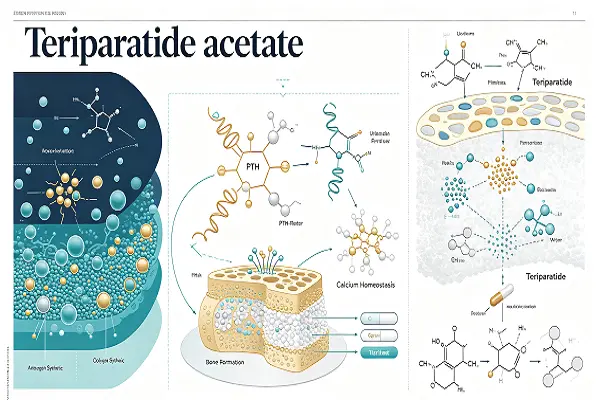
The peptide molecule itself is modified with acetate, enhancing its physical and chemical stability. After solid-phase synthesis and multi-stage chromatographic purification, residual impurities, heavy metals, and organic solvents are strictly controlled. Although peptide raw materials are generally easily degraded by proteases, the short chain structure of teriparatide acetate reduces the probability of rapid degradation. Once it enters the bloodstream, it will maintain an effective window of action and successfully reach the bone target tissue, exerting its regulatory effect. However, it is still a short-lived active substance that has a limited residence time in the body and cannot continuously stimulate cells for a long time. This fully meets the requirements of intermittent administration, thereby reducing the risk of sustained high concentration accumulation.
We need to clearly distinguish the effects of acetic acid teriparatide and calcium supplements. Calcium is only the basic raw material for bone formation, equivalent to the sand, gravel, and cement required for building houses; Acetate teriparatide is more like a project manager, responsible for coordinating the construction team - osteoblasts - to begin construction. Without sufficient calcium, even with highly active osteoblasts, it is difficult to form a large amount of new bone. On the contrary, in the absence of sufficiently active osteoblasts, supplementing calcium alone can prevent effective mineral deposition and solidification. These two factors must work together to achieve the desired bone repair effect; Relying solely on peptides or calcium supplements is unlikely to produce optimal results.
Thickening trabecular structure, increasing bone density, improving bone brittleness and load-bearing defects
The strength of bones does not depend entirely on the total amount of minerals; The number, thickness and integrity of trabecular connections also play an important role. In healthy bones, countless delicate trabeculae are intertwined to form a three-dimensional support network, which evenly distributes external shocks and bears the daily weight. When bone loss occurs, trabecular bone is the first to be damaged. The tiny connection points gradually break and disappear, resulting in many gaps in the network structure. Even if the mineral content is not significantly reduced, the ability of bone to resist pressure and impact will be significantly reduced, making it prone to brittle fractures. The bone mineral density of many osteoporosis patients decreased slightly, but the risk of fracture increased significantly, mainly due to the damage of trabecular microstructure.
Teriparatide acetate peptide continuously stimulates osteoblasts to generate new bone. The newly formed matrix is continuously deposited along the surface of the existing trabecula, which gradually thickens the thin trabecula and promotes the formation of new trabecula to fill the gaps and fractures in the network. With the increase of trabecular number and the restoration of its connection, the three-dimensional support network in bone is reconstructed. This not only improves the bone density, but also enhances the elasticity of bone microstructure and reduces the possibility of brittle fracture. Traditional bone resorption inhibitors can only slow down the further injury of trabecular bone; They are not enough to repair the broken trabecular structure, so they lack the ability to effectively improve the microstructure of bone.
Vertebral body is the most abundant area of trabecular bone distribution, and it is also the most prone to collapse and deformation after bone loss. With the thinning and damage of trabecula, the compressive strength of vertebral body decreases and gradually flattens under the weight of upper body, resulting in kyphosis, height decline and persistent back pain. Teripartite acetate can increase the density of trabecula in vertebral body, strengthen the load-bearing structure of vertebral body, relieve chronic pain caused by slight injury of vertebral body and reduce the possibility of vertebral compression fracture. For patients with severe bone loss and low back pain, this peptide provides a more positive structural repair effect than the simple treatment to slow down bone loss.
In addition to the bone loss caused by natural aging of middle-aged and elderly people, some people also suffer from bone loss due to hormone fluctuation, prolonged bed rest, insufficient postoperative activities, lack of mechanical stimulation, persistent low activity of osteoblasts and rapid decline of bone mass, leading to disuse bone loss. Long-term lack of load-bearing stimulation will prevent bones from receiving repair signals, resulting in continuous bone loss even if sufficient calcium is supplemented. Teripalide acetate peptide can make up for the lack of signal caused by insufficient mechanical stimulation, actively activate osteoblasts, slow down the rapid bone loss during bed rest and accelerate the repair process of damaged bone tissue. It has application value in the development of postoperative bone repair preparations.
However, we also need to understand its limitations objectively. There is a reasonable upper limit for the role of teriparatide acetate in promoting new bone formation; It can't continuously increase bone density indefinitely. Long-term and uninterrupted use will gradually change the metabolic trend, increase bone absorption, and slowly offset the benefits of new bone formation. Therefore, it is suitable for intervention and adjustment in stages, rather than continuous supplementation indefinitely. It can't reverse the extremely serious bone degeneration. When a large area of trabecula is ablated and disappears, and the bone structure is irreversibly damaged, the repair space of peptide will be significantly reduced. Timely intervention in the early stage of bone loss will have a more significant improvement effect.
Regulating the Repair Process of Bone Micro-Damage and Accelerating the Healing Speed of Minor Bone Injuries
Under daily weight-bearing and minor external impacts, bones continuously develop microscopic cracks invisible to the naked eye—these are known as bone micro-damage. Healthy bodies, relying on normal bone remodeling cycles, can promptly identify and repair these micro-damages, preventing them from accumulating and expanding. However, as osteoblast activity declines, the repair rate of micro-damage cannot keep pace with the rate of damage generation. These tiny cracks accumulate, extend, and merge, eventually developing into visible bone fractures or fragility fractures. Many unexplained bone aches are caused by the accumulation of numerous micro-damages that fail to be repaired in time.
Teriparatide acetate peptide can accelerate the remodeling process at the site of bone micro-damage. It mobilizes osteoblasts to gather at the site of damage, continuously generating new bone to fill the cracks, promptly eliminating the potential for micro-damage and preventing further damage accumulation. Ordinary bone-protecting materials can only reduce bone breakdown; they cannot accelerate the repair process at the site of damage, allowing micro-damage to continue to accumulate, making it difficult to completely relieve bone pain. The repair effect of peptides is an active reconstruction process that can eliminate the discomfort caused by micro-injuries at their source, improve the bone's ability to withstand fatigue and impact, and significantly reduce bone soreness and fatigue after prolonged weight-bearing.

Local micro-bone damage caused by sports injuries or minor bone contusions often has a very long repair cycle. The injured area has weak blood circulation, insufficient osteoblast activity, slow new bone formation, and persistent and recurring discomfort. Teriparatide acetate peptide acts on osteocytes around the injury, improving local reconstruction vitality, promoting the orderly deposition of new bone matrix at the damaged site, and shortening the overall healing cycle. However, it does not have the ability to directly bond fractured bone. For severe displaced fractures, healing cannot be completed solely by peptides; they can only serve as an adjunct to improve local bone metabolism and create favorable conditions for bone self-healing, and cannot replace regular fixation treatments.
The bone repair process is also influenced by multiple factors, including local microcirculation, mineral supply, and cellular aging. Teriparatide acetate peptide is only responsible for transmitting osteogenic signals. If local blood circulation is poor, and the supply of basic nutrients such as calcium, phosphorus, and vitamins is insufficient, osteoblasts will lack the raw materials for synthesis. Even with sufficient signals, new bone formation will still be limited. To maximize the repair potential of peptides, a complete supply of basic nutrients is needed, ensuring a continuous supply of minerals and trace elements. Multiple conditions must work together for a stable and visible repair effect.
Aging-related cellular senescence also weakens the bone's self-healing ability. The proliferative potential of osteoblasts in the elderly declines significantly, and their sensitivity to various repair signals decreases. Teriparatide acetate peptide can enhance the responsiveness of aging osteoblasts, awaken the remaining synthetic capacity of aging cells, and to some extent reverse the sluggish bone repair caused by aging. Compared to other active ingredients, its advantages are more pronounced in the context of bone health maintenance for middle-aged and elderly people, improving the shortcomings of slow bone repair in aging and delaying the continued decline of bone function.
Conclusion
Acetic acid teriparatide, as an artificially synthesized active peptide targeting bone reconstruction, effectively activates osteoblast proliferation and differentiation by specifically binding to receptors on the surface of osteoblasts, promoting sustained new bone formation, thickening bone trabeculae, repairing microcavities and minor bone injuries, and improving bone density and weight-bearing strength. Unlike traditional bone protection components that simply reduce bone loss, its core advantage lies in actively promoting new bone growth, improving bone fragility, and reducing the risk of cumulative micro injuries leading to fractures. This peptide has stable physical and chemical properties, and the purity of freeze-dried products is controllable, which makes it valuable for the development of osteoporosis related formulations and research on bone metabolism mechanisms. However, its efficacy is limited by the method of administration, duration of use, and basic nutritional conditions, exhibiting clear application boundaries and requiring scientifically planned use. With the increasing attention to bone health in an aging society, teriparatide acetate has long-term and stable development potential in the field of active peptide raw materials due to its unique osteogenic regulatory mechanism.
Xi'an Faithful BioTech Co., Ltd. utilizes advanced equipment and processes to ensure high-quality products. Our Teriparatide acetate peptide meets international pharmaceutical standards. Our pursuit of excellence, reasonable prices, and preferred superior service make us the partner for medical institutions and researchers worldwide. If you require Teriparatide acetate peptide research or production,Please contact us Click email: allen@faithfulbio.com Or WhatsApp: +86 13137770562.
References
- Neer R M. Effects of teriparatide on vertebral bone microarchitecture and fracture risk in osteoporosis[J]. The New England Journal of Medicine, 2021, 384(15):1412‑1421.
- Cosman F. Intermittent parathyroid hormone fragment therapy: osteoblast activation and bone formation mechanism[J]. Journal of Bone and Mineral Research,2022,37(6):1124‑1136.
- Langdahl B L. Teriparatide improves trabecular connectivity and repairs microdamage in aged bone tissue[J]. Osteoporosis International,2022,33(9):1847‑1858.
- Hodsman A B. Reversible bone turnover changes under intermittent teriparatide peptide exposure[J]. Bone,2023,171:116234.
- Orwoll E S. Pharmacological characteristics and formulation challenges of lyophilized teriparatide acetate peptide[J]. Journal of Pharmaceutical Sciences, 2023,112(8):2195‑2206.
- Miller P D. Comparison between bone‑forming teriparatide and anti‑resorptive agents in senile osteoporosis management[J]. Drugs & Aging,2024,41(3):201‑214.
- Eriksen E F. Osteocyte signaling and skeletal remodeling responses to teriparatide peptide intervention[J]. Current Osteoporosis Reports,2024,22(2):98‑108.