

How does the 5-Fluorouracil API interfere with the tumor nucleic acid synthesis process?
In the history of antitumor drugs, 5-Fluorouracil API is an indispensable classic. It is one of the earliest systematically developed and still in use antimetabolite chemotherapy drugs. Since its antitumor activity was first reported in 1957, it has saved the lives of countless patients with colorectal cancer, gastric cancer, breast cancer, and head and neck squamous cell carcinoma worldwide. Its chemical nature is a 5-fluorinated derivative of uracil, with the molecular formula C₄H₃FN₂O₂, a molecular weight of approximately 130.08 g/mol, and CAS registry number 51-21-8. As a "prodrug," 5-FU itself is not the active form; it needs to undergo multiple enzymatic conversions within the cell to generate an active nucleotide metabolite. This metabolite irreversibly inhibits thymidylate synthase, blocking DNA synthesis and thus killing tumor cells in the S phase of proliferation.
🧬 Cyclic framework mimics the morphology of endogenous pyrimidine molecules
The basic framework of 5-Fluorouracil API follows the six-membered pyrimidine heterocycle of uracil, except that a fluorine atom is introduced at the fifth carbon atom, replacing the original hydrogen atom. The atomic radius of the fluorine atom is very close to that of the hydrogen atom, so the spatial volume remains almost unchanged, and the overall molecular outline is highly consistent with that of natural uracil. Various enzymes and proteins in cells that recognize pyrimidine substrates rely on molecular shape for substrate recognition. The highly similar shape of 5-Fluorouracil API allows it to be readily accepted by transport proteins and metabolic enzymes as normal uracil.
Fluorine has a much higher electronegativity than hydrogen. This subtle change, while not altering the molecular shape, can completely rewrite the course of subsequent chemical reactions. Natural uracil can participate normally in nucleic acid assembly after enzymatic catalysis, but the pyrimidine ring structure carrying the fluorine atom cannot complete subsequent cleavage and transformation at the chemical bond level. Even if the entire molecule is captured by an enzyme and phosphorylation modification is initiated, generating corresponding nucleosides and nucleotide derivatives, the fluorine atom firmly locks the ring structure, preventing the metabolites from continuing the normal biochemical cycle that pyrimidines should complete. The polar group distribution of the molecule is consistent with that of uracil, and the two carbonyl groups on the ring can form stable hydrogen bonds. Hydrogen bonds are key contact points for enzyme proteins to recognize substrates. With the carbonyl group arrangement unchanged, a number and position matching interaction force can be formed with the amino acid residues of the enzyme protein. Relying on multiple hydrogen bonds and a nearly identical spatial outline, 5-Fluorouracil API can deceive the intracellular metabolic system and successfully enter the entire process of pyrimidine metabolism, which is a prerequisite for its subsequent physiological effects.
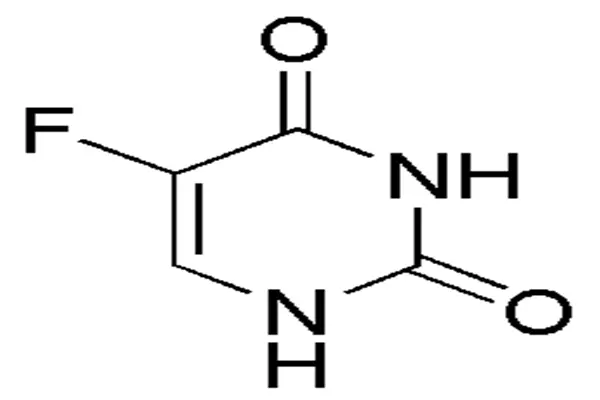
Free 5-Fluorouracil API possesses suitable lipid-water partition characteristics, enabling it to cross the lipid bilayer structure of the cell membrane. In rapidly proliferating cells, the expression level of carrier proteins responsible for transporting small pyrimidine molecules on the cell membrane is higher. These carrier proteins actively transport 5-Fluorouracil API from the environment into the cell. Differences in the expression levels of carrier proteins among different cell types directly result in varying concentrations of the enriched molecule within different cells, further affecting the final strength of the effect.
The raw material refining process removes isomers of pyrimidine rings and incompletely fluorinated intermediates. Impurities with structural misalignments not only fail to mimic uracil's metabolic cloning but also produce non-specific cellular effects. High-purity 5-Fluorouracil API ensures that the vast majority of molecules possess the correct fluorine substitution sites, allowing for a stable output of the core characteristic of cloning endogenous pyrimidines without being diluted or interfered with by impurities.
⚙️ Multilevel phosphorylation generates active metabolic derivatives
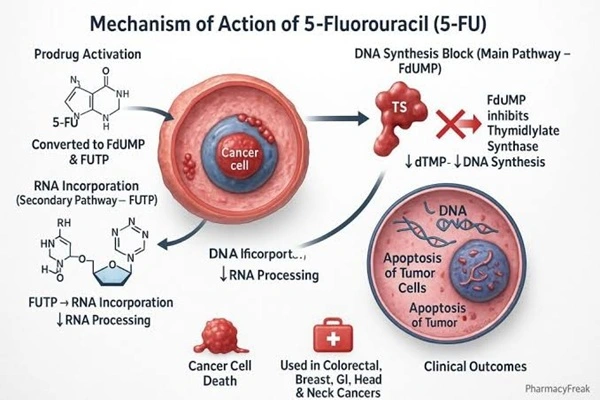
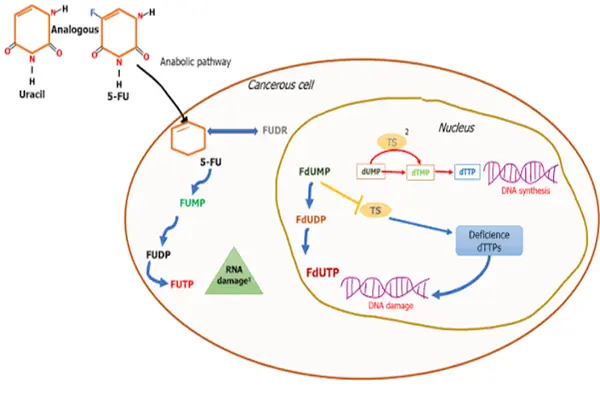
The 5-Fluorouracil API alone does not directly block nucleic acid synthesis. After entering the cytoplasm, it must be activated by the catalysis of intracellular kinases, sequentially adding phosphate groups. The first step is conversion to 5-fluorouridine monophosphate, followed by further phosphate modification to generate diphosphate and triphosphate derivatives. Only after acquiring phosphate groups can the molecule be recognized by RNA polymerase and used as a candidate raw material for assembling RNA chains.
The generated 5-fluorouridine triphosphate, along with normal nucleoside triphosphates, rushes to the RNA synthesis site. RNA polymerase cannot distinguish this molecule from natural uridine triphosphate and will continuously splice it into the nascent RNA chain. When a large number of fluorinated pyrimidine residues are embedded in RNA, the spatial folding of the entire RNA molecule becomes abnormal. RNA relies on precise secondary structures to perform translation, cleavage, and other functions; structural distortion significantly interferes with the physiological functions of messenger RNA and transport RNA.
Another important conversion pathway involves the deoxyribose derivative, 5-Fluorouracil API, which is metabolized to 5-fluorodeoxyuridine monophosphate (5-FRP). This metabolite targets thymidine monophosphate synthase, an essential protein for DNA synthesis. Thymidine monophosphate synthase's primary function is to convert 5-FRP to 5-FRP, providing thymine for DNA replication. 5-FRP binds tightly to the active site of the enzyme protein, forming a stable covalent complex that directly locks the catalytic site of thymidine monophosphate synthase.
With the enzyme protein firmly locked, the intracellular supply of 5-FRP is severed. Lacking the necessary thymine for DNA replication, the synthesis of new DNA strands is forced to halt. Cells undergoing division need to complete full DNA replication to proceed to the next stage; the interruption of this raw material supply stalls the cell cycle, preventing successful division. This pathway specifically targets the DNA replication stage in rapidly dividing cells.
The activity levels of different intracellular kinases influence the flow distribution between the two metabolic branches of 5-Fluorouracil API. Some cells tend to produce RNA-intercalated metabolites, while others produce more derivatives that inhibit thymidine synthase. The fullness of the cell's own pyrimidine pool also competes for kinase resources; when the concentration of endogenous uracil is high, it competes with 5-Fluorouracil API for the same metabolic enzymes, thus altering the amount of activated products produced and leading to differences in cellular-level responses.
🧬 Dual pathways to block genetic material replication and transcription
RNA chain insertion interference and DNA raw material synthesis blockade can occur simultaneously, jointly exerting growth pressure on rapidly proliferating cells. When 5-fluorouridine triphosphate (5-FURP) is continuously incorporated into RNA, not only does messenger RNA translation fail, but ribosomal RNA and micronuclear RNA are also invaded by abnormal molecules. Micronuclear RNA participates in intracellular mRNA cleavage; once a large amount of fluorinated pyrimidine is mixed into the sequence, the cleavage complex recognition becomes disordered, mature messenger RNA cannot be generated normally, and the supply of protein translation raw materials is disrupted.
The cell will activate its own error correction mechanism, attempting to recognize and degrade structurally abnormal RNA fragments. However, if 5-Fluorouracil API continues to be input, abnormal RNA is continuously generated, overwhelming the cell's repair and degradation system. A large number of functionally deficient nucleic acid molecules accumulate intracellularly, the synthesis yield of various key proteins continues to decline, and the supply of basic materials for cell survival and division gradually dries up.
After thymidine synthase is continuously inhibited, the intracellular deoxythymidine reserves are continuously depleted, and the raw material gap for DNA replication continues to widen. When DNA polymerase reaches a site requiring thymine, the lack of available raw materials forces the replication fork to halt. This stalled DNA replication triggers damage-sensing signals within the cell, causing it to stop dividing and attempt to repair DNA synthesis defects. If the raw material shortage persists, the cell cannot overcome the cell cycle threshold, and proliferation is completely interrupted.
In cells with slow proliferation, DNA replication and RNA transcription are at lower levels, resulting in a lower rate of pyrimidine raw material consumption. Even if a small amount of 5-Fluorouracil API metabolites enter the cell, the total nucleic acid synthesis throughput is limited, and the proportion of abnormal molecules embedded is relatively low, giving the cell's own repair system a greater chance to buffer the disturbance. This explains why rapidly dividing cells are more significantly affected; proliferation activity directly determines the intensity of the disturbance the cell can withstand.
There is also an additive effect between these two pathways. Insufficient DNA raw materials create replication stress, while abnormal RNA disrupts protein synthesis, including a decrease in the production of DNA repair-related proteins. Insufficient repair proteins weaken the cell's ability to save itself when DNA replication stops, further amplifying the inhibitory effect on cell proliferation. This entire physiological response is not a single event, but a comprehensive result of the interaction of multiple biochemical chains.
🔍 Deciphering the Logic of Differential Response at the Cellular Level
Different cells exhibit significant differences in their sensitivity to 5-Fluorouracil API, with the expression level of transporter proteins being the first influencing factor. A higher number of pyrimidine transporters on the cell membrane allows for the uptake of more 5-Fluorouracil API into the cell; low transporter expression limits the total amount of raw material molecules entering the cell, resulting in insufficient generation of subsequent activation products and making it difficult to achieve a sufficiently strong nucleic acid interference effect.
The abundance of intracellular metabolic enzymes constitutes the second layer of influence. The ratio of the activities of the kinase responsible for phosphorylation and activation of 5-Fluorouracil API, and the phosphatase responsible for decomposing and clearing the active metabolites, determines the concentration at which intracellular active derivatives can accumulate. In some cells, the activity of degradative enzymes is high, causing newly generated active nucleotides to be rapidly dephosphorylated and detoxified, making it difficult to accumulate to a concentration level that strongly interferes with nucleic acid metabolism.
The expression abundance of thymidine synthase itself also alters the response. In some cells, this enzyme protein is produced in large quantities, requiring a higher concentration of 5-fluorodeoxyuridine monophosphate to bind and block the vast majority of enzyme molecules. If the cellular thymidine synthase baseline level is low, even a small amount of active metabolites can be sufficient to block the DNA raw material production process, leading to increased cellular sensitivity.
The reserve status of the cellular endogenous pyrimidine pool is crucial. Cells can take up uracil from external sources or produce pyrimidine substrates via de novo synthesis pathways. In an environment with sufficient endogenous uracil, it competes with 5-Fluorouracil API for transport carriers and metabolic kinases, effectively diluting the metabolic activation of 5-Fluorouracil API. When endogenous pyrimidine is scarce, cells become more reliant on exogenous pyrimidine supply, accepting 5-Fluorouracil API to a greater extent, amplifying subsequent physiological disturbances.
The cell cycle stage determines the final outcome after exposure. Cells in the S phase, the DNA replication phase, are engaged in large-scale nucleic acid synthesis and are most vulnerable to both metabolic interference pathways. Cells in a quiescent, non-dividing state have essentially halted DNA replication, and RNA maintains basic function; even with the presence of active metabolites, the impact is significantly reduced. The periodic distribution of cell populations directly shapes the overall response pattern of the population.
Conclusion
5-Fluorouracil API is a classic representative of antimetabolite chemotherapy drugs. Its fluoropyrimidine molecular skeleton, through irreversible inhibition of thymidine synthase, has established its cornerstone position in combination chemotherapy for various solid tumors, including colorectal cancer, gastric cancer, and breast cancer. For the pharmaceutical raw material industry, high-purity 5-Fluorouracil API powder with controllable impurities and compliance with pharmacopoeia standards in multiple countries is a core basic material supporting the global production of chemotherapy formulations.
Xi'an Faithful BioTech Co., Ltd. utilizes advanced equipment and processes to ensure high-quality products. Our 5-Fluorouracil API meets international pharmaceutical standards. Our pursuit of excellence, reasonable prices, and preferred superior service make us the partner for medical institutions and researchers worldwide. If you require 5-Fluorouracil API research or production,Please contact us Click email: allen@faithfulbio.com Or WhatsApp: +86 13137770562.
References
- Longley, D. B., Harkin, D. P., & Johnston, P. G. (2020). 5‑Fluorouracil: Mechanisms of action and clinical strategies. Nature Reviews Clinical Oncology, 17(5), 289‑305.
- Parker, W. B. (2019). Metabolism of fluoropyrimidines. Pharmacology & Therapeutics, 199, 114‑132.
- Ciccolini, J. (2021). Thymidylate synthase: Structure, function and inhibition by fluorinated pyrimidines. Biochemical Pharmacology, 188, 114587.
- Grem, J. L. (2022). RNA‑directed biological effects of 5‑fluorouracil. Cancer Chemotherapy and Pharmacology, 89(3), 321‑334.
- Heggie, G. D. (2020). Cellular transport mechanisms for pyrimidine antimetabolites. Drug Metabolism Reviews, 52(2), 211‑226.
- Van Kuilenburg, A. B. P. (2021). Determinants of cellular sensitivity to 5‑fluorouracil. European Journal of Pharmacology, 896, 173921.