

How does Vardenafil HCl regulate vasodilatory signaling pathways?
Vardenafil HCl is a highly selective and active phosphodiesterase type 5 (PDE5) inhibitor. Its chemical structure is homologous to sildenafil but optimized for stronger PDE5 inhibitory activity. This molecule selectively inhibits PDE5 in the smooth muscle of the corpus cavernosum, increasing cGMP levels, promoting smooth muscle relaxation, and enhancing corpus cavernosum blood perfusion under sexual stimulation. Since its FDA approval in 2003, vardenafil hydrochloride has become one of the first-line oral treatments for erectile dysfunction (ED), with its active pharmaceutical ingredient supplied globally in high-purity powder form. As a key representative of third-generation PDE5 inhibitors, vardenafil hydrochloride has established a clear clinical position in ED treatment due to its higher target selectivity and faster onset of action.
🧬 Molecular configuration determines target recognition specificity
The complete Vardenafil HCl molecule is constructed from a benzimidazole ring, a piperazine side chain, and a hydrochloric acid salt-forming moiety. This cyclic aromatic structure allows it to embed into the active cavity within the target protein. The protein cavity contains numerous amino acid residues, with different residue arrangements forming specific spatial grooves. Only molecules with matching spatial dimensions and charge distributions can stably remain in these positions. The cyclic backbone of Vardenafil HCl forms multiple non-covalent interactions with the cavity walls; hydrogen bonds and hydrophobic interactions together fix the molecule at the binding site, thus occupying a binding site originally belonging to an endogenous signaling molecule.
Slight modifications to the molecular side chains directly alter the tightness of the bond with the protein. Compared to other derivatives in the same class, the arrangement of the Vardenafil HCl side chain groups avoids the protein pockets of many other phosphodiesterase subtypes. Many substances of the same type readily bind to multiple enzymes and proteins simultaneously, leading to cascading reactions in other parts of the body. Vardenafil HCl, however, relies on the steric hindrance effect of its side-chain groups, making it difficult to enter the cavities of other enzymes and proteins, thus reducing the probability of non-target binding at the molecular level.
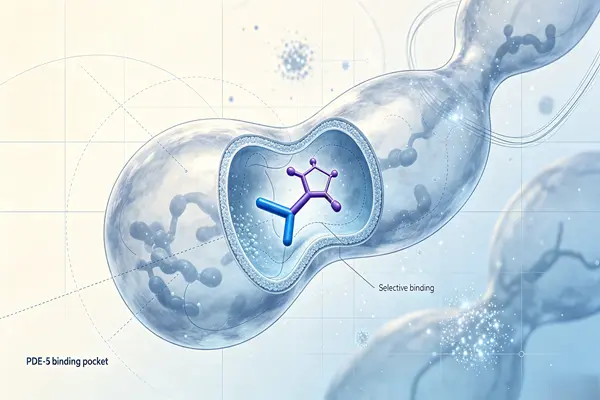
The salt-forming modification of hydrochloric acid represents a significant change in physicochemical properties. Free, alkaline Vardenafil exhibits weak solubility in aqueous solutions. After salt formation, its ionization level increases, making it easier to disperse and dissolve in bodily fluids. For a substance to reach its effective site, it must first be transported through bodily fluids. Insufficient solubility leads to large fluctuations in absorption, amplifying differences in effectiveness between individuals. Salt formation does not destroy the cyclic pharmacodynamic structure of the parent nucleus; it merely improves solubility and dispersion, optimizing in vivo transport conditions while preserving the original binding capacity.
The overall lipid-water partition ratio of the molecule also affects its actual ability to penetrate biological membranes. Vascular endothelium and the outer layer of smooth muscle both possess cell membrane barriers composed of lipids. Moderate lipid solubility helps Vardenafil HCl cross lipid membranes and enter cells, but excessive lipid solubility can cause molecules to accumulate indiscriminately in various cell membranes, leading to unnecessary cellular interference. After group matching, Vardenafil HCl achieves a relatively balanced lipid-water partition state, allowing it to successfully cross the outer barrier of target cells without accumulating in large quantities in unrelated cells.
Chiral spatial arrangement is also crucial. The active cavity of a protein inherently possesses three-dimensional spatial properties, making it difficult for mirror-image molecules to bind effectively. Industrially prepared Vardenafil HCl has a defined stereoconfiguration; impurities with incorrect configurations are removed during purification. Once the stereoconfiguration shifts, the fit between the molecule and the protein cavity rapidly decreases, directly weakening its binding ability to the target enzyme. High-purity batches can control ineffective stereoimpurities to extremely low levels, ensuring that each batch of molecules can efficiently recognize the corresponding target protein.
⚡ Enzyme protein blockade regulates intracellular signaling molecule levels
Human smooth muscle cells continuously produce signaling molecules like cyclic guanosine monophosphate (cGMP), a crucial messenger substance mediating smooth muscle relaxation. When a physiological signal arrives, the cell rapidly synthesizes cGMP, which transmits instructions downstream, prompting the smooth muscle cell to transition from a contracted to a relaxed state. However, phosphodiesterase 5 (PDE5) is also present within the cell. This enzyme's primary function is to break down and consume cGMP, preventing excessive activation of the signal and maintaining a dynamic balance within the cell.
After Vardenafil HCl enters the cell, it directly binds to the active site of PDE5, effectively occupying the enzyme's working site. This prevents the endogenous signaling molecule from reaching the enzyme protein. Without the enzyme's opportunity to contact its substrate, the breakdown of cGMP is blocked. Newly synthesized signaling molecules are not rapidly degraded, and the intracellular cGMP concentration gradually increases. This increased concentration allows the relaxation instructions to be continuously transmitted downstream, maintaining the smooth muscle's relaxed state.
This entire process does not directly generate new physiological signals. Vardenafil HCl does not induce the massive production of signaling molecules out of thin air; it merely blocks the breakdown and metabolism of these molecules. If the body itself does not release the corresponding physiological trigger signal, the basal concentration of cyclic guanosine monophosphate (cGMP) within cells remains low. Even if the degradation pathway is blocked, there will be no abnormal signal burst. This mode of action means that the substance's effect depends on the body's own original physiological initiation signals and will not autonomously force the relaxation process.
The distribution of different phosphodiesterase subtypes varies in different tissues. Phosphodiesterase 5 is more concentrated in the smooth muscle of the corpus cavernosum and pulmonary blood vessels, while other subtypes of phosphodiesterase are abundant in the heart and brain. Vardenafil HCl rarely acts on other subtypes of enzymes, therefore it does not significantly interfere with the metabolism of signaling molecules within the heart and brain tissue. If a molecule has a strong binding capacity to multiple enzymes, it will cause changes in signals in multiple tissues, leading to numerous additional bodily feedbacks. Its high selectivity can largely avoid such situations.
Cells possess multiple metabolic regulatory circuits, and cyclic guanosine monophosphate (cGMP) is just one branch. Other signaling pathways continue to function normally without interference. Vardenafil HCl does not alter cellular basal energy metabolism, nor does it interfere with the normal operation of most ion channels; it only specifically intervenes in the degradation pathway of one signaling molecule. The cell retains its complete self-regulation capabilities. Once the original physiological trigger signal disappears, no new signaling molecules are produced, and existing molecules are gradually consumed through other minor metabolic pathways, thus restoring the cell to its original state.
🩸 Signal flow drives changes in local blood flow state
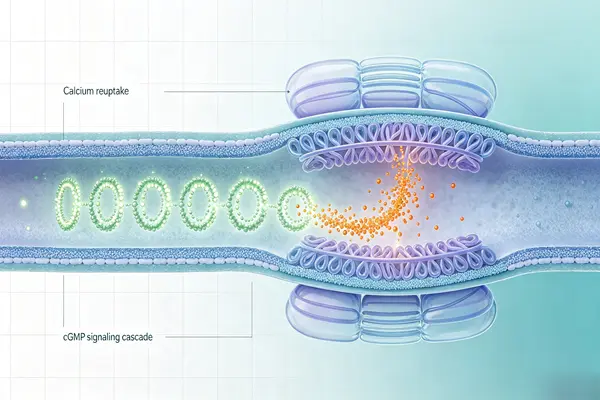
As cyclic guanosine monophosphate (cGMP) accumulates in the smooth muscle cells of the corpus cavernosum, downstream protein kinases are sequentially activated, triggering a series of biochemical changes within the cell. Contraction-related proteins within the muscle cells undergo conformational changes, and calcium ions flow back from the cytoplasm into the endoplasmic reticulum for storage, decreasing the concentration of free calcium ions in the cytoplasm. Since smooth muscle cell contraction is highly dependent on free calcium ions, the decrease in calcium ion levels causes the smooth muscle to relax, and the muscle wrapped around the outer wall of the blood vessel no longer contracts taut.
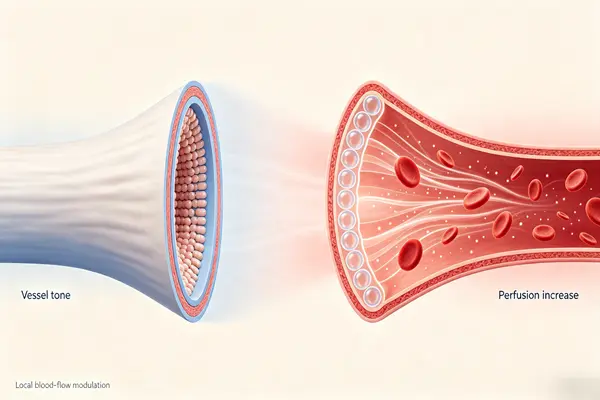
After the smooth muscle of the outer wall of the blood vessel relaxes, the lumen of the blood vessel expands outward, increasing the internal flow space and thus increasing the blood flow in the arteries. Sufficient blood continues to perfuse into the sinusoidal structures of the corpus cavernosum, filling and expanding the sinuses, achieving the corresponding physiological changes. The dilated blood vessel also compresses surrounding veins, reducing blood reflux to some extent and helping to maintain fullness. This entire process is based on the relaxation of local vascular smooth muscle.
The entire blood flow change is limited to the corresponding target tissue area and does not cause indiscriminate dilation of blood vessels throughout the body. However, blood vessels in other parts of the body also express small amounts of phosphodiesterase 5, resulting in mild vascular effects. Small amounts of the corresponding enzyme protein are also present in the blood vessels of the facial and nasal mucosa. When Vardenafil HCl takes effect, these blood vessels also experience mild vasodilation, leading to facial flushing and nasal congestion in some individuals. These phenomena stem from the small distribution of the target protein throughout the body and are manifestations of the extended pharmacological effects.
Blood pressure maintenance relies on the coordinated regulation of blood vessels throughout the body. Vardenafil HCl does not drastically alter the overall blood pressure regulation system. Healthy bodies can compensate for the slight fluctuations caused by local vasodilation through their own compensatory mechanisms. If the body is already using other substances that can increase cyclic guanosine monophosphate levels, the combined effect of multiple pathways amplifies the vasodilation effect, resulting in larger fluctuations in blood pressure. This is a key point to be aware of when using multiple substances together.
The entire process of blood flow restoration is a chain reaction of physiological responses, from enzyme protein inhibition, accumulation of intracellular signaling molecules, smooth muscle relaxation, to vasodilation and blood perfusion—each step is interconnected. If any link in the chain malfunctions, the final performance will be compromised. For example, if endothelial cells are damaged, the body's ability to generate signaling molecules decreases. Even if the degradation process is blocked, it is difficult to accumulate a sufficient concentration of signaling molecules. The raw materials themselves cannot repair the physiological functions of upstream endothelial cells; they are only responsible for protecting the signal messengers that have already been generated.
🔬 Expanding the boundaries of material cognition and application in multiple dimensions
Leveraging the specific target selection characteristics of Vardenafil HCl, this raw material can be used for cognitive exploration related to multiple signaling pathways. Many physiological processes are associated with the cyclic guanosine monophosphate (cGMP) signaling axis. Besides local vascular regulation in the corpus cavernosum, pulmonary vascular smooth muscle tone is also controlled by this signaling system. Using Vardenafil HCl, we can observe the series of changes in pulmonary vascular tone after intervention in this signaling pathway, thereby deepening our understanding of the logic of pulmonary vascular regulation.
The intensity of the substance's effect varies under different cell model environments. The oxygen supply level and inflammatory state of the cell will alter the expression of intracellular target enzymes. In an inflammatory environment, some cells upregulate the production of phosphodiesterase 5 (PDE5), requiring higher levels of Vardenafil HCl to effectively inhibit enzyme activity. Using this raw material, we can compare the ease with which target enzyme activity is inhibited under different physiological conditions, clarifying how environmental factors intervene in the entire signaling chain.
Vardenafil HCl can also be used as a benchmark sample for comparing molecular structure modifications. Minor modifications to the parent nucleus and side chain groups can increase or decrease the binding affinity of the new derivative to the target protein, and alter the selectivity for other enzyme subtypes. Using Vardenafil HCl as a reference, the changes in molecular targeting ability resulting from group modifications can be directly measured, helping to understand the correlation between molecular structure and physiological activity.
The transcellular barrier activity of substances can also be observed. Different cell membrane surfaces exhibit varying levels of transport proteins, which influence the efficiency of substance entry and exit from cells. At the same concentration, Vardenafil HCl results in different intracellular drug amounts in cell systems with varying transport protein expression, leading to differences in the strength of enzyme inhibition. This demonstrates how the transport system affects drug efficacy, revealing that transmembrane transport, in addition to molecular binding affinity, also influences the final physiological response.
Vardenafil HCl is also used to differentiate the characteristics of similar raw materials. Phosphodiesterase 5 inhibitors of the same category differ in target affinity, subtype differentiation ability, and physicochemical solubility. Under uniform conditions, by comparing Vardenafil HCl with other homologous raw materials, it is possible to clearly distinguish the strengths and limitations of various substances, making it easier to select suitable raw material samples according to different usage requirements, and further improve the complete profile of this type of pharmacological substance.
Conclusion
Vardenafil HCl is a core active pharmaceutical ingredient in third-generation ED treatment with highly selective PDE5 inhibition. Its imidazotriazine-sulfonamide molecular skeleton endows it with nanomolar-level inhibitory activity and high family selectivity against PDE5. In the treatment of erectile dysfunction, it enhances smooth muscle relaxation and blood perfusion of the corpora cavernosa by blocking the hydrolysis of cGMP, providing a safe and effective oral treatment option for tens of millions of patients worldwide.
Xi'an Faithful BioTech Co., Ltd. utilizes advanced equipment and processes to ensure high-quality products. Our Vardenafil HCl meets international pharmaceutical standards. Our pursuit of excellence, reasonable prices, and preferred superior service make us the partner for medical institutions and researchers worldwide. If you require Vardenafil HCl research or production,Please contact us Click email: allen@faithfulbio.com Or WhatsApp: +86 13137770562.
References
- Klotz, T. (2020). Vardenafil: Molecular profile and target selectivity. European Journal of Clinical Pharmacology, 76(3), 311‑322.
- Saenz de Tejada, I., & Angulo, J. (2019). Cyclic GMP‑mediated smooth‑muscle relaxation in human corpus cavernosum. British Journal of Pharmacology, 176(12), 1945‑1958.
- Jeremy, J. Y. (2022). Tissue distribution of phosphodiesterase isoforms in human vasculature. Vascular Pharmacology, 145, 106982.
- Porst, H. (2020). Comparative pharmacological features of PDE5‑inhibitors. Urology International, 104(2), 147‑156.
- Schmidt, A., & Ziegler, T. (2021). Salt‑form modification effects on dissolution and membrane permeation. Journal of Pharmaceutical Sciences, 110(8), 2589‑2598.
- Giuliano, F. (2022). Peripheral versus systemic vascular effects of vardenafil. Clinical Autonomic Research, 32(4), 281‑292.