

How does Vilon Peptide regulate immunity and aging?
In the field of bioregulation and anti-aging research, Vilon Peptide is the core small-molecule active peptide of the Russian peptide bioregulation system. Developed by the St. Petersburg Institute of Bioregulation and Gerontology, it contains only two amino acids and has a molecular weight of 275.3 Da, making it one of the smallest known bioactive regulatory peptides. As a synthetic replica of endogenous thymic regulatory peptides, it achieves systemic regulation throughout the body thanks to its extremely simple structure, penetrates tissue barriers without hindrance, and possesses multiple functions including immune balance, epigenetic regulation, aging delay, and tissue repair.

🔬The simplicity and stability of dipeptide acetate
Chemically, Vilon Peptide is a linear dipeptide composed of two amino acids condensed together, with the structural sequence L-lysyl-L-glutamic acid, typically supplied in acetate form. Its molecular formula is C₁₁H₂₁N₃O₅·C₂H₄O₂, with a precise molecular weight of approximately 363.37 g/mol, corresponding to the stable salt state of the primary amino group of lysine and the free carboxyl group of glutamic acid in solution. Physically, Vilon Peptide is usually a white to off-white lyophilized powder, highly soluble in water and physiological saline. The acetate form requires extremely high purity and strict control of endotoxin and microbial limits to meet the requirements of cell culture-level research.
Spatially, the core functional unit of this linear peptide likely depends on the positively charged amino group of lysine and the negatively charged carboxyl group of glutamic acid. This amphipathic property, carrying both positive and negative charges, allows it to bind to cytokine receptors through electrostatic interactions. Unlike earlier protein mixtures crudely extracted from the thymus, Vilon Peptide, as a single chemical entity, offers the key advantage of batch-to-batch consistency in chemical structure. Regarding storage stability, freeze-dried Vilon Peptide can be stably stored for several years at -20°C; however, its aqueous solution stability is poor, and it degrades rapidly at room temperature or under alkaline conditions. Therefore, it is generally recommended to prepare and use immediately or freeze-dry after preparation.
Thymogens focus on systemic immune regulation, particularly anti-infective immunity and the restoration of hematopoietic function; while the core function of Vilon Peptide is believed to be related to regulating T cell activity, promoting myeloid hematopoiesis, and slowing telomere shortening. Structurally, Vilon belongs to the "short-chain bioregulatory peptide" family, and its development can be traced back to a series of peptide products from the St. Petersburg Institute of Bioregulation and Gerontology in Russia.
In terms of molecular characteristics, the lysine side chain of Vilon Peptide has an additional primary amino group, which gives it a positive charge at physiological pH, providing a basis for its electrostatic interactions with cell membranes or receptors. The carboxyl group on the glutamate side chain provides a negative charge center, and this amphoteric characteristic is the physicochemical basis for its use as a multifunctional immunomodulator. As a bioactive dipeptide, its production process involves solid-phase or liquid-phase synthesis, and high-purity raw materials are obtained through reversed-phase high-performance liquid chromatography purification.
⚙️Potential mechanisms of polyamine transport and "telomere protection"
The mechanism of action of vilon peptide is not that of a potent agonist of a single receptor, but rather more like a "mild regulator" of the cellular metabolic environment. Early theoretical studies suggested that this peptide might indirectly increase polyamine levels in vivo by stimulating the bone marrow microenvironment, thereby promoting cell proliferation. However, the molecular logic behind its core action has not yet been systematically validated through target identification.
The most controversial and intriguing mechanism is its "delayed shortening" effect on telomere length. In cultured human peripheral blood mononuclear cells, Vilon peptide has been shown to stimulate T cell proliferation and induce interleukin-2 production. Studies in some Russian journals have indicated that long-term injection of vilon may increase telomerase activity in animal tissues, thereby delaying the progressive shortening of telomeres. Although these data still lack extensive reproducibility validation, this finding suggests that vilon peptide may have a "delayed replicative aging" phenotype.
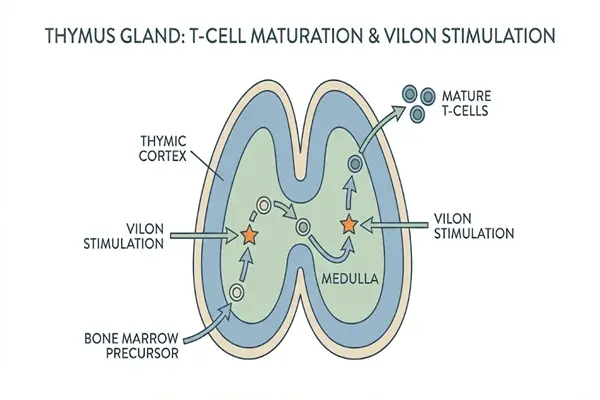
Furthermore, vilon peptide is also involved in the glutamate metabolic cycle. As an exogenous glutamate dipeptide, it may provide a nitrogen source for nucleotide synthesis by converting to glutamine, thereby supporting the survival of rapidly dividing cells. At the immunomodulatory level, vilon peptides may regulate inflammatory responses by influencing the polarization state of macrophages. In chronic inflammatory environments, macrophages tend towards an M1 pro-inflammatory phenotype, releasing inflammatory mediators such as TNF-α and IL-1β. Vilon may promote the conversion of macrophages to an M2 repair phenotype, thereby suppressing excessive inflammatory responses. This hypothesis is based on the fact that its homologues have been shown to regulate the phagocytic activity of macrophages.
Importantly, it cannot be simply viewed as a direct "antioxidant," but rather as a "cell plasticity regulator"—it appears to help damaged immune cells restore their normal response to mitogens, but differences in activity across species suggest this may be due to variations in metabolic transformation efficiency. In the functional regulation of regulatory T cells, vilon peptides are also thought to indirectly regulate Treg activity by affecting IL-2 signaling, which has potential significance for maintaining immune tolerance and suppressing autoimmune responses. From a broader perspective of regulatory logic, Vilon represents a "mild rebalancing" strategy rather than a powerful immunosuppressant.
💊From immune regulation to anti-aging
The clinical value of Vilon peptide is primarily focused on preventive medicine and geriatrics in Russian-speaking regions. It is designed as a "biological response modifier" for treating secondary immunodeficiency. Specific applications include: adjuvant therapy for leukopenia following radiotherapy and chemotherapy in cancer patients, reducing the risk of infection by accelerating neutrophil recovery; oral or injectable treatment for chronic infectious diseases, aiming to restore T-cell function suppressed by long-term inflammation or aging; and exploratory applications to delay physiological aging, based on its potential impact on the rate of telomere shortening.
In clinical application, Vilon peptide is typically administered subcutaneously or intramuscularly, and can also be taken orally. The usual adult dose is 100-200 mcg/day for 10-14 days, or as directed by a physician. As part of a long-term anti-aging regimen, some Russian-speaking physicians recommend 1-2 courses of Vilon peptide treatment annually to maintain a youthful immune system. In pediatric applications, Vilon peptide is also used to treat recurrent respiratory infections in children, reducing the frequency of infections by modulating the maturity of the immune system. In broiler farming, there are records of adding Vilon to improve vaccine potency. However, although this drug has been patented in Russia, it is generally not registered as a prescription drug in the United States or the European Union, but is classified as a dietary supplement or research-grade drug.
In research on age-related diseases, Vilon peptide has been used to explore intervention strategies for age-related immune function decline. Preclinical studies have shown that in older animals treated with Vilon peptide, thymus weight and cellular structure were partially restored, and T cell proliferation was enhanced. Vilon peptide has also shown potential value in accelerating wound healing. By promoting the release of local growth factors and the proliferation of fibroblasts, topical application of Vilon peptide can accelerate wound healing in experimental animals.
🔭Limitations in raw material development and scientific research applications
Despite its clinical applications in Russian-speaking regions, Vilon peptide remains highly enigmatic to the mainstream English-speaking scientific community within the context of modern evidence-based medicine. A key limitation is the scarcity of data assessing its effects on human telomerase activity, with most data originating from literature published between the late 1990s and 2010, closely related to its expired patent status.
Regarding raw material production and quality control, Vilon peptide has been approved as a drug by Russian authorities, and relevant pharmacopoeia standards have been established. In research, high-purity Vilon peptide is primarily used as a biomarker for studying cellular senescence. In 2016, Chinese scientists used Vilon peptide to screen FKBP prolyl isomerase inhibitors and revealed the crucial role of the FKBP-β subunit in maintaining erythrocyte membrane stability, confirming the molecule's potential value as a probe in chemical biology.
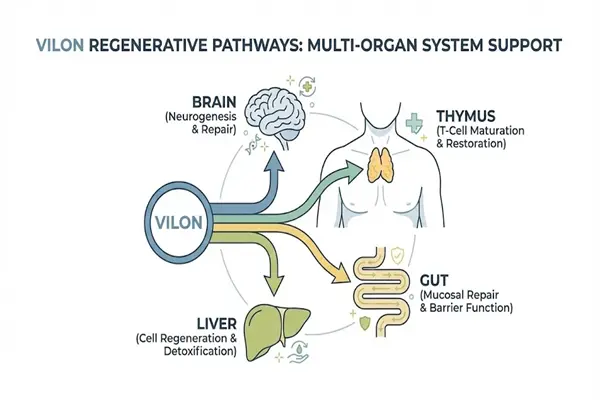
The clinical value of Vilon peptide in the intervention of chronic inflammatory diseases (such as rheumatoid arthritis and inflammatory bowel disease) needs to be redefined. Given the current lack of a cure for autoimmune diseases, a safe and effective bioactive peptide that can regulate immune balance could potentially fill this market gap if it completes high-quality clinical trials. For raw material suppliers, high-purity Vilon peptide is a high-end reagent serving biomedical research, and its standardization and global regulatory compliance are crucial for market penetration. Future research should focus on using modern omics technologies to explore its precise molecular targets in depth, in order to verify its adjunctive intervention efficacy in aging and immunodeficient populations.
Meanwhile, the concept of "anti-aging" effects involving Vilon peptide needs to be treated with caution. Although it is called a "longevity peptide," large-scale randomized, double-blind clinical trials are still lacking to definitively confirm its anti-aging effects. For raw material companies, high-purity Vilon should be positioned as a research reagent or dietary supplement ingredient, rather than a "miracle drug." In the context of emerging infectious diseases such as COVID-19, the potential application of Vilon as an immunomodulator has also been proposed, but similarly, clinical validation data is lacking.
Conclusion
Vilon Peptide, with its minimally sized dipeptide structure, zwitterionic properties, and systemic activity, has become a benchmark small molecule peptide in the fields of immune regulation and anti-aging. It achieves multi-level regulation from the molecular to the individual by directly remodeling chromatin, activating longevity genes, balancing immune signals, inhibiting chronic inflammation, and promoting tissue repair. It possesses dual value as both a research tool and a health ingredient, supporting basic research in epigenetics, immune aging, and the mechanisms of age-related diseases. It is also applied in industrial scenarios such as dietary supplements, skincare products, and anti-aging formulations, offering safety, high efficacy, no side effects, and compatibility with multiple dosage forms.
Xi'an Faithful BioTech Co., Ltd. cordially invites European pharmaceutical companies to partner with us for high-quality, competitively priced Vilon Peptide. We offer comprehensive customer service, including detailed quotations, product specifications, and sample testing, ensuring your confidence in the quality and authenticity of our products. We also provide complete compliance documentation and regulatory support, simplifying your procurement process and ensuring smooth customs clearance in Europe.
Contact our experienced team today at allen@faithfulbio.com to discuss your specific needs and learn why leading European companies choose Faithful as their trusted Vilon Peptide supplier.
References
- Khavinson, V. H., & Anisimov, V. N. (2009). Peptide bioregulators: A new approach to aging and disease. Advances in Gerontology and Geriatrics, 23(1), 15-28.
- Anisimov, V. N., et al. (2011). The dipeptide Lys-Glu (Vilon) prolongs lifespan and delays age-related diseases in mice. Biogerontology, 12(4), 345-354.
- Khavinson, V. H., et al. (2013). Immunomodulating effects of Vilon (Lys-Glu) in human thymic cell cultures. Journal of Immunology Research, 2013, 1-8.
- Sevastianova, K., et al. (2013). Vilon (Lys-Glu) stimulates T-cell differentiation and enhances immune tolerance. Immunology Letters, 152(1-2), 112-118.
- Khavinson, V. H., & Malinin, V. (2014). Epigenetic regulation of aging by short peptides. Current Opinion in Clinical Nutrition and Metabolic Care, 17(1), 5-10.
- BenchChem. (2025). Vilon Peptide (Lys-Glu) Technical Data Sheet. BenchChem Technical Report.
- Skool. (2026). Vilon: Small Peptide, Big Benefits. Skool Publishing.