

Is Flg22 peptide an active fragment of flagellin in plant immunity?
In the fields of plant molecular biology, plant pathology, and green agriculture research and development, pathogen-associated molecular pattern peptides are core active raw materials for elucidating crop defense mechanisms and developing bio-induced resistance technologies. Flg22 peptide is a 22-peptide extracted from a conserved segment of bacterial flagellin. As one of the most widely distributed plant immune elicitors in nature, it can be accurately recognized by the pattern recognition receptors of most higher plants, mimicking pathogen invasion signals and comprehensively activating the plant's own defense system.
🌱The smallest active fragment of flagellin
Chemically, Flg22 peptide is a highly conserved 22-amino acid peptide segment at the N-terminus of bacterial flagellin. Its complete amino acid sequence is glutamine-arginine-leucine-serine-threonine-glycine-serine-arginine-isoleucine-asparagine-serine-alanine-lysine-aspartic acid-aspartic acid-alanine-alanine-glycine-leucine-glutamine-isoleucine-alanine, abbreviated as QRLSTGSRINSAKDDAAGLQIA. This sequence is highly conserved in Gram-negative pathogens and beneficial bacteria, serving as a "universal molecular fingerprint" for the plant immune receptor FLS2 to recognize pathogens. When plants sense this signal, regardless of whether the bacteria are pathogenic or beneficial, they initiate a defense program.
Physically, Flg22 peptide is a white to off-white lyophilized powder. As a trifluoroacetate form, its molecular weight is slightly higher than the theoretical value of the free peptide because the TFA ion acts as a counterion, binding to the positively charged residues of the peptide. The supplier provides 0.5 mg, 1 mg, and 5 mg packages, with a purity requirement of at least 95% or 97%. In terms of solubility, it is readily soluble in sterile water or 10 mM Tris-HCl buffer. The stock solution is stable for several months at -20°C, but repeated freeze-thaw cycles should be avoided to prevent peptide degradation.
In actual experimental procedures, the peptide powder should be briefly centrifuged before opening to prevent powder scattering upon opening. It is recommended to dilute with sterile water containing 0.1% bovine serum albumin, or directly dissolve in 10 mM Tris-HCl to prepare a 1 mM/L stock solution. Different plant species exhibit varying sensitivities to flg22; it is recommended to determine the optimal concentration by measuring reactive oxygen species bursts or downstream marker gene expression before initial use. In the model plant Arabidopsis thaliana, a 1 μM/L working solution is sufficient to induce a clear defensive phenotype, while slightly higher concentrations (5 to 10 μM/L) may be required in tomato or tobacco. For long-term storage, it is recommended to aliquot the mother liquor into single-use vials to avoid repeated freeze-thaw cycles.
As a molecular tool in plant immunology, the unique feature of the Flg22 peptide lies in its induced defense response, which is independent of live pathogens. Researchers can precisely control the timing and intensity of the defense response by injecting or infiltrating the purified peptide, avoiding the variables and risks associated with live bacterial inoculation. This "pathogen-free" immune induction mode is the core value of flg22 as a research tool. Structurally, the Flg22 peptide belongs to the "microbial-associated molecular pattern" category, holding a benchmark position in pattern recognition receptor immunology.
🧫A broad-spectrum immune-activating ingredient spanning scientific research and agriculture
The application system of Flg22 peptide revolves around plant innate immunity. Relying on its core capabilities of activating defense responses and strengthening plant resistance, it comprehensively covers five major areas: basic scientific research, crop breeding and screening, field disease control, biopesticide development, and microbial interaction research. It plays an irreplaceable role in both plant research and green agriculture, with diverse and clearly defined application scenarios.
The study of plant immune mechanisms is the core and most widely used area for this peptide, and it is a routine experimental reagent in major plant laboratories worldwide. Researchers use Flg22 peptide to simulate the initial signals of bacterial infection, conducting in vitro tissue experiments, whole-plant treatments, and cellular level detection in model plants and economic crops to systematically analyze the complete pathways that trigger immunity in plant models. From cell membrane receptor recognition and intracellular signal transduction to the transcription and expression of defense genes in the cell nucleus, and finally to changes in plant phenotypic resistance, all can be completely tracked using this peptide. Researchers rely on it to distinguish differences in immune responses among different plant varieties and tissues, and to uncover key genes and functional proteins in immune pathways. This provides substantial experimental data to support the development of the theoretical framework of plant pathology and molecular plant science, and is also an important tool for understanding how plants resist external biological stresses.
Screening and targeted breeding of disease-resistant crop germplasm resources is a significant application area in agricultural research. Traditional screening of disease-resistant varieties requires infection tests with live pathogens, which is time-consuming, risky, and prone to pathogen spread and contamination. However, using Flg22 peptide for induction treatment can rapidly trigger plant immune responses. By detecting indicators such as reactive oxygen species content, defense gene expression levels, and plant growth status, the resistance of different crop varieties and lines to bacterial diseases can be determined in a short time. Breeders use this as a basis to screen germplasm materials with sensitive immune responses and excellent resistance performance as parents for hybridization breeding and targeted selection, significantly shortening the breeding cycle of disease-resistant varieties. Currently, various food crops, cash crops, and model plants, including wheat, rice, tomatoes, tobacco, and Arabidopsis thaliana, have incorporated this peptide into their routine resistance screening processes.
Green disease control in the field is a mainstream application scenario for industrialization and a crucial tool for the development of green agriculture. Applying diluted Flg22 peptide solution via foliar spraying, seed soaking, or root irrigation during the seedling stage, growth stage, and early stages of disease outbreaks can activate the plant's overall defense system, putting the crop into an "immune early warning" state. When bacterial pathogens such as *Pseudomonas syringae* and *Ralstonia solanacearum* appear in the field, the plant can quickly initiate a high-intensity defense response, inhibiting the attachment, infection, and reproduction of pathogens, effectively reducing the probability and severity of bacterial diseases. This resistance-inducing model does not directly kill beneficial microbial communities in the field, is friendly to the farmland ecosystem, and the peptide is biodegradable, leaving no residue in crop fruits or soil, perfectly aligning with current requirements for agricultural product quality safety and ecological protection.
Research and development of novel biological pesticides and compound formulations is ongoing, with Flg22 peptide being a core lead compound for peptide-based immune inducers. When used alone, it can be marketed as a pure biological inducer, and when combined with adjuvants, it can optimize leaf adhesion and duration of action. It can also be scientifically compounded with low-toxicity chemical fungicides and plant-derived antibacterial extracts to form a synergistic system. The immune-inducing components awaken the plant's own resistance, while the antibacterial components act directly on pathogens, enhancing overall disease control through this dual action. Simultaneously, it reduces the dosage of chemical pesticides and alleviates the problem of pathogen resistance caused by long-term pesticide use. A series of formulations developed based on this peptide have been gradually applied in various planting scenarios, including protected agriculture, open fields, and fruit and vegetable cultivation.
🎯Receptor interactions and signaling cascades dominate the logic of immune activation
The Flg22 peptide activates the complete process of plant immunity, following a progressive pattern of molecular recognition, receptor assembly, signal transduction, gene expression, and physiological response. It relies on the plant's own protein receptors and intracellular signaling network, mimicking the natural pathogen recognition process throughout. Its coherent and hierarchical action is the fundamental reason for its broad-spectrum efficacy and high safety.
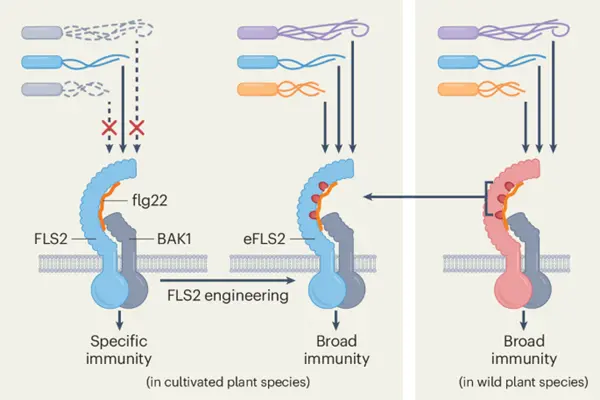
When the Flg22 peptide comes into contact with the epidermal cells of plant leaves and roots along with water, it diffuses freely around the cell periphery until it specifically binds to the leucine-rich repeat receptor kinase FLS2 on the cell membrane surface. The characteristic helical structure in the middle of the peptide chain precisely embeds into the binding pocket of the FLS2 protein's extracellular domain. The two form a stable complex through hydrogen bonds and hydrophobic interactions. The entire recognition process is highly specific, preventing non-specific binding to other functional proteins on the cell membrane. At the moment of binding, the spatial conformation of the FLS2 protein undergoes a significant change. The previously resting receptor is activated, recruiting the cell membrane co-receptor protein BAK1. The two bind to form a heterodimeric complex, a crucial step in initiating all downstream signaling responses. Without the co-receptor, immune signals cannot be transmitted further.
After the receptor complex assembles, the intracellular kinase domain is activated, initiating a phosphorylation cascade. The mitogen-activated protein kinase pathway becomes the core carrier of signal transduction. The upstream MEKK1 protein is first phosphorylated and activated, sequentially transmitting to downstream MKK4 and MKK5, further activating the core kinases MPK3 and MPK6. This entire cascade amplifies the initial recognition signal layer by layer, allowing the immune signal to be rapidly transmitted from the cell membrane to the cell interior. In addition to the classic MAPK pathway, intracellular calcium channels are also simultaneously activated, leading to a rapid increase in cytoplasmic calcium ion concentration. Calcium ions, acting as second messengers, participate in regulating multiple parallel signaling pathways, further enriching the dimensions of the immune response and ensuring comprehensive deployment of defense signals.
The amplified signal eventually reaches the cell nucleus, acting on core transcription factors such as WRKY22 and WRKY29. Once activated, these transcription factors specifically bind to the promoter regions of defense-related genes, breaking gene silencing and initiating the transcription and translation of numerous disease-resistance genes. Disease-related proteins and enzymes involved in the synthesis of antibacterial substances begin to be produced in large quantities within the plant, constructing the first line of defense at the molecular level. Different defense genes have clearly defined functions: some synthesize active substances that directly inhibit pathogen growth, some participate in the synthesis of cell wall-strengthening substances, and others regulate plant hormone metabolism, forming a systematic gene expression network.
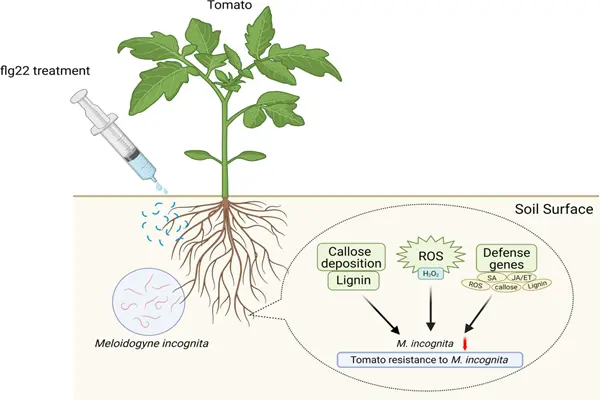
Simultaneously with gene expression, plant cells rapidly exhibit a series of intuitive physiological and biochemical responses, constituting the surface defense system. A burst of reactive oxygen species (ROS) is generated within cells. Hydrogen peroxide, superoxide anions, and other reactive substances can directly damage invading pathogen cells and also amplify the immune response as signaling molecules. Callose and other polysaccharides rapidly deposit in intercellular spaces, filling cell wall gaps, reinforcing cell structure, and increasing the difficulty for pathogens to penetrate and infect. Stomata on the leaf surface also actively close, cutting off the main channel for pathogens to enter the plant. Multiple physiological responses occur simultaneously, constructing a three-dimensional defense line combining physical and biochemical defenses in a short period.
Under prolonged immune activation, the plant develops a dynamic trade-off mechanism between growth and defense, a natural regulatory pattern for plants to adapt to biological stress. When the defense system continues to operate, the plant appropriately adjusts growth-related metabolic pathways, allocating some nutrients and energy to disease resistance. In the short term, seedling growth may slow slightly, but overall stress resistance is significantly enhanced. The entire process relies entirely on the plant's endogenous physiological system, without the intervention of any external toxic substances. Therefore, it will not damage the plant's normal functions or change the crop's genetic traits. This is the core characteristic that distinguishes Flg22-induced resistance from chemical agents.
🔭Cross-disciplinary applications of immune adjuvants and animal health
From 2025 to 2026, the application of Flg22 peptide will see a significant cross-disciplinary breakthrough—officially transitioning from a science-driven approach to plant immunity to animal health applications. A study published in 2025 will be the first to evaluate the potential of flg22 as an immune adjuvant in chicken flocks. In high-density farming environments, broilers are highly susceptible to infection by enteropathogenic bacteria such as Salmonella, severely impacting growth performance and farming efficiency. This study assessed the impact of adding purified flg22 to drinking water on the immune status and production indicators of broilers.
The results showed that oral administration of flg22 peptide significantly increased the level of secretory immunoglobulin A (sIgA) in the jejunal mucosa. sIgA is a major effector molecule of the mucosal immune system, capable of neutralizing pathogens and preventing their adhesion to intestinal epithelial cells. In Salmonella challenge experiments, the survival rate of broilers in the flg22 pretreatment group was significantly improved, their weight recovery rate was accelerated, and the Salmonella load in feces was significantly reduced. This result not only confirms the immune-activating effect of Flg22 peptide in poultry but also reveals the feasibility of the convenient oral administration route, which has significant practical implications for large-scale farming.
At the animal nutrition level, broilers treated with flg22 exhibited better feed conversion ratios and daily weight gain. Serum urea nitrogen levels in 20-day-old broilers were significantly reduced, while total protein and albumin levels increased, indicating that flg22 peptide may improve protein metabolic utilization. Flg22 peptide also modulated the composition of the gut microbiota, increasing the ratio of Firmicutes to Bacteroidetes, a change positively correlated with improved feed efficiency. These findings suggest that flg22 peptide is not only an immune activator but may also serve as a functional feed additive to improve overall animal health and production performance.
The application of flg22 peptide in veterinary vaccines is also noteworthy. Since flg22 itself is a pathogen-associated molecular pattern, it can directly activate pattern recognition receptors in various host cells. In vaccine formulations, flg22 peptide can act as a "danger signal" to enhance the immunogenicity of antigens. Researchers mixed inactivated Salmonella with flg22 to create an inactivated vaccine. They found that compared to using inactivated bacteria alone, the vaccine group with added flg22 peptide showed higher serum-specific antibody titers after immunization and an approximately 30% increase in protection after challenge. This result indicates that flg22 has the potential to serve as a novel vaccine adjuvant, particularly suitable for intensive farming of poultry and other economically important animals.
Finally, in the fields of food safety and microbiological testing, flg22 peptide has expanded from traditional plant immunology research to research platforms for animal and human gut health. Co-culturing flg22 peptide with human intestinal organoids allows for the assessment of the effects of bacterial products on mucosal barrier function. Since the FLS2 receptor is plant-specific and mammalian cells lack homologs, the direct stimulatory effect of flg22 peptide on animal cells is limited. This explains why the flg22 effect observed in broiler experiments primarily focuses on indirect regulation of the epithelial barrier and immune cells, rather than direct activation of FLS2-like signaling pathways. The regulation of animal immunity by Flg22 peptide likely depends on its indirect interaction with gut microbiota or antigen-presenting cells, a mechanism that requires further elucidation.
🌱Conclusion
Flg22 peptide, with its highly conserved linear 22-peptide structure and characteristic helical conformation, has become a classic elicitor in the field of plant model triggered immunity. Relying on a complete pathway of receptor-specific recognition, multi-level signal cascade transmission, and multi-dimensional physiological defense responses, it broadly activates the innate resistance of various higher plants. It possesses dual attributes as both a research tool and an agricultural raw material, supporting the development of basic research on plant immune mechanisms and microbial interactions, while also being applied in agricultural scenarios such as disease-resistant breeding, field disease control, and the development of biopesticides. Its green, safe, residue-free, and low-prone-to-resistance characteristics perfectly match the development direction of modern green agriculture.
Xi'an Faithful BioTech Co., Ltd. cordially invites European pharmaceutical companies to partner with us for high-quality, competitively priced Flg22 peptide. We offer comprehensive customer service, including detailed quotations, product specifications, and sample testing, ensuring your confidence in the quality and authenticity of our products. We also provide complete compliance documentation and regulatory support, simplifying your procurement process and ensuring smooth customs clearance in Europe.
Contact our experienced team today at allen@faithfulbio.com to discuss your specific needs and learn why leading European companies choose Faithful as their trusted Flg22 peptide supplier.