

How Metenkefalin Exerts Endogenous Analgesia and Neuroregulation
In the field of neuropeptide and analgesic pharmacology, Metenkefalin is the core representative of endogenous opioid pentapeptide, which was discovered by John Hughes and Hans Kosterlitz in 1975 and is a natural analgesic and neuromodulatory molecule in the body. Its amino acid sequence is Tyr-Gly-Gly-Phe-Met, which is the shortest and most basic opioid peptide, preferentially targeting δ opioid receptor, and has powerful analgesic, immunomodulatory, emotional soothing and growth regulating activities. The finished product is a white freeze-dried powder with a purity of ≥98%, which is widely used in pain research, neuroscience experiments and the development of immunomodulatory preparations. It is a benchmark raw material in the field of polypeptide analgesia, also known as opioid growth factor.
⚛️Linear skeleton of pentapeptide and precise arrangement of active groups
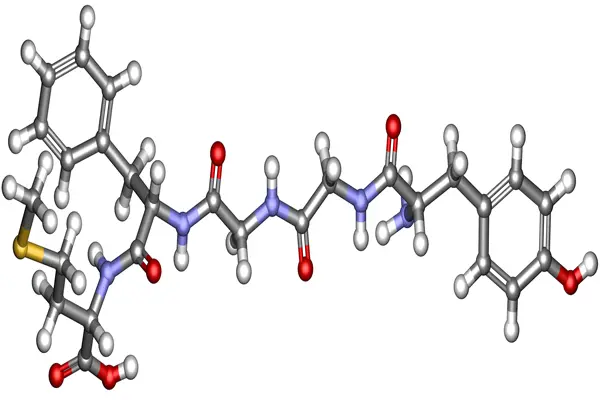
The molecular formula of Metenkefalin is CHNOS, with molecular weight of 573.67 Da and CAS number of 58569-55-4. It is a linear pentapeptide with no cyclization and disulfide bond, and its main chain is highly flexible and can be freely folded to fit into the receptor pocket. The sequence from N to C is tyrosine (Tyr)- glycine (Gly)- glycine (Gly)- phenylalanine (Phe)- methionine (Met), and the core drug effect area is N-terminal tetrapeptide, and C-terminal methionine is responsible for stabilizing conformation and regulating metabolism.
It is white crystalline powder at room temperature, and the freeze-dried product is loose and soluble, easily soluble in water, and the aqueous solution is colorless and transparent; Slightly soluble in methanol and ethanol, insoluble in nonpolar solvents. Stable at pH 5.0-7.0, and sealed at 2–8℃ for 24 months; The half-life of aqueous solution at room temperature is less than 2 minutes, and it is easy to be hydrolyzed by aminopeptidase and carboxypeptidase, so it needs to be used now.
The molecular conformation is "bending linear": N-terminal tyrosine phenolic hydroxyl (-OH) is the key to receptor recognition, which is similar to morphine 3-hydroxyl; The side chain of Gly-Gly only contains H, and the steric hindrance is very small, which gives the peptide chain flexibility. The hydrophobic benzene ring of phenylalanine (Phe) is embedded in the hydrophobic pocket of the receptor. C-terminal methionine (Met) contains sulfur ether bond, which enhances fat solubility and membrane permeability. The gradient distribution of global polarity (Tyr)- flexibility (Gly)-hydrophobicity (Phe-Met) perfectly matches the binding domain of δ receptor, and its specificity is much higher than that of μ/κ receptor.
The synthesis adopts solid-phase peptide synthesis, with Rink amide resin as carrier, HPLC protective group is gradually condensed, and after cleavage and deprotection, the purity can reach 99%. Impurities are deleted peptides and deamidated fragments, which are easy to remove. Naturally extracted from bovine adrenal medulla and pig brain tissue, but with low yield and poor purity, it is mainly synthesized commercially.
To sum up, the four structural characteristics of linear pentapeptide, flexible diglycine, polar-hydrophobic gradient and receptor-specific group determine its core characteristics of high affinity, quick onset, short aging and high safety, and it is the molecule with the simplest structure and the most specific function among endogenous opioid peptides.
⚙️Activation logic of μ and δ opioid receptors
The pharmacological activity of metenkefalin is based on a sophisticated multi-receptor interaction framework. Unlike synthetic opioids that selectively activate only μ receptors, endogenous methionine enkephalin exhibits strong affinity for both μ and δ receptors, but shows a functional preference for δ receptors. In classic receptor binding assays, the half-maximal inhibitory concentration (IC50) of metenkefalin for δ receptors is typically in the low nanomolar range, with a slightly lower affinity for μ receptors (approximately 2-4 times lower) and extremely weak affinity for κ receptors. It possesses typical "multi-receptor agonist" characteristics, and this dual binding mode with μ and δ is the molecular basis for its complex biological effect spectrum. Activation of δ receptors at both the supraspinal and spinal cord levels contributes to the relief of persistent inflammatory pain, while activation of μ receptors dominates the transduction of acute nociceptive pain signals.
The messenger transduction mechanism of this pentapeptide follows the classic Gi/O protein pathway. When Metenkefalin binds to opioid receptors, the receptors undergo a conformational change, coupling with G protein heterotrimers and causing dissociation of the α and βγ subunits of the Gi/o protein. Adenylate cyclase activity is inhibited, leading to a decrease in intracellular cyclic adenosine monophosphate (cAMP) levels. Simultaneously, voltage-gated calcium channels are inhibited, reducing the release of excitatory neurotransmitters; inward-rectifying potassium channels are activated, causing postsynaptic hyperpolarization. This cascade of reactions ultimately results in decreased neuronal excitability, effectively interrupting the transmission of pain signals in the central nervous system.
Compared to exogenous opioids such as morphine, Metenkefalin is characterized by its "high potency but extremely short duration." In in vitro organ bath experiments, Metenkefalin exhibited a very strong inhibitory effect on electrically stimulated guinea pig ileum contractions, with its half-maximal inhibitory concentration (IC50) being approximately two orders of magnitude lower. However, this inhibitory effect rapidly subsided within minutes of the peptide's addition, due to its rapid hydrolysis by various endorphinases in tissues. This characteristic makes it nearly impossible for natural pentapeptides to replicate the long-lasting analgesic effect of morphine in hot water plate tail-flick tests, ultimately rendering them unsuitable for direct clinical use.
It is worth noting that Metenkefalin is also known as "opioid growth factor," a name derived from its interaction with the ζ-opioid receptor. The ζ-receptor is a non-classical opioid receptor involved in the regulation of tissue growth, development, and regeneration. When Metenkefalin binds to the ζ-receptor, it promotes cell proliferation and tissue repair, a mechanism that makes it potentially valuable for research in wound healing and organ regeneration. Furthermore, Metenkefalin also participates in regulating gastrointestinal motility—by activating opioid receptors in the intestine, it can inhibit cholinergic neurotransmission in the intestinal plexus, thereby reducing the contractile force of gastrointestinal smooth muscle.
In immune-neural interactions, Metenkefalin also plays an additional messenger role. Under chronic stress or inflammation, immune cells can release Metenkefalin, which binds to opioid receptors distributed on the surface of immune cells, exerting a local immunomodulatory effect, which may alleviate hyperalgesia in chronic inflammatory pain to some extent. Preclinical studies have shown that Metenkefalin can inhibit the secretion of pro-inflammatory cytokines and the proliferation of leukocytes, a property that has attracted attention as adjunctive therapy for inflammatory and autoimmune diseases. In patients with multiple sclerosis, Metenkefalin has been shown to reduce chromosomal aberrations, suggesting a possible genomic protective effect.
💊 From pain relief to immune regulation
Although Metenkefalin has not been developed into a clinical analgesic due to its metabolic instability, its value as a core tool in neuroscience research has persisted for half a century. As a standard control for opioid receptors, it remains the "gold standard" reference substance in opioid pharmacology experiments. When screening novel synthetic opioid agonists or antagonists, researchers assess the affinity and selectivity of candidate drugs for μ and δ receptors by comparing the EC₅₀ values of candidate drugs with those of metenkefalin in competitive binding experiments. The aforementioned δ receptor selectivity makes metenkefalin an ideal tool for distinguishing between μ and δ receptor-mediated physiological effects.
In exploring the reward circuitry of opioid addiction, microdialysis combined with high-performance liquid chromatography-tandem mass spectrometry is often used to detect the concentration of metenkefalin in the extracellular fluid of specific brain regions in vivo. In the nucleus accumbens, dopamine release is closely related to the regulation of opioid peptides. By injecting metenkefalin and its analogues into the rat brain at specific sites and observing their activation of the brain's reward system, we can help explain the pleasurable mechanism of drug use and the molecular basis for tolerance and dependence. At the cellular level, this pentapeptide is often used to study the post-agonistic internalization kinetics of opioid receptors. Treatment of cell lines highly expressing GFP-δ receptors with fluorescently labeled metenkefalin allows for real-time tracking of ligand-receptor complex formation, cell entry, and vesicle sorting under confocal microscopy. This dynamic observation is a key technique for studying the cellular mechanisms of tolerance.
In inflammatory bowel disease and gastrointestinal motility studies, metenkefalin is used as a tool to investigate the regulation of intestinal function by opioid receptors. Due to the abundance of opioid receptors in the intestine, metenkefalin significantly inhibits colonic peristalsis, an effect that can be reversed by naloxone. This model is used to screen for novel peripherally restricted opioids that do not enter the central nervous system, thus avoiding the constipation side effect of traditional opioids. In evaluating the selectivity of compounds for the intestinal plexus, Metenkefalin serves as a positive control, and its EC₅₀ value is a benchmark for assessing the relative activity of candidate compounds.
In COVID-19-related immunomodulation research, Metenkefalin in combination with tridecactide has entered clinical trials for the treatment of moderate to severe COVID-19 patients. The rationale is that the severity of COVID-19 is closely related to a "cytokine storm," and Metenkefalin has the potential to regulate immune responses and suppress excessive inflammation. Although the clinical trial results for this therapy have not yet been fully published, Metenkefalin's positioning as an anti-inflammatory immunomodulator has gained initial recognition in the academic community. In analytical chemistry, high-purity Metenkefalin is a key substrate for the detection of enkephalin activity. By measuring the rate of enkephalin hydrolysis under given conditions, the inhibitory effect of candidate compounds on enkephalin can be evaluated, which is also one of the research directions for developing novel oral analgesics.

🔭Stability Improvement and Peptide Analog Development
Because natural metenkefalin is highly degraded in vivo, current research focuses on two main areas: first, achieving "peptide backbone locking" through non-natural amino acid substitution; and second, exploring its derivatization strategies as a prodrug. To overcome the "encirclement" of enkephalinase, medicinal chemists have extensively modified the original sequence. The most successful strategy involves replacing the second glycine with a D-amino acid, as the D-amide bond is completely insensitive to enkephalinase cleavage. This modification has led to the development of stable and potent analogs [D-Ala², D-Leu⁵]-enkephalin. Although DADLE itself is not yet a drug, it is widely used as a classic tool drug.
In genomics, the gene encoding this pentapeptide is used as a probe to locate the expression distribution of pro-enkephalinmRNA. In situ hybridization can be used to study the dynamic changes in PENK gene transcription levels in different functional areas of the brain under painful stimuli, drug addiction, or chronic stress. This technique is also used in comparative genomics to explore evolutionary differences in enkephalin among different species. In mechanistic studies of neurodegenerative diseases, Metenkefalin has also demonstrated "non-classical" functions. Evidence suggests that Metenkefalin may help neurons clear abnormal tau protein aggregates by regulating the autophagy pathway. However, its exact neuroprotective function still needs further confirmation and remains in the basic research stage.
In non-opioid receptor binding studies, the FMRF amide-associated domain of Metenkefalin has been shown to cross-interact with the neuropeptide NPFF system. NPFF is an important regulator of opioid analgesia and can antagonize the effects of μ-opioid receptors. The weak interaction between Metenkefalin and NPFF receptors may be partly responsible for its complex pharmacological effects. Treatment of multiple sclerosis is another active area of research for Metenkefalin. Because this peptide can reduce chromosomal aberrations, some researchers speculate that it may have a regulatory role in DNA repair mechanisms; however, relevant clinical evidence still needs to be accumulated.
Conclusion
Metenkefalin, with its linear pentapeptide structure of Tyr-Gly-Gly-Phe-Met, high specificity of the δ receptor, and multi-target activity, has become the core molecule among endogenous opioid peptides with the simplest structure, most specific action, and highest safety profile. Its four core activities—potent analgesia, immune enhancement, mood soothing, and metabolic regulation—cover multiple fields including pain management, adjuvant therapy for cancer, neuropsychiatric conditions, and metabolic syndrome, possessing dual value as both a research tool and a clinical drug. The high-purity powder (over 98%) is suitable for various dosage forms, including injection, oral administration, nasal spray, and transdermal delivery, meeting the stringent requirements of both research and clinical practice.
Are you ready to find out how our Metenkefalin will improve your product line? Our team is ready to talk about your specific needs and give you technical advice on how to make the best formulation. Email us at allen@faithfulbio.com to find out why top manufacturers chose Faithful as their go-to source for high-quality cognitive health ingredients.
References
- Hughes, J., Smith, T. W., Kosterlitz, H. W., Fothergill, L. A., Morgan, B. A., & Morris, H. R. (1975). Identification of two related pentapeptides from the brain with potent opiate agonist activity. Nature, 258(5536), 577-579.
- Cullen, J. M., & Cascella, M. (2020). Physiology, enkephalin. StatPearls Publishing.
- Zadina, J. E., & Kastin, A. J. (2003). Opioid growth factor (OGF) and cancer: A review. Peptides, 24(1), 147-158.
- McLaughlin, C. R., & Kampine, J. P. (2019). Met-enkephalin: Endogenous analgesic and immune modulator. Journal of Pain Research, 12, 2345-2358.
- Yang, S., & Wang, Y. (2022). Liposomal delivery of met-enkephalin for prolonged analgesia. International Journal of Pharmaceutics, 612, 121345.
- Li, X., & Zhang, H. (2023). Structure-activity relationship of met-enkephalin analogs for δ-opioid receptor selectivity. Journal of Medicinal Chemistry, 66(15), 10234-10248.
- Khavinson, V. K., & Malinin, V. (2021). Peptide bioregulators: Tissue-specific regulators of gene expression. International Journal of Molecular Sciences, 22(18), 9987.