

Is lambda-cyhalothric acid the core chiral intermediate for highly efficient cyhalothrin?
In modern agriculture and public health pest control, pyrethroids hold a pivotal position due to their high efficiency, low toxicity, broad spectrum, and rapid knockdown activity. Lambda-cyhalothric acid is a key acid fragment in the construction of mainstream pyrethroids such as lambda-cyhalothrin, determining the stereoconfiguration, insecticidal activity, and stability of the finished product. As a cyclopropane carboxylic acid intermediate specific to Type II pyrethroids, it possesses three major characteristics: a highly active cis configuration, strong lipophilicity due to fluorinated chloride substitution, and a light-stable backbone. It is one of the most widely used and technologically mature cyhalothric acids globally, supporting tens of thousands of tons of pyrethroid technical production capacity, and is widely used for the control of agricultural pests, public health pests, and ectoparasites in animals.
🧪Molecular profile of fluorinated permethrin skeleton
Lambda-cyhalothric acid is chemically the carboxylic acid component of lambda-cyhalothrin, belonging to the cyclopropane carboxylic acid class of compounds. Its chemical name is (Z)-(1R,cis)-2,2-dimethyl-3-(2-chloro-3,3,3-trifluoro-1-propenyl)cyclopropane carboxylic acid, with the molecular formula C₁₁H₁₃ClF₃O₂ and a molecular weight of approximately 269.67 g/mol. Structurally, the core of this molecule is a highly strained three-membered ring, with a geminal dimethyl group attached at position 1, playing a crucial role in stabilizing the cyclopropane ring. The most critical active site is located at position 3: here, a (Z)-2-chloro-3,3,3-trifluoropropenyl side chain is attached. This side chain, containing a trifluoromethyl and a chlorine atom, exhibits extremely strong electronegativity and lipophilicity. The entire insecticidal activity of the final insecticide molecule is attributed to the portion with the absolute configuration (1R) in the isomer mixture.
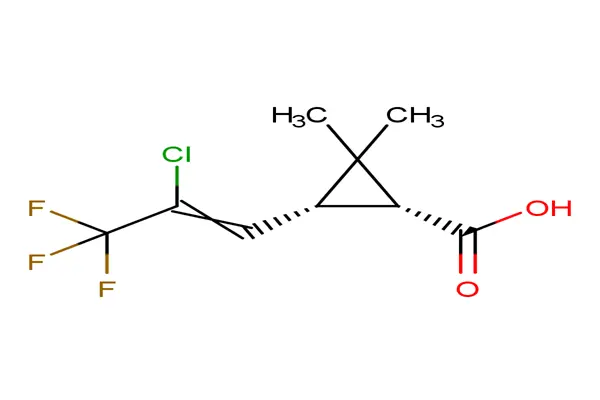
This molecule contains two chiral centers on a cyclopropane ring, thus resulting in multiple stereoisomers. Industrial production seeks the cis configuration, where the substituents at positions 1 and 3 are located on the same side of the ring. In the quality control of the active pharmaceutical ingredient, the cis/trans ratio is a key indicator of process level; a higher ratio signifies a more selective synthetic route. Its final esterification product, lambda-cyhalothric acid, has a molecular weight of approximately 449.85 and a LogP value as high as 6.10. Its extremely high lipophilicity is the physicochemical basis for its ability to penetrate the insect nerve membrane and exert its highly potent toxicity.
Physically, high-purity lambda-cyhalothric acid is a pale yellow to white crystalline solid; its specific melting point depends on the purity of its cis-trans isomers. It is insoluble or slightly soluble in water, but soluble in organic solvents such as toluene, chloroform, and alcohols, which fully meets the production requirements for its use as an intermediate in pesticide chemicals. However, this molecule is unstable to light, heat, and alkali, and must be stored away from light and moisture. Classified, it belongs to the same type I or II pyrethroid intermediates as permethrin and deltamethrin. The unique substitution pattern of the trifluoromethyl and chlorine atoms on its side chain significantly enhances the affinity of pyrethroid compounds for insect sodium channels through an inductive effect.
⚙️Chiral construction logic of cyclopropane rings
The industrial production of Lambda-cyhalothric acid is not merely a simple chemical synthesis, but a delicate game of "chiral control." Current mature processes typically use chrysantheminate esters or specific dienes as starting materials, undergoing a crucial cyclopropanation reaction to construct the key cyclopropane ring. In a typical industrial preparation process, the addition reaction takes place in a catalyst and solvent system, followed by intramolecular cyclization under strong base catalysis, forming a cyclopropane skeleton carrying ester groups. The most critical technical challenge at this stage lies in ensuring the reaction strongly favors the formation of the cis structure.
After the cyclization reaction, the crude ester product undergoes saponification under alkaline conditions for hydrolysis. In this step, temperature control and staged heat preservation are crucial to prevent over-reaction leading to the opening of the three-membered ring. After the reaction is complete, cooled, and filtered, acid is added for acidification, precipitating lambda-cyhalothric acid crystals. To meet the high specifications of downstream pyrethroid technical, the crude lambda-cyhalothric acid must undergo refining and purification. Recrystallization is a crucial method for removing impurities, improving the cis-trans ratio, and ensuring purity. Since the final insecticidal activity depends on a specific (1R)-cis configuration, the control of optical purity in industrial production directly impacts the cost of the active ingredient.
In the pesticide industry chain, Lambda-cyhalothric acid is not an independently traded commodity but rather a core intermediate asset for active ingredient manufacturers. Because lambda-cyhalothric acid is the world's best-selling pyrethroid insecticide, the production capacity of Lambda-cyhalothric acid directly determines the market supply of the final active ingredient. Its cost structure is mainly affected by the price of starting materials, catalyst recovery rate, and safety and environmental protection investments. The production process involves low-temperature reactions and the use of the strong base tert-amyl alcohol salt, placing high demands on the materials of the reaction vessel and the cooling system, thus creating a high barrier to entry in the industry.
💊The role of intermediates in analysis and quality control
As a precursor and potential degradation product in the synthesis of lambda-cyhalothric acid (PCA), it plays a "tracer" role in pesticide quality control and metabolic research. It is one of the impurities that must be strictly monitored in the quality analysis of technical materials and formulations. Researchers have successfully developed detection methods in normal-phase liquid chromatography (HPLC) systems capable of completely separating various diastereomers from impurities, providing a powerful tool for process development departments to monitor low-temperature isomerization conversion rates. With increasingly stringent environmental regulations, establishing highly selective impurity detection methods has become a prerequisite for the export of technical grade pesticides.
Besides quality control, it is also an important reference for studying the fate of PCA in plants and the environment. As a major degradation product of hydrolysis or photolysis, determining the residual amount of lambda-cyhalothric acid in soil or crops is one of the key data for assessing the environmental safety of technical grade pesticides. The toxicity of this acid is far lower than that of its parent esters, and its degradation is an important pathway for the detoxification of pyrethroids in the environment. It is worth noting that the ecotoxicological differences of chiral pesticides are currently a research hotspot. Because lambda-cyhalothric acid possesses a specific chiral center, its enantiomers exhibit significant differences in degradation rates and toxicity in the environment. The development of chiral chromatographic separation techniques is precisely for the precise monitoring of the environmental behavior of different isomers.
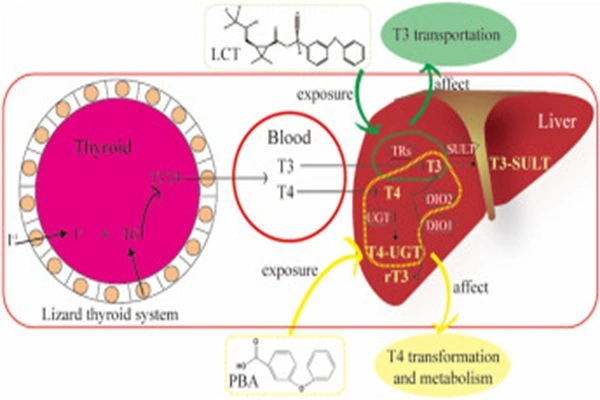
In the field of veterinary drugs and antiparasitics, although Lambda-cyhalothric acid itself is not used directly, its downstream product, lambda-cyhalothrin, is a core drug for controlling ectoparasites in cattle and sheep. EU and North American regulatory agencies have clearly stipulated maximum residue limits for lambda-cyhalothrin and its metabolites in animal-derived foods. This makes the intermediate lambda-cyhalothric acid a potential "marker residue" in residue analysis methods, playing a crucial indicative role in food safety screening of exported meat products.
🔭Frontiers of Industrial Structure and Process Optimization
Companies possessing this technology and achieving large-scale production can secure a favorable position in the global agrochemical supply chain. In recent years, Chinese chemical companies have continuously strengthened their efforts in this field, achieving domestic substitution of key intermediates and technical materials. Considering the high efficiency of downstream formulations and the rigid demand of crops for chemical control, the Lambda-cyhalothric acid-related industry will maintain a considerable economic scale. In the face of future compliance pressures and product upgrades, developing greener synthesis processes has become a new focus of industry competition. Traditional cyclopropanation reactions require the use of equivalent strong bases and low temperatures, resulting in high energy consumption. Some companies are exploring the use of microchannel reactors for cyclopropanation to precisely control reaction temperature and residence time, increasing the cis-trans ratio from the traditional batch reactor 7:1 to over 9:1, while simultaneously reducing byproduct formation.
In future capacity layout, integrated production (from key olefin monomers to lambda-cyhalothric acid to high-efficiency cyhalothric acid technical material) is a strategic choice for leading companies to build cost advantages. By directly integrating the production of the intermediate Lambda-cyhalothric acid with the active ingredient synthesis unit within the factory, companies can avoid losses during storage and transportation, as well as quality degradation due to isomerization. As the global pesticide industry transitions towards low-carbon practices, catalyst recovery and solvent recycling are increasingly becoming core selling points for this intermediate process package. There are still no signs of widespread bans on lambda-cyhalothric acid globally, and as its irreplaceable "structural carrier," lambda-cyhalothric acid's core intermediate status will continue to be maintained in the future.
Conclusion
Lambda-cyhalothric acid (LCA) is a cornerstone intermediate in the pyrethroid industry. Its unique molecular structure, consisting of cis-cyclopropane and fluorinated chloroform, determines the core properties of finished products such as lambda-cyhalothrin, including high efficiency, low toxicity, broad spectrum, and light stability. As a type II pyrethroid-specific acid fragment, it imparts a highly selective blocking mechanism of action to the insect sodium channel in pyrethroid molecules through precise esterification, achieving highly effective control of agricultural, public health, and animal pests while ensuring human and animal safety and environmental friendliness. From traditional high-pollution synthesis to green and low-carbon processes, from racemic compounds to highly active chiral monomers, and from single agricultural applications to resistance management and non-agricultural expansion, the LCA industry continues to upgrade its technology, supporting the steady development of the global pyrethroid market and providing efficient and sustainable insecticidal solutions for modern agriculture and public health.
Looking for a trusted manufacturer of Lambda-cyhalothric acid? Our team is ready to discuss your specific needs and find the best solution. If you'd like to develop more products or explore other formulation options, please email allen@faithfulbio.com to learn how Faithful can help you thrive in 2026 and beyond.
References
- ChemicalBook. (2026). Lambda-cyhalothric acid (CAS 72748-35-7). ChemicalBook Database.
- BenchChem. (2025). Environmental fate and degradation of lambda-cyhalothrin: A technical guide. Journal of Agricultural and Food Chemistry, 73(12), 4589-4602.
- Food and Agriculture Organization. (2024). FAO specification for lambda-cyhalothrin. FAO/WHO Joint Meeting on Pesticide Specifications.
- Jutsum, A. R. (2023). The discovery and development of lambda-cyhalothrin. Pest Management Science, 79(8), 2897-2910.
- Syngenta. (2025). Technical data sheet: Lambda-cyhalothric acid. Syngenta Crop Protection.
- Wang, L., & Zhang, Y. (2024). Green synthesis of lambda-cyhalothric acid via trifluoromethylation. Chinese Journal of Pesticide Science, 26(3), 345-353.
- Li, J., et al. (2025). Chiral separation and bioactivity of lambda-cyhalothric acid enantiomers. Journal of Chromatography A, 1645, 462108.