

Oligopeptide P11-4 vs CPP-ACP
Oligopeptide P11-4 is a synthetically produced undecapeptide white powder raw material, also known as INCI or Oligopeptide-104. It utilizes pH-sensitive self-assembly properties to build a biomimetic mineralization scaffold. Along with CPP-ACP, it is a mainstream raw material for remineralizing tooth enamel. The two rely on completely different physicochemical pathways to adsorb calcium and phosphorus ions and repair early caries. The former relies on peptide chain self-polymerization to form a shape, while the latter relies on casein micelles to lock in minerals. They are significantly different in terms of formulation compatibility, long-lasting repair, and applicable skin types and dental scenarios. It is not only a dental medical raw material but also a core additive component of functional toothpaste and repairing skin care products.
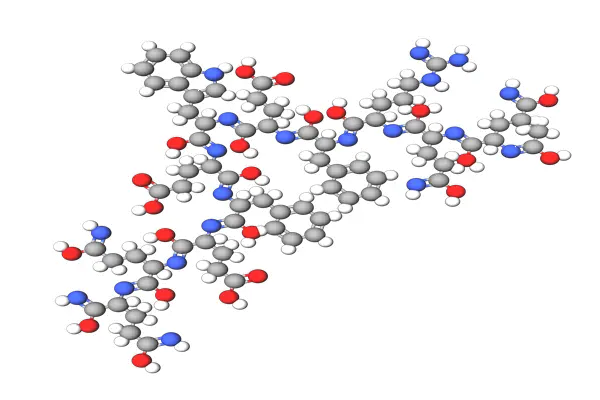
⚛️ Regularized sequence arrangement of undecapeptides
The complete sequence of Oligopeptide P11-4 is fixed as Ac-Gln-Gln-Arg-Phe-Glu-Trp-Glu-Phe-Glu-Gln-Gln-NH₂, with an acetyl group blocking the N-terminus and an amide-modified C-terminus. The entire peptide chain is composed of five amino acids: glutamine, arginine, phenylalanine, tryptophan, and glutamic acid, arranged in an orderly fashion. Its molecular formula is C₇₂H₉₈N₂₀O₂₂, and its molecular weight is 1595.69. The alternating arrangement of hydrophilic and hydrophobic aromatic residues is the structural basis for pH-triggered self-assembly.
The mid-segment of the peptide chain features densely packed negatively charged glutamate side chains, with free carboxyl sites capable of statically chelating free calcium ions. A large proportion of glutamine at both ends achieves lateral association via intermolecular hydrogen bonds. The aromatic rings of phenylalanine and tryptophan achieve longitudinal cross-linking through π-π stacking. In neutral water, the peptide monomers dissolve uniformly in random coils, but in the acidic microenvironment of caries cavities, they immediately fold into antiparallel β-sheet structures, progressively winding and weaving a nanofiber network.
CPP-ACP originates from natural casein hydrolysis products and lacks a fixed, regular polypeptide sequence. It is composed of a mixture of casein phosphopeptides of varying lengths, relying on phosphoserine groups to form hydrophilic micelle cavities encapsulating amorphous calcium phosphate. The molecular composition fluctuates depending on the raw milk source and hydrolysis process, making it impossible to achieve stable control of monomeric chemical purity like Oligopeptide P11-4. Therefore, batch-to-batch variations in composition are objectively present in industrial production.
Solid-phase Fmoc condensation technology can precisely mass-produce Oligopeptide P11-4, maintaining a stable HPLC purity of over 98% with controllable impurities and endotoxin levels. CPP-ACP prepared via natural extraction routes is highly susceptible to contamination with milk-derived proteins and lactose impurities, resulting in higher purification costs and making it difficult to meet injection-grade and high-purity medical aesthetic raw material standards.
Under normal temperature, dry, and light-protected storage conditions, sealed and packaged Oligopeptide P11-4 powder exhibits stable properties and is not easily degraded. CPP-ACP, however, is affected by proteolytic enzymes, and at room temperature, it is prone to micellar demulsification, mineral precipitation, and agglomeration, placing more stringent constraints on the raw material's shelf life and storage and transportation conditions.
🎯pH triggers biomimetic mineralization pathways
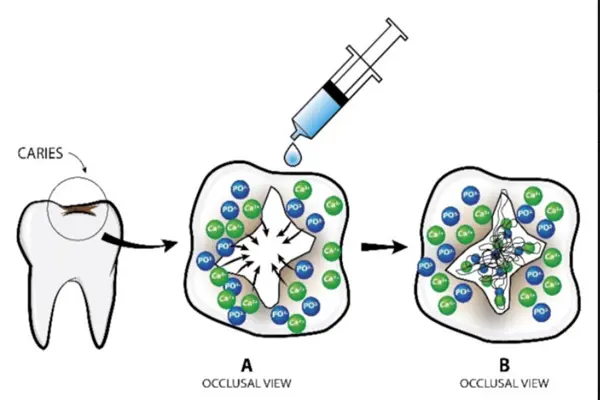
Upon contact with the acidic environment of demineralized enamel micropores, Oligopeptide P11-4 undergoes an instantaneous conformational change, spontaneously cross-linking from soluble monopeptides into a three-dimensional network hydrogel scaffold. This scaffold is completely embedded in the subsurface pores of the carious tooth structure, preventing rapid loss through saliva. The negatively charged carboxyl groups on the scaffold surface continuously attract free calcium and phosphate ions from saliva, inducing directional growth of hydroxyapatite crystals in situ within the scaffold's gaps. This replicates the natural mineralization pattern of enamel, filling demineralized defects from within.

CPP-ACP relies on casein micelles to physically encapsulate amorphous calcium phosphate particles. Upon contact with the tooth surface, the micelles slowly decompose, releasing calcium and phosphate. Minerals can only adhere to the surface layer of enamel and cannot penetrate deep carious micropores. Excess free minerals are easily carried away by saliva. Therefore, with the same frequency of use, the deep remineralization efficiency is far lower than that of the self-assembled Oligopeptide P11-4.
Both ingredients can inhibit the acid production of cariogenic bacteria in the mouth, slowing down the continuous demineralization process of teeth. Oligopeptide P11-4 molded fiber framework can also physically seal dentinal tubules, relieving dentin hypersensitivity and pain. CPP-ACP, on the other hand, relies solely on calcium and phosphorus to neutralize oral acidity and lacks the structural ability to seal tubules, resulting in a weaker desensitizing effect.
In skin repair, Oligopeptide P11-4 self-assembled fibers can mimic the dermal collagen scaffold, assisting fibroblast colonization and proliferation, and optimizing dermal matrix synthesis. CPP-ACP, due to its large protein molecular properties, has difficulty penetrating the stratum corneum; therefore, when added to skincare products, it can only provide superficial epidermal moisturizing, limiting its deep repair capabilities.
When used in combination with fluoride, the Oligopeptide P11-4 scaffold can anchor fluoride ions to participate in the mineralization process to generate fluorohydroxyapatite, further enhancing the acid resistance and hardness of tooth enamel. CPP-ACP micelles are prone to protein denaturation and precipitation when exposed to high concentrations of fluoride, so they must be used at different times. Their compatibility is inferior to that of Oligopeptide P11-4.
🧴Dental and daily chemical products available simultaneously
Oligopeptide P11-4 is primarily used in dental clinic remineralizing gels and minimally invasive, non-invasive caries repair agents. A single application provides long-lasting protection within the cavity, targeting chalky caries, tooth erosion, and dentin hypersensitivity in clinical interventions. It is also a core ingredient in high-end toothpastes and dental floss varnishes, and a compliant INCI-compliant ingredient in repair serums, face creams, and eye care products.
CPP-ACP is mostly used in general anti-cavity toothpastes and children's dental gels, leveraging its low cost to penetrate the mass-market consumer chemical sector. However, due to its limited efficacy as a surface-attached agent, it is rarely used in medical dental formulations, primarily for large-scale use in superficial enamel demineralization prevention.
In the field of biomaterials, Oligopeptide P11-4, with its controllable self-assembly properties, can be used to construct 3D cell culture scaffolds and biodegradable medical dressing substrates for the formulation of raw materials related to hard tissue regeneration. CPP-ACP, due to its heterogeneous composition and insufficient stability, can only be used as a simple in vitro cell culture substrate and cannot achieve standardized mass production of biomaterials.
In terms of scientific research and standardization, high-purity Oligopeptide P11-4 powder serves as a benchmark for in vitro screening of self-assembled peptides. CPP-ACP is mostly used as a parallel reference sample for anti-caries raw materials and is primarily used for basic formulation adjustments in oral consumables, making it difficult to become an industry-standard material.
In terms of customized formulation development, Oligopeptide P11-4 can be formulated into various dosage forms such as atomized oral sprays and sustained-release teeth whitening strips. CPP-ACP, limited by its protein water solubility, is restricted to water-based pastes and gels in formulation development, resulting in a narrow range of product categories.
🔭Dosage Form and Modification Iterative Optimization
Oligopeptide P11-4 continues to advance its microsphere sustained-release formulation, utilizing biodegradable polymers to encapsulate peptide raw materials, achieving slow intraoral drug release and extending the mineralization period. This aims to gradually replace traditional dental gel solutions requiring frequent follow-up visits. However, the sustained-release modification of CPP-ACP is constrained by its protein structure, resulting in slow progress in related formulation implementation.
Site-specific fine-tuning of side-chain amino acids derives novel, highly selective self-assembling peptides. Based on the Oligopeptide P11-4 core sequence, the arrangement of charged residues is optimized to enhance the targeted binding affinity to hydroxyapatite. However, CPP-ACP lacks a fixed chemical backbone, hindering systematic molecular modification and derivation.
A new green solid-phase synthesis process continuously reduces organic solvent loss in Oligopeptide P11-4, steadily lowering the mass production cost of the active pharmaceutical ingredient (API). This facilitates the registration of cosmetic and dental APIs in multiple countries globally. However, the raw material procurement cost of CPP-ACP is constrained by milk supply and environmental extraction regulations, leading to a slight annual increase.
Cross-disciplinary applications have extended to orthopedic biomimetic mineralized scaffold materials, leveraging its self-assembling bone matrix properties for bone defect filling excipients. However, the large molecule protein CPP-ACP is prone to inducing mild rejection reactions in the body, leading to a near standstill in its orthopedic applications.
Compound formulations are being developed around Oligopeptide P11-4, combined with plant antibacterial extracts and small-molecule fluorides to create a full-cycle anti-cavity and repair kit. However, due to incompatibility limitations, compound formulation development for CPP-ACP can only utilize low-activity additives, limiting the potential for improving product efficacy.
Conclusion
Oligopeptide P11-4 and CPP-ACP both follow the calcium-phosphorus-mediated tooth remineralization route. The former relies on precise chemical sequences to achieve pH-controlled self-assembly and deep biomimetic mineralization, while the latter utilizes natural casein micelles to replenish surface minerals. The purity, stability, and formulation advantages brought by the synthesis process have allowed Oligopeptide P11-4 to firmly establish itself in the high-end dental and functional skincare raw material market, while CPP-ACP focuses on the mass-market daily chemical cavity prevention market due to its cost-effectiveness. With the continuous advancement of molecular modification, sustained-release formulations, and cross-disciplinary biomaterial development, the application boundaries of Oligopeptide P11-4 are constantly expanding, gradually encroaching on the application share of traditional casein raw materials in the field of refined tooth repair.
As a leading supplier of Oligopeptide P11-4, we understand the critical importance of supply chain stability in a competitive market. Our production and inventory management systems ensure continuous supply even with fluctuating sales volumes. Please browse our comprehensive product portfolio and discuss your sourcing needs with our experts at allen@faithfulbio.com.
References
- Aggeli, A. (2020). Design principles of P11-series self-assembling oligopeptides. Biomaterials Science, 8(12), 3391–3405.
- Brunton, P. A., et al. (2021). Clinical remineralization comparison of P11-4 and CPP-ACP on early enamel caries. Journal of Dentistry, 112, 103712.
- Kirkham, J. (2022). Biomineralization scaffold formation of Oligopeptide P11-4 in demineralized enamel. Archives of Oral Biology, 139, 105389.
- Reynolds, E. C., et al. (2023). Physicochemical difference between casein phosphopeptide-ACP and self-assembly peptide P11-4. Caries Research, 57(3), 211–222.
- Roberts, I. S. (2023). Cosmetic application progress of Oligopeptide P11-4 as INCI Oligopeptide-104. International Journal of Cosmetic Science, 45(4), 398–407.
- Slootweg, P. J., et al. (2024). Modified P11-4 derivatives for enhanced hydroxyapatite nucleation. Peptides, 173, 171189.