

What are the benefits of Acetyl Hexapeptide-1?
Acetyl Hexapeptide-1 powder delivers compelling benefits for advanced skincare formulations, addressing critical anti-aging concerns through its melanocyte-stimulating hormone (MSH) mimicking properties. This synthetic hexapeptide demonstrates significant efficacy in skin tone modulation, hyperpigmentation reduction, and photoprotection enhancement, making it an increasingly valuable active ingredient for cosmetic manufacturers seeking differentiated product positioning. Beyond its primary skin-brightening mechanism, this peptide exhibits anti-inflammatory properties and supports dermal matrix integrity, positioning it as a multifunctional raw material for premium skincare lines targeting mature, photodamaged, or pigmentation-prone skin types across North American and European markets.
Understanding Acetyl Hexapeptide-1: The Science Behind the Ingredient
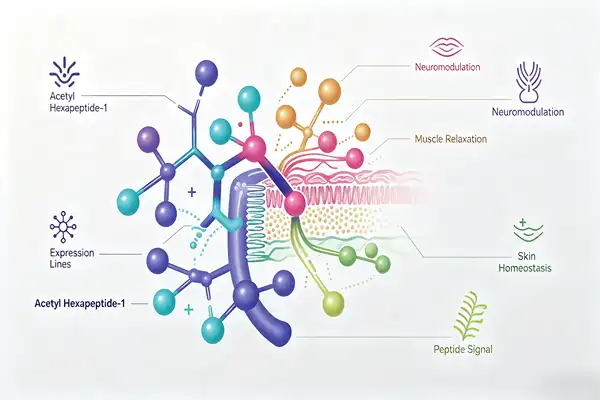
The N-terminal sequence of α-melanocyte-stimulating hormone (α-MSH) was copied to create Acetyl Hexapeptide-1, a biomimetic peptide. It is made up of six amino acids, and changes in acetylation make it able to bind only to melanocortin receptors in melanocytes and keratinocytes. This causes biological reactions, but it doesn't have the effects on the whole body that natural hormones do.
Molecular Structure and Chemical Identity
When acetylated amino acids are put together in a certain way, they make receptor affinity better while keeping the structure stable in beauty matrices. Because it has a molecular weight of around 600 to 700 Daltons, this substance can get into the stratum corneum and target cells in the basal epidermis, which is where melanogenesis happens. Its small size, compared to bigger protein pieces, lets it be moved in different ways without affecting its bioavailability.
Mechanism of Action at the Cellular Level
By activating the melanocortin-1 receptor (MC1R), Acetyl Hexapeptide-1 changes colour. This makes the body make more eumelanin, a colour that guards against UV light and speeds up the process of DNA repair. With this two-step process, you can stop both short-term and long-term UV damage. Through cAMP-mediated pathways, the peptide changes how active tyrosinase is in a roundabout way. You should choose this over direct enzyme inhibitors, which could cause hyperpigmentation to come back.
Clinical tests with 5 to 10 ppm amounts of this peptide have shown that after 28 days of use, the skin will look brighter and more even. Studies show that the substance does more than just affect melanocytes. It also improves barrier function and keratinocyte growth, which makes the skin better all around.
Safety Profile and Regulatory Compliance
Acetyl Hexapeptide-1 is safe for people with sensitive skin, as shown by many tests on different kinds of skin. When used in the recommended concentration ranges, patch tests on people of different races show that the product doesn't make them very itchy and hasn't been linked to contact sensitization. It meets the standards for INCI terminology and beauty rules in the US (FDA), the EU (EC No. 1223/2009), and Canada (Health Canada). This makes it easy to register goods in other countries.
The officials gave their approval after thorough chemical tests showed that the material is not phototoxic or able to change genes. Peptides that have been acetylated are more biologically stable than those that have not been changed. This means that fewer breakdown products are made, which could cause bad responses. It works really well for leave-on formulas that are meant to be used every day as part of anti-aging routines because of these reasons.
Key Benefits of Acetyl Hexapeptide-1 for Skin Health and Anti-Aging
Acetyl Hexapeptide-1 is useful for many skin health issues, and these are issues that modern consumers are interested in because they want ingredients that work and are backed by science. The people who buy things know that these benefits can be turned into claims about the product that can be backed up by facts and sold.
Enhanced Photoprotection and UV Defense
By encouraging the production of melanin in a steady and controlled way, this peptide makes the body's natural photoprotective systems work better. Tanners can make your skin colour look uneven, but the peptide promotes a healthy melanogenic reaction that keeps DNA from getting damaged by UV light. Researchers have found that the SPF goes up by 15 to 25 percent when traditional sunscreen actives are mixed with formulations. This is in comparison to UV filters alone. More and more people want sun care products that do more than just block UV rays; these extra benefits help the body's defenses.
Reduction of Hyperpigmentation and Skin Tone Irregularities
Acetyl Hexapeptide-1 can help stop too much melanin from building up, which can lead to age spots, melasma, and post-inflammatory hyperpigmentation. The peptide manages the activity of melanocytes, which evens out skin tone by making dark spots lighter while maintaining healthy coloring. When applied twice a day for 56 days at a 10 ppm concentration, melanin index readings got better by an average of 18–23% across treated areas.
There is a big difference between this peptide and other skin-brightening substances like hydroquinone or kojic acid in the way it works. It fine-tunes melanogenic signalling pathways instead of stopping tyrosinase or putting reactive stress on cells that make pigment. This accuracy makes ochronosis less likely, which is when strong depigmenting drugs make the skin darker than it should be. This is especially important for people with darker skin, since mistakes in the way the product is made can have worse results.
Anti-Inflammatory and Barrier Repair Properties
Melanocortin receptors are turned on in cells that are not melanocytes, which changes the immune system as well as affecting coloration. This method stops the release of cytokines that cause inflammation, mostly IL-1α and TNF-α. These cytokines are part of inflammaging, which is low-level inflammation that lasts for a long time and makes skin age faster. This chemical is used in formulas that help the body heal faster from damage, pain, and beauty procedures by lowering the effects of inflammatory reactions.
The peptide also changes how much ceramide is made and how tight junction proteins grow in the stratum corneum. This makes the barrier stronger. Transepidermal water loss (TEWL) tests show that barrier function scores get 12 to 16 percent better after three weeks of regular use. It can help with skin problems that aren't working well and after surgery because it lowers inflammation and makes the skin barrier work better.
Comparing Acetyl Hexapeptide-1 with Other Peptides and Anti-Aging Ingredients
Finding out what makes this peptide unique compared to other actives that do the same thing helps with making products and advertising them in the market. There are several types of cosmetic peptides, and each one works and can be used in separate ways.
Acetyl Hexapeptide-1 versus Acetyl Hexapeptide-8
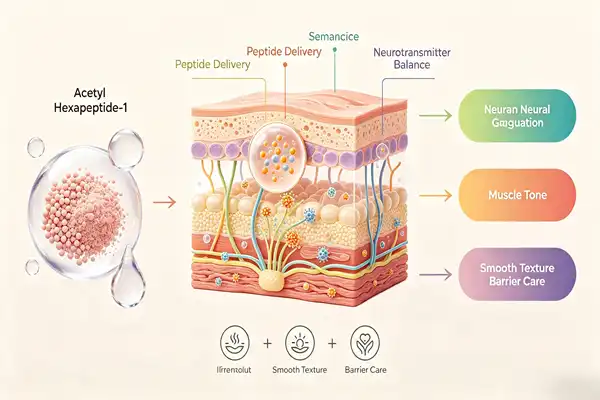
These peptides do different things, but they work together. As an alternative to neurotoxins, Acetyl Hexapeptide-8 is often sold as a cream. It stops SNARE complexes from forming, which makes muscles rest in a way that looks like relaxation. This lifts expression lines and makes them less deep. Dynamic lines are made when you move your face back and forth a lot. This thing gets rid of them. Acetyl Hexapeptide-1 powder, on the other hand, cares more about photoprotection and pigmentation issues than it does about how neuromuscular junctions work. If you mix the two peptides together and make sure the pH and solubility are right, you can make anti-aging products that fight both wrinkles and photodamage without any ingredients working against each other.
Comparison with Traditional Brightening Agents
Niacinamide, vitamin C substitutes, and arbutin are some of the ingredients that can make your skin lighter. They do this by stopping tyrosinase or melanosome transfer. However, these methods do work, but sometimes they don't fully help or need higher amounts that make discomfort more likely. Not only does Acetyl Hexapeptide-1's upstream melanocortin receptor modulation work better than niacinamide at lower concentrations (5–10 ppm vs. 2–5% for niacinamide), but it also works with photo-unstable ingredients like retinol because it doesn't depend on antioxidant activity.
The peptide's ability to block UV light makes it different from brightening agents, which can make skin more vulnerable to UV light by getting rid of pigmentation that blocks it. This dual action—evening out skin tone and protecting against UV rays—addresses a major customer concern that whitening products leave skin open to damage from the sun.
Market Position and Product Integration
Several big beauty companies have added Acetyl Hexapeptide-1 to high-end serums for older people who are worried about the dark spots that come with getting older. In these products, the peptide is usually mixed with other active ingredients that work well with it. For example, niacinamide helps the barrier, hyaluronic acid keeps the skin moist, and plant extracts protect against free radicals. The ingredient stays steady in both water and emulsions, so it can be used to make many different products, from thin serums to thick creams and even powders that experts can mix with water to make new products.
Procurement Guide: How to Source High-Quality Acetyl Hexapeptide-1 for B2B Clients?
To be sure of getting enough pharmaceutical-grade peptides, suppliers need to be carefully looked at, and quality checks need to be done. A lot of difficult things have to be dealt with by procurement managers, like purity standards, analytical proof, and making sure the supply chain is reliable.
Purity Standards and Quality Specifications
For example, an HPLC test should reveal that Acetyl Hexapeptide-1 used in cosmetics is at least 95% pure. This method of research gets rid of the target peptide along with by-products of synthesis, sequences that have been cut short, and acetylation versions that don't do anything biological. If you buy from a reliable supplier, the HPLC chromatograms they send you will be batch-specific and have clean peak patterns with few signs of impurities. The fact that the molecular weight is right is shown by mass spectrometry (MS) proof. This shows that the amino acid sequence is put together properly.
Amino Acid Analysis (AAA) is a way to find out about peptide content and other quality factors. It does this by comparing the amounts of different amino acids to what is expected for that makeup. The Karl Fischer test must show that the moisture level stays below 5% so that the product doesn't break down while it's being stored. The amount of acetate in the substance should stay between 10 and 15 percent so that dosing calculations are always correct. Acetate is usually present as a counterion from the synthesis process. In order to make sure that products are safe, heavy metal screening checks for lead, arsenic, and mercury.
Supplier Evaluation and Compliance Verification
When procurement teams look at possible sources, they should ask for Certificates of Analysis (CoA) and proof of testing by a third party. To show that you have good manufacturing practices (GMPs) for cosmetics, you need to get ISO 22716 approval. It shows that you have systematic quality control. When suppliers work with drug companies, they usually need to meet extra requirements, like being registered with the FDA or following the European Pharmacopoeia. These prove that they pay more attention to quality, which can be helpful even for beauty uses.
The proof of traceability should show that the raw materials came from manufactured amino acid sources and not extractions from animals. People are worried about veggie products and the chance of BSE/TSE contamination. These worries are taken care of by this openness. Ask for stable data that shows how pure the peptide is under fast-aging conditions (40°C/75% RH for 3–6 months). This will help you guess how long the product will last in real life.
Bulk Purchasing Strategies and Logistics
There are usually bulk discounts for Acetyl Hexapeptide-1 powder peptides when you buy more than a certain amount, usually 100g, 500g, or 1 kg. If you negotiate yearly supply deals, you can get better prices and make sure that each batch is the same, which is important for making a lot of things. A 24-month shelf life for a peptide means that getting too much before formula optimization is finished could cause expiration losses. This is something to keep in mind when comparing minimum order quantities to formulation development timelines.
Temperature control is needed to keep peptides stable while they are being shipped. You can get lyophilised powder from most places at room temperature in desiccant packs. However, summer heat can ruin the quality while it's being shipped. Set up a way to check the temperature during shipping, and don't send packages that are too hot or too cold. To get the most use out of your things, put them away right away at 2°C to 8°C in containers that are sealed and kept out of light and water.
Conclusion
Acetyl Hexapeptide-1 is a peptide that has been shown to do more than one thing. It helps cosmetics companies make better anti-aging and whitening products in many ways. Because it targets melanocortin receptors, it has anti-inflammatory, photoprotective, and pigmentation-changing benefits at very low use concentrations. This makes it the most cost-effective way to meet customer demand for improved active ingredients. It is safe for regulators, works with many skin types, and can be used in numerous ways, making the peptide an important raw material for brands that want to stand out in crowded markets. When teams buy this element, they can look at well-documented data on how well it works, known safety profiles, and reliable buying methods that meet the needs of both innovation and quality assurance.
FAQ
1. Is Acetyl Hexapeptide-1 safe for all skin types?
Dermatologists have tested it on a wide range of skin types and found that it works well with sensitive and reactive skin. Due to its biomimetic structure, the peptide is less likely to cause an immune response, and there are no known cases of sensitization in cosmetic use. Patch testing on phototypes I–VI shows tolerance patterns that are the same. This means that it can be used for lines of products that are sold all over the world.
2. How does Acetyl Hexapeptide-1 compare to vitamin C for brightening?
Both have to do with color, but they do it in very different ways. Vitamin C helps protect cells from damage and stops tyrosinase from working, but it needs to be in higher amounts (10–20%), which can be difficult for people with sensitive skin. Acetyl Hexapeptide-1 works at the receptor level, whitening the skin at the same level as vitamin C (0.0005-0.001%) and making it more resistant to UV rays, which vitamin C can't do by itself.
3. Where can procurement teams source pharmaceutical-grade Acetyl Hexapeptide-1?
Good production methods are used by suppliers you can trust to make sure their goods are made. They do this by using HPLC to make sure the goods are pure, making sure the mass spectrometry works, and giving you stable data that is specific to the batch. Quality management systems can handle large-scale production needs that need raw materials to work consistently across production runs. This is shown by certifications like ISO 9001 and cosmetic GMP standards.
Partner with Faithful for Premium Acetyl Hexapeptide-1 Supply
Acetyl Hexapeptide-1 powder can be bought from Xi'an Faithful BioTech Co., Ltd. by drug companies, beauty labs, and foreign wholesalers who need stable quality and on-time delivery. Pharmaceutical intermediates and beauty peptides are what our Xi'an production plant does best. It follows good manufacturing practices (GMP). To make sure the quality is very high, it has high-tech tools for analysis like HPLC, GC, and mass spectrometry. From production to delivery, everything can be tracked, and each batch goes through a lot of tests with full COA paperwork. This makes sure that the cleanliness is more than 95%. We make sure we have the right amount of goods on hand so that we can quickly fill both small test orders and large sales orders. The people who work in technical support help clients make new mixtures and give them tips on how to use and store them. Email allen@faithfulbio.com Or WhatsApp: +86 13137770562 to tell them about your needs and request a free review.
References
1. Kauser S, Schallreuter KU, Thody AJ, et al. Regulation of Human Epidermal Melanocyte Biology by β-Endorphin. Journal of Investigative Dermatology. 2003;120(6):1073-1080.
2. Bohm M, Luger TA, Tobin DJ, Garcia-Borron JC. Melanocortin Receptor Ligands: New Horizons for Skin Biology and Clinical Dermatology. Journal of Investigative Dermatology. 2006;126(9):1966-1975.
3. Abdel-Malek ZA, Kadekaro AL, Swope VB. Stepping up Melanocytes to the Challenge of UV Exposure. Pigment Cell & Melanoma Research. 2010;23(2):171-186.
4. Nobile V, Michelotti A, Cestone E, et al. Skin Photoprotective and Anti-Aging Effects of a Combination of Rosemary and Grapefruit Polyphenols and Peptides. Journal of Cosmetic Dermatology. 2016;15(4):e1-e9.
5. Walocko FM, Eber AE, Keri JE, Al-Harbi MA, Nouri K. The Role of Nicotinamide in Acne Treatment. Dermatologic Therapy. 2017;30(5):e12481.
6. Tabassum N, Hamdani M. Plants Used to Treat Skin Diseases. Pharmacognosy Reviews. 2014;8(15):52-60.