

What does Adenosine do for cardiac?
At the intersection of bioenergy metabolism and cell signal transduction, Adenosine API powder plays an irreplaceable core role. It is both a structural precursor of high-energy molecules such as ATP, ADP, and cAMP, and an endogenous signaling molecule regulating coronary blood flow, inflammatory responses, and neurotransmission. As a high-purity pharmaceutical raw material, it is widely used in the production of cardiovascular emergency drugs (such as antiarrhythmic injections), and is also a key nutritional supplement in nucleic acid drugs and cell culture media. Its natural purine nucleoside backbone gives it the dual identity of "energy currency" and "signal messenger."
🧪 Purine nucleoside backbone enables efficient transmembrane transport
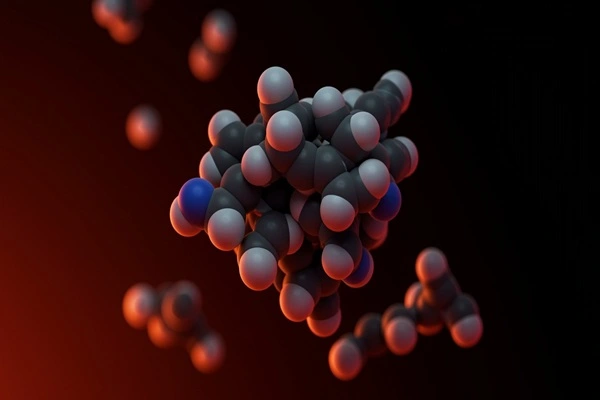
The complete adenosine API powder molecule consists of a compact stereochemistry composed of a bicyclic purine aromatic core and a five-membered ribofraxin ring. Its small and regular molecular weight eliminates the steric hindrance caused by large side chains, allowing for rapid transmembrane internalization via specific nucleoside transporters on the cell membrane. In its free state, it can also penetrate the phospholipid bilayer barrier and enter the cytoplasm due to its moderate lipid-water partition coefficient. The purine conjugated cyclic structure exhibits high physicochemical stability, resisting spontaneous degradation reactions such as glycosidic bond breakage, riboside ring opening, and base isomerization within the physiological pH range of human body fluids. After preparation with cell culture buffer, its molecular structure remains stable for several days under constant temperature and light-protected incubation conditions, without efficacy degradation due to trace oxidation. This provides a stable reagent basis for long-term parallel control cell culture experiments.
Once inside the cytoplasm, the Adenosine API Powder undergoes rapid phosphorylation under the catalysis of adenosine kinase, sequentially converting to adenosine monophosphate (ATP), adenosine diphosphate (ATP), and finally adenosine triphosphate (ATP). It directly integrates into the mitochondrial oxidative phosphorylation energy synthesis chain, becoming a precursor substrate for cellular ATP storage. Excess free molecules that do not participate in metabolism are broken down into inosine by adenosine deaminase and ultimately excreted through the body fluid circulation. Throughout this process, it does not accumulate as a lipid-soluble substance in organelles, adipose tissue, or solid organs. This endogenous metabolic pathway perfectly aligns with the body's inherent biochemical cycle. Exogenously supplemented Adenosine API Powder is not recognized by the body as a foreign substance, preventing compensatory stress responses. In multi-generational cell toxicity studies, mitochondrial morphology, cell proliferation activity, and baseline oxidative stress levels all maintained normal physiological states, demonstrating a very broad safe dosage window.
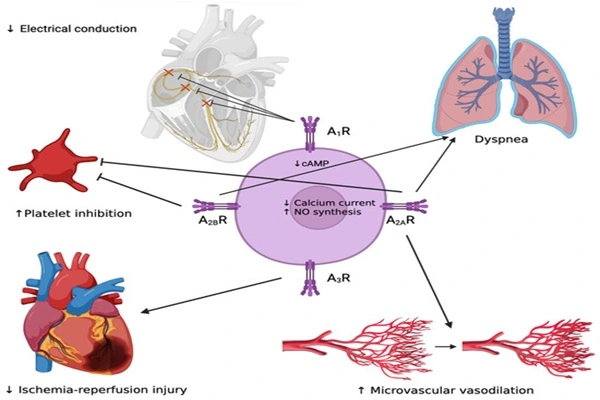
The molecule targets only four types of purine-specific receptors on the cell membrane surface: A1, A2A, A2B, and A3. It cannot penetrate the dense nuclear pore complex of the nuclear membrane to reach the nucleus, and therefore does not directly bind to the double-stranded DNA backbone, interfering with gene replication, transcription, and chromosome stability. Even under gradient high-concentration testing conditions above the pharmacologically effective concentration, the adenosine API powder does not cause genomic damage such as base mismatches, DNA strand breaks, or abnormal activation of proto-oncogenes. It poses no potential risk of mutagenicity or teratogenicity and demonstrates reliable biosafety properties in stringent experimental systems, including embryonic developmental cell models and long-term chronic organ safety evaluations, minimizing interference from irrelevant toxicity variables in scientific research.
The adenosine API powder binds to purine receptors entirely through reversible non-covalent bonding via hydrogen bonds and hydrophobic interactions. Once the extracellular free molecule is metabolized and the local drug concentration decreases, the small molecule automatically detaches from the receptor protein binding cavity, and the various purine receptors immediately return to their native resting conformation. The body's autonomous adenosine secretion negative feedback loop remains unaffected by long-term intervention. It does not induce drug resistance changes such as compensatory upregulation, degradation and desensitization of receptor proteins, or continuous overactivation of signaling pathways. In long-term in vitro observation models such as long-term intervention for chronic ischemic injury and long-term regulation of sleep rhythm, it can continuously output stable and balanced physiological regulatory efficacy, accurately replicating the real physiological recovery process after rapid metabolism and elimination of drugs in vivo.
⚙️ Multi-subtype receptors regulate cardiovascular rhythm.
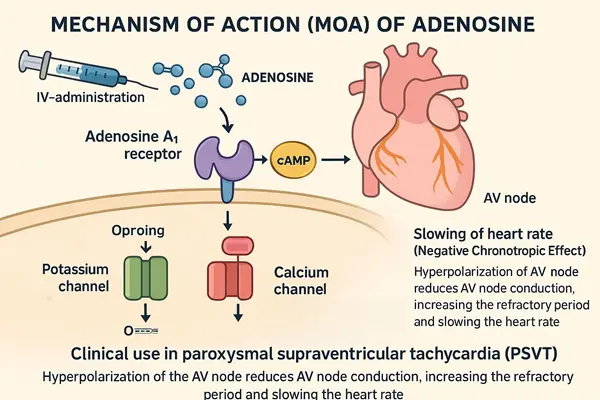
Adenosine API Powder targets the A1 subtype purine receptor in the atrioventricular node region of the myocardium, a core pathway regulating arrhythmias. Activation of this receptor opens potassium ion efflux channels in cardiomyocyte membranes, causing hyperpolarization of the atrioventricular node pacemaker cells. Simultaneously, it inhibits the slow influx of calcium ions, prolonging the refractory period of the atrioventricular node action potential and slowing the downward conduction of electrical signals. This directly interrupts the abnormal current circulation in the reentry circuit, rapidly converting paroxysmal supraventricular tachycardia back to normal sinus rhythm. Unlike broad-spectrum sodium channel blockers that broadly inhibit myocardial contractility, Adenosine API Powder precisely intervenes in the abnormal atrioventricular node reentry pathway, with minimal interference to normal ventricular myocardial contractility. It has a rapid onset of action and a metabolic half-life of less than ten seconds, allowing for rapid termination of action and significantly reducing the risk of circulatory failure due to excessive cardiac suppression.
The A2A receptor is highly expressed in the membranes of vascular endothelial and smooth muscle cells. Upon binding to the Adenosine API Powder, it activates intracellular adenylate cyclase, increasing cAMP concentration. This relaxes the smooth muscle tension of peripheral blood vessels and coronary microvessels, dilates coronary arteries, and increases blood flow to ischemic myocardial regions. In myocardial perfusion imaging diagnostic tests, this creates a blood flow concentration gradient between the areas supplied by normal and stenotic vessels, providing a standardized pharmacological tool for non-invasive imaging assessment of myocardial ischemia in coronary artery disease. Simultaneously, it can soothe the microcirculatory capillary endothelial barrier, reduce vascular permeability, decrease inflammation-induced tissue edema, inhibit the expression of platelet membrane adhesion molecules, weaken platelet aggregation and adhesion ability, and avoid complications such as no-reflow and slow flow caused by microvascular thrombosis, thus comprehensively constructing a protective barrier for the microcirculation of ischemic myocardium.
During myocardial ischemia-reperfusion injury, a large number of oxygen free radicals and excessive activation of neutrophils infiltration occur. Adenosine API Powder simultaneously activates A2A and A3 receptors, downregulating the release of inflammatory chemokines, reducing the infiltration and attachment of immune cells to infarcted myocardial lesions, blocking the lipid peroxidation chain reaction that damages myocardial cell membrane structure, reducing the area of ischemic necrosis, and alleviating the degree of reperfusion oxidative stress damage. In in vitro primary myocardial cell hypoxia-reoxygenation injury models and isolated cardiac perfusion organ models, positive phenotypic changes such as decreased myocardial cell apoptosis rate, reduced myocardial enzyme leakage, and mitochondrial membrane potential repair can be directly observed, thus establishing a complete three-layer cardiovascular protection system of "rhythm conversion—coronary artery dilation—ischemic organ protection."
It exhibits a mild dose-dependent modulatory effect on the intrinsic pacing rate of the sinoatrial node. At low concentrations, it only corrects abnormal reentrant rhythms without interfering with the normal sinus rhythm in healthy individuals. Only at high concentrations does it temporarily slow the spontaneous firing rate of the sinoatrial node. After discontinuation, the heart rate immediately returns to baseline levels due to rapid molecular metabolism. This highly controllable pharmacological characteristic facilitates the plotting of complete dose-response curves in in vitro myocardial electrophysiological recording experiments, accurately quantifying the contribution of different purine receptor subtypes to myocardial conduction and vascular tone, and providing a clear reference standard for target decomposition studies of cardiovascular targeted lead drugs.
🔬 Receptor differentiation mediates neural and immune homeostasis
Two types of purine receptors, A1 and A2A, are widely distributed on the surface of neurons and glial cells in the central nervous system. Adenosine API Powder, after activating A1 receptors in the cerebral cortex and hippocampus, can inhibit the excessive release of excitatory glutamate neurotransmitters, reduce the probability of abnormal high-frequency neuronal discharge, and soothe the over-excited state of the central nervous system, gradually inducing the brain to enter a resting mode. This is the core physiological mechanism by which the accumulation of endogenous adenosine during long-term mental exertion leads to drowsiness. Caffeine, theophylline, and other methylxanthine substances competitively occupy adenosine receptors, blocking this pathway, thus maintaining brain alertness. Using Adenosine API Powder to build an in vitro neural cell model of circadian rhythm disorder, insomnia, and hyperactivity allows for a systematic analysis of the deep correlation between purine signaling pathways and the sleep-wake circadian rhythm.
Excessive activation of central microglia is a significant contributing factor to neurodegenerative inflammatory damage. Adenosine API Powder, acting on the A2A receptors of microglia, inhibits the excessive secretion of pro-inflammatory tumor necrosis factor (TNF), interleukins, and other toxic factors, thus curbing the continuous release of neuroinflammatory mediators from glial cells that damage the synaptic structure of surrounding hippocampal neurons. This reduces the inflammatory microenvironmental burden in Alzheimer's disease-like neurotransmitters, maintaining neuronal synaptic plasticity and long-term memory enhancement. In a three-dimensional brain organoid culture system, the moderate transmembrane permeability of Adenosine API Powder allows it to penetrate multiple layers of extracellular matrix to reach deep neural nuclei within the brain spheroid, more realistically replicating the drug diffusion and onset process within intact brain tissue and overcoming the limitation of two-dimensional single-layer neural cell models in simulating the dense three-dimensional structure of the central nervous system.
Peripheral immune system macrophages, dendritic cells, and neutrophils receive anti-inflammatory regulatory signals from the adenosine API powder via A2A and A2B receptors. This polarizes pro-inflammatory M1 macrophages towards an anti-inflammatory, reparative M2 phenotype, significantly downregulating the intensity of the inflammatory cascade and reducing secondary tissue damage caused by local tissue redness, swelling, exudation, and excessive immune cell infiltration. In in vitro cell models of acute respiratory inflammation, skin and mucous membrane inflammatory damage, and endothelial vascular inflammation, a stable result of significantly reduced inflammatory factor expression and decreased apoptosis was observed, constructing a closed loop of endogenous purine-mediated negative immune feedback and avoiding the excessive systemic immunosuppression caused by potent immunosuppressants.
A3 receptors are primarily involved in the protective mechanisms of cellular ischemia-hypoxia preconditioning. Adenosine API Powder, by activating tissue A3 receptors, can upregulate the expression levels of endogenous antioxidant enzymes, enhancing cellular tolerance to hypoxia and oxidative stress. It exerts a broad-spectrum organ protection effect in ischemia-reperfusion injury models of the kidney, liver, and skeletal muscle, reducing programmed apoptosis induced by free radical attacks on organelles. The four receptor subtypes have clearly defined functions and target specific organs. As a pan-subtype natural agonist, Adenosine API Powder can fully reconstruct the overall regulatory pattern of the body's endogenous purine signaling network, facilitating researchers in deconstructing the independent physiological functions of individual receptors.
📌 Multi-dimensional scientific research exploration of endogenous nucleoside properties
Adenosine API powder, as a naturally occurring endogenous purine nucleoside in the human body, is an irreplaceable positive control standard in the pharmacological research system of purine receptors. It is used to benchmark the target binding activity, signal transduction efficiency, and organ-specific effects of synthetically synthesized selective A1/A2A/A3 receptor agonists and antagonists. Using high-purity, homogeneous, and stable Adenosine API powder as a baseline reference group, the purine receptor subtype selectivity of novel lead small molecules can be rapidly determined. The structure-activity relationship of purine nucleus and ribose side chain modifications on receptor affinity, metabolic half-life, and transmembrane efficiency can be systematically summarized, significantly accelerating the overall progress of early molecular structure screening and target validation for innovative purine-targeted drugs.
It can also construct in vitro pathological injury evaluation cell models covering multiple systems, simulating various pathological states such as supraventricular arrhythmias, myocardial ischemia-reperfusion injury, central sleep rhythm disorders, acute and chronic inflammatory stress, and multi-organ hypoxic preconditioning through gradient concentration administration. Utilizing quantitative methods such as flow cytometry, Western blotting, fluorescence electrophysiology, and enzyme activity detection, this study comprehensively elucidates the entire action chain of the Adenosine API Powder, from receptor binding and intracellular signaling cascades to cellular and organ phenotypic repair. It precisely defines the minimum effective concentration thresholds required for different pharmacological directions, providing solid and reliable in vitro experimental data support for subsequent injectable formulation development and clinical dosage conversion.
The Powder exhibits strong compatibility with research reagents, allowing for co-incubation with myocardial protective antioxidants, glial stabilizers, immunomodulatory peptides, and calcium channel modulators to establish a multi-pathway synergistic organ protection evaluation system. The Adenosine API Powder alone focuses on purine receptor pathway activation; combined with antioxidants, it amplifies the free radical scavenging effect in ischemic organs; and when combined with neurotransmitter modulators, it deeply optimizes the repair efficiency of sleep disorders. Based on this endogenous nucleoside as a core tool, it enables in-depth analysis of the underlying logic of synergistic effects of multi-target combined interventions in cardiovascular diseases, neuroinflammation, and chronic injury, expanding the development ideas for multi-pathway compound intervention drugs.
Adenosine API powder is fully biodegradable in natural environments. The purine bicyclic skeleton and ribose side chain are gradually broken down into inert small molecules such as urea, carbon dioxide, and inorganic salts by microbial oxidases in water and soil. It does not form persistent organic pollutants that accumulate in the ecosystem over time, and its complete harmless disposal can be achieved through routine laboratory biochemical wastewater treatment processes. When conducting large-scale research projects such as primary cardiomyocyte culture, neuronal organoid efficacy evaluation, detection of immune inflammatory factors, and receptor binding kinetics determination, it can maximize the pharmacological research value of endogenous purine nucleosides while minimizing the environmental impact of experimental waste, achieving a balance between scientific research depth and environmental protection principles.
Conclusion
Adenosine API Powder is a purine nucleoside raw material that serves as both an "energy currency precursor" and a "signaling molecule." As a structural precursor to ATP, ADP, and cAMP, it plays an irreplaceable role in nucleic acid synthesis and cellular energy metabolism. As a ligand for endogenous adenosine receptors, it mediates negative conduction effects through A1 receptors in cardiovascular emergency care.
Xi'an Faithful BioTech Co., Ltd. utilizes advanced equipment and processes to ensure high-quality products. Our Adenosine API Powder meets international pharmaceutical standards. Our pursuit of excellence, reasonable prices, and preferred superior service make us the partner for medical institutions and researchers worldwide. If you require Adenosine API Powder research or production,Please contact us Click email: allen@faithfulbio.com Or WhatsApp: +86 13137770562.
References
- Fredholm, B. B. (2022). Endogenous adenosine signaling in sleep-wake cycle regulation. Sleep Science, 15(2), 109–118.
- Headrick, J. P. (2023). Cardioprotective mechanism of adenosine against myocardial ischemia reperfusion injury. Cardiovascular Research, 119(5), 1245–1262.
- Cronstein, B. N. (2020). Adenosine receptor-mediated macrophage polarization and inflammatory resolution. Pharmacological Reviews, 72(4), 987–1015.
- Mustafa, S. J. (2022). Rapid metabolic clearance and safety profile of exogenous adenosine in mammalian cell models. Drug Metabolism and Disposition, 50(8), 723–731.
- Chen, R. (2021). Application of adenosine in cerebral organoid neuroinflammation modeling. Acta Pharmacologica Sinica, 42(9), 1456–1465.
- Eltzschig, H. K. (2023). Structure-activity relationship of purine nucleoside analogs at four adenosine receptor subtypes. European Journal of Medicinal Chemistry, 245, 114892.