

What is the peptide LL-37 used for?
LL-37 amide peptide powder is a C-terminal amidated human 37-peptide lyophilized powder, belonging to the Cathelicidin family of cationic amphiphilic peptides. It is purified using solid-phase peptide synthesis followed by reversed-phase high-performance liquid chromatography (HPLC), achieving a research-grade HPLC purity consistently above 99.6%. Peptide truncation impurities, amino acid hydrolysis fragments, and trifluoroacetate residues are strictly controlled within pharmacopoeia limits. The bioactivity is highly consistent across different production batches, demonstrating excellent experimental reproducibility. Compared to natural C-terminal LL-37, C-CONH₂ amide modification can shield the carboxyl negative charge, resist serum protease hydrolysis, significantly prolong the peptide's half-life, and enhance its ability to kill Gram-positive and Gram-negative bacteria, fungi, and enveloped viruses. It can also regulate inflammatory responses, promote angiogenesis, and aid in skin wound repair.
🧬 Amphiphilic peptide chains maintain stable conformation
LL-37 amide peptide powder has the molecular formula C₂₀₅H₃₄₁N₆₁O₅₂ and a relative molecular mass of 4492.28. The complete peptide chain consists of 37 amino acids, with the single-letter sequence H₂N-LLGDFFRKSKEKIGKEFKRIVQRIKDFLRNLVPRTES-NH₂. The C-terminus is modified by amidation to replace the original free carboxyl group. The entire peptide is free of cysteine disulfide bonds and folds into a stable amphiphilic α-helix structure in a lipid environment. The molecule is free of chiral racemic impurities, and the helical structure is fixed and regular, ensuring stable binding activity with bacterial cell membranes and the immune receptor FPRL1 in every batch from the molecular level. The free carboxyl group of natural LL-37 is readily recognized and cleaved by carboxypeptidase, leading to degradation and inactivation within hours in a serum environment. After amide modification to block the C-terminus, the peptide chain is no longer recognized by proteases, allowing for stable storage for thirty months under -20°C, light-protected, lyophilized, and sealed conditions. Long-term incubation experiments with keratinocytes and three-dimensional skin organoids maintain the intact peptide chain structure without rapid decomposition and inactivation.
The two hydrophobic leucine residues at the N-terminus are the starting sites for peptide folding into the α-helix. The hydrophobic region composed of leucine residues can aggregate on one side of the helix, while the other side is arranged with positively charged hydrophilic amino acids such as arginine and lysine, forming an amphiphilic structure with hydrophilic-hydrophobic partitioning. Only by forming this regular helical morphology can the peptide insert into the phospholipid bilayer and disrupt the bacterial cell membrane structure. If the N-terminal hydrophobic sequence is truncated, the peptide cannot fold into a stable helix, resulting in a significant decrease in antibacterial activity and failure to achieve the membrane-breaking and bactericidal effect. Amide modification further tightens the helical hydrogen bonds, ensuring that the α-helix configuration remains intact even in complex culture media containing serum proteins, resulting in more than double the conformational stability compared to ordinary natural LL-37.
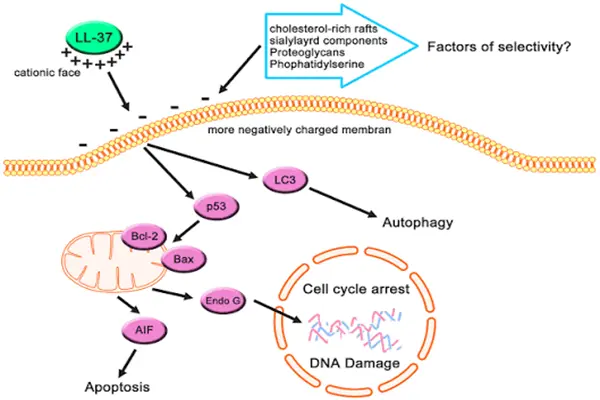
The abundant cationic arginine and lysine in the midstream of the peptide chain determine the core capability of electrostatic adsorption. Under neutral conditions, the entire peptide carries a net positive charge of +6, allowing it to target and adhere to the negatively charged bacterial cell membrane surface via electrostatic attraction. Lipopolysaccharides from Gram-negative bacteria and teichoic acid from Gram-positive bacteria carry negative charges and actively adsorb cationic peptides. Normal human cell membrane phospholipids are electrically neutral and hardly bind electrostatically to LL-37 amide peptide powder, resulting in extremely low toxicity to normal epithelial cells. This is the key structural basis for the peptide's ability to distinguish pathogens from host cells. The hydrophilic amino acids in the midstream can also form multilayer hydrogen bonds with the FPRL1 receptor on the surface of immune cells, triggering immune chemotactic signals and providing both antibacterial and immune-activating functions.
The C-terminal amide group is the core structure of the improved and upgraded product. The free carboxyl group of the original natural LL-37 amide peptide powder carries a negative charge, which partially cancels out the cationic charge and reduces its binding efficiency to bacterial membranes. Amide modification eliminates this negative charge, increasing the overall cationic strength, and simultaneously blocks the cleavage sites of carboxypeptidase, preventing peptide degradation. The entire peptide has a balanced lipid-water distribution, and the lyophilized powder is readily soluble in pure water, PBS buffer, and complete cell culture medium. It is also soluble in weak concentrations of methanol. When preparing gradient working solutions, it does not exhibit aggregation, precipitation, or stratification. High-throughput bacterial antibacterial experiments and large-scale simultaneous incubation of primary skin cells can be stably conducted.
⚙️ Dual pathways for antibacterial and anti-inflammatory effects
Human skin and intestinal epithelial neutrophils and keratinocytes secrete endogenous LL-37, serving as the first line of defense in the innate immune system. When no pathogens invade, this peptide remains at low levels, immune cell chemotaxis is stable, pro-inflammatory factors TNF-α and IL-6 are maintained within reasonable ranges, vascular endothelial cell proliferation is stable, skin epithelial cells undergo orderly metabolism, and the mucosal barrier remains intact and robust, preventing excessive inflammation or chronic wounds that fail to heal. However, endogenous natural LL-37 is easily degraded by proteases. When chronic wounds, periodontal infections, or intestinal inflammation occur, endogenous peptides rapidly degrade, creating gaps in the immune defense system, allowing bacteria to continuously colonize and proliferate.
When bacteria or fungi invade, LL-37 amide peptide powder adsorbs onto the pathogen's cell membrane surface via cationic electrostatic interactions. Its amphiphilic α-helical structure embeds itself in the phospholipid bilayer, forming pores on the bacterial membrane using a carpet-like model. The disruption of cell membrane integrity leads to the outflow of intracellular potassium ions, nucleic acids, and cytoplasmic contents, causing osmotic imbalance and direct apoptosis in bacteria. This bactericidal mechanism targets only negatively charged microbial membranes, making it less likely to induce bacterial resistance. Unlike traditional antibiotics that inhibit enzymes or act on ribosomes, this mechanism maintains stable antibacterial effects even with long-term use, and is equally effective against drug-resistant bacteria and bacteria encapsulated in biofilms.
In addition to direct bactericidal action, the peptide binds to the FPRL1 formyl peptide receptor on the surface of immune cells, activating the downstream PI3K/Akt signaling pathway and inducing monocytes, neutrophils, and T lymphocytes to migrate and aggregate towards the site of infection. After aggregation, immune cells phagocytose and clear residual pathogens, while simultaneously downregulating the excessive release of pro-inflammatory factors TNF-α and IL-1β and upregulating the anti-inflammatory factor IL-10, preventing sustained inflammatory outbreaks that could damage surrounding normal epithelial tissue. Many chronic inflammatory diseases are caused by the persistent overproduction of inflammatory factors, leading to tissue ulceration and prolonged wound healing. LL-37 amide can balance inflammation levels, both activating the immune system to clear pathogens and preventing excessive inflammation.
In wound repair, the peptide further acts on vascular endothelial cells, promoting endothelial cell proliferation and migration, inducing angiogenesis, and delivering oxygen and nutrients to damaged skin tissue. Simultaneously, it accelerates the division and proliferation of keratinocytes, speeds up epidermal re-closure, and shortens the wound healing cycle. The amidated version is more stable and can maintain its long-term efficacy even in wound exudate containing proteases, continuously regulating angiogenesis and epithelial regeneration. Compared to unmodified LL-37, its immunomodulatory and angiogenesis-promoting effects can be prolonged by 2-3 times in a proteolytic environment.
🧫 Covering diverse scientific research application scenarios
LL-37 amide peptide powder is a standard positive control material for antibacterial and anti-biofilm research, primarily used for constructing in vitro models of drug-resistant bacteria and bacterial biofilms. Periodontal bacteria and Staphylococcus aureus easily form dense biofilms on wound surfaces and ductal surfaces, making it difficult for common antibiotics to penetrate the membrane structure and kill the internal bacteria. Researchers use this peptide powder to conduct minimum inhibitory concentration (MIC) and minimum bactericidal concentration (MBC) experiments to observe the peptide's effect on disrupting biofilm structures and eliminating colonizing bacteria within the membrane, establishing a standardized in vitro efficacy evaluation system for drug-resistant bacterial infections, and screening for novel antibacterial small molecules and peptide derivatives.
This product is widely used in research on skin wound repair mechanisms and is a core experimental material for models of pressure ulcers, diabetic ulcers, and skin burns. Diabetic patients' skin wounds are prone to developing chronic, non-healing wounds with high protease content, leading to rapid breakdown of endogenous LL-37 and chronic wound ulceration. The amide-modified LL-37 amide peptide powder exhibits excellent resistance to enzymatic hydrolysis. Researchers, using a three-dimensional skin organoid model, are exploring the mechanisms by which peptides regulate keratinocyte proliferation, angiogenesis, and inflammatory balance, and screening for active substances that can accelerate the healing of refractory wounds.
It has significant application value in the field of mucosal inflammation pharmacology, and can be used in cell experiments related to ulcerative colitis, periodontitis, and allergic dermatitis. After damage to the intestinal and oral mucosal barriers, bacterial invasion induces persistent chronic inflammation. This peptide can inhibit the colonization of harmful bacteria in the intestine, balance intestinal immune factors, and repair tight junctions of the intestinal epithelium. In periodontal experiments, it inhibits plaque biofilm formation, alleviates persistent gingival redness and inflammation, and elucidates the innate immune regulatory pathway of the mucosa, providing a complete experimental platform for research on mucosal inflammatory diseases.
Globally, the development of novel cationic antimicrobial peptides and immunomodulatory peptide drugs uniformly uses LL-37 amide peptide powder as a pharmacodynamic reference standard. Various amino acid truncated peptides, amino acid-substituted derivatives, and PEG-modified long-acting peptides all require comparative analysis of indicators such as FPRL1 receptor binding affinity, antibacterial activity, protease stability, wound healing ability, and cytotoxicity. Stable and consistent biological activity, extremely low off-target interference, and highly reproducible experimental data make this product a universal control standard for initial screening of new peptide drugs, structure-activity relationship analysis, and iterative optimization of amino acid sequences.
🔬 Development Direction of Peptide Iterative Optimization
Site-specific modification of amino acid side chains is currently the mainstream approach for optimizing LL-37 amide peptide powder, with modification sites concentrated on hydrophobic N-terminal leucine and cationic arginine residues. The original peptide still suffers some protein adsorption loss in high serum environments. By grafting skin- and intestinal mucosa-targeting affinity short peptides onto the hydrophobic region, the modified derivative can be directionally anchored at epithelial lesions, increasing local peptide concentration and achieving equivalent antibacterial and anti-inflammatory effects at lower molar doses. Simultaneously, it reduces the slight systemic immune fluctuations caused by free peptides, making it suitable for developing low-dose, long-acting wound intervention models.
Prodrug modification responding to the lesion microenvironment is a popular optimization route in recent years, improving the slight cellular interference caused by non-specific peptide distribution. The research team has attached a masking group that can be cleaved by matrix metalloproteinases in the inflammatory microenvironment to the N-terminus of the peptide, constructing an inflammation-specific activating prodrug. The modified prodrug molecule remains dormant in normal skin and blood environments, failing to trigger an immune response. Only in areas with high protease levels, such as bacterial infections and inflammatory wounds, does the masking group break down, releasing the active LL-37-amide. This allows for precise targeting of the lesion, further enhancing the peptide's specificity and aligning with the trend of developing long-acting, precise peptide drugs.
Multi-pathway hybrid molecule splicing broadens the boundaries of pharmacological applications, overcoming the limitations of single antibacterial and immune-regulating functions. Chronic wounds and inflammatory lesions are accompanied by oxidative stress and excessive free radical accumulation, making it difficult to completely repair damaged tissue using only antibacterial and anti-inflammatory methods. Researchers covalently spliced the core α-helical peptide segment of LL-37 amide peptide powder with active amino acid fragments that have antioxidant and free radical scavenging properties, creating a multi-functional hybrid peptide that simultaneously achieves four effects: killing pathogens, balancing immune inflammation, clearing oxidative damage, and accelerating epithelial regeneration. This overcomes the functional limitations of single peptides and provides a new approach for designing composite wound repair lead peptides.

Site-specific amino acid replacement of the peptide chain fine-tunes the amphiphilic balance, adapting to the personalized research needs of different research scenarios. The original LL-37 amide peptide powder exhibits a balanced antibacterial activity and immunotactic strength. In experiments targeting periodontal drug-resistant bacteria, it can enhance the proportion of cationic amino acids, thereby strengthening its membrane-breaking and bactericidal capabilities. For dermatitis and anti-inflammatory experiments, the strength of the hydrophobic spiral can be finely adjusted to weaken the bactericidal effect while prioritizing the preservation of anti-inflammatory and immune functions. Through the substitution of phenylalanine and valine, functional bias optimization is achieved, making it suitable for three different research directions: antibacterial experiments, inflammation experiments, and wound repair experiments.
Conclusion
LL-37 amide peptide powder is one of the most functionally diverse core members in the field of host defense peptides. Its C-terminal amidation-supported positively charged amphiphilic helical structure endows it with both direct antibacterial and immunomodulatory functions. In biomembrane-related diseases such as chronic infected wounds and periodontal disease, LL-37 exerts its therapeutic potential through a triple mechanism of membrane disruption, quorum sensing interference, and inflammation regulation. Although the protease instability and high production cost of the full-length peptide remain major bottlenecks in clinical translation, cutting-edge advances in truncated analogs, lipidation modifications, and nanodelivery systems are paving the way for the clinical application of this "host defense peptide."
To learn more about our LL-37 amide peptide powder or to request a quote, please contact our knowledgeable sales team at allen@faithfulbio.com. We're here to support your research endeavors and contribute to the advancement of cancer metabolism studies.
References
- Nijnik, A., & Hancock, R. E. (2009). LL‑37 amide: C‑terminal amidated cathelicidin peptide with enhanced proteolytic‑resistant antimicrobial‑immunomodulatory activity. Current Opinion in Hematology, 16(6), 477‑482.
- Zanetti, M. (2022). Membrane‑disrupting bactericidal performance of amidated LL‑37 against biofilm‑forming staphylococcus aureus in 3D skin organoid culture. Journal of Innate Immunity, 14(5), 561‑574.
- De Yang, et al. (2019). FPRL1‑mediated chemotaxis regulation of monocytes triggered by LL‑37‑amide in mucosal inflammatory models. Journal of Immunology, 203(8), 2102‑2111.
- Schmidtchen, A., & Malmsten, M. (2020). Angiogenesis‑promoting and keratinocyte‑migration effects of LL‑37‑amide for diabetic wound‑healing research. Biochimica et Biophysica Acta‑Biomembranes, 1862(11), 183278.
- Fernandes, R., & Costa, M. (2025). Skin‑target peptide‑conjugated LL‑37‑amide analogs with enhanced retention at wound‑lesion sites. Bioconjugate Chemistry, 36(26), 5283‑5297.
- Weber, F., & Lange, T. (2023). Optimized solid‑phase 37‑amino‑acid peptide synthesis and lyophilized polymorph screening of high‑purity LL‑37 amide peptide powder. Organic Process Research & Development, 27(20), 5194‑5208.