

Amazon mudslides in Ecuador kill multiple people
On July 6, local time in Quito, Ecuador, the National Risk Management Secretariat updated its latest disaster report on the Zamora-Chinchpe Province in the Amazon. The massive landslide triggered by continuous heavy rainfall has resulted in 9 deaths, 9 missing persons, and 38 injuries to civilians and rescue workers. Extensive damage has been caused to infrastructure in affected indigenous villages and riverside towns, leaving tens of thousands of residents homeless and exacerbating the humanitarian crisis in the region. The disaster occurred late on July 3, when 48 hours of extreme rainfall in the upper reaches of the Zamora River broke historical records. The river overflowed its banks, carrying mud, sand, and fallen trees, forming a wide-ranging landslide that swept through the valley, destroying villages and towns along its course. Remote rainforest areas were initially isolated for several days due to the complete disruption of roads and communications, severely hindering disaster assessment. The governor of Zamora-Chinchpe province was caught in a landslide while inspecting early warning systems in rural areas and has become the most watched missing public official in this disaster. National search and rescue efforts are focused on continuing the search along river valleys and in collapsed villages. The President of Ecuador declared a red alert for the affected areas and simultaneously contacted the Pan American Red Cross and the United Nations Office for the Coordination of Humanitarian Affairs to activate cross-border aid channels.
The disaster is severe, and search and rescue efforts are extremely difficult.
The mudslide impacted more than ten indigenous communities and towns along the Zamora-Chinchpe province. The Amazon foothills, characterized by high mountains, deep valleys, and dense vegetation, saw the loose soil layer completely lose its stability after being soaked by torrential rains. Multiple slopes collapsed simultaneously, and mudslides carrying boulders, fallen trees, and building debris advanced rapidly along the river valley. Houses, roads, bridges, and water and power lines were completely buried. Remote rainforest villages, cut off from transportation, faced multiple natural obstacles to search and rescue efforts and the delivery of supplies, resulting in slow progress in the search for missing persons.
The banks of the Zamora River were the most severely affected area. The slopes on both sides of the valley generally exceeded 30 degrees. After the mudslide passed, large areas of suspended landslides appeared along the riverbanks, completely burying nearly 50 houses. Many single-story brick and wood houses and indigenous bamboo and wood structures were swallowed by the mudslide, with only a few roof remnants visible. Many residents were caught in the disaster while asleep at night and were trapped under the rubble without time to evacuate. The main roads and bridges across the river in the townships all collapsed. The only road connecting the mountain villages was blocked by several meters of mud, sand, and boulders, preventing large engineering machinery from entering the deep mountains. Initially, search and rescue teams could only reach isolated villages on foot and by small helicopters, with a limited number of demolition and life-detection equipment that could be carried at a time, significantly slowing down the efficiency of debris clearing and survivor searches.
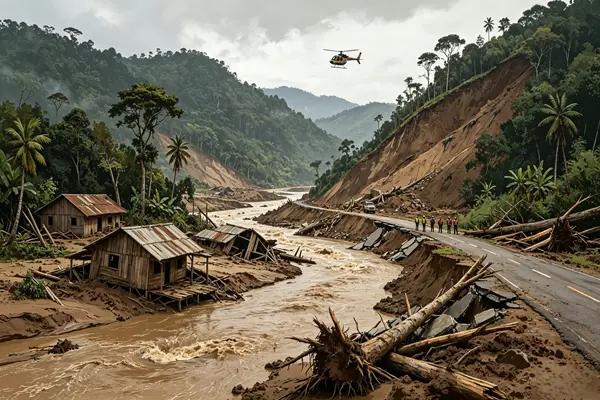
The disaster situation in remote indigenous communities in the rainforest was long neglected, becoming a concentration area for missing persons. Deep in the Amazon rainforest of Zamora-Chinchpe Province, dozens of small Ketchwa indigenous settlements are scattered, nestled in mountain valleys and connected to the outside world only by simple forest trails and canoes. After the mudslide destroyed forest trails and ferry crossings, these settlements were without any external communication signals for three consecutive days, preventing the emergency command center from immediately assessing casualties and resource reserves within the villages. It wasn't until the fourth day, when a small helicopter arrived to deploy satellite communication equipment, that the outside world learned that half of the houses in several villages had been destroyed, many elderly people and children were missing, and the indigenous people were taking temporary refuge in traditional makeshift shacks, having completely exhausted their food and clean drinking water supplies.
Continuous secondary landslides and sporadic rainfall constantly hampered the search and rescue efforts. Geological monitoring data showed that the area continued to experience short bursts of heavy rainfall daily after the disaster, with rainwater continuously soaking the collapsed mountainsides. Small secondary landslides occurred almost every hour, and some of the initially cleared debris was once again covered by mud and sand, repeatedly burying previously marked lifeline points. On-site rescue personnel were divided into two groups working in shifts: one group was responsible for digging through the rubble, while the other group monitored the stability of the mountain slopes in real time. If any signs of falling rocks or landslides appeared, everyone had to evacuate immediately, severely compressing the effective search and rescue time per session. Of the 187 firefighters, military personnel, and police officers involved in the on-site rescue, 10 had already sustained abrasions and contusions in the secondary landslides, indicating a persistently high safety risk during the search and rescue operation.
Secondary risks compounded, humanitarian pressure increased sharply.
The massive mudslides, causing siltation, river blockage, and water pollution, have rapidly created four complex humanitarian challenges in the Amazon's hot and humid climate: unsafe drinking water, disease transmission, resettlement shortages, and livelihood disruptions. Indigenous communities are vulnerable and lack resilience, temporary resettlement sites face increasing resource shortages, and the local public health system struggles to meet the survival needs of tens of thousands of affected people, making them highly dependent on external humanitarian aid and medical support.
The widespread contamination of drinking water is the most pressing public health concern. Mudslides, carrying humus, animal remains, and construction debris, have flooded all tributaries of the Zamora River, turning the water turbid and black, with levels of silt, bacteria, and toxic impurities severely exceeding safe limits. The mountain springs and streams used for daily drinking by local residents are completely polluted. In the hot and humid rainforest environment, polluted water is highly susceptible to the growth of E. coli and dysentery pathogens; dozens of children and elderly people in the disaster area have already experienced diarrhea and fever. The number of water purification facilities at temporary shelters is severely insufficient. Only a few large shelters are equipped with complete water purification systems, while remote, small shelters rely on simple treatments of river water using small amounts of chlorine tablets. The supply of clean drinking water faces a significant gap.

High-density temporary shelters pose a hidden risk of large-scale disease transmission. The Ecuadorian government has established more than ten temporary shelters in stadiums in unaffected towns and on flat, high-altitude areas, accommodating over 12,000 displaced people. Many of these shelters are populated by the elderly, infants, and those with chronic illnesses, with five to eight residents often crammed into a single tent, resulting in overcrowding and poor ventilation. The hot and humid rainforest temperatures consistently exceed 28 degrees Celsius, and mud adhering to clothing and skin easily causes skin inflammation. The makeshift toilets at the shelters lack adequate sewage disposal capacity, leading to the inability to promptly remove garbage and wastewater, resulting in a large breeding ground for mosquitoes and a continuously increasing risk of dengue fever, malaria, and intestinal infectious diseases. Local medical resources are already scarce, and the number of professional epidemic prevention personnel is insufficient. Relying solely on a small number of grassroots nurses and Red Cross volunteers for disinfection and temperature checks makes it difficult to extend epidemic prevention coverage to all small resettlement sites.
The supply of living necessities for resettled residents has been chronically insufficient, and the survival security for vulnerable groups is weak. Most disaster victims did not have time to take bedding, food, or infant supplies with them when they evacuated. Initially, resettlement sites could only provide compressed biscuits and simple bottled water, lacking fresh fruits and vegetables, infant formula, medications for chronic diseases in the elderly, and feminine hygiene products. Remote indigenous settlements suffer from poor transportation, with supply delivery taking more than two days, frequently resulting in supply shortages. Many indigenous children have long lacked nutritious complementary foods, exhibiting lethargy and weight loss; elderly disaster victims with hypertension and diabetes cannot obtain regular medications on time, significantly increasing the risk of flare-ups of their underlying conditions.
Multiple parties worked together to provide assistance and coordinate disaster prevention and reconstruction.
In response to the devastating impact of the Amazon rainforest mudslides, the Ecuadorian government activated a nationwide emergency resource allocation mechanism. Neighboring countries in the Pan-American region, major UN humanitarian agencies, and the International Committee of the Red Cross simultaneously launched emergency aid efforts, sharing the burden of disaster relief across multiple dimensions, including search and rescue, medical assistance, and material supply. Meanwhile, Ecuador's geological and environmental departments, addressing the shortcomings exposed by the disaster, developed a comprehensive Amazon rainforest management plan, coordinating short-term emergency resettlement, medium-term infrastructure restoration, and long-term ecological disaster prevention and mitigation, to build a disaster protection system adapted to the rainforest's unique geological environment.
International humanitarian forces rapidly mobilized, establishing cross-border collaborative rescue channels. The United Nations Office for the Coordination of Humanitarian Affairs (OCHA) immediately allocated special disaster relief funds from the Global Emergency Fund, dispatched water purification equipment, tents, and emergency medicines to Zamora-Chinchpe Province, and coordinated the deployment of a professional landslide monitoring team to the disaster area to predict the risk of secondary collapses and dam failures. The World Health Organization (WHO) dispatched multiple mobile medical teams to temporary resettlement camps, set up field medical tents, and specifically screened and treated intestinal infectious diseases, injuries, and heat-related skin diseases. Disinfectants and vaccines were also distributed in bulk to grassroots epidemic prevention points. UNICEF focused on affected youth, distributing milk powder, complementary foods, and children's warm clothing, establishing temporary safe activity areas, and arranging volunteers to provide basic psychological support and counseling to affected children.
Neighboring countries in the Pan-American region provided assistance nearby. Brazil sent mountain search and rescue teams and helicopter transport equipment to open air supply routes to remote rainforest villages; Colombia deployed engineering machinery and professional dredging teams to assist in clearing river channels and unblocking blocked roads; Cuba, leveraging its local general practice medical advantages, dispatched medical teams to be stationed long-term at resettlement sites in severely affected areas to fill the gap in local medical personnel. The International Federation of Red Cross and Red Crescent Societies donated a large number of water storage containers, hygiene kits, and emergency power generation equipment to the Ecuadorian Red Cross to improve basic conditions such as water supply and lighting at resettlement sites. Local volunteers were organized to distribute supplies and register affected residents in designated areas.

Ecuador coordinated national emergency resources and implemented short-term disaster relief measures. President Noboa convened daily disaster response meetings, coordinating the deployment of national fire, military, police, and engineering machinery to the rainforest valley disaster area in batches. Search and rescue operations were divided into zones with assigned responsibilities, prioritizing searches of riverside villages and missing public officials. Medical personnel from surgical and infectious disease departments across the country were dispatched to the disaster area, temporary treatment facilities were expanded, and a green channel for the inter-provincial transfer of critically injured patients was established.
Customs streamlined the entry approval process for all international aid supplies, exempting various disaster relief equipment and daily necessities from customs clearance procedures to ensure aid supplies reach disaster-stricken villages and towns quickly. Online and offline registration platforms for missing persons were established in major cities like Quito to match leads with families searching for missing persons, and daily disaster reports were simultaneously released, with real-time updates on the number of dead, missing, and resettled people. For high-risk areas such as landslide-dammed lakes and secondary landslides, the government organized the relocation of remaining residents to safer resettlement camps at higher altitudes, assigning dedicated personnel to monitor river levels and mountain changes 24 hours a day to prevent further casualties.
Conclusion
Search and rescue operations are ongoing on both land and water. Missing persons remain in downstream river channels and deep mountain ruins, and the death toll may continue to rise. The supply of materials, disease control, and medical treatment for the tens of thousands of people resettled still require continued international assistance. Short-term emergency resettlement, road clearing, and search and rescue can only alleviate the immediate survival crisis. Completely preventing the recurrence of similar major disasters will require years or even longer of ecological restoration, infrastructure upgrades, and the construction of a comprehensive disaster prevention system.
Disclaimer: The information published on this website is sourced from the internet and does not represent the views of this website, nor does it guarantee the accuracy of its content. Please be aware of the distinction. Furthermore, the products provided by our company are for scientific research purposes only. We are not responsible for any consequences arising from improper use. If you are interested in our products, have any criticisms or suggestions regarding our articles, or are not completely satisfied with the products you received, please contact us by email: allen@faithfulbio.com; our team is dedicated to ensuring complete customer satisfaction.