

Many countries have improved their guidelines for the diagnosis and treatment of heat-related illnesses.
Due to the continued impact of global warming, extreme heat waves and extreme temperatures are occurring more frequently and extensively worldwide. These heat waves are lasting longer, covering wider areas, and their extreme values are constantly breaking historical records. Heat-related illnesses have become a persistent public health challenge threatening the lives and health of people globally. The latest monitoring data from the World Health Organization shows a significant increase in cases of heatstroke, heat exhaustion, heatstroke, and heat-induced cardiovascular and respiratory complications globally over the past five years. The number of deaths and disabilities caused by heat is increasing year by year, and the health risks associated with heat have spread to all continents and the vast majority of countries and regions, regardless of the hemisphere or whether they are developed or developing economies.
Global standards for high-temperature diagnosis and treatment have been comprehensively upgraded.
With extreme heat waves becoming the norm, heat-related illnesses have transformed from seasonal ailments into year-round, global public health risks. Traditional heatstroke diagnosis and treatment guidelines suffer from numerous problems, including vague standards, outdated procedures, non-standardized treatment of severe cases, and poor suitability for specific populations, making them ill-suited to the current complex situation of heat-related illnesses. To address this, the World Health Organization (WHO) took the lead by releasing a new version of its "Heat Waves and Health Action Plan Guidelines," establishing a unified framework for the diagnosis and treatment of heatstroke and the prevention and control of heat-related health issues globally. Subsequently, many countries in Europe, America, Asia-Pacific, and Africa revised their localized treatment guidelines based on their local climate characteristics, population constitutions, and the distribution of medical resources, achieving a standardized, refined, and regulated upgrade in the global diagnosis and treatment of heatstroke.
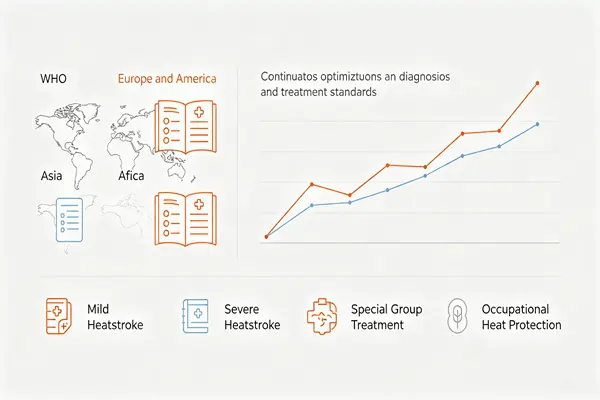
International authoritative medical systems have taken the lead in completing the iteration of core standards. The International Society of Critical Care Medicine (ISCLC) assembled 18 of the world's leading critical care medicine experts and public health scholars to release a new version of its heatstroke-specific treatment guidelines. This new guideline makes crucial corrections to long-standing clinical misconceptions, explicitly prohibiting the use of antipyretics and nonsteroidal anti-inflammatory drugs (NSAIDs) to treat severe heatstroke, thoroughly correcting previous erroneous medication regimens, and significantly reducing the risk of complications in severely ill patients. Meanwhile, the guidelines clearly define the golden principle for cooling and treatment, requiring that heatstroke patients must undergo professional cooling intervention within 30 minutes, and their core body temperature must be reduced to below 38.5℃ within 2 hours. Rapid, effective, and physical cooling is established as the core principle of severe heatstroke treatment, becoming a globally unified core standard for heatstroke treatment.
China has simultaneously updated its localized authoritative diagnosis and treatment system. In 2025, the PLA Heatstroke Prevention and Control Expert Group, in conjunction with the Chinese Medical Association, released the "Chinese Guidelines for the Diagnosis and Treatment of Heatstroke (2025 Edition)," achieving a comprehensive upgrade of the diagnosis and treatment system. The new guidelines, for the first time, incorporate neurocritical care management into the core treatment process for high-temperature diseases, constructing a full-chain diagnosis and treatment model of "rapid identification—golden cooling—multi-organ support—neuroprotection—long-term rehabilitation," filling the gap in the diagnosis and treatment of neurological damage prevention and long-term rehabilitation for severe high-temperature patients in China. Meanwhile, the classification standards for heat-related illnesses have been refined, accurately distinguishing between four levels: heat exhaustion, mild heatstroke, severe heat failure, and severe heatstroke. Differentiated medication, cooling, monitoring, and rehabilitation plans have been developed for each level, enabling precise diagnosis and treatment even in primary healthcare institutions.
Many European and American countries are focusing on improving treatment guidelines for high-risk groups and occupational scenarios. The Cleveland Clinic in the United States updated its clinical treatment manual for heat-related illnesses, focusing on refining specific treatment plans for four vulnerable groups: the elderly, children, pregnant women, and patients with chronic diseases. For patients with cardiovascular diseases, diabetes, and respiratory diseases, the manual optimizes fluid replacement, monitoring, and medication strategies to avoid exacerbating underlying conditions due to heat. Many European countries, relying on WHO regional guidelines, have improved their rapid emergency response mechanisms for heat-related illnesses, requiring hospitals to open dedicated emergency channels for heat-related illnesses during the summer, increase intensive care beds, and equip themselves with professional cooling equipment to ensure priority access, treatment, and care for patients with heat-related illnesses.
Significantly improve the effectiveness of treating heat-related illnesses
In traditional clinical practice, heat-related illnesses have long suffered from prominent problems such as "neglecting mild cases, failing to treat severe cases, using inappropriate medications, and lacking a systematic rehabilitation program." Many patients experience worsening conditions, leading to multiple organ failure, neurological damage, and even death due to delayed identification, improper treatment, and misdiagnosis. Newly revised treatment guidelines from multiple countries directly address clinical pain points and blind spots in treatment, precisely dispelling long-standing misconceptions, refining standardized treatment procedures, and significantly improving the overall success rate of treating heat-related illnesses globally, while reducing the disability and mortality rates of severe cases.
The new guidelines clearly define tiered treatment standards, resolving the core challenges of ambiguous identification and chaotic management of heat-related illnesses. Previously, in clinical practice, most medical institutions made cursory judgments about heat-related symptoms, simply distinguishing between heatstroke and severe cases, easily overlooking early warning signs and intervention for mild cases, leading to delayed treatment and the development of critical illnesses. The new globally unified standard clearly defines the characteristics and treatment plans for four levels of heat-related illnesses: Heat exhaustion is characterized by dizziness, fatigue, excessive sweating, palpitations, and burning skin. The guidelines specify rapid relocation to a cool environment, electrolyte replenishment, rest, and observation as the primary treatments to prevent the disease from progressing. Mild heatstroke presents with elevated body temperature, nausea, vomiting, and flushed or pale complexion; standardized procedures include oral rehydration, physical cooling, and symptomatic care. Patients with heat exhaustion require enhanced intravenous rehydration, vital sign monitoring, and organ protection. For the most dangerous heatstroke, rapid cooling, multi-organ monitoring, neuroprotection, and intensive care are strictly implemented to prevent missed diagnoses, misdiagnoses, and delayed treatment, achieving "early identification, early intervention, tiered treatment, and precise treatment."
The guidelines also aim to correct long-standing clinical misconceptions and mitigate the risks of human error in diagnosis and treatment. In the past, many erroneous treatment methods existed in the private sector and even in some grassroots medical institutions, including using antipyretics to lower fever, simply drinking plain water for rehydration, applying heat to induce sweating, wiping large areas with alcohol to lower fever, and moving critically ill patients arbitrarily. These misconceptions can easily aggravate organ damage and accelerate the deterioration of the condition. The new multinational unified guidelines explicitly prohibit all kinds of erroneous operations, clearly stating that antipyretics are strictly prohibited for heatstroke, and only safe methods such as ice water immersion, ice saline infusion, and physical cooling with cooling blankets should be used; it also clearly states that rehydration for high-temperature illnesses should prioritize electrolyte water and dilute saline, avoiding electrolyte imbalances caused by simply rehydrating with plain water; and it standardizes the transfer and monitoring procedures for critically ill patients to minimize secondary harm during treatment and fundamentally regulate clinical diagnosis and treatment practices.

Targeted measures address the shortcomings in the diagnosis and treatment of special populations, strengthening the health defense line for vulnerable groups. The elderly have weak thermoregulation, children have high metabolism, pregnant and postpartum women bear heavy physical burdens, and patients with chronic diseases have weakened organ function. These groups are at high risk for heat-related illnesses due to their insidious onset, rapid progression, and high mortality rate, and represent a weak link in traditional diagnosis and treatment. The new guidelines specifically develop detailed treatment guidelines for these four vulnerable groups, relax screening standards for high-risk groups, refine joint treatment plans for patients with underlying diseases and heat-related injuries, and require medical institutions to prioritize the monitoring and observation of elderly and pediatric patients, extending the observation period to prevent missed diagnoses of mild cases and delays in the treatment of severe cases. At the same time, clear regulations are established regarding prohibited drugs and cooling methods for infants, young children, and pregnant and postpartum women, avoiding harm to these special populations from routine treatments and significantly improving the safety and success rate of treatment for vulnerable groups.
Building a long-term health protection and governance system for high temperatures
The improvement and upgrading of treatment guidelines are the medical foundation for the prevention and control of heat-related illnesses. However, the key to protecting public health lies in the routine implementation, widespread application, and comprehensive risk control. Currently, countries around the world are using the new version of the heat-related illness treatment guidelines as the core, linking medical institutions, emergency departments, communities, enterprises, and schools to build a long-term governance system integrating "medical treatment, early warning and prevention, public education, occupational protection, and emergency support." This promotes the implementation of advanced treatment standards and comprehensively addresses the risks of normalized extreme heat.
Medical institutions in various countries have fully completed the upgrading of their treatment systems, strengthening the foundation for clinical treatment. Hospitals at all levels worldwide, community health service centers, and township health centers are simultaneously conducting specialized training on the new guidelines, organizing emergency department, intensive care unit, and general practitioner medical staff to systematically learn about triage identification, rapid cooling, critical care, and rehabilitation nursing standards, and comprehensively updating clinical treatment procedures. During the summer heatwave, hospitals across the country routinely open dedicated treatment channels and emergency green channels for heat-related illnesses, equipped with professional supplies such as ice water, cooling blankets, ice saline solution, and monitoring equipment. They optimize the entire process of receiving, examining, and treating patients to ensure rapid and efficient treatment of heat-related illnesses. Simultaneously, a review mechanism for severe heat-related cases has been established to continuously optimize treatment plans, improve local heat-related illness treatment levels, and narrow regional medical disparities.

Meteorological and medical collaboration is being deepened to establish a precise high-temperature health early warning mechanism. Countries are leveraging the collaborative mechanisms of the World Meteorological Organization and the World Health Organization to improve the high-temperature weather-health risk linkage early warning system, issuing corresponding health protection tips and medical guidance based on the temperature level. During hot weather, precise information on protection for high-risk groups, outdoor work risk warnings, and heatstroke first aid is disseminated to guide the public in avoiding heat-related injuries. Community and township-level primary healthcare institutions are focusing on identifying elderly people, patients with chronic diseases, and people living alone, conducting door-to-door temperature checks, health monitoring, and protection guidance to intervene in potential heat-related illness risks in advance, shifting from "treatment of illness" to "prevention."
Promoting public science education and specialized protection measures in schools and businesses reduces the probability of illness from the source. Many countries are leveraging new media platforms, offline lectures, and public science outreach activities to comprehensively popularize new methods for identifying heat-related illnesses, self-rescue and mutual-aid techniques, and knowledge on avoiding common misconceptions. This enables the general public to independently identify early signs of heatstroke, master correct cooling and hydration methods, and seek scientific help and standardized treatment in cases of severe illness. Schools at all levels are optimizing their summer schedules, avoiding outdoor activities during peak heat hours, and conducting high-temperature safety education on campuses. Industries such as construction, sanitation, and logistics are strictly implementing work stoppage and shift work systems for high-temperature operations, ensuring on-the-job health monitoring, equipping themselves with professional heatstroke prevention supplies and first-aid personnel, and fully integrating the new occupational high-temperature diagnosis and treatment protection standards into daily production management to minimize occupational high-temperature injuries.
Conclusion
Heat-related illnesses are preventable, identifiable, and treatable, but the health risks posed by extreme heat are long-term. Improving treatment guidelines is only the starting point for prevention and control. To truly build a strong defense against heat-related illnesses, medical institutions need not only to strictly implement standardized treatment procedures and continuously improve their treatment capabilities, but also the concerted efforts of the entire society to establish a comprehensive system encompassing high-temperature warnings, daily protection, emergency response, public education, and occupational safety, making scientific heatstroke prevention, proper self-rescue, and timely medical treatment a consensus and conscious action for all.
Disclaimer: The information published on this website is sourced from the internet and does not represent the views of this website, nor does it guarantee the accuracy of its content. Please be aware of the distinction. Furthermore, the products provided by our company are for scientific research purposes only. We are not responsible for any consequences arising from improper use. If you are interested in our products, have any criticisms or suggestions regarding our articles, or are not completely satisfied with the products you received, please contact us by email: allen@faithfulbio.com; our team is dedicated to ensuring complete customer satisfaction.