




Dubai launches $5.1 billion super maintenance center for aircraft.
The Dubai government, in conjunction with Dubai Airlines Group and Emirates Group, officially announced the launch of a world-class aircraft super maintenance center project with a total investment of US$5.1 billion. Located in the core area of Dubai's Southern Aerocity, the project covers over 4 million square meters and includes core facilities such as ultra-large hangars, advanced maintenance workshops, a global warehousing center for aircraft parts, a digital operations and maintenance laboratory, and an aviation talent training base. Upon completion, it will become the largest, most technologically advanced, and most comprehensive one-stop aircraft maintenance hub in the Middle East and even globally. Currently, the global aviation industry is experiencing a deepening recovery, with the civil aviation fleet steadily expanding. The demand for maintenance of wide-body aircraft and new-generation narrow-body aircraft is surging. This, coupled with changes in the global geopolitical landscape, the rise of regional aviation markets, and the restructuring of the aviation supply chain, has led to capacity saturation, longer maintenance cycles, and continuously rising costs at traditional European and American aircraft maintenance centers. Leveraging its strategic location as a Middle Eastern aviation hub and targeting the global aviation maintenance market, Dubai has invested $5.1 billion in a super maintenance facility. This will not only fill the gaps in the Middle East's high-end aviation maintenance industry chain and reshape the global aviation maintenance market competition landscape, but will also drive the clustered development of the entire industry chain, including aviation manufacturing, logistics, digital technology, and high-end employment. This will strengthen Dubai's position as a global aviation center, deeply tap into the aviation market dividends of the Middle East, Africa, South Asia, and Europe, and have a profound strategic impact on the global aviation industry layout, regional economic transformation, and the restructuring of the international aviation supply chain. This article comprehensively analyzes the underlying logic and future impact of the Dubai Aviation Super Maintenance Center from three dimensions: project planning and core positioning, the changing global aviation maintenance market, and its strategic economic value.
A major $5.1 billion project has been launched, creating a world-class one-stop aircraft maintenance hub.
The $5.1 billion aircraft super-maintenance center announced by Dubai is the largest aviation infrastructure project in Dubai in nearly a decade and a core benchmark project for the UAE's aviation industry upgrade. The project has an eight-year planning period and will be implemented in three phases. Positioned as a global platform for full-aircraft, full-process, and full-lifecycle aircraft maintenance services, its hardware standards, technical capabilities, and service scope are all benchmarked against the world's top levels, aiming to create a new benchmark for the global aircraft maintenance industry.
From the overall project plan, the super-maintenance center is located in Dubai World Centre Aero City in southern Dubai, adjacent to Al Maktoum International Airport and close to the world's largest cargo airport and Dubai's logistics hub. Its prime location allows for rapid connection to route networks in the Middle East, Europe, Africa, and Asia Pacific, significantly reducing aircraft shunting distances for maintenance and lowering airline time and operating costs. The project covers a total area of 4.05 million square meters, with a total construction area of over 2.2 million square meters. Its core plan includes eight functional modules: 12 ultra-large wide-body aircraft maintenance hangars, 20 narrow-body aircraft deep maintenance workshops, a specialized aircraft engine maintenance center, a global bonded warehousing center for aviation parts, a digital intelligent operation and maintenance laboratory, an aviation composite material repair base, a high-end aviation talent training park, and a cross-border aviation materials trading platform. The ultra-large hangars can simultaneously accommodate 18 of the world's largest wide-body passenger aircraft, including the A380 and Boeing 787, for deep maintenance. The engine maintenance workshops can perform overhauls, inspections, and refurbishments of all mainstream Airbus and Boeing engines. The parts warehousing center will store over one million types of core aviation components, creating the Middle East's first global bonded warehouse for aviation materials, enabling same-day allocation and rapid replenishment of aviation materials.
The project has a total investment of US$5.1 billion, jointly funded by the Dubai Government Strategic Investment Fund, Emirates Group, and the Dubai Aviation Enterprise Consortium. The Dubai government provides comprehensive policy support in terms of land, infrastructure, tax incentives, customs clearance facilitation, and energy security. The first phase of the project involves an investment of US$1.6 billion, focusing on the construction of four wide-body hangars, basic maintenance workshops, an aviation materials storage center, and supporting infrastructure, with a planned completion and operation date of 2030. The second phase, with an investment of US$2.2 billion, will expand into high-end sectors such as engine maintenance, composite material repair, and digital maintenance laboratories, improving the entire maintenance chain. The third phase, with an investment of US$1.3 billion, will establish an aviation talent base, a cross-border aviation materials trading platform, and an aviation technology innovation center, creating an integrated industrial cluster encompassing maintenance, trade, R&D, and talent. Upon completion, the project will be able to undertake in-depth maintenance for over 400 wide-body aircraft and 800 narrow-body aircraft annually, with total annual maintenance man-hours exceeding 12 million hours. Its maintenance capabilities will cover over 95% of mainstream civil aircraft models worldwide, including the Airbus A380 and A350, and Boeing 777 and 787, among other next-generation large passenger aircraft. It will also be able to undertake maintenance services for business jets, cargo aircraft, and general aviation aircraft.
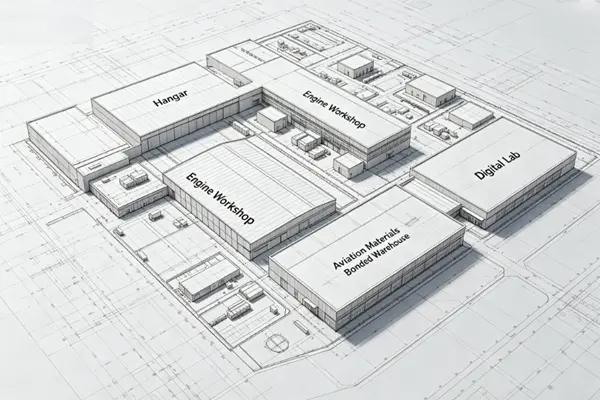
In terms of technology and service positioning, the Dubai Airways Super Maintenance Center focuses on three core directions: digitalization, greening, and high-end services, fully aligning with the highest international standards. The maintenance workshop incorporates cutting-edge technologies such as the Industrial Internet, AI-powered intelligent testing, digital twin maintenance, automated maintenance robots, and intelligent non-destructive testing to achieve digital control over the entire aircraft maintenance process, significantly shortening maintenance cycles and improving accuracy. It fully adopts green maintenance processes, promoting low-carbon and environmentally friendly materials, energy-saving maintenance equipment, and clean energy power supply, creating the world's first carbon-neutral aviation maintenance base, in line with the global aviation industry's sustainable development trend. Simultaneously, it breaks with traditional maintenance models, providing a one-stop integrated service for deep aircraft overhauls, cabin refurbishment, engine overhauls, parts replacement, aviation material supply, line maintenance, technical management, and aircraft modification, offering full lifecycle maintenance solutions for airlines worldwide.
In terms of operation and cooperation, Dubai Aviation Group takes the lead, uniting Emirates and Dubai Airlines as core clients. It also establishes deep strategic partnerships with global aviation giants Airbus and Boeing, as well as Rolls-Royce, Pratt & Whitney, and CFM International, securing original equipment manufacturer (OEM) maintenance authorization, technical support, and direct parts supply rights to ensure the professionalism and authority of its maintenance technology. The project is open to the global market, primarily serving airlines in the Middle East, Africa, South Asia, Europe, and Central Asia, while also undertaking overseas maintenance orders from Asia-Pacific and American airlines, aiming to become the preferred overseas maintenance base for global airlines. Upon completion, the project will directly fill the gap in the Middle East's lack of a top-tier wide-body aircraft deep maintenance center, ending the Middle East's long-standing reliance on European and American maintenance bases for large passenger aircraft overhauls, and achieving regional autonomy and control over aviation maintenance.
The global aircraft maintenance market is undergoing dramatic changes, and Dubai is seizing the golden window of opportunity for industrial relocation.
The global aircraft maintenance (MRO) market is currently undergoing a new round of structural changes. Traditional European and American maintenance centers are facing saturated capacity, high costs, and supply chain pressures. The Asia-Pacific market is rapidly emerging, and the Middle East, with its location, policies, and locational advantages, has become a core destination for industry relocation. Dubai's $5.1 billion super maintenance center has accurately timed the turning point in the global aviation industry, seizing future dominance in the global aircraft maintenance market.
From the perspective of the overall size of the global aircraft maintenance market, with the full recovery of the global civil aviation industry, the continuous expansion of the global civil aviation fleet, the widespread adoption of new-generation wide-body aircraft and long-range passenger aircraft, coupled with older aircraft entering their overhaul cycles, the global aircraft maintenance market is experiencing explosive growth. Data from the International Air Transport Association (IATA) shows that the global aircraft maintenance market size will exceed $92 billion in 2025 and is projected to reach $140 billion by 2030, with an average annual growth rate exceeding 9%. Among these, high-end maintenance services such as deep overhauls of wide-body aircraft, engine maintenance, and aircraft cabin modifications are growing the fastest, indicating a huge market gap. Traditionally, the core global aircraft maintenance market is concentrated in Europe (Germany and France), the United States (Miami and Seattle), and Asia (Singapore and Guangzhou). However, in recent years, Europe and the United States have faced multiple challenges, including soaring labor costs, limited hangar resources, longer maintenance schedules, and disrupted supply chains. This has forced many airlines to outsource maintenance orders, seeking high-quality overseas maintenance bases, creating a significant market opportunity for the Middle East.
The rise of regional aviation markets has become the core underlying logic for Dubai's strategic development of its maintenance industry. Leveraging its location as a global transportation hub, the Middle East has become a key transit region for global air passenger and cargo traffic. Middle Eastern airlines such as Emirates, Qatar Airways, and Riyadh Airlines are rapidly expanding, and the Middle Eastern civil aviation fleet has grown by over 45% in the past five years. A large number of long-range wide-body aircraft have entered operation, but local maintenance capabilities are severely insufficient. Overhauls and engine repairs for large aircraft are highly dependent on Europe and the United States, resulting in long maintenance cycles and high costs. The gap in local maintenance demand continues to widen. Meanwhile, the aviation markets in Africa, South Asia, and Central Asia are developing rapidly, with a surge in the number of airlines and a rapid expansion of fleet size. However, these regions completely lack high-end maintenance capabilities, relying entirely on external markets for all maintenance services. The Middle East, with its geographical proximity, convenient routes, streamlined customs clearance, and cost advantages, naturally becomes a hub for aviation maintenance serving the surrounding region. Dubai's establishment of a super maintenance base can not only meet the maintenance needs of local airlines but also radiate to the emerging aviation market of billions of people in the surrounding area, boasting an extremely vast market hinterland.
Changes in the global geopolitical landscape and the restructuring of the aviation supply chain further amplify Dubai's locational advantages. In recent years, rising trade protectionism and frequent geopolitical conflicts in Europe and the United States have led to challenges for aviation maintenance bases there, including unstable supply chains, hindered parts allocation, and continuously rising maintenance costs. Global aviation companies are accelerating the diversification of their supply chains to reduce their dependence on the single European and American markets. The Middle East, with its stable political environment, low energy costs, open and inclusive policies, and status as a global route hub, has become a safe choice for aviation industry development. Meanwhile, the global aviation industry is accelerating its low-carbon transformation, with green maintenance and sustainable operation becoming new tracks in the industry. Dubai, leveraging its abundant solar and hydrogen clean energy resources, can create a low-carbon maintenance model that aligns with the green transformation needs of global airlines, forming a differentiated competitive advantage.
The global aviation maintenance industry is transforming towards low cost, hub-and-spoke, and digitalization, and Dubai has accurately grasped this trend. Compared to the high labor costs in Europe and the United States, Dubai's open policies for high-end foreign technical talent give it a significant advantage in labor costs. Relying on the Dubai aviation hub, its aircraft shunting and parts transportation efficiency is among the world's best. The project comprehensively deploys digital maintenance technologies to achieve cost reduction and efficiency improvement, giving it a clear competitive edge over traditional maintenance bases. Currently, Singapore, Turkey, and Saudi Arabia are all developing their aviation maintenance industries. With a massive investment of US$5.1 billion, Dubai is seizing the opportunity to become the absolute regional leader and compete for influence in the Middle East aviation industry.
Leveraging a trillion-dollar industry cluster to reshape Dubai's global aviation economic strategic landscape
The construction of Dubai's $5.1 billion super-maintenance aviation center is far more than just a simple infrastructure project. It represents a core strategic move for Dubai to deepen its global aviation hub strategy, promote economic diversification, and build a complete aviation industry chain. This will drive the clustering of the entire industry chain, including aviation manufacturing, logistics and trade, the digital economy, high-end employment, and cross-border services, creating trillions of dollars in economic value, reshaping the regional economic landscape, and significantly enhancing Dubai's global competitiveness.
From a direct economic perspective, the construction and operation of the super-maintenance center will bring massive investment, employment, and tax benefits to Dubai. The project has an 8-year construction period and will drive the development of related industries such as construction, infrastructure, equipment, and energy, creating over 60,000 construction jobs. Once fully operational, it will directly provide over 28,000 high-end aviation technology, operation and maintenance management, technology research and development, aviation materials trade, and talent training positions, and indirectly create over 100,000 jobs in aviation logistics, cross-border trade, hotels and restaurants, and business services, attracting top global aviation talent to Dubai. Market estimates suggest that once fully operational, the project will generate over $8 billion in annual revenue and over $700 million in annual tax revenue, significantly boosting Dubai's GDP and becoming a new growth engine for Dubai's aviation economy. Simultaneously, the project will drive the development of derivative businesses such as bonded trade in aviation materials, aircraft modification, business jet maintenance, and aviation technology export, forming a composite industrial model of aircraft maintenance + trade + services, continuously amplifying economic benefits.
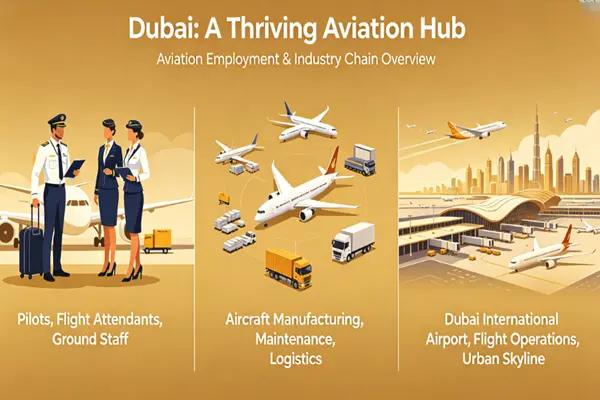
In terms of industrial upgrading, the project will address the shortcomings in Dubai's aviation industry chain, propelling Dubai from an aviation hub to a full-fledged aviation industry center. For a long time, Dubai's aviation industry has focused on passenger transport, air logistics, and airport operations, with weaknesses in upstream aircraft manufacturing, downstream high-end maintenance, and technology research and development, resulting in low added value for the aviation industry. The establishment of the Super Maintenance Center will attract Airbus, Boeing, aero-engine manufacturers, and aero-part suppliers, driving the development of upstream industries such as aero-part manufacturing, aero-composite material production, and aero-equipment R&D. Simultaneously, it will foster local aero-maintenance technology companies, promote independent innovation in aero-technology, improve the aero-talent training system, and connect the entire aero-industry chain, transforming Dubai from a mere air transit hub into a global center for aero-technology, maintenance, trade, and talent, achieving a leap in industrial value.
In terms of global city competition, the Super Maintenance Center will further strengthen Dubai's position as a top-tier global aviation center and solidify its leading position in the Middle East's aviation industry. Dubai currently boasts one of the world's busiest international airports, with passenger and cargo throughput ranking among the highest globally. With the addition of the Super Maintenance Center, Dubai will simultaneously possess world-class airport operations, air passenger and logistics, full-type aircraft maintenance, and aero-trade services capabilities, becoming one of the few comprehensive aviation hubs globally, surpassing competitors such as Singapore and Istanbul, radiating to the Middle East, Africa, Europe, and the Asia-Pacific market, and becoming a key node connecting the East and West's aviation markets. The project will enhance Dubai's influence in global aviation industry rule-making, standards export, and technological cooperation, deeply binding it with global aviation giants and establishing it as a core platform for global aviation industry collaboration.
At the regional and national strategic level, the project will deeply empower the UAE's "Vision 2031," driving the UAE to reduce its dependence on oil and achieve economic diversification. The UAE has long been committed to reducing its reliance on the oil economy, focusing on non-oil industries such as aviation, tourism, finance, and the digital economy, with aviation as a core pillar. As a landmark project, the super maintenance center will drive the overall upgrading of the UAE's aviation industry, linking it with Abu Dhabi's aviation industry to form a UAE aviation industry cluster; it will also radiate to Gulf countries such as Saudi Arabia, Qatar, and Oman, promoting the coordinated development of the Gulf region's aviation industry and enhancing the Gulf region's global economic influence. Furthermore, the project will deepen cooperation between the Middle East and the global aviation market, attracting global capital, technology, and talent to the Middle East and promoting high-quality regional economic development.
Furthermore, the project will provide a new cooperation platform for the global aviation industry, promoting the diversified development of the global aircraft maintenance market. Breaking the long-term monopoly of Europe and the United States on the high-end aircraft maintenance market, providing global airlines with more maintenance options, and optimizing the global aviation supply chain layout; driving global aircraft maintenance technology exchange, talent sharing, and standard co-construction, promoting the standardized, digital, and green development of the global aircraft maintenance industry, and injecting new impetus into the recovery and sustainable development of the global civil aviation industry.
Conclusion
Dubai's launch of a $5.1 billion super aviation maintenance center is a major strategic move amidst the changing global aviation industry landscape. It's a crucial step for Dubai to seize the opportunities presented by the global aviation maintenance market and solidify its position as a global aviation hub. It's also a landmark project for the UAE to promote economic diversification and reduce its dependence on oil. Against the backdrop of a global aviation industry recovery, explosive growth in maintenance demand, supply chain restructuring, and accelerated industrial relocation, Dubai, leveraging its unique geographical advantages, open and inclusive policy environment, strong financial resources, and precise industry positioning, is creating a world-class one-stop aviation maintenance hub. This will fill the gap in the Middle East's high-end aviation industry and reshape the competitive landscape of the global aviation maintenance market.
Upon completion, this project will not only bring Dubai a massive number of jobs, substantial economic benefits, and a complete aviation industry chain, propelling Dubai from an aviation transit hub to a global aviation industry center, but it will also deeply serve emerging aviation markets in the Middle East, Africa, South Asia, and Europe, driving the rise of regional aviation industries, breaking the long-standing European and American monopoly on the global high-end aviation maintenance field, and optimizing the global aviation supply chain layout. Globally, the aviation industry is experiencing a new wave of development, with digitalization, greening, and hub-and-spoke architecture becoming mainstream trends. Dubai's forward-thinking approach provides a new model for the upgrading of the global city's aviation industry.
In the future, as the project is implemented and put into operation in phases, the Dubai Aviation Super Maintenance Center will continue to generate industrial dividends, driving a profound adjustment in the global aviation maintenance market landscape and promoting the coordinated development of aviation manufacturing, trade, technology, and talent. It will occupy an increasingly important position in the global aviation economic landscape. For global airlines, aviation companies, and regional economies, this significant project in Dubai represents both a new development opportunity and a new variable in industrial competition, profoundly influencing the future direction of the global aviation industry and contributing to higher-quality and more sustainable development of the global civil aviation industry.
Disclaimer: The information published on this website is sourced from the internet and does not represent the views of this website, nor does it guarantee the accuracy of its content. Please be aware of the distinction. Furthermore, the products provided by our company are for scientific research purposes only. We are not responsible for any consequences arising from improper use. If you are interested in our products, have any criticisms or suggestions regarding our articles, or are not completely satisfied with the products you received, please contact us by email: allen@faithfulbio.com; our team is dedicated to ensuring complete customer satisfaction.
