

How do Australians view the social media ban after it took effect?
A Parental Duet: A Tug-of-War Between Reassurance and Anxiety
At 6 a.m. on December 10th, Melbourne mother Sarah Hanson was awakened by noises in the kitchen. When she found her 15-year-old son, Liam, preparing breakfast, she could hardly believe her eyes. "For the past six months, he's been glued to his phone every morning until he's late for school, and now he's actually asking me if I want to go buy fresh bread with him," Hanson told The Guardian, unable to hide her excitement. She showed her family calendar on her phone, which already marked their mini-golf trip for the weekend—Liam's suggestion the day before.
Hanson's surprise is not an isolated case. According to a poll released in early December by a local data consulting firm, 75% of parents explicitly support the ban, and this figure rises to 84% among teachers. Martha Costa, a homeroom teacher at a Sydney secondary school, said she has witnessed too many students suffering from psychological problems due to social media over the past three years: "A sixth-grade girl was dieting because she felt she wasn't thin enough. Upon further questioning, she learned that an algorithm was pushing body image anxiety content to her every day." After the ban took effect, Costa noticed a significant decrease in students glued to their phones in class. "The kids started discussing the movies they watched on the weekend during breaks, instead of the latest updates from some internet celebrity."
But on the other side of the jubilation, an undercurrent of anxiety is equally strong. Brisbane mother Mel Davis's daughter, Isobel, used a photo of Beyoncé to pass Snapchat's facial recognition, an incident that left her both amused and exasperated. "I'm both relieved that she can still stay connected with her friends, and worried that this avoidance behavior will cause her to lose respect for the rules." What worries Davis even more is that her daughter has recently started using anonymous social media apps not on the regulated list. "Those platforms don't have content moderation; I have no idea who she's chatting with."
For families with special needs, the impact of the ban is even more direct. Julie Clark, a single mother living in a Perth suburb, has a 13-year-old son with autism, and social media used to be an important channel for his social interaction. "He has difficulty communicating with people in real life, but in the autism support group on YouTube, he can freely share his thoughts." After the ban took effect, his son's emotions became unusually volatile. "He locks himself in his room and refuses to talk to me. I feel like I've lost a window into his heart."
Some parents also worry that the ban will affect their parent-child relationship. Mark Anderson from Sydney found that his 15-year-old daughter has recently been avoiding him when making phone calls. "She used to share funny videos from TikTok with me, but now she treats me like a 'monitor.'" In more than 100 parent responses collected by The Guardian, 30% of respondents said that the ban made their children feel distrusted. "They feel that we would rather believe the government's ban than believe that they can use social media reasonably."
The Survival Battle for Teenagers: Finding a Way Out in the Cracks of the Ban
Late on December 9th, Melbourne's online world was unusually active. Many teenagers under the age of 16 posted "farewell videos" on social media platforms, and the hashtag #seeyouwhenim16 quickly became a trending topic on TikTok. Lily, a 15-year-old influencer, tearfully told the camera in a video: "Thank you for your companionship over the past three years. I will keep this account until I turn 16, and I hope you will still be there then." This video garnered over 100,000 likes within hours, and the comments section was filled with the reluctance and resentment of her peers.
But this reluctance quickly transformed into motivation to find a way out. A week before the ban took effect, VPN searches in Australia surged to a near 10-year high. Free VPN provider Windscribe revealed that within 24 hours of the ban taking effect, its installations in Australia increased by 400%. Fourteen-year-old Luca Hagop showed reporters his "secret weapon": first, he registered an account using his mother's identity information, then he used a VPN to hide his real location. "As long as I don't frequently switch devices, the platform has a hard time detecting it."
Besides technical circumvention, teenagers have also formed unique "mutual aid networks." Isobel formed an "account activation group" at school specifically to help classmates pass age verification. "We found that using still photos to pass facial recognition has a high success rate, especially in poor lighting." She also shared an even simpler method: "Register with an adult's email address, then change your birthday to 1999; the platform won't verify it at all."
For teenagers, social media has long transcended the realm of entertainment tools, becoming an important part of their social lives. Fifteen-year-old Claire Ni explained, "We're not addicted to the internet; it's just that our social interactions are inherently different from yours." She opened her phone's calendar, which was marked with classmates' birthdays, party times, and other information. "These are all synced through Snapchat group chats. Without social media, I simply couldn't remember so many things."
The social disconnect caused by the ban is becoming apparent. Emily, a student at a Sydney secondary school, noticed her classmates were starting to divide: "Those who successfully circumvented the ban would flaunt their new posts, while those who were banned were ostracized." What bothered her even more was that many offline events had moved to unregulated platforms. "I didn't even know about last week's class reunion because they announced it in an anonymous group, and I wasn't invited."
Not all teenagers are rebelling against the ban. 15-year-old Thomas felt "relieved" by the Snapchat ban: "There was always so much pointless comparison on that platform, people showing off their new sneakers, people posting photos of their overseas vacations, and I felt inferior to everyone else every day." Thomas now plays basketball at the community court after school every day. "I find playing basketball face-to-face with my friends much more fun than liking their posts online."
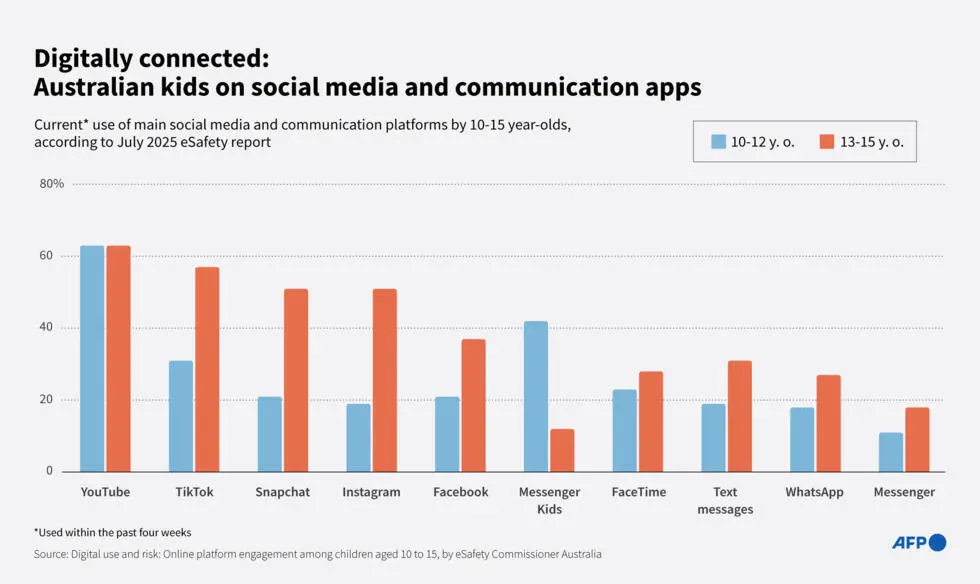
Experts and Platforms: An Uncertain Social Experiment
While public sentiment oscillates between support and opposition, experts and scholars are examining this social experiment from a more rational perspective. Elise Ferdinand, a lecturer at the University of Sydney Business School, believes the ban has positive implications for protecting the mental health of teenagers: "Research shows that the longer teenagers use social media, the higher their risk of developing anxiety and depression. The ban at least creates a breathing space for them."
However, Ferdinand also points out that the ban is not a perfect solution. "It simply shifts the problem from one place to another." She worries that teenagers will flock to less regulated online spaces, "and anonymous platforms not subject to the ban may harbor more cyberbullying and harmful information, making them more dangerous for teenagers."
Data security expert Mark Wilson expresses concern about privacy issues in the age verification process. "Platforms need to collect a large amount of personal information, including ID photos and facial recognition data, which inherently poses a huge security risk." Australia has experienced several data breaches in recent years, with the personal information of over one million users being leaked in 2024 alone. "We cannot protect teenagers at the expense of exposing them to new risks."
In this struggle, the attitudes of social media platforms are particularly complex. Meta began closing accounts belonging to teenagers on December 4th, but simultaneously stated publicly that the ban "is pushing young people to less safe platforms." TikTok, on the other hand, uses a combination of technology and manual review to identify non-compliant accounts. Its Australian head stated, "We will comply with the law, but we also hope the government will consider the legitimate social needs of teenagers."
On December 12th, the American online platform Reddit filed a lawsuit in the Australian High Court, becoming the first mainstream platform to challenge the ban. Reddit argued in its legal documents that it is a "public forum, not a social platform" and should not be subject to the ban. An Australian government spokesperson responded, "We stand firmly with parents and children and will defend this law protecting teenagers with all our might."
Australia's e-security commissioner, Grant, acknowledged that the implementation of the ban cannot be achieved overnight. "We don't believe all teen accounts will disappear overnight; it's a long-term process," Grant revealed. He added that relevant departments have sent letters to social media platforms not included in the regulatory list, advising them to conduct self-assessments. "We will dynamically adjust the scope of regulation based on the actual situation to ensure the effectiveness of the ban."
Reflections from a Global Perspective: The Art of Balancing Protection and Freedom
Australia's "digital fence" experiment is attracting global attention. New Zealand, Denmark, Malaysia, and other countries have indicated they will consider promoting similar legislation, while relevant departments in Brazil and Indonesia have begun studying Australia's legislative experience. "Australia provides a new approach to global youth online protection," said Anna Riddell, UNICEF Australia's representative. "However, each country's circumstances are different, and this model cannot be simply replicated."
The core of the controversy lies in finding a balance between protecting youth and safeguarding their digital rights. Fifteen-year-old Jones has hired a lawyer to prepare a legal challenge to the ban. In his petition, he wrote, "Social media is an important channel for us to express our opinions and participate in society. A blanket ban deprives us of our constitutional rights." Jones believes the government should strengthen regulation of the platform, rather than restricting teenagers' access. "The root of the problem is harmful content, not us users."
Former Facebook Australia CEO Stephen Scherer offered a more constructive suggestion: "Digital literacy education and parental guidance may be more effective than age restrictions." Scherer believes the government should invest more resources to help teenagers develop healthy online habits. "We need to teach them how to..." "Identify harmful content, rather than directly cutting them off from the online world."
On the afternoon of December 12, Australian Prime Minister Albanese, in an interview with ABC, reiterated his defense of the ban: "New technologies bring convenience, but also risks. Our responsibility is to protect the next generation and allow them to grow up in an environment free from algorithmic interference." When asked about teenagers circumventing the ban, Albanese stated that the government would work closely with platforms to continuously improve regulatory measures. "This is a long-term battle, but we are confident of ultimate victory."
As evening fell, the Sydney sunset shone on Stella's desk. She finally logged into TikTok, and a party invitation from a friend popped up on her screen. Behind her, her mother was preparing dinner in the kitchen, and the sound of a news broadcast came from the living room—Reddit's lawsuit had been accepted by the court, and the legality of the ban would face a new test. This battle between protection and freedom, regulation and innovation, has clearly only just begun. And globally, how to build a safe and open digital space for teenagers remains a question of our time that awaits answers.
Disclaimer: The information published on this website comes from the internet, which does not mean that this website agrees with its views or confirms the authenticity of the content. Please pay attention to distinguish it. In addition, the products provided by our company are only used for scientific research. We are not responsible for the consequences of any improper use. If you are interested in our products, or have critical suggestions on our articles or are not completely satisfied with the products received, Please also contact us via Email :sales9@faithfulbio.com ; Our team is committed to ensuring the complete satisfaction of customers.