

Does Naproxen USP have anti-inflammatory and analgesic effects?
In the spectrum of nonsteroidal anti-inflammatory drugs (NSAIDs), Naproxen USP is a classic representative of aryl propionic acid drugs, belonging to the same family as ibuprofen and ketoprofen. Its chemical nature is (S)-6-methoxy-α-methyl-2-naphthacetic acid, with the molecular formula C₁₄H₁₄O₃, a molecular weight of 230.26, and CAS registry number 22204-53-1. As a non-selective cyclooxygenase inhibitor, it exerts a triple effect of antipyretic, analgesic, and anti-inflammatory by blocking the synthesis of prostaglandins through the inhibition of both COX-1 and COX-2 isoenzymes. Its S configuration is the predominant active form, and clinically used naproxen is usually found in a single enantiomer.
🧬 Stable molecular configuration of naphthalenecyclopropionic acid
Naproxen USP has the complete molecular formula C₁₄H₁₄O₃. Its core is a rigid naphthalene ring with a propionic acid side chain and a chiral carbon skeleton. It retains only the S-levorotatory active configuration, rigorously eliminating ineffective R-type racemic impurities. Its chiral purity meets pharmacopoeia standards and will not interfere with inflammatory cell assays due to stereoisomers. Ordinary propionic acid derivatives without naphthalene ring modification have poor molecular stability and are easily and rapidly decomposed under intracellular oxidative conditions, resulting in a short effective period. Naproxen USP relies on intramolecular hydrogen bonds formed by the conjugated plane of the naphthalene ring. It maintains its complete molecular structure even after thirty months of dry, light-protected, and sealed storage at 2 to 8°C. In continuous multi-day co-incubation experiments with chondrocytes and macrophages, its molecular activity did not show significant attenuation.
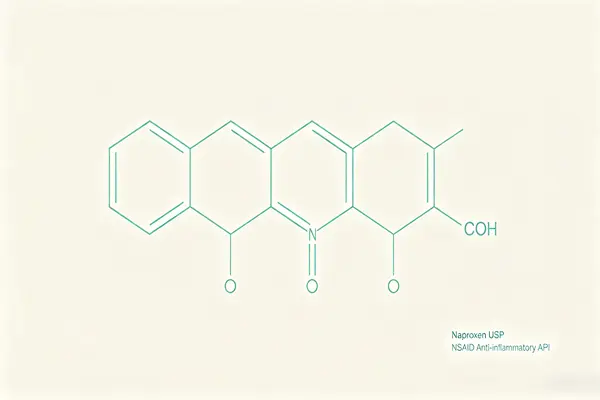
The aromatic conjugated plane of the naphthalene ring is the core functional region for binding to the hydrophobic pocket of the COX enzyme protein. The naphthalene ring's dual aromatic ring structure can embed itself into the enzyme's catalytically active cavity, stably occupying the substrate binding site through hydrophobic interactions, blocking the binding of arachidonic acid to the COX enzyme, and reducing prostaglandin production at its source. If the naphthalene ring conjugated structure is removed, the molecule cannot stably anchor to the target enzyme, producing only a weak and transient analgesic effect, making it unsuitable for long-term joint inflammation cell passage culture systems. The intact naphthalene ring backbone is the core support for the anti-inflammatory and analgesic function of Naproxen USP.
The terminal propionic acid carboxyl group regulates the molecule's lipid-water distribution balance. The carboxyl group imparts water solubility to the molecule, preventing crystallization, aggregation, and stratification during gradient dilution of cell incubation solutions. The aromatic structure of the naphthalene ring enhances lipid solubility, allowing it to smoothly penetrate the synovium and epithelial cell membrane phospholipid layer, rapidly reaching the interior of inflammatory lesion cells. Highly polar, non-aromatic ring-free small molecules struggle to penetrate diseased tissue barriers, while strongly hydrophobic, carboxyl-free raw materials cannot be uniformly dispersed in culture media. Naproxen USP balances tissue permeability with solvent dispersibility, making it suitable for high-throughput macrophage inflammation screening and large-scale simultaneous chondrocyte culture.
The entire molecule lacks broad-spectrum, non-specific protein binding ability, recognizing only COX enzymes highly expressed in the inflammatory activation state. It does not significantly interfere with the basal metabolic pathways of normal resting epithelial cells and chondrocytes, accurately distinguishing between diseased inflammatory cells and healthy tissue cells, and significantly reducing interference from irrelevant pathways in the observation system. Randomly disrupting the propionic acid side chain carboxyl group significantly reduces the molecule's affinity for COX enzymes, resulting in a marked decrease in anti-inflammatory and analgesic regulatory effects.
⚙️ Mechanism of COX enzyme inhibition for anti-inflammatory and analgesic effects
In healthy organisms, COX enzyme expression remains at a low basal level, a small amount of prostaglandins participate in normal tissue repair and vascular homeostasis regulation, inflammatory factor secretion remains at a weak basal level, cartilage matrix synthesis and degradation maintain a dynamic balance, the synovial membrane is free from congestion and edema, intracellular lipid metabolism and protein translation processes are not interfered with by exogenous small molecules, and tissue cell proliferation and repair maintain natural homeostasis.
When the body experiences trauma, joint degenerative diseases, or bacterial stimulation, macrophages and synovial cells significantly upregulate COX-1 and COX-2 expression, catalyzing the continuous conversion of arachidonic acid into large amounts of prostaglandins. This induces local vasodilation, tissue edema, and increased nerve pain sensitivity, simultaneously releasing pro-inflammatory factors such as TNF-α and IL-6, accelerating cartilage matrix degradation, forming a vicious cycle of "inflammation-pain-cartilage damage." Single analgesic ingredients only temporarily block pain signal transmission and cannot inhibit excessive prostaglandin synthesis; inflammation and articular cartilage damage will continue to progress repeatedly.
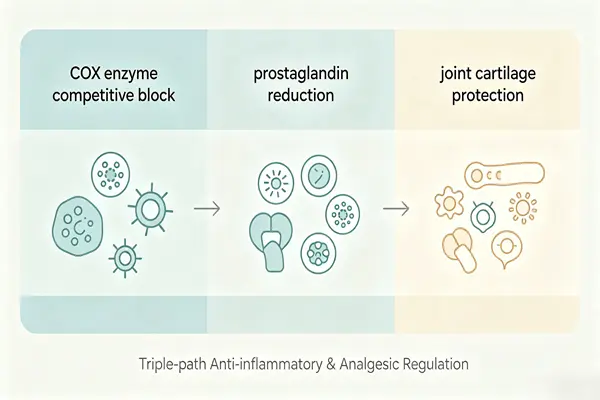
After penetrating the cell membrane of inflamed lesions, Naproxen USP competitively binds to the COX enzyme catalytic site via the conjugated plane of the naphthalene ring, occupying the arachidonic acid substrate binding cavity, blocking the enzymatic reaction process, and significantly reducing the total amount of prostaglandin synthesis. This cuts off the core mediators of inflammation, pain, and edema upstream. On one hand, it alleviates peripheral nerve hypersensitivity and reduces local pain; on the other hand, it constricts dilated microvessels in the lesion, reducing tissue congestion and edema; simultaneously, it downregulates the release of pro-inflammatory factors from macrophages, slowing down the degradation rate of cartilage matrix. This triple effect simultaneously improves inflammatory damage, unlike ordinary analgesic ingredients that only provide simple analgesia without anti-inflammatory and repairing effects.
Naproxen USP targets only the COX enzyme pathway, which is highly expressed in inflammation, and does not indiscriminately interfere with lipid metabolism in various cells throughout the body. While broad-spectrum anti-inflammatory substances can simultaneously interfere with multiple tissue metabolic pathways, and observation systems are contaminated with a large number of interference signals unrelated to cellular metabolic disorders, Naproxen USP has a specific and clear target. Related observation systems can lock onto the single variable of "COX-mediated inflammation suppression," significantly improving the accuracy of observation conclusions related to joint inflammation and acute injury pain.
🧫 Diverse Scientific Research Application Scenarios
Naproxen USP is a standard control material for observing the inflammatory mechanisms of rheumatoid arthritis and osteoarthritis. Its core application is in establishing in vitro models of inflammatory damage in primary articular chondrocytes and synovial macrophages. Degenerative joint disease continuously activates the COX pathway, inducing cartilage destruction and local swelling and pain. Leveraging Naproxen's pharmacopoeia-grade stable COX-inhibiting activity, it facilitates prostaglandin ELISA quantification, cartilage matrix protein detection, and statistical analysis of inflammatory cell viability. This allows for the establishment of a standardized evaluation system for anti-inflammatory substances in joints, enabling comparative analysis of the alleviating effects of various non-steroidal small molecules and natural extracts on joint inflammation.
Naproxen USP is widely used for pharmacological observation of acute soft tissue injuries and postoperative swelling and pain. It is suitable for co-culturing models of LPS and mechanically induced macrophage inflammation. Traumatic and postoperative tissues rapidly synthesize large amounts of prostaglandins, leading to swelling and pain. Naproxen USP can inhibit excessive prostaglandin production, reduce local inflammatory responses, elucidate the compensatory mechanisms of acute injury inflammation, screen for low-toxicity analgesic and anti-inflammatory active substances, and improve the screening platform for lead molecules for traumatic pain intervention.
It possesses irreplaceable value in the research of fever-related immune inflammation and mucosal inflammation, and is used for the construction of in vitro models of inflammation in peripheral blood mononuclear cells and gastrointestinal epithelial cells. Systemic fever and mucosal inflammation induced by exogenous stimuli are both accompanied by excessive activation of the COX pathway. Naproxen USP can downregulate the release of pyrogenic prostaglandins and is widely used in explorations related to fever-induced inflammation and gastrointestinal mucosal damage protection, expanding the research and development direction of compliant pharmacopoeia-grade anti-inflammatory and analgesic small molecules.
The development of novel non-steroidal anti-inflammatory lead molecules globally is uniformly based on Naproxen USP as the efficacy reference benchmark. Various naphthalene ring-modified derivatives, tissue-targeted prodrugs, and long-acting sustained-release anti-inflammatory small molecules require cross-sectional comparison of core indicators such as COX enzyme inhibition efficiency, downregulation of pro-inflammatory factors, chondrogenic capacity, and non-specific toxicity to normal cells. Stable and consistent anti-inflammatory and analgesic activity, compliance with USP pharmacopoeia purity standards, and highly reproducible cell assay data make it a universal reference standard for high-throughput screening of non-steroidal anti-inflammatory small molecules, analysis of the skeletal structure-activity relationship of naphthalenepropionic acid, and iterative optimization of molecular structure.
🔬 Iterative optimization direction of naphthalenepropionic acid molecules
Site-specific modification of the naphthalene ring side chain is currently the mainstream approach for Naproxen USP molecular optimization, with modification sites concentrated at the propionic acid carboxyl terminus and the naphthalene ring aromatic substitution site. The original small molecule diffuses uniformly throughout the body, but its enrichment concentration at joint lesions is limited, requiring moderate effective concentrations to inhibit the COX pathway. By grafting a short peptide with synovial affinity onto the propionic acid carboxyl terminus, the modified derivative can be directionally enriched in diseased joint tissue, blocking prostaglandin synthesis at lower molar doses, reducing the exposure of trace small molecules to peripheral healthy somatic cells, and is suitable for developing low-dose, long-acting joint inflammatory intervention models.
Responsive modification to the acidic microenvironment of inflammatory lesions is a popular optimization route, improving the weak basal cellular metabolic interference caused by the indiscriminate diffusion of small molecules. The research team has inserted a cleavable shielding group in the acidic environment of the inflammatory lesion at the propionic acid carboxyl terminus to construct a prodrug specifically activated by damaged tissue. The modified prodrug exhibits no COX-binding activity in healthy, non-inflammatory cells, thus not interfering with normal prostaglandin synthesis. Only after entering acidified, inflamed lesion cells does the masking group hydrolyze and detach, releasing the active Naproxen core, precisely targeting and inhibiting local inflammation. This further enhances the specificity of the molecular action, aligning with the trend of developing low-toxicity, targeted anti-inflammatory APIs.
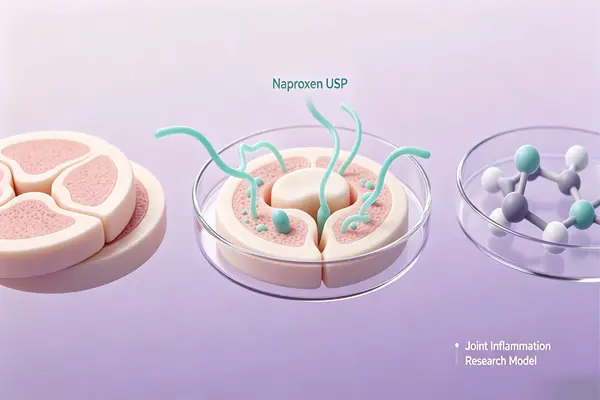
Multifunctional hybrid molecules broaden the boundaries of pharmacological action, overcoming the functional limitations of single COX enzyme inhibition. Chronic joint inflammation is often accompanied by multiple problems such as cartilage matrix loss and oxidative stress; simply blocking prostaglandin synthesis cannot completely repair cartilage damage. Researchers covalently spliced the Naproxen naphthopropionic acid core framework with cartilage repair-promoting and antioxidant active fragments to create a multifunctional fusion molecule. This molecule simultaneously achieves a triple effect of inhibiting COX inflammation, scavenging intracellular reactive oxygen species, and delaying cartilage matrix degradation, overcoming the functional limitations of single-target anti-inflammatory APIs and providing a new approach for designing composite joint protection lead molecules.
Naphthalene ring substituents fine-tune the COX-binding bias, adapting to the personalized needs of different inflammatory research scenarios. The original Naproxen USP provides balanced inhibition of COX-1 and COX-2, making it suitable for general arthritis inflammation experiments. By replacing the substituent groups on the naphthalene ring side chain, highly COX-2 selective derivatives and balanced broad-spectrum anti-inflammatory derivatives can be prepared, respectively. The highly selective version is suitable for low-irritation inflammation models of the gastrointestinal mucosa, while the balanced version is suitable for short-term intervention observation of acute traumatic swelling and pain, enabling precise inflammatory regulation research based on subtype.
Conclusion
Naproxen USP is a core member of the arylpropionic acid class of nonsteroidal anti-inflammatory drugs (NSAIDs). Its S-configuration chiral molecular structure endows it with potent dual COX-1/COX-2 inhibitory activity. As a first-line treatment for chronic inflammatory diseases such as osteoarthritis, rheumatoid arthritis, and ankylosing spondylitis, naproxen has clear clinical value in relieving pain and inflammation.
As a leading supplier of Naproxen USP, we understand the critical importance of supply chain stability in a competitive market. Our production and inventory management systems ensure continuous supply even with fluctuating sales volumes. Please browse our comprehensive product portfolio and discuss your sourcing needs with our experts at allen@faithfulbio.com.
References
- DailyMed. (2019). NAPROXEN Tablets, USP - Prescribing Information. National Institutes of Health.
- DailyMed. (2019). Naproxen Tablets USP - Prescribing Information. National Institutes of Health.
- Sigma-Aldrich. (n.d.). Naproxen USP Reference Standard (CAS 22204-53-1).
- USP29-NF24. (2007). Naproxen Sodium Tablets Monograph. United States Pharmacopeia.
- Sigma-Aldrich. (n.d.). Naproxen Related Compound E USP Reference Standard.
- DailyMed. (2011). Theraproxen-500 - Label Information. National Institutes of Health.
- Sigma-Aldrich. (n.d.). Naproxen Related Compound L USP Reference Standard.
- Merck. (n.d.). Naproxen Related Compound A Pharmaceutical Secondary Standard.