

How do Peptide and Cagrilintide help to stimulate satiety and stabilize appetite and weight rhythm?
Cagrilintide is a synthesized long-acting peptide active ingredient that is fundamentally different from commonly found weight loss and appetite suppressant ingredients in the market. Many people struggle with uncontrollable appetite, quickly feel hungry after eating, and experience weight fluctuations, often attributing it simply to a lack of willpower or overeating. They rely on dieting, meal replacements, or regular appetite suppressant products, which can only provide temporary relief, and their weight will quickly rebound. These methods have failed to address the fundamental causes of disrupted signals of hunger and satiety in the body. The ability of the body to perceive hunger and satiety depends entirely on the appetite center in the brain receiving signals from the body. After eating, the intestines and pancreas release signals of satiety, telling the brain, "Enough, don't eat." When food is scarce for a long time, the body will release signals of hunger, reminding the brain to eat. If this signaling system becomes disrupted, the satiety signal becomes weaker and the hunger signal becomes stronger, the brain will continue to feel unsatisfied, the appetite spiral will spiral out of control, and the intake of calories will far exceed the body's needs, naturally leading to continuous weight gain. Most weight loss ingredients can only expand and occupy space in the stomach or temporarily stimulate nerves to suppress appetite, but cannot act on the appetite signal center in the brain, making it difficult to fundamentally stabilize the balance between hunger and satiety. The biggest feature of the Peptide Cagralintide is that it mimics the natural satiety signal substance in the human body, acting on the appetite center of the brain for a long time, continuously transmitting the "I am full" signal, reducing hunger and food intake, while not forcibly stimulating nerves or causing palpitations or insomnia. It does not completely eliminate appetite, but rather recalibrates the body's satiety, gradually stabilizing appetite rhythms and weight management, and has unique value in the research and formulation development of weight homeostasis regulation.
Uncontrolled appetite and recurring weight gain stem from a disorder in the satiety signaling system
Many people suffer from uncontrollable appetite problems, feel hungry soon after meals, and lose weight before recovering. Their first reaction is to blame themselves for lacking willpower, or resort to dieting, meal replacements, or exercise to forcibly control their intake. Although these methods can reduce calorie intake in the short term and bring temporary weight loss, it is very difficult to persist in the long term. Once normal diet is restored, weight will quickly rebound, sometimes even exceeding previous levels. The fundamental reason for this phenomenon is not only the lack of willpower, but also the disorder of the signal system responsible for regulating appetite in the brain. The satiety signal weakens, the hunger signal increases, and the brain remains in a state of "not feeling full", constantly driving the body to search for food. We can simply understand the appetite center of the brain as a thermostat. In a healthy state, it can accurately perceive the energy level of the body, send signals to stop eating when full, and send signals to eat when hungry, thereby maintaining a balance between activity and rest, and keeping weight within a relatively stable range.
When the appetite regulation system fails, this' thermostat 'becomes insensitive. Even if the body consumes enough calories, the satiety signal cannot be effectively transmitted to the brain, and the brain constantly receives the wrong signal of "still hungry, still wanting to eat". In this state, even if one is full, they will soon feel hungry again, wanting to eat whenever they see food and unable to control their diet. The calorie intake far exceeds the actual expenditure, and the excess calories are continuously converted into fat and stored, leading to continuous weight gain. Ordinary dieting and meal replacement rely on willpower and external means to forcibly reduce food intake, but the hunger signals inside the brain do not weaken, but remain in a long-term "suppressed" state. Once willpower weakens or dieting is stopped, the brain drives the body to retaliate through overeating, leading to a rapid rebound in weight. This is the fundamental reason why most weight loss methods fail.
Some weight loss supplements burn calories by stimulating the central nervous system and accelerating metabolism. Although they can indeed bring short-term weight loss, these supplements often come with significant side effects such as palpitations, insomnia, dry mouth, and emotional fluctuations. Long term use can bring a heavy burden to the body. Once stopped, the metabolic level will decrease, leading to a rapid rebound in weight. Some ingredients only absorb water and swell in the stomach, creating a feeling of fullness. However, this feeling of fullness is short-lived; Once the moisture is absorbed, hunger will quickly return. In addition, long-term overdose may interfere with the normal absorption of other nutrients, making it not an ideal long-term weight management plan.
Relying solely on willpower or external methods to suppress appetite and control weight is not enough. The key is to readjust the appetite regulation system of the brain, ensuring the effective transmission of satiety signals, so that the brain can accurately perceive the energy status of the body, know when to stop eating, and when to eat. The human body contains a satiety signal substance called amylin. After eating, amylin is released from the pancreas along with insulin, acting on the appetite center of the brain, transmitting the signal 'I am full', thereby inhibiting further eating. When this signaling system weakens, even after eating a lot, the brain cannot receive a strong enough satiety signal, leading to sustained loss of appetite. Peptide Cagrilintide mimics the function of natural human pancreatic amyloid protein. Through artificial structural optimization, its duration of action is longer, stability is better, and it can continuously transmit satiety signals to the appetite center of the brain. This re regulates the appetite regulation system, restores normal satiety in the brain, and fundamentally reduces the impulse to overeat.
We need to distinguish between two completely different weight management methods. One method is to forcefully suppress appetite and reduce intake through willpower and external means. This method is effective in the short term, but it is prone to rebound and may have side effects. Another method is to regulate the appetite signaling system of the brain, allowing the body to naturally restore normal satiety. After the appetite stabilizes, the weight will naturally decrease steadily and not easily rebound. The mechanism of action of peptide drug carrageenan peptide is to regulate the appetite signaling center. Its function is gradual, relying on continuous satiety signals to guide the gradual improvement of dietary habits, so rapid and significant weight loss effects cannot be achieved in the short term.
Long-acting peptide structure optimization mimics the sustained action of natural satiety signals
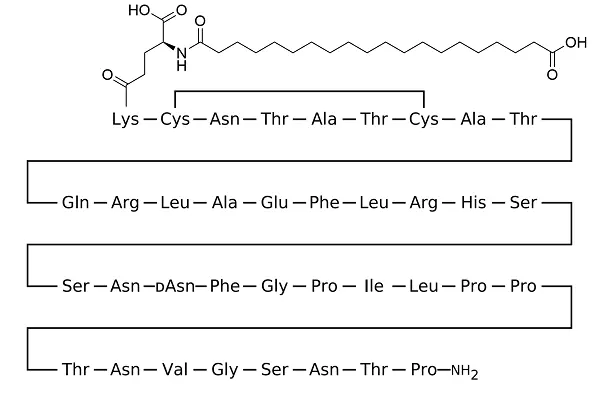
Peptide Cagrilintide is a long-acting peptide analogue artificially and directionally optimized based on the natural human amylinin. Natural amylinin, after being released into the body, is quickly degraded by enzymes, resulting in a short duration of action. It can only transmit satiety signals for a short time after a meal and cannot maintain appetite regulation for an extended period. Furthermore, natural amylinin molecules easily aggregate to form amyloid precipitates, exhibiting poor stability and making it unsuitable for direct use as a long-acting formulation. Cagrilintide, through the replacement and modification of key amino acids on the peptide chain, significantly improves the molecule's resistance to enzymatic degradation and stability, while retaining a high degree of bioactivity similar to natural amylinin. It can precisely bind to corresponding receptors on the brain's appetite center, continuously transmitting satiety signals and overcoming the shortcomings of the short-lived and unstable action of natural amylinin.
Cagrilintide is a long-acting peptide modified with fatty acid side chains. The fatty acid side chains attached to the molecule can reversibly bind to albumin in the blood, forming a "reservoir" effect. After binding to albumin, the peptide molecules increase in size, making them less likely to be rapidly filtered and excreted by the kidneys or degraded by enzymes. This allows them to maintain a stable concentration in the blood, slowly and continuously releasing the active molecules and exerting their appetite-regulating effect over a long period. This long-acting design eliminates the need for frequent dosing; a single dose can maintain a stable blood concentration for several days, significantly improving convenience and compliance—a key advantage over ordinary short-acting peptides.
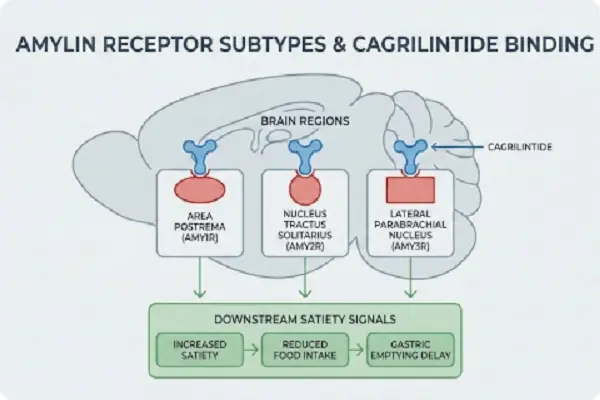
When Peptide Cagrilintide reaches the appetite-regulating area of the brain via blood circulation, the peptide molecules precisely recognize and bind to amylin receptors on the surface of neurons in the appetite center. This activates downstream signaling pathways, transmitting a "satiety" signal to the neurons. Upon receiving this satiety signal, these neurons reduce the release of hunger signals and enhance the perception of fullness, allowing individuals to feel full even with a small amount of food, thus reducing the urge to eat more. Many common weight-loss aids cannot cross the blood-brain barrier to reach the brain's appetite center, functioning only peripherally. Cagrilintide, however, with its optimized structure, possesses excellent central accessibility, allowing it to directly act on the core areas of appetite regulation, modulating appetite at its source with far greater efficiency than peripherally acting aids.
Besides directly transmitting satiety signals, Cagrilintide also regulates the activity of the brain's dopamine reward system. Many people experience uncontrolled appetite and binge eating not because their bodies actually need that much energy, but because the pleasure and reward effect of eating is too strong. The brain develops a strong craving for high-sugar, high-fat foods, driving people to eat continuously for the reward. After acting on the appetite center, Cagrilintide can moderately reduce the reward effect of food, decreasing cravings for high-calorie foods, making it less irresistible to eat when seeing delicious food, and making eating behavior more rational and controllable. This gentle regulation of the reward system helps users gradually establish healthy eating habits, rather than relying on willpower, significantly reducing the difficulty of long-term adherence.
Cagrilintide doesn't completely suppress appetite, nor does it make you lose all desire to eat; it simply brings excessive appetite back to a normal level. The satiety signal it delivers is physiological and gentle; users will feel "full after eating a little, and don't want to eat as much," rather than "completely lacking appetite and feeling nauseous." This physiological appetite regulation avoids the emotional fluctuations, malnutrition, and retaliatory eating problems caused by forcibly suppressing appetite, making weight management more stable and comfortable. High-quality Cagrilintide is prepared using a solid-phase peptide synthesis process, undergoing multiple rounds of chromatographic purification, fatty acid modification, and freeze-drying to remove residual peptides, mismatched peptides, heavy metals, and organic solvents generated during synthesis. The purity and bioactivity remain stable and balanced across different batches. The peptide powder exhibits excellent stability when stored under suitable sealed, light-proof, and low-temperature conditions. It has good formulation compatibility and can be used with various buffer systems and stabilizers. It works through the central appetite regulation mechanism without causing additional burden on peripheral organs, making it suitable for long-term, continuous research and development.
Reduce food intake, stabilize appetite rhythm, and gradually improve the dilemma of weight management
The core challenge of weight management is not short-term food restriction, but long-term stable appetite rhythm and healthy eating habits. Many people can't lose weight because of poor appetite. This is either manifested in the decline of hunger protection mode and metabolism due to excessive dieting, or in the inability to suppress appetite, which leads to overeating, fluctuation of intake and repeated fluctuation of weight. Cagrilintide can help users feel full even if they eat less by constantly sending satiety signals to the brain. This will naturally reduce the amount of food consumed per meal, at the same time, it will also reduce the hunger between meals, reduce the desire for snacks and extra food, and make the daily total calorie intake decrease steadily, instead of relying on willpower to control it unsteadily.
With the continuous use, the brain's appetite regulation system is gradually recalibrated, so that its sensitivity to satiety signals returns to normal, and the user's eating habits are slowly changing. In the past, they may need to eat until they are fully satisfied; Now, they are satisfied with 60-70% satiety. In the past, they would feel hungry two or three hours after meals; Now, they can wait until the next meal reliably. Previously, they could not resist high-sugar and high-fat foods; Now, their desire for these foods has greatly decreased. These changes are not only realized by willpower, but naturally occur after the internal appetite signal system of the body returns to normal. Therefore, they are more durable, more stable and less likely to rebound. As the eating habits gradually become healthier, the weight will show a steady and sustained downward trend, rather than a rapid decline in the short term and then a rapid rebound.
Many weight-loss methods can reduce fat, but also lead to muscle loss, lower basal metabolic rate, and form an "easy-to-gain physique". Once the normal eating habits are restored, the weight will rebound quickly. Cagrilintide helps to keep lean body weight and minimize muscle loss while reducing food intake. This is because it regulates appetite through physiological satiety signal, mainly to reduce excess calorie intake, rather than leaving the body in a state of serious nutritional deficiency. The body will not enter the "hunger mode" to break down a lot of muscles to gain energy. At the same time, a stable appetite rhythm allows users to consume protein and other nutrients more regularly. Combined with moderate exercise, it is helpful to maintain muscle mass and basal metabolic rate while losing weight, and prevent the rebound caused by decreased metabolism after losing weight.
Cagrilintide can also improve metabolic indexes related to weight. Overweight is usually accompanied by metabolic problems, such as blood sugar fluctuation, dyslipidemia and decreased insulin sensitivity. These problems, in turn, aggravate appetite disorder and weight gain, resulting in a vicious circle. With the steady weight loss, the appetite rhythm returns to normal, the metabolic pressure of the body decreases, the insulin sensitivity gradually increases, and the blood sugar and blood lipid levels tend to be stable. The improvement of metabolic state further consolidates the results of weight management and makes the body enter a virtuous circle of "stabilizing appetite, losing weight and improving metabolism"
We can't expect Cagrilintide to achieve immediate results. It takes time to recalibrate the appetite system, change eating habits and lose weight steadily. It is impossible to see significant results in just a few days. This is not the kind of radical weight loss product that can make you lose your appetite immediately and lose a few pounds in a week. On the contrary, it helps users to gradually establish healthy eating habits through physiological appetite regulation, and realizes stable, continuous and non-rebound weight management. It is suitable for people with uncontrolled appetite, weak satiety, frequent hunger and fluctuating weight, as well as those who have tried various methods to lose weight but failed. It is not suitable for people with normal weight who just want to lose weight. It has obvious limitations and its applicability cannot be expanded indefinitely. It is also important to emphasize that Cagrilintide is a prescription-grade peptide active ingredient and must be used under the guidance of a professional doctor. Without professional supervision, it should not be used as a daily health care product, and the dosage and use plan need to be personalized.
Unlike traditional weight loss methods, physiological regulation is safer and more sustainable
In the field of weight management, traditional weight loss methods mainly fall into several categories: dieting and meal replacements, exercise, stimulating the nervous system to accelerate metabolism, and surgical intervention. Each of these methods has its limitations. Dieting and meal replacements can easily lead to malnutrition, decreased metabolism, and binge eating; exercise requires long-term commitment, and weight rebound is likely once stopped, and for people with a high starting weight, exercise may also cause joint damage; drugs that stimulate the nervous system to accelerate metabolism are often accompanied by significant side effects such as palpitations, insomnia, and high blood pressure, and their long-term safety is questionable; surgical intervention is highly invasive and risky, and is only suitable for severely obese individuals. Cagrilintide, as a physiological appetite-regulating peptide, has unique advantages compared to these traditional methods.
First, Peptide Cagrilintide mechanism of action is physiological. It mimics the body's own satiety signaling substances, acting on the brain's natural appetite regulation pathways, rather than being an external, forced intervention. The human body has its own satiety signaling system based on amylin. Cagrilintide simply enhances and prolongs the function of this system, making it more effective, rather than creating a completely new and unfamiliar intervention pathway. This physiological regulation is more in line with the body's own circadian rhythms, resulting in fewer side effects, better user tolerance, and avoiding the palpitations, insomnia, and high blood pressure problems commonly associated with neurostimulatory weight loss drugs.

Secondly, Cagrilintide's long-acting design makes it more convenient to use and improves adherence. Traditional weight loss methods require strict daily diet control, daily exercise, and daily medication, which are huge tests of willpower and time, making it difficult for many to stick to. Cagrilintide, with its optimized long-acting structure, provides stable effects for several days with a single use, eliminating the need for frequent daily use, significantly reducing the complexity of use, and increasing the likelihood of long-term adherence. For busy individuals with fast-paced lifestyles and limited time and energy for complex weight loss programs, this long-acting and convenient method is highly attractive.
Third, Cagrilintide helps establish healthy eating habits, not just short-term weight loss. Many traditional weight loss methods focus on how many pounds you lose in the short term, neglecting long-term changes in eating habits, resulting in rapid weight regain. Cagrilintide regulates appetite signals, allowing users to naturally reduce food intake and cravings for high-calorie foods. With continued use, users gradually develop healthy eating habits such as stopping when they are 60-70% full, eating three regular meals a day, and reducing snacking. Once these habits are established, they can be maintained long-term even with reduced use, fundamentally solving the problem of weight rebound. This "teaching a man to fish" approach to weight management is far more valuable than simply forcibly reducing intake in the short term.
Of course, Cagrilintide is not a perfect "miracle drug" for weight loss; it also has its limitations and scope of application. It primarily targets weight problems caused by uncontrolled appetite and insufficient satiety. Its effectiveness may be limited for obesity caused by other reasons (such as severe endocrine disorders, drug side effects, or genetic obesity). It cannot replace a healthy diet and exercise; it is merely an auxiliary tool for weight management, helping users to more easily control their appetite and establish healthy habits. Without controlling diet and exercise, relying solely on peptides will hardly achieve the desired weight management results. Furthermore, as an active peptide ingredient, it may cause common adverse reactions such as injection site reactions and mild gastrointestinal discomfort. Although these are usually mild and gradually tolerated, it still requires use under professional guidance.
Conclusion
Peptide Cagrilintide, a synthetically produced long-acting amylin analogue peptide, differs from traditional dieting, meal replacements, and neurostimulant weight loss methods. Relying on a structurally optimized stable peptide molecule and long-acting fatty acid modification design, it mimics the body's natural satiety signals, precisely targeting the brain's appetite center. It continuously transmits the physiological signal of "I'm full," recalibrating the disordered appetite regulation system, reducing excessive appetite, decreasing food intake, and gently regulating the food reward effect. This helps users gradually establish healthy eating habits and achieve stable, continuous, and non-rebounding weight management. Its effects are physiological and gentle; it does not completely deprive the user of appetite and does not cause the palpitations, insomnia, or other side effects commonly found in neurostimulant weight loss drugs. Its long-acting design makes it more convenient to use and improves adherence. High-quality synthetic Cagrilintide powder has high purity, stable activity, and good formulation compatibility, making it an important active ingredient for appetite regulation mechanism research and weight management formulation development. It also has the potential for continued expansion in areas such as combination therapy and metabolic syndrome management. This raw material is a prescription-grade peptide with clearly defined usage restrictions and safety boundaries, and must be used under professional medical guidance. With the increasing popularity of physiological weight management concepts and the continuous advancement of peptide technology, Cagrilintide will continue to demonstrate unique scientific research value and broad application prospects in the fields of weight homeostasis regulation and metabolic health.
Xi'an Faithful BioTech Co., Ltd. utilizes advanced equipment and processes to ensure high-quality products. Our Peptide Cagrilintide meets international pharmaceutical standards. Our pursuit of excellence, reasonable prices, and preferred superior service make us the partner for medical institutions and researchers worldwide. If you require Peptide Cagrilintide research or production,Please contact us Click email: allen@faithfulbio.com Or WhatsApp: +86 13137770562.
References
- Roth J D, Roland B L. Amylin receptor agonists for the treatment of obesity: mechanisms and clinical progress[J]. Obesity Reviews,2019,20(3):398‑410.
- Madsbad S, Holst J J. Amylin and GLP‑1 receptor co‑agonism for weight management: rationale and translational evidence[J]. Nature Reviews Endocrinology, 2020,16(10):577‑590.
- Blundell J E, Finlayson G. Amylin modulation of appetite, satiety and food reward: implications for obesity treatment[J]. Physiology & Behavior, 2021,232:113334.
- Treur T L, Kars M. Cagrilintide, a long‑acting amylin analogue: pharmacology, pharmacokinetics and early clinical development[J]. Expert Opinion on Investigational Drugs,2022,31(5):447‑456.
- Lingvay I, le Roux C W. Efficacy and safety of cagrilintide as an adjunct to lifestyle intervention for weight management[J]. The Lancet Diabetes & Endocrinology,2022,10(11):791‑801.
- Davies M, Færch L. Cagrilintide combined with semaglutide (CagriSema) for obesity and type 2 diabetes: mechanistic and clinical insights[J]. Diabetes Care,2023,46(8):1632‑1643.
- Lau J, Knop F K. Long‑acting peptide therapeutics for metabolic diseases: formulation strategies and future directions[J]. Nature Reviews Drug Discovery,2024,23(4):291‑310.