

How does Denatonium Saccharide trigger the taste avoidance reflex?
In the landscape of bittering agents, denatonium benzoate has long been known as "the world's bitterest substance," widely used as an aversive agent to prevent accidental ingestion in industrial alcohols, cleaning agents, and children's toys. However, the water solubility of its benzoate form limits its application in certain scenarios. Denatonium Saccharide, as a saccharin salt derivative, introduces the saccharin anion to replace the benzoate group, thus maintaining a strong bitter taste while adjusting the molecule's hydrophilicity and crystal properties.
🧪 Ionic structure enables ultra-high taste sensitivity
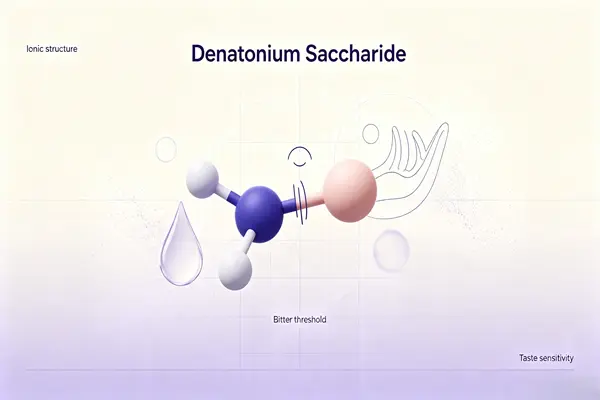
Denatonium Saccharide has a cation-anion paired salt structure. The cationic skeleton is modified from the lidocaine parent structure. The benzyl quaternary ammonium group forms a large, hydrophobic, rigid segment, while the saccharin anion acts as a hydrophilic pairing group to balance the overall charge. This amphiphilic configuration, with one end hydrophobic and the other hydrophilic, allows the molecule to easily attach to the liquid membrane surface of oral taste bud epithelial cells and quickly contact the receptor protein binding pocket on the outer side of the cell membrane. If the anion and cation are separated and used individually, the intensity of bitter taste perception will decrease significantly. The complete salt structure is the basic framework for maintaining ultrasensitive taste recognition and is the core structural difference between it and similar bittering agents such as denatonium benzoate.
The large molecular stereochemistry of the quaternary ammonium cation can perfectly embed into the hydrophobic cavities of various TAS2R bitter taste receptors in the human body. Multiple benzene rings and alkyl side chains are firmly locked inside the receptor protein through van der Waals forces and hydrogen bonds, forming a stable ligand-receptor complex. Conventional bitter substances such as quinine and caffeine can only activate a few bitter taste receptor subtypes, while Denatonium Saccharide can simultaneously activate eight different bitter G protein-coupled receptors, triggering a signal amplification effect at multiple targets. Even at a trace addition of only 0.01 ppm, the human body can clearly perceive a strong bitter taste. Extremely low dosages will not interfere with the color, viscosity, or solubility of the carrier product, making it suitable for various liquid, gel, and solid dosage form formulations.
The molecule dissociates into free cations and saccharin anions in an aqueous environment. The dissociation is gentle and complete, preventing aggregation and precipitation in solution. Under normal temperature and light-protected storage conditions, the salt structure is highly stable, without hydrolysis, oxidation, or ion exchange failure. Saccharin anions are chemically inert and do not react with acids, alkalis, alcohols, or surfactants. They retain their bitterness even after prolonged storage in weak acid/weak alkali systems and ethanol solvents. For products requiring long-term shelf life, such as industrial antifreeze, pipe descaling agents, makeup removers, and nail polish, their stability ensures their safety against accidental ingestion.
The large quaternary ammonium structure of saccharin molecules makes it difficult to penetrate the tight junction barrier of the oral mucosa. The vast majority of saccharin remains on the surface of taste buds, providing sensory stimulation, with very little entering the bloodstream for systemic metabolism. Even if trace amounts are absorbed through the mucous membranes, they are rapidly broken down into small, inert metabolites by the liver and ultimately excreted in urine via the kidneys. They do not accumulate in internal organs and cause chronic damage. Only direct, large-volume contact with the eye mucosa poses a slight risk of irritation. When added properly to products, normal skin contact will not cause any adverse reactions, indicating a relatively broad safety margin.
⚙️ Receptor transmission triggers an instinctive resistance response
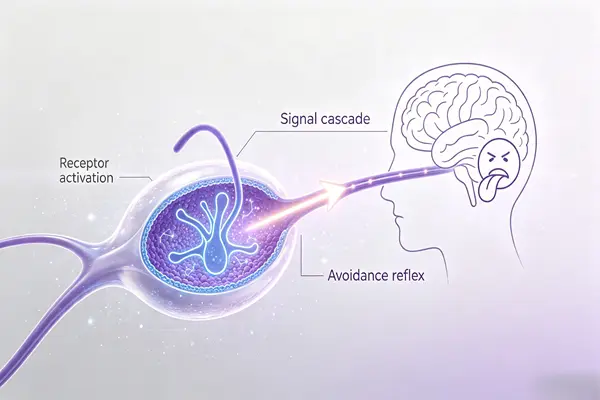
When the cations of Denatonium Saccharide bind to bitter taste receptors on the cell membrane of taste buds, the receptor protein immediately undergoes a conformational flip, activating the intracellular specific taste G protein. The dissociated protein subunits further initiate the catalytic activity of phospholipase Cβ2. This cascade reaction is the initiator for the downward transmission of bitter taste signals, and the entire process is completed in milliseconds. The discomfort is felt almost instantly upon human contact. When the receptors are not bound, taste cells are in a quiescent and stable state. Once the ligand binds, the intracellular biochemical reaction chain is fully activated, without signal interruption or attenuation, ensuring that the aversion signal is transmitted intact to the nerve endings.
The activated phospholipase breaks down phospholipid molecules on the cell membrane, generating two second messengers: inositol triphosphate (ITT) and diacylglycerol. IT binds to channel proteins on the surface of the endoplasmic reticulum, causing a large release of calcium ions stored in the endoplasmic reticulum into the cytoplasm. A sharp increase in intracellular calcium ion concentration is the core driving force behind the electrical signals generated by taste cells. The higher the calcium ion concentration, the greater the change in cell membrane potential, resulting in the release of more neurotransmitters and a stronger perception of bitterness in the brain. Denatoninium saccharide's powerful receptor activation directly corresponds to this explosive release of intracellular calcium ions.
The increased calcium ion concentration opens TRPM5 ion channels on the cell membrane, allowing sodium ions to flood into the taste cells along the concentration gradient. This causes depolarization potential fluctuations in the cell membrane, opening voltage-gated channels and releasing ATP as a neurotransmitter. After ATP contacts the afferent taste nerve fibers below, the nerve generates an action potential that travels along the cranial nerve to the taste center in the cerebral cortex. The central nervous system interprets the signal, ultimately forming the unbearable bitterness and nausea sensation. This entire closed-loop transmission from cell to nerve to brain is precisely regulated by molecular structure, preventing perceptual bias.
The intense bitterness directly triggers the body's innate protective reflexes, causing the oral muscles to contract rapidly, spitting out the substance, and triggering gagging and nausea in the throat. This behaviorally stops swallowing, preventing children or pets from accidentally ingesting toxic liquids such as cleaning agents, fuel, mold removers, and antifreeze. This instinctive behavioral barrier doesn't rely on toxicity; it establishes a barrier purely through sensory aversion. It avoids irreversible damage such as digestive tract corrosion or liver and kidney poisoning from small amounts of accidental ingestion, making it a gentle yet highly effective passive safety measure.
🔬 Targeted approach to avoid systemic physiological interference
The action of Denatonium Saccharide is strictly confined to the receptors on the oral taste epithelium. After a brief oral contact triggering a reflex, even if a small amount is swallowed into the gastrointestinal tract, it will not effectively bind to the bitter taste receptors on the gastrointestinal parietal cells, thus failing to stimulate digestive physiological activities such as peristalsis, gastric acid secretion, and gallbladder contraction. Many bitter plant extracts can stimulate the gastrointestinal mucosa to accelerate emptying, easily causing abdominal pain and diarrhea. However, this ingredient only exerts its effect at the oral sensory level; after entering the digestive tract, it is rapidly diluted and broken down, without disrupting the normal digestive cycle. Even accidental ingestion of a small amount will not cause gastrointestinal dysfunction.
Although a small number of bitter taste receptors are scattered on the smooth muscle cells of the respiratory tract and airways, Denatonium Saccharide almost never reaches the airway target after swallowing. It does not have the incidental pharmacological effects of dilating bronchi or regulating airway tone, and will not alter respiratory rhythm or lung ventilation. For sensitive individuals with asthma or airway hyperresponsiveness, products containing this bittering agent will not induce respiratory stress symptoms. Compared to multifunctional bitter agonists, it offers a more singular and controllable effect, significantly reducing unknown risks during product use.
The intact stratum corneum of the epidermis completely blocks the penetration of large-molecule quaternary ammonium salt structures. When hands come into contact with solutions or creams containing Denatonium Saccharide, the molecules cannot penetrate the stratum corneum to reach living cells. It will not alter the skin barrier lipid structure, stimulate abnormal proliferation of keratinocytes, or cause contact dermatitis such as redness, itching, or peeling. Only when the skin is broken or mucous membranes are directly immersed in high concentrations of the undiluted solution for extended periods will a slight stinging sensation occur. At standard compliant ppm levels, the safety for external contact is fully guaranteed, making it compatible with the additive standards of various topical daily chemical and industrial personal care products.
The metabolic degradation pathway is simple and direct. The trace components absorbed into the body do not participate in systemic circulatory regulation such as blood sugar regulation, lipid metabolism, and hormone synthesis, and will not affect endocrine homeostasis such as insulin secretion, liver fat breakdown, and thyroid hormone release. There is no risk of long-term accumulation interfering with organ function, nor will it produce potential chronic toxicity to the hematopoietic, nervous, or reproductive systems. The toxicological assessment level is low-risk, meeting the control standards for consumer product safety additives in most countries worldwide, and it can be used compliantly in export industrial products and cross-border daily chemical products.
📌 Trace amounts added to ensure stable protective efficacy
Denatonium Saccharide achieves complete anti-ingestion protection with ultra-low nanogram dosages, typically requiring only 1/100,000 to 1/1,000,000 in a product formulation. It does not alter the original product's physical state; liquids remain clear and homogeneous, and pastes do not exhibit layering, clumping, or discoloration. Core performance attributes such as odor, viscosity, and volatility remain unaffected. It can be used in trace amounts in high-value industrial solvents, automotive chemical fluids, high-end nail care products, and pipeline corrosion inhibitors—products with stringent purity requirements—without affecting product performance due to impurities introduced by bittering agents.
It exhibits excellent compatibility with most daily chemical and industrial additives, including acids, alkalis, alcohols, nonionic surfactants, and preservatives, without causing precipitation, discoloration, decomposition, or off-odors. It remains stable in various pH and solvent systems, including acidic rust removers, alkaline descaling solutions, high-concentration ethanol disinfectants, and silicone oil lubricants. Even after months or years of long-term storage, its bitterness recognition ability remains undiminished, ensuring its safety against accidental ingestion throughout its entire lifecycle and reducing safety vulnerabilities caused by later product failure.
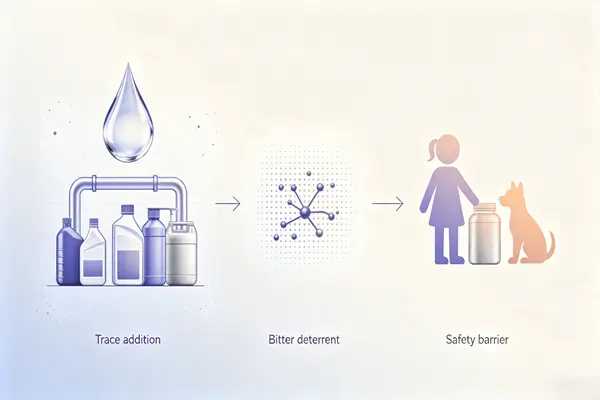
For young children and pets—two high-risk groups for accidental ingestion—the strong bitterness creates a deep aversion memory, prompting them to actively avoid contact with similar products after a single lick, providing a long-lasting behavioral warning. In situations where children's curiosity leads them to bite bottle caps, suck on tubes, or spill liquids, the instantaneous regurgitation reflex directly prevents dangerous swallowing, significantly reducing the incidence of accidental chemical poisoning in the home. This is a cost-effective and easy-to-implement consumer product safety solution.
In taste physiology research, Denatonium saccharide is used as a standardized broad-spectrum agonist of the TAS2R receptor. It is characterized by stable purity, a clearly defined target, and a well-defined signaling pathway. It is used to establish in vitro culture models of taste cells, screen for novel taste regulatory molecules, and analyze the polymorphic differences in bitter taste receptor genes. Using the same batch of raw materials ensures consistent activation intensity across multiple parallel experiments, eliminating signal fluctuations caused by impurities. This improves the reproducibility and reliability of data in sensory pharmacology and neurobiology research, making it an irreplaceable standard reference reagent in basic taste research.
Conclusion
Denatonium Saccharide is a salt formed from saccharinic acid and denatonium benzoate cations. Its quaternary ammonium salt structure endows it with a strong ability to activate bitter taste receptors. In personal care and daily chemical products, it acts as an "aversion agent" to prevent accidental ingestion. For the fine chemical raw material industry, high-purity denatonium saccharide powder with excellent batch-to-batch consistency is a core raw material supporting the "safety protection" function of daily chemical products and industrial alcohol formulations.
Xi'an Faithful BioTech Co., Ltd. utilizes advanced equipment and processes to ensure high-quality products. Our Denatonium Saccharide meets international pharmaceutical standards. Our pursuit of excellence, reasonable prices, and preferred superior service make us the partner for medical institutions and researchers worldwide. If you require Denatonium Saccharide research or production,Please contact us Click email: allen@faithfulbio.com Or WhatsApp: +86 13137770562.
References
- Meyerhof, W. (2022). The human bitter taste receptor repertoire and ligand binding profiles. Chemical Senses, 47(6), bjac038.
- Roper, S. D. (2021). Signal transduction in mammalian taste receptor cells. Physiological Reviews, 101(3), 1127–1162.
- Clark, A. A. (2023). Species differences in denatonium saccharide sensitivity across mammalian TAS2R orthologs. Journal of Comparative Physiology A, 209(4), 561–572.
- Loper, G. L. (2022). Physicochemical comparison of denatonium saccharide versus denatonium benzoate bitterants. Journal of Cosmetic Science, 73(2), 109–118.
- Zhang, L. (2020). Toxicokinetic and metabolic assessment of quaternary ammonium bitter deterrent compounds. Regulatory Toxicology and Pharmacology, 116, 104728.
- Iwatsuki, K. (2022). Peripheral and central neural processing of intense bitter stimuli in humans. Neuroscience Letters, 772, 136421.
- Van der Klaauw, M. M. (2023). Non-lethal bitter repellent mechanisms for household and industrial hazard prevention. Journal of Safety Research, 85, 143–151.