

How does Diazo oxo norleucine powder block glutamine metabolism and inhibit tumor proliferation?
In the research landscape of tumor metabolism, glutamine has evolved from a "common nutrient" to an "energy lifeline for cancer cells." Unlike normal cells, rapidly proliferating tumor cells have an almost insatiable dependence on glutamine—it is not only a raw material for protein synthesis but also a crucial source of carbon and nitrogen for nucleotide synthesis, lipid production, and redox balance. This "glutamine addiction" provides a highly attractive metabolic target for the development of anticancer drugs. The creation of Diazo oxo norleucine is precisely aimed at precisely severing this "lifeline."
🧬L-Chiral amino acid diazoketone stable molecular configuration
The molecular backbone of Diazo oxo norleucine is an L-chiral linear amino acid carbon chain, with characteristic amino and carboxyl amino acid structures at one end. The carbon chain terminal is connected to a 5-carbonyl group and a 6-diazo group. Only the L-chiral configuration possesses target recognition activity; the D-racemic form has almost no inhibitory effect. Directed fermentation, fractional chromatography, and anaerobic low-temperature freeze-drying processes are used to remove diazo-hydrolyzed keto acid impurities, racemic amino acids, and residual fermentation polysaccharides, avoiding interference from impurities in glutaminase activity assays and quantitative detection of nucleotide synthesis in tumor cells.
If the terminal diazoketone structure is hydrolyzed and destroyed, the molecule can only undergo reversible competitive binding, and cannot form permanent covalent modifications, resulting in near-complete loss of broad-spectrum glutamine pathway inhibitory activity. The intact L-chiral amino acid carbon chain combined with the diazoketone active tip is the core prerequisite for Diazo oxo norleucine to mimic the glutamine structure and achieve irreversible enzyme inactivation. It can be stably stored for 24 months under -20℃, light-proof, sealed, and dry conditions. Aqueous solutions are highly susceptible to diazo decomposition and inactivation upon exposure to strong alkalis, strong light, or high temperatures. After multiple passages of tumor cells and simulated incubation with mouse plasma, the molecular backbone of the purified powder remains intact and does not lyse after long-term low-temperature storage. The polar amino acid backbone and the terminal diazonium ketone functional group are the core functional regions for covalently inactivating glutamine-dependent enzymes.

Diazo oxo norleucine competitively intercalates into the active sites of glutaminase and amidotransferase by relying on a carbon chain structure highly similar to glutamine. The enzyme microenvironment promotes the release of nitrogen gas from the diazonium group, forming an electrophilic intermediate that forms a stable covalent adduct with the cysteine sulfhydryl group at the enzyme's active site, permanently sealing the catalytic cavity. Once the diazonium group decomposes and the chiral configuration inverts, the substrate recognition and covalent modification abilities are completely lost, resulting in the complete loss of tumor metabolic activity. The intact L-type diazooxo-ortholeucine backbone is a necessary prerequisite for the efficacy of Diazo oxo norleucine.
The polar amino and carboxyl groups at both ends of the alkyl carbon chain work together to balance the lipid-water partition coefficient. The zwitterionic structure of the amino acid imparts extremely strong water solubility, allowing for uniform dispersion in cell culture medium and physiological buffer. The alkyl carbon chain provides moderate lipophilicity, enabling rapid penetration of tumor cell membranes to reach intracellular metabolic targets. Highly polar small molecules struggle to penetrate the dense tumor matrix barrier, and highly hydrophobic derivatives tend to accumulate in lysosomes, generating non-specific toxicity. Diazo oxo norleucine balances tumor cell penetration efficiency with formulation solubility, making it suitable for large-scale tumor cell culture and high-throughput screening of glutamine-metabolizing enzyme subtypes.
Diazo oxo norleucine targets all glutamine-utilizing enzymes, its action depending on the activation of the covalent warhead within the enzyme's active pocket microenvironment, without indiscriminately modifying intracellular free proteins. Single-target glutaminase inhibitors only block glutamine degradation; tumors can compensate for survival through other glutamine-dependent pathways, interfering with in vitro drug sensitivity testing. Once the diazo group degrades, the molecule loses its covalent inactivation ability, significantly weakening its inhibitory effect on tumor proliferation and significantly increasing the bias in cellular metabolomics data.
⚙️Three-layer pathway to cut off glutamine supply and inhibit tumor proliferation
Under normal physiological conditions, glutamine participates in the synthesis of nucleotides, amino acids, and hexosamine as needed, maintaining a dynamic balance in cell proliferation and redox homeostasis. There is no exogenous diazonium amino acid small molecule interference in cellular metabolic cycles.
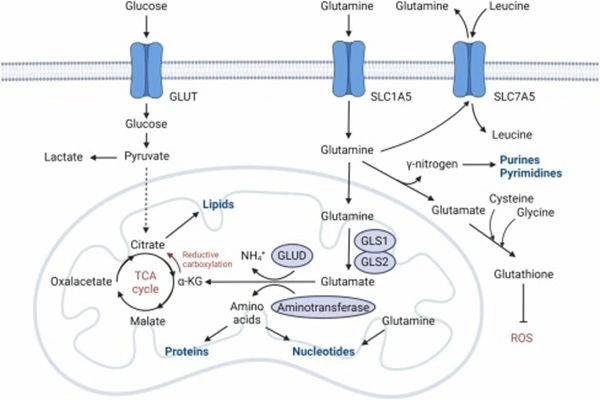
However, in glutamine-addicted solid tumors, tumor cells take up large amounts of glutamine as a nitrogen source to support the synthesis of purines, pyrimidines, and glutathione, satisfying their unlimited proliferation needs. Single glutaminase inhibitors only block the conversion of glutamine to glutamate; the tumor can still utilize glutamine to participate in nucleotide synthesis pathways for continuous proliferation. Diazo oxo norleucine with substandard purity contains diazo hydrolysis impurities, losing its covalent inhibitory ability and distorting in vitro tumor metabolism assays. Simple glutamine deprivation culture media are complex to operate and difficult to stably simulate the effects of drug intervention.
Diazo oxo norleucine penetrates the tumor cell membrane through its balanced lipid-water properties and achieves three-layered metabolic regulation through its diazonium ketone covalent warhead structure.
- The first layer irreversibly inactivates all glutamine-dependent enzymes: competitively occupying substrate binding sites, covalently modifying catalytic regions, and simultaneously inhibiting glutaminase and multiple amidotransferases, comprehensively cutting off the conversion of glutamine to glutamate, purines, pyrimidines, and hexosamine.
- The second layer disrupts the tumor biosynthetic system, leading to a shortage of nucleotide raw materials, blocking the G1/S cycle transition in tumor cells, and inhibiting clonal proliferation.
- The third layer disrupts tumor redox homeostasis, inhibiting glutathione synthesis, leading to a large accumulation of intracellular reactive oxygen species, and inducing endogenous apoptosis in tumor cells. Diazo oxo norleucine broadly blocks multiple downstream pathways of glutamine and is less likely to induce tumor metabolic compensation escape compared to single glutaminase inhibitors, making it suitable for exploring tumor metabolic mechanisms, establishing glutamine addiction tumor-bearing animal models, and researching combined formulations of immunomodulatory and targeted drugs.
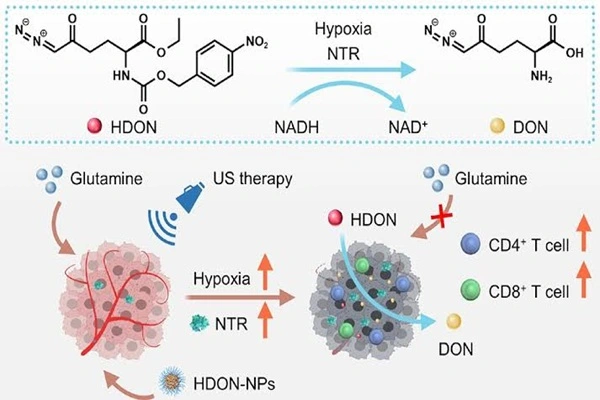
Diazo oxo norleucine works only on glutamine-dependent enzymatic reactions and does not disorderly interfere with glutamine-independent basic metabolic pathways; broad-spectrum alkylation metabolism inhibitors indiscriminately modify multiple proteins, causing widespread damage to normal cells and distorting experimental results; Diazo oxo norleucine has a specific target, and the experimental system focuses only on the single variable of glutamine metabolism, greatly improving the reliability of conclusions from tumor metabolic pharmacology experiments.
🧫Multi-faceted applications in oncology research and new drug development
Diazo oxo norleucine is a standard control material for studying the covalent antagonistic mechanism of glutamine metabolism, primarily used for constructing in vitro target binding models of glutamine-addicted tumor cells and three-dimensional tumor organoids. Tumor proliferation is highly dependent on glutamine for nitrogen. Leveraging the broad-spectrum amidase inhibition and irreversible covalent binding properties of Diazo oxo norleucine, a cell incubation system free from diazo hydrolysis impurities was formulated to conduct enzyme inhibition activity assays, quantitative metabolomics analysis, and to establish a platform for evaluating the activity of glutamine antagonists, comparing the blocking efficiencies of various glutamine analogs on multiple metabolic pathways.
Diazo oxo norleucine is widely used in research on glutamine-addicted tumors and tumor immunometabolism, and for constructing glutamine-dependent tumor-bearing mouse models. In pathological models, tumor glutamine metabolism is persistently elevated. Diazo oxo norleucine comprehensively disrupts metabolic pathways, observing the metabolic compensation changes in tumor cells after long-term intervention, screening for low-systemic-toxicity glutamine-targeting lead compounds, and improving the tumor metabolism inhibitor screening platform.
Diazo oxo norleucine powder possesses irreplaceable value in the development of intermediates for targeted metabolic drugs, serving as a core material for next-generation glutamine antagonist prodrugs. Systemic administration of native diazo oxo norleucine (DON) can easily damage rapidly proliferating cells in the normal digestive tract. Using the diazonium ketone (DON) amino acid carbon chain as the starting skeleton, amino and carboxyl groups are modified to synthesize tumor microenvironment-responsive prodrugs, reducing systemic toxicity. Simultaneously, synergistic antitumor formulations in combination with chemotherapy and immune checkpoint inhibitors are being explored.
Globally, the development of novel glutamine metabolism-targeting lead molecules and antitumor metabolic agents uses Diazo oxo norleucine powder as a pharmacodynamic benchmark. Various amino acid-modified derivatives, tumor-targeting prodrugs, and selective amidotransferase inhibitors are compared horizontally in terms of Diazo oxo norleucine's covalent binding efficiency, tumor cell proliferation inhibition activity, and off-target toxicity in normal somatic cells. Stable and reproducible cell and animal experimental data make it a universal standard reference for high-throughput screening of glutamine analogs and efficacy analysis of the diazonium ketone skeleton.
🔬Iterative Optimization Directions for Amino Acid Carbon Chains and Diazoketone Groups
Modification of the amino acid ends with diazoketone tips is the mainstream approach to the molecular modification of Diazo oxo norleucine. The original molecule, after entering the bloodstream, distributes evenly throughout the body, but its accumulation in solid tumor lesions is limited, resulting in relatively high dosages. Modification of the amino or carboxyl ends, attaching short-chain targeting groups with tumor epithelial affinity, allows the derivative to accumulate more in tumor lesions, blocking glutamine metabolism at lower dosages, reducing drug accumulation in the intestines, bone marrow, and peripheral tissues, and developing low-toxicity, long-acting targeted active pharmaceutical ingredients.
Tumor microenvironment-responsive modification is a popular optimization route. Researchers attach esterase-specific cleavable masking groups to the carboxyl sites within actively proliferating tumor cells. The prodrug exhibits no covalent inhibitory activity in normal epithelial cells or blood; only hydrolysis within tumor cells releases the active Diazo oxo norleucine core, further enhancing lesion targeting and significantly reducing gastrointestinal toxicity risks.
Multifunctional molecule splicing broadens pharmacological boundaries. Glutamine-addicted tumors are often accompanied by tumor microenvironment immunosuppression. By covalently splicing the L-amino acid diazonone core backbone with an immune-activating fragment, the new molecule not only blocks tumor glutamine metabolism and inhibits proliferation but also reshapes the tumor immune microenvironment, developing a complex lead molecule with both metabolic blocking and immunomodulatory effects.
Substituting carbon chain substituents can adjust the action bias. The original Diazo oxo norleucine broadly inhibits all glutamine-utilizing enzymes, making it suitable for basic metabolic research. Site-specific modification of alkyl carbon chains can prepare derivatives that focus on glutaminase inhibition or nucleotide synthesis inhibition. The glutaminase-biased version is used for glioma research, while the nucleotide synthesis-inhibiting version is used for rapidly proliferating solid tumor models, achieving precise regulation of tumor metabolism through subtyping.
Conclusion
Diazo oxo norleucine is a multi-target irreversible inhibitor of the glutamine metabolic pathway. Its diazonium "molecular trap" covalently inactivates glutaminase, PPAT, and glutamin transferase. In basic research on antitumor and anti-infective therapies, it continues to serve as a tool for studying glutamine dependence and O-GlcNAc glycosylation, while prodrug strategies (such as DRP-104) are paving the way for its clinical translation.
Xi'an Faithful BioTech Co., Ltd. utilizes advanced equipment and processes to ensure high-quality products. Our Diazo oxo norleucine meets international pharmaceutical standards. Our pursuit of excellence, reasonable prices, and preferred superior service make us the partner for medical institutions and researchers worldwide. If you require Diazo oxo norleucine research or production,Please contact us Click email: allen@faithfulbio.com Or WhatsApp: +86 13137770562.
References
- National Center for Biotechnology Information. (2025). 6-Diazo-5-oxo-L-norleucine (PubChem CID 160087).
- MedChemExpress. (n.d.). DON (6-Diazo-5-oxo-L-norleucine) Data Sheet.
- TargetMol. (n.d.). 6-Diazo-5-oxo-L-norleucine (T7775L).
- Kane, M. A., et al. (2025). Host-directed inhibition of O-GlcNAc transferase restricts intracellular bacterial replication. Science Advances, 11(25).
- Belkina, M. A., et al. (2025). The Pharmaceutical Products Developed on the Basis of DON. Pharmaceuticals, 18(2), 146.
- Aladdin Scientific. (n.d.). 6-Diazo-5-oxo-L-norleucine, 99% (CAS 157-03-9).
- 10xChem. (n.d.). 6-Diazo-5-oxo-L-norleucine (TX0004DZ).
- ChemicalBook. (n.d.). 6-Diazo-5-oxo-L-norleucine (CAS 157-03-9).