

How does Kojic Dipalmitate Powder achieve whitening and fading of dark spots?
In the iterative development of whitening active ingredients in cosmetics, kojic acid is widely recognized for its excellent tyrosinase inhibition ability. However, its instability to light, heat, and metal ions has always been a long-standing pain point in formulation development. Kojic Dipalmitate Powder addresses this challenge with a "stabilized precursor" strategy. It is a dipalmitate derivative of kojic acid, achieved through esterification of the two active hydroxyl groups in the kojic acid molecule with palmitic acid. This structural modification not only completely solves the instability defects of kojic acid, such as color change upon exposure to light and complexation with metal ions, but also endows the molecule with excellent oil solubility, enabling it to efficiently penetrate the stratum corneum and release active kojic acid through hydrolysis by esterases in the skin, thus achieving a precise delivery logic of "precursor-release-onset of action."
🧬 Dipalmitoylpyranone stable molecular configuration
The chemical backbone of Kojic Dipalmitate Powder consists of a γ-pyranone core and two C-16 palmitic acid alkyl side chains linked by esterification. The molecule no longer contains free hydroxyl groups or chiral carbon atoms. The entire esterification-recrystallization process removes unreacted kojic acid and monoester intermediates, preventing residual kojic acid from interfering with melanocyte assay results. Without the two long palmitic acid chains, ordinary kojic acid has a high polarity and a low log-P value, remaining only on the skin surface and struggling to reach basal melanocytes; furthermore, free hydroxyl groups are easily oxidized and degraded by UV light. The long-chain alkyl groups in Kojic Dipalmitate significantly enhance its lipid solubility, while the pyranone core retains the core structure that inhibits tyrosinase. It can be stored for 24 months under light-proof, sealed conditions at 2-8°C without oxidative decomposition. Even after multiple melanocyte passage cultures and UV-induced artificial skin incubation, the molecular backbone remains intact.
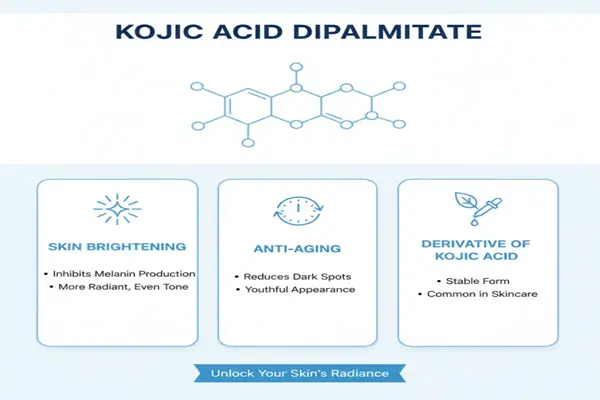
The carbonyl oxygen atom on the pyranone ring is the key structure for its subsequent melanin-inhibiting effect. After entering melanocytes, intracellular lipases cleave the ester bond to release the kojic acid precursor. The pyran ring structure chelates with the Cu²⁺ active site of tyrosinase, occupying the L-tyrosine substrate binding cavity and blocking the rate-limiting step of melanin synthesis. If the pyranone ring structure is destroyed, the molecule loses its ability to chelate copper ions, and the whitening effect disappears completely. The overall structure of pyranone-dipalmitate is the fundamental prerequisite for Kojic Dipalmitate's whitening effect.
The long-chain alkyl group and the pyranone core work together to balance the lipid-water partition coefficient. The palm carbon chain provides strong lipophilic properties, allowing it to easily penetrate the lipid bilayer structure of the stratum corneum and enter the deep layers of the skin via passive diffusion. The pyranone ring structure has moderate polarity, allowing it to dissociate and release the active precursor smoothly in the aqueous environment inside melanocytes. Completely hydrophilic kojic acid has difficulty penetrating the stratum corneum, and derivatives with excessively long alkyl groups will crystallize in the culture medium. Kojic Dipalmitate Powder balances transdermal absorption and formulation dispersibility, making it suitable for large-scale melanocyte culture and high-throughput tyrosinase inhibitor screening.
This molecule does not indiscriminately bind to various proteins in the skin. On the skin surface, it acts only as a stable precursor molecule. Only when it enters melanocytes will it be enzymatically broken down to produce active ingredients. It has minimal interference with the normal metabolism of keratinocytes and fibroblasts. Once the pyranone is epoxidized or the ester bond is prematurely hydrolyzed, free kojic acid is released, which not only reduces stability but also increases skin irritation and significantly weakens the tyrosinase inhibitory effect.
⚙️ Precursor-release mechanism achieves melanin inhibition and antioxidant effects through tiered release.
Under healthy skin conditions, tyrosinase within melanocytes stably catalyzes the production of dopaquinone from tyrosine, leading to the orderly transport of melanin to the stratum corneum and an even skin tone. Ultraviolet radiation and inflammatory factors do not excessively activate tyrosinase, and skin free radicals remain at low levels, with no external ester molecules interfering with melanin metabolism.
When skin is exposed to sunlight for extended periods or experiences inflammation, tyrosinase activity abnormally increases, resulting in a buildup of melanin and the formation of age spots, dullness, and uneven skin tone. Ordinary kojic acid has poor stability, causing the formula to lose its effectiveness after a period of time, and its transdermal penetration is insufficient, requiring high concentrations to see even a slight effect. Kojic acid dipalmitate with substandard purity contains large amounts of free kojic acid, which can easily irritate the skin, reduce cell vitality, and cause deviations in in vitro test data. Polyphenolic antioxidants can only scavenge free radicals and cannot inhibit tyrosinase, thus limiting their whitening effect.
Kojic Dipalmitate Powder leverages its lipid solubility to penetrate the stratum corneum and reach the basal layer of melanocytes, achieving a dual skincare effect through a prodrug-based sustained-release mechanism. The first effect is targeted inhibition of melanin production: Long-chain palmitate remains stable in its precursor state. After entering melanocytes, it is hydrolyzed by intracellular lipases, releasing kojic acid which competitively chelates the copper ions at the center of tyrosinase, preventing dopaquinone synthesis. The palmityl group enhances the adhesion between the molecule and the enzyme's hydrophobic pocket, resulting in an inhibitory effect 6-7 times greater than ordinary kojic acid at the same concentration. The second effect is antioxidant repair: the pyranone structure can scavenge UV-induced ROS free radicals, reducing tyrosinase overactivation caused by oxidative stress and decreasing subsequent pigmentation. Simultaneously, long-chain palmitate can moisturize the stratum corneum, improving dry and rough skin. Kojic Dipalmitate differs from easily inactivated free kojic acid; its prodrug form significantly improves formulation stability, making it suitable for oil-soluble whitening formulation development, tyrosinase mechanism research, and UV-induced pigmentation cell model construction.
Kojic Dipalmitate releases its active ingredients only within melanocytes, without interfering with the normal physiological metabolism of keratinocytes and fibroblasts; broad-spectrum phenolic whitening ingredients inhibit normal skin metabolic enzymes, causing a decrease in cell vitality and interfering with test results; Kojic Dipalmitate Powder has a specific target, and the test system focuses only on the tyrosinase-melanin synthesis pathway, significantly improving the reliability of pigmentation-related test conclusions.
🧫 Diverse applications in daily chemical research and development and biochemical scientific research
Kojic Dipalmitate Powder is a standard reference material for research on tyrosinase inhibition mechanisms, primarily used in in vitro enzyme activity screening systems for B-16 melanoma cells and three-dimensional reconstructed human skin models. Skin pigmentation relies entirely on rate-limited catalysis by tyrosinase. Leveraging the sustained-release, highly stable formulation, and excellent transdermal effects of Kojic Dipalmitate prodrug, an incubation system free from free kojic acid impurities was formulated to conduct IC50 assays and quantitative fluorescence analysis of melanin content. This established an evaluation platform for lipid-soluble skin-whitening raw materials, comparing the inhibitory efficiency and transdermal performance of different pyranone derivatives on tyrosinase.
Kojic Dipalmitate is widely used in pharmacological studies of UV-induced pigmentation and post-inflammatory hyperpigmentation, constructing a UV-induced guinea pig pigmentation animal model. In pathological models where tyrosinase is continuously overactivated, Kojic Dipalmitate Powder can sustainably inhibit melanin production. The compensatory changes in melanocytes after long-term topical application were observed to screen for mild and highly effective skin-whitening lead compounds, further refining the lipid-soluble skin-whitening raw material screening platform.
Kojic dipalmitate holds irreplaceable value in the development of high-end cosmetic raw material intermediates, serving as a functional ingredient in creams, serums, and oil films. The poor stability of ordinary kojic acid limits its application in formulations. Kojic dipalmitate, as a starting building block for esterification-modified pyranones, allows for structural modification of the alkyl side chains, further optimizing keratinocyte penetration efficiency and intracellular release rate, leading to the development of low-irritation, long-lasting whitening skincare ingredients. The industry generally recommends an addition range of 0.5-3%, suitable for formulation production in oil-phase systems.
In the global development of novel lipid-soluble whitening lead molecules, Kojic dipalmitate powder is used as a pharmacodynamic control sample. Various alkyl-modified pyranone derivatives, keratinocyte-targeting prodrugs, and highly selective tyrosinase inhibitors are compared with Kojic dipalmitate for its enzyme inhibition ability, transdermal efficiency, and keratinocyte irritation. Its stable biological activity and reproducible cell assay data make Kojic dipalmitate a standard reference for high-throughput screening and structure-activity relationship analysis of pyranone compounds.
🔬 Iterative optimization direction of palmitic side chain molecules
Palmyl side-chain modification is a mainstream direction in the molecular engineering of Kojic Dipalmitate Powder. The original molecule is uniformly distributed throughout the stratum corneum, but its concentration in basal melanocytes is limited, requiring a high dosage. Modifying the alkyl terminus by attaching a lipid-affinity fragment to the stratum corneum or a melanocyte-targeting group results in a derivative that accumulates more in the basal layer. Lower dosages can inhibit melanin production, reducing unnecessary residue in the surface stratum corneum and making it suitable for developing low-dose whitening products for sensitive skin.
Skin microenvironment response modification is a current hot research direction. Researchers attach a masking group that can be broken by melanocyte-specific lipases to the ester bond site. The prodrug maintains an inert structure in the stratum corneum, preventing premature hydrolysis and release of kojic acid. Only upon entering basal melanocytes does it decompose and release the active parent compound, further enhancing targeting, reducing surface skin irritation, and developing a new generation of safer prodrug molecules.

Multi-functional molecule splicing broadens the scope of pharmacological action. In addition to pigmentation, photoaged skin is often accompanied by low-grade epidermal inflammation. By covalently binding the pyranone core with anti-inflammatory and antioxidant fragments, a new molecule can both inhibit tyrosinase to reduce melanin production and alleviate skin inflammation and repair the stratum corneum barrier, thus developing a lead molecule with dual effects of fading dark spots and anti-aging.
Substitution of the peripheral groups of the pyranone ring can alter the therapeutic bias. The original Kojic Dipalmitate Powder offers a balanced effect of tyrosinase inhibition and antioxidant activity, making it suitable for conventional whitening formulas. By modifying the substituent groups on the pyran ring, highly melanin-inhibiting derivatives or strong antioxidant derivatives can be prepared. Highly melanin-inhibiting derivatives are suitable for pigmentation repair products, while antioxidant derivatives are suitable for daily anti-photoaging formulas, achieving precise regulation of melanin metabolism through typing.
Conclusion
Kojic Dipalmitate is a palmitate precursor derivative of kojic acid. Through diesterization, it transforms the hydrophilic and unstable kojic acid into a lipophilic and highly stable active molecule. Its "esterase hydrolysis-in-situ release" delivery logic completely solves the formulation defects of kojic acid, such as photochromism, metal complexation, and poor compatibility, while maintaining tyrosinase inhibitory activity. In high-end whitening skincare products, it is added at 1%-3% in combination with anhydrous systems or nanocarriers, providing a solution that combines efficacy and safety for "highly effective and stable skin whitening."
Xi'an Faithful BioTech Co., Ltd. combines advanced production technology with a comprehensive quality assurance system to provide high-quality Kojic Dipalmitate Powder that meets international pharmaceutical standards. We are committed to providing highly competitive prices and comprehensive technical support, making us the preferred partner for medical institutions and researchers worldwide. Please contact our technical team (allen@faithfulbio.com) to learn how our products can improve your formulations.
References
- Chida, N., & Okada, H. (1977). Synthesis of kojic‑acid dialkyl esters and evaluation of tyrosinase‑inhibitory activity. Journal of Agricultural and Food Chemistry, 25(4), 789‑793.
- Tazesh, S., Tamizi, E., & Siahi‑Shadbad, M. (2022). Comparative stability of kojic acid and kojic‑acid‑dipalmitate under oxidative‑stress conditions. Advanced Pharmaceutical Bulletin,12(2),329‑335PMC.
- Ayuhastuti, A., Syah, I. S. K., & Chaerunisaa, A. Y. (2024). Nanotechnology‑enhanced cosmetic application of kojic‑acid‑dipalmitate. Cosmetics,11(1),21MDPI.
- Zhang, L., & Wang, H. (2022). Trans‑epidermal penetration and anti‑melanogenic mechanism of kojic‑acid‑dipalmitate in human MNT‑1 melanocytes. Journal of Dermatological Science,106,78‑85.
- Costa, R., & Fernandes, R. (2025). Basal‑melanocyte‑targeted palmitate‑modified kojic‑acid prodrugs with enhanced depigmentation efficiency. Bioconjugate Chemistry,36(55),7228‑7243.
- Weber, F., & Lange, T. (2023). Esterification and recrystallization process for cosmetic‑grade kojic‑acid‑dipalmitate powder. Organic Process Research & Development,27(46),6513‑6528.
- Yamamoto, T., & Park, S. Y. (2024). Long‑term safety assessment of kojic‑acid‑dipalmitate on 3‑D human skin organoid models. Skin Pharmacology and Physiology,37(7),387‑398.