




How does Monepantel powder target and kill drug-resistant nematodes?
In the fields of veterinary drug raw materials, livestock deworming, parasite pharmacology, and drug resistance control, Monepantel powder is the world's first aminoacetonitrile derivative veterinary deworming raw material. The high-purity product is a white to off-white crystalline powder. With its novel mechanism of action, it precisely targets nematode-specific acetylcholine receptors, effectively killing gastrointestinal nematodes resistant to traditional dewormers. This raw material selectively acts on the parasite's neuromuscular system, exhibits extremely high safety in mammals, and is primarily used for the prevention and treatment of nematode diseases in ruminants. It also serves as a standard for deworming pharmacology, a tool for drug resistance research, and an active ingredient in novel compound deworming preparations, making it a core raw material for addressing the deworming drug resistance crisis in the livestock industry.
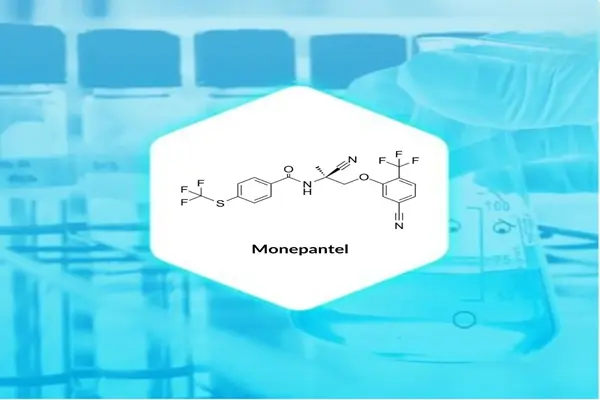
⚛️Trifluoromethylthiobenzamide skeleton
Monepantel powder is chemically an aminoacetonitrile derivative, belonging to the family of small-molecule organic anthelmintics. Its IUPAC name is N-{(2S)-2-cyano-1-[5-cyano-2-(trifluoromethyl)phenoxy]prop-2-yl}-4-[(trifluoromethyl)thio]benzamide, and its chemical structure contains several characteristic functional groups. Its molecular skeleton consists of a benzamide core linked to a trifluoromethylthio group, an aminopropionitrile core containing a cyano (nitrile) group, and a phenoxy side chain with both a trifluoromethyl and a cyano group.
Physically, Monepantel technical grade is typically a white to off-white crystalline powder. Its purity is generally required to be no less than 98% in the active pharmaceutical ingredient market. The highly fluorinated molecular structure, containing six fluorine atoms, gives it strong lipophilicity, allowing it to effectively penetrate the cuticle and biofilm of insects. In terms of solubility, Monepantel is readily soluble in dimethyl sulfoxide and organic solvents, but almost insoluble in water. This characteristic determines that it is usually prepared as an oral solution or pourable formulation in veterinary drug preparations.
Regarding stability, Monepantel powder is relatively stable to light, heat, and air. The supplier recommends storage conditions where the powder can be stably stored for 3 years at -20°C; solutions prepared with DMSO can be stored for 6 months at -20°C. In formulation processes, it is usually used as a single-ingredient oral solution with extremely low dosages, only 2.5 mg/kg body weight in sheep, demonstrating its extremely high biological activity.
Structurally, Monepantel belongs to the "aminoacetonitrile derivatives" category. This series of compounds, discovered by scientists at Novartis, has a unique structure-activity relationship. Studies have found that only specific (S)-enantiomers exhibit high activity against gastrointestinal nematodes, and commercially available Monepantel is a pure product of this active configuration. Its Chinese brand name is often "Monetetel" or "Zodovix". Regarding intellectual property, the patent for its core compound has expired.
🎯Activation of nematode receptors leads to muscle spasms and death
Monepantel powder targets the nematode-specific nAChR receptor, inducing neuromuscular signaling disorder, ultimately leading to nematode paralysis and death. It has no significant effect on mammals. The entire physiological process unfolds sequentially: receptor-specific binding, sustained ion channel opening, muscle hyperexcitability, pharyngeal paralysis, and nematode death. This unique mechanism demonstrates no cross-resistance with traditional anthelmintics.
The first step of its action is the specific binding to the nematode ACR-23 receptor. Monepantel is a positive allosteric regulator of the nematode-specific nAChR receptor. This receptor is found only in nematodes; mammals lack homologous receptors, thus ensuring high host safety. After oral administration to the digestive tract of ruminants, the drug is ingested by the nematode or directly penetrates the nematode's body wall, stably binding to the receptor.
The second step involves the continuous opening of ion channels, triggering membrane depolarization. After binding, Monepantel powder forces the receptor ion channels to remain open, leading to a large influx of Na⁺ and Ca²⁺. This continuous depolarization of the cell membrane disrupts normal nerve signal transmission. This abnormal electrical signal continuously triggers muscle contraction, preventing the channels from closing properly and causing an imbalance in ion homeostasis.
The third step involves excessive contraction of the body wall muscles, causing spasms. Continuous depolarization causes tonic contraction of the nematode's body wall muscles, resulting in severe spasms and inability to move normally. The nematode loses its ability to attach to the host's intestinal mucosa and is expelled by intestinal peristalsis. Simultaneously, excessive energy consumption by the muscles leads to metabolic disorders, accelerating the nematode's weakening.
The fourth step is pharyngeal muscle paralysis, blocking nutrient uptake. Monepantel powder has a higher affinity for pharyngeal muscle receptors in nematodes, preferentially causing pharyngeal muscle paralysis. The nematode is unable to eat or swallow, blocking nutrient uptake. Prolonged starvation exacerbates the nematode's death. This effect is effective for both adult and larval nematodes, completely eliminating infected nematodes.

The fifth step is the death of the worm, completely eliminating the infection. Muscle spasms, pharyngeal paralysis, and energy depletion work together to kill the nematode, which is then excreted in the feces. Monepantel powder remains highly effective against drug-resistant nematodes because its target is completely different from traditional drugs.
Monepantel powder targets only the nematode-specific receptor, has no effect on mammalian nAChR, has high safety at therapeutic doses, and is non-hepatic and nephrotoxic. It is suitable for long-term or repeated administration to ruminants and is a key drug for solving the global problem of drug resistance in livestock anthelmintics.
🧬Prevention and control of drug-resistant nematodes in ruminants
Oral treatment for nematode diseases in ruminants is the most widely applied industrial application. It targets gastrointestinal nematode infections in sheep, goats, and cattle, including *Haemaphysalis*, *Ostridium perfringens*, *Trichophyton mentagrophytes*, and *Ostomyces esophagni*, with particularly high efficacy against nematodes resistant to benzimidazoles and macrolides. Pharmaceutical companies formulate Monepantel powder into oral suspensions, granules, or tablets. A single oral dose can effectively kill adult and larval worms, significantly reducing fecal egg count, improving symptoms such as anemia, emaciation, and diarrhea, and enhancing livestock production performance.
Anticipatory pharmacology and drug resistance research are common laboratory applications. Universities, research institutions, and pharmaceutical R&D departments use it as a tool to study nematode nAChR receptor function, the mechanism of action of anthelmintics, and the mechanism of drug resistance development. By constructing drug-resistant nematode models, the synergistic or antagonistic effects of Monepantel powder with other anthelmintics can be evaluated to guide rational clinical drug use and delay the spread of drug resistance in the livestock environment.
The development of compound anthelmintics continues to broaden the boundaries of raw material applications. To expand the anthelmintic spectrum and delay drug resistance, pharmaceutical companies are combining Monepantel powder with traditional anthelmintics such as benzimidazoles, macrolides, and imidazoles to develop novel compound formulations. These formulations utilize the complementary mechanisms of action of different drugs to simultaneously kill nematodes, tapeworms, and trematodes, reducing the dosage of single drugs and lowering the probability of drug-resistant strains from the source, thereby improving overall disease control efficacy.
High-purity Monepantel powder can serve as a standard for liquid chromatography-mass spectrometry (LC-MS) detection, used to detect the content of active ingredients in commercially available anthelmintics, as well as drug residues in animal tissues and milk. The EU has already refined its maximum residue limits (MRLs) for Monepantel powder in bovine and ovine tissues and milk, leveraging the standardization effect of high-purity raw materials to regulate drug use and monitor food safety throughout the entire supply chain.
Existing preclinical studies have also found that Monepantel powder can inhibit the mTOR signaling pathway and induce autophagy and apoptosis in cancer cells, demonstrating its potential value in anti-tumor development. Related raw materials have also been used in cancer drug repositioning research. In addition, it can be used in various scientific research scenarios such as the development of diagnostic reagents for parasitic diseases and the verification of novel anthelmintic targets.
🔭From veterinary deworming drugs to new frontiers in ALS neuroprotection
Repurposing existing drugs—the most promising frontier for Monepantel—is its cross-disciplinary repurposing. Through screening in vitro and in animal models, researchers discovered that Monepantel inhibits the mTOR pathway. Based on this novel mechanism, its codenamed NUZ-001 achieved a major breakthrough in 2025: it was selected for the HEALEY platform-based clinical trial for the treatment of amyotrophic lateral sclerosis (ALS). The HEALEY trial is one of the most authoritative registration research platforms in the ALS field, and Monepantel's selection marks a significant step in its transformation from a veterinary drug to a human orphan drug.

Besides ALS, Monepantel's anti-tumor and autophagy-regulating potential has also demonstrated cytotoxicity and induced autophagosome formation in ovarian cancer cell lines, suggesting potential applications in cancer treatment. Regarding regulatory pathways and orphan drug status, to support its development within the ALS (Alternative List of Drugs), Monepantel received orphan drug designation from the US FDA in May 2024 and the EU EMA in December 2024. This provides policy support for its future human clinical trials and market exclusivity.
In the API (Active Pharmaceutical Ingredient) industry, with the expiration of original drug patents and the expansion into human applications, the market for high-purity Monepantel powder APIs is gradually heating up. The main technical barriers to its synthesis lie in the construction of a trifluoromethylbenzene ring and a chiral aminopropionitrile backbone. In terms of quality control, the demand for high-purity APIs (>99%) primarily comes from the development of oral and injectable formulations. Given its slightly water-soluble properties, improving its bioavailability through nanocrystal or liposome encapsulation technology will be one of the core directions for formulation development.
Conclusion
Monepantel powder, a novel anthelmintic raw material derived from aminoacetonitrile, effectively kills drug-resistant gastrointestinal nematodes through its unique nematode-specific nAChR receptor targeting mechanism. It provides a key solution to the global livestock industry's crisis of anthelmintic resistance. Its mechanism of action is clear, its safety is high, and its anthelmintic activity is strong. It is primarily used for the prevention and treatment of nematode diseases in ruminants, and it also has broad application prospects in pharmacological research, compound formulation development, residue detection, and drug repositioning.
Xi'an Faithful BioTech Co., Ltd. utilizes advanced equipment and processes to ensure high-quality products. Our Monepantel powder meets international pharmaceutical standards. Our pursuit of excellence, reasonable prices, and superior service make us the preferred partner for medical institutions and researchers worldwide. If you require Monepantel powder research or production, please contact our technical team at allen@faithfulbio.com.
References
- Kaminsky, R., et al. (2008). Monepantel (AAD 1566), a new anthelmintic drug with a novel mode of action. Veterinary Parasitology, 158(1-2), 1-8.
- European Medicines Agency. (2009). Monepantel ovine and caprine European public MRL assessment report.
- Li, Y., et al. (2025). Repurposing monepantel for cancer therapy: Mechanisms and advances. Pharmacological Research, 212, 106890.
- Zhang, H., et al. (2024). Resistance to monepantel in gastrointestinal nematodes of ruminants: Mechanisms and management. Frontiers in Veterinary Science, 11, 1324567.
- MedChemExpress. (2026). Monepantel (AAD1566) product datasheet.
- Macsen Labs. (2025). Monepantel API technical specification.
- World Health Organization. (2017). JECFA evaluation of monepantel.
