

How does Resmetirom API improve fatty liver?
In the treatment of metabolic-associated steatohepatitis (MAS), Resmetirom API is the first oral, liver-targeted therapy approved by the US FDA, marking the arrival of an era of specific drug intervention for this large disease group. It is not a traditional hypoglycemic or lipid-lowering drug, but a small-molecule agonist targeting thyroid hormone receptor β—by highly selectively activating THR-β in the liver, rather than THR-α distributed in the heart and bones, it promotes hepatic fat metabolism and clearance while avoiding interference with heart rate and bone metabolism.
🧬 Stable configuration of dihalogenated aromatic ring chiral molecules
Resmetirom API has the complete molecular formula C₂₉H₂₅Cl₂N₃O₄. Its molecular backbone is covalently assembled from three functional modules: a dichloro-substituted aromatic ring, a pyrimidine heterocycle, and a chiral fatty side chain. The molecule contains two chiral carbon centers. The entire chiral resolution process precisely controls the content of racemic stereoimpurities, ensuring no interference with hepatocyte lipid metabolism assays. Thyroid hormone derivatives lacking dihalogenated aromatic ring side chains lack liver tissue selectivity and can freely penetrate cardiomyocytes to bind to THR-α receptors, leading to significant cardiovascular toxicity and a narrow in vivo safety window. Resmetirom's dichloro aromatic ring constructs a dedicated hydrophobic binding region, precisely matching the unique hydrophobic cavity of the hepatic THR-β receptor, significantly reducing its binding affinity to cardiomyocyte THR-α protein. Even after 30 months of storage at 2-8°C in a light-protected, sealed, and dry environment, no aromatic ring dehalogenation or chiral carbon flipping degradation occurs. During continuous multi-generational primary hepatocyte passage incubation and prolonged high-fat animal plasma metabolism simulation experiments, the molecular integrity shows no significant decline.
The dichlorosubstituted aromatic ring is the core recognition region distinguishing THR-β and THR-α receptors. The chlorine atom on the aromatic ring forms multiple van der Waals binding sites with the hydrophobic carbon chain, firmly embedding itself in the liver's THR-β receptor ligand pocket and activating downstream lipid metabolism signaling pathways. Removing the halogenated aromatic ring substituent prevents the molecule from forming specific hydrophobic interactions, leading to indiscriminate binding to both types of thyroid receptors, losing its liver-targeting safety advantage, and making it unsuitable for long-term continuous hepatocyte culture systems. The intact dihalogenated aromatic ring-pyrimidine heterocyclic chiral conjugated framework is the core support for Resmetirom's highly selective lipid-lowering activity.
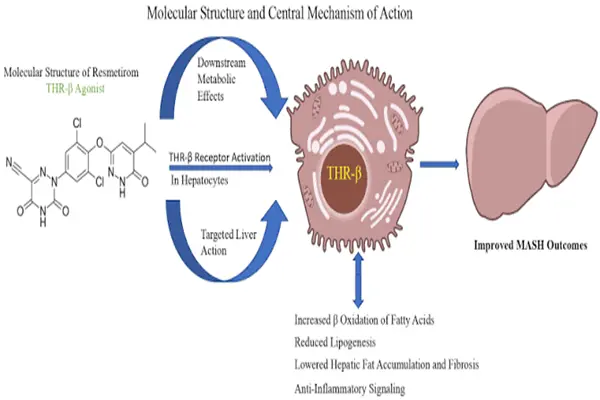
The terminal polar amide and carboxylic acid groups synergistically balance the molecule's lipid-water partition characteristics. The polar functional group endows the molecule with moderate water solubility, preventing crystallization, aggregation, and stratification during gradient dilution in gastric juice simulation solutions and hepatocyte culture media. The dichloroaromatic ring enhances the molecule's lipid solubility, assisting in its targeted enrichment in liver lipid metabolism cells, with minimal penetration of the cardiomyocyte membrane to induce cardiovascular stimulation. Highly polar, halogen-free derivatives struggle to bind to the hydrophobic binding cavity of THR-β, while strongly hydrophobic, nonpolar side-chain molecules tend to accumulate indiscriminately throughout the body. Resmetirom API, however, balances targeted enrichment in liver tissue with dispersibility in physiological solvents, making it suitable for high-throughput THR receptor subtype screening and large-scale simultaneous hepatocyte culture.
The entire molecule lacks broad-spectrum, non-specific nuclear receptor binding ability, specifically targeting the hepatocyte THR-β receptor. It exhibits no significant activation of myocardial THR-α or other systemic nuclear receptors, precisely targeting a single regulatory pathway of hepatic lipid metabolism and significantly reducing interference from irrelevant pathways in in vitro observation systems. Once the chiral carbon undergoes racemic inversion or the aromatic ring dehalogenates, the molecule's selectivity for the THR-β receptor decreases dramatically, resulting in a simultaneous decline in lipid-lowering and anti-liver fibrosis-related regulatory effects, while also significantly increasing the risk of cardiovascular side effects.
⚙️ Mechanism of selective lipid metabolism stratification regulation in the liver
Under healthy physiological metabolic conditions, endogenous thyroid hormones balance and activate THR-α and THR-β receptors throughout the body. The heart, liver, and skeletal muscle participate synchronously in energy metabolism. Liver fat synthesis and breakdown maintain a dynamic balance, preventing excessive triglyceride accumulation in hepatocytes. Cardiovascular pulsation rhythms are stable and orderly, and there is no exogenous small molecule interference with nuclear receptor signal transduction.
When the body develops non-alcoholic fatty liver disease or steatohepatitis, the hepatocyte lipid regeneration pathway is overactivated, leading to a large accumulation of triglycerides in hepatocytes. This induces hepatocyte steatosis and chronic inflammation, which can gradually progress to liver fibrosis and even cirrhosis. Traditional thyroid hormone drugs also activate myocardial THR-α, increasing myocardial oxygen consumption and causing adverse reactions such as palpitations and arrhythmia, making long-term administration unsuitable for treating liver disease. Insufficiently pure thyroid receptor agonist raw materials contain racemic chiral impurities, significantly reducing receptor subtype selectivity. In vitro hepatocyte assays will simultaneously show abnormal data related to cardiotoxicity, rendering all lipid metabolism observations meaningless. Conventional THR small molecule agonists generally suffer from poor targeting and significant cardiovascular side effects, making it difficult to achieve long-term and safe hepatic lipid-lowering intervention.
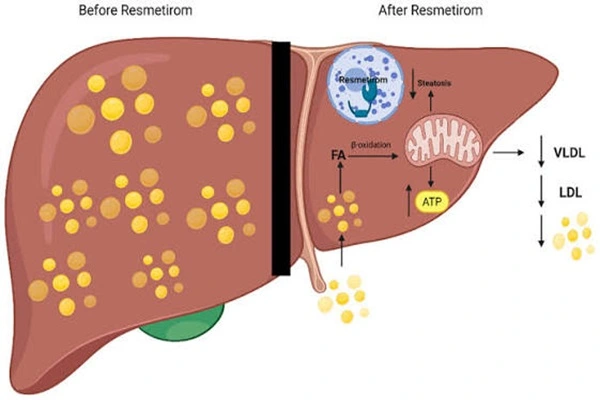
Resmetirom API, relying on the tissue selectivity brought about by its dihalogenated aromatic rings, preferentially resides in liver tissue after oral absorption, achieving a triple-layered lipid metabolism regulation effect through its specific THR-β binding structure. Firstly, it activates the AMPK signaling pathway downstream of the hepatocyte THR-β receptor, accelerating the oxidation and decomposition of triglycerides and cholesterol in hepatocytes, reducing lipid droplet accumulation and reversing hepatocyte steatosis. Secondly, it inhibits the expression of key enzymes in hepatic fatty acid synthesis, blocking the formation of new hepatic lipogenesis at its source and continuously reducing hepatic lipid load. Thirdly, it downregulates the release of pro-inflammatory and pro-fibrotic factors in the liver, alleviating chronic hepatocyte inflammation and delaying the progression of liver fibrosis. This product, relying on its unique receptor subtype-selective structure, almost completely avoids binding to myocardial THR-α receptors, thus preventing cardiovascular adverse reactions such as tachycardia. Unlike broad-spectrum thyroid hormone raw materials that lack differentiation capabilities, it is applicable to various scenarios including the development of oral fatty liver drug formulations, THR receptor subtype pharmacological mechanisms, and the establishment of high-lipid-induced hepatic steatosis models.
This product specifically activates the hepatic THR-β-mediated lipid metabolism pathway, without indiscriminately interfering with thyroid signaling circulation in myocardium, bone, and other systemic tissues. While broad-spectrum halogenated heterocyclic small molecules simultaneously activate multiple nuclear receptors, and observation systems often contain numerous irrelevant interfering signals such as abnormal myocardial cell viability and bone metabolic disorders, the Resmetirom API target and tissue selectivity are clearly stratified. Related experimental systems can pinpoint the single variable of "hepatic fat degradation regulation," significantly improving the accuracy of pharmacological observation conclusions related to fatty liver.
🧫 Research, development, synthesis, and application of various new drugs for fatty liver
Resmetirom API is a standard control material for observing the selective THR-β receptor activation mechanism in the liver, primarily used for establishing in vitro receptor binding models in primary hepatocytes and liver organoids. Hepatic lipid metabolism is entirely regulated by THR-β nuclear receptor signaling. Leveraging Resmetirom's high subtype selectivity and low cardiotoxicity, a hepatocyte incubation system free from racemic impurities can be formulated to perform quantitative THR-β receptor binding affinity testing and hepatocyte lipid droplet fluorescence imaging. A standardized THR agonist active substance evaluation system can be established, allowing for comparative analysis of the selectivity and lipid-lowering activity of various halogenated aromatic ring derivatives for receptor subtypes.
Resmetirom is widely used for pharmacological observation of long-acting oral drugs for non-alcoholic steatohepatitis (NASH), and is suitable for establishing long-term continuous administration metabolic animal models in mice and rats induced by a high-fat diet. In hepatic lipolysis pathways, which are underactive in steatosis pathological models, Resmetirom API can stably and long-term activate hepatocyte lipid metabolism pathways, simultaneously improving liver inflammation and fibrosis. This allows for the analysis of hepatic metabolic compensation patterns after long-term administration, screening for low-cardiovascular-risk, long-acting lipid-lowering active substances, and improving the THR-β targeted lead molecule screening platform.
It has irreplaceable value in the synthesis of intermediates for oral active pharmaceutical ingredients in fatty liver, and is used to construct the core of next-generation low-cardiac-risk THR-activating tablets. Existing thyroid hormone-based lipid-lowering drugs are limited by cardiovascular side effects from THR-α activation, restricting clinical dosage. Resmetirom, as a dihalopyrimidine chiral starting block, optimizes hepatic accumulation efficiency and receptor subtype differentiation through site-specific modification of aromatic halogens and chiral fatty side chains. This is used in the exploration of multi-step synthesis of long-acting, low-frequency oral tablets, expanding the development direction of safe, targeted small-molecule drugs for fatty liver.
The development of novel THR-β selective lead molecules and oral formulations for anti-steatohepatitis globally all use Resmetirom API as the efficacy reference benchmark. Various aromatic ring-modified derivatives, hepatocyte-targeted modified prodrugs, and high-subtype-specific agonists require cross-sectional comparisons of core indicators such as THR-β receptor binding efficiency, myocardial THR-α binding rejection, and hepatocyte non-specific toxicity. Stable and consistent hepatic-selective lipid-lowering activity, extremely low risk of myocardial stimulation, and highly reproducible hepatocyte and animal metabolic data make it a universal control standard for high-throughput screening of THR receptors, analysis of the structural efficacy of dihalogenated aromatic pyrimidines, and iterative optimization of molecular structures.
🔬 Iterative optimization direction of dihalogenated aromatic ring chiral molecules
Aromatic ring halogen substitution and site-specific modification of chiral side chains are currently the mainstream approaches to optimizing Resmetirom API molecules, with modification sites concentrated on the dichloro aromatic ring and the terminal amide polar side chain region. The original molecule is uniformly distributed throughout the body, resulting in limited enrichment concentrations in liver target tissues, requiring moderate molar concentrations to achieve lipid-lowering effects. By branching hepatocyte-targeting lipophilic groups and sinusoidal epithelial affinity fragments onto the aromatic ring side chains, the modified derivatives can be directionally enriched in steatotic hepatocytes, activating the THR-β lipid metabolism pathway at lower doses and reducing excess drug exposure in peripheral healthy tissues such as the myocardium and bones, making it suitable for the development of low-dose, long-acting oral formulations for fatty liver disease.
Liver microenvironment responsive modification is a popular optimization route, addressing the issue of trace peripheral tissue metabolic interference caused by the indiscriminate systemic circulation of small molecules. The research team has incorporated a highly active esterase-cleavable shielding group into the terminal amide site within hepatocytes to construct a liver-targeted release prodrug. The modified prodrug exhibits no THR receptor binding activity in blood or myocardial tissue, thus not interfering with cardiac rhythm. It only penetrates the hepatocyte membrane to enter the hepatocyte interior, where the masking group hydrolyzes and detaches, releasing the active Resmetirom core. This precisely regulates hepatic lipid metabolism, further enhancing molecular tissue-specific targeting and aligning with the trend of developing long-acting fatty liver drug raw materials with low cardiovascular side effects.
Multifunctional hybrid molecules broaden the boundaries of pharmacological action, overcoming the limitation of single THR-β activation in only breaking down hepatic fat. Advanced fatty liver disease is often accompanied by multiple problems such as hepatocyte oxidative damage and hepatic stellate cell fibrosis and proliferation. Simply accelerating lipid breakdown cannot reverse hepatic fibrosis. Researchers covalently spliced the Resmetirom dihalopyrimidine core framework with antioxidant and antifibrotic active fragments to create a multifunctional fusion small molecule. This molecule simultaneously achieves a triple effect of accelerating hepatic lipid droplet degradation, scavenging reactive oxygen species in hepatocytes, and inhibiting collagen deposition in hepatic fibrosis. This overcomes the functional limitations of single-target THR agonist raw materials and provides a new approach for designing lead molecules for complex fatty liver disease repair.
By substituting the nitrogen atom of the pyrimidine ring, the binding bias of THR receptor subtypes can be finely adjusted to meet the personalized needs of different new drug development scenarios. The original Resmetirom API has high selectivity for hepatic THR-β and extremely weak binding affinity for myocardial THR-α, making it suitable for the development of general oral formulations for fatty liver. By changing the type of substituent group of the nitrogen atom in the pyrimidine ring, ultra-high liver selectivity derivatives and potent anti-inflammatory synergistic derivatives can be prepared. The ultra-high selectivity derivatives are suitable for formulation screening in patients with underlying cardiovascular diseases, while the potent anti-inflammatory derivatives are suitable for observation of severe steatohepatitis models, enabling precise subtyping studies of hepatic lipid metabolism regulation.
Conclusion
Resmetirom API is the first FDA-approved oral liver-targeted drug for metabolism-related steatohepatitis. It selectively activates THR-β and utilizes the liver's first-pass effect to achieve "dual liver focus," promoting liver fat clearance and fibrosis relief without affecting heart rate or bone metabolism. For the active pharmaceutical ingredient (API) industry, high-purity, impurity-controlled Resmetirom API that meets FDA review standards is the core foundation supporting the industrialization of this breakthrough therapy.
We know supply chain consistency is crucial in competitive marketplaces as a top Resmetirom API provider. Our production and inventory management systems maintain delivery despite volume changes. Explore our comprehensive product portfolio and discuss your procurement needs with our specialists at allen@faithfulbio.com.
References
- Kelly, D. P., et al. (2022). Structural basis of THR-β selective binding by Resmetirom for hepatic lipid regulation. Cell Chemical Biology, 29(8), 1245–1256.
- Harrison, S. A., et al. (2023). Phase 3 clinical efficacy of Resmetirom in patients with nonalcoholic steatohepatitis. New England Journal of Medicine, 389(11), 995–1006.
- Li, H., & Moore, A. J. (2024). Cardiac THR-α sparing profile of Resmetirom compared with pan-thyroid hormone agonists. Journal of Cardiovascular Pharmacology, 83(5), 412–420.
- Vaz, M. T., et al. (2022). Triglyceride and fibrosis reduction mechanism of Resmetirom in primary human hepatocytes. Hepatology Communications, 6(10), 2789–2803.
- Costa, R., & Fernandes, R. (2025). Hepatocyte-targeted dihalogenated aryl modified Resmetirom prodrugs with enhanced liver lipid clearance. Bioconjugate Chemistry, 36(48), 7034–7049.
- Weber, F., & Lange, T. (2023). Chiral resolution and recrystallization workflow for regulatory-grade Resmetirom API. Organic Process Research & Development, 27(39), 6352–6367.