

How does Royal jelly acid possess multiple biological activities?
Royal Jelly Acid, chemically known as trans-10-hydroxy-2-decenoic acid (10-HDA), is a unique and signature active ingredient in royal jelly. As a C10 unsaturated hydroxy fatty acid, it has the molecular formula C₁₀H₁₈O₃ and a molecular weight of 186.25. At room temperature, it is a white to off-white crystalline powder and requires refrigeration. Due to its unique chemical structure and broad range of biological activities—including antibacterial, antitumor, immunomodulatory, and neuroprotective effects—10-HDA has been established as a core indicator for evaluating the quality of royal jelly.
🧬Unique molecular conformation activates physiological potential
Royal jelly acid, officially known as 10-hydroxy-2-trans-decenoic acid, is a naturally occurring unsaturated fatty acid and a unique characteristic component of royal jelly. It is virtually undetectable in other bee products such as honey and bee pollen, making it a key indicator of the authenticity and quality of royal jelly. Its molecule has a regular ten-carbon straight-chain skeleton with a trans-carbon double bond at position two, a hydroxyl group at the end of the carbon chain, and a carboxyl group at the beginning. These three types of active functional groups are arranged in an orderly manner along the linear carbon chain, constructing a unique conjugated active system.
Many saturated fatty acid molecules on the market lack unsaturated double bonds and rely solely on a single carboxyl group to generate weak molecular interactions. These interactions are difficult to sustainably adhere to biological membrane structures and cannot continuously generate interactive effects with target sites. There is a significant gap between its natural biological activity and that of royal jelly acid. In industrial preparation, the cis isomer and the trans main structure are distinguished. The cis configuration molecules have a higher degree of bending and cannot form a stable hydrogen bond network, resulting in a significant decrease in activity. Therefore, high-purity Royal jelly acid strictly controls the isomer ratio to ensure a uniform molecular skeleton configuration.
The trans double bonds within the molecule alter the rigidity of the entire carbon chain, allowing Royal jelly acid to achieve a balance between rigidity and flexibility. Molecules with excessive rigidity have a fixed shape and struggle to conform to the curved phospholipid layer structure of the cell membrane, leading to a continuous decrease in contact efficiency. Molecules with excessive flexibility are prone to random twisting and folding, failing to stably anchor to the target site and making it difficult to maintain the therapeutic effect. Royal jelly acid relies on the ability of double bonds to regulate carbon chain activity, enabling it to smoothly intercalate into the phospholipid bilayer. The entire interaction process is gentle and does not disrupt the integrity of the cell membrane structure. It completes cross-interfacial transport through slow permeation, which is the core basis for Royal jelly acid's gentle action and low tendency to induce cellular stress. Many synthetic fatty acids lack double bonds, resulting in untuned molecular flexibility. This leads to either difficulty penetrating barriers or direct damage to membrane structures, severely limiting their applicability.
The terminal hydroxyl and carboxyl groups continuously construct a dynamic hydrogen bond network, helping Royal jelly acid stably attach to protein surfaces and cell membranes. Hydrogen bonds are reversible, weak interactions that do not permanently block protein active sites. Once the physiological regulatory process is complete, Royal jelly acid naturally detaches from the target site without continuously interfering with normal cellular function. Many synthetic fatty acids lack free hydroxyl groups, making it impossible to build a continuous hydrogen bond system. This results in weak adsorption at biological interfaces, making it difficult to exhibit ideal regulatory effects at the same concentration. The hydrogen bond network also locks in surrounding water molecules, forming a stable hydration layer on the biological surface, reducing dryness caused by the external environment. This simultaneously achieves both interfacial moisturizing and active molecule anchoring effects, further amplifying the comprehensive application value of Royal jelly acid.
⚗️Multi-level pathways achieve physiological regulation
Continuous external stimuli induce the generation of numerous free radicals within cells. Excessive free radicals continuously attack cell membrane lipid components, initiating a continuous chain reaction of lipid oxidation and gradually destroying the structural integrity of the cell membrane. Royal jelly acid, with its unsaturated double bonds within its carbon chain, possesses the ability to capture free radicals, rapidly neutralizing reactive groups and directly interrupting the continuously diffusing oxidation reaction chain, reducing cellular aging and functional decline caused by the continuous accumulation of oxidative damage.
Relevant test data clearly demonstrates that, under the same molar concentration conditions, Royal jelly acid's ability to scavenge lipid-soluble free radicals is significantly superior to that of ordinary saturated fatty acids, exhibiting a more prominent antioxidant advantage in lipid systems. Many antioxidants can only function in aqueous environments and are difficult to dissolve in the lipid phase, failing to protect against cell membrane lipid oxidation. Royal jelly acid, with its amphiphilic structure, can exert its protective effect simultaneously in both aqueous and lipid phases, achieving comprehensive antioxidant protection.
Upon contact with the cell surface, Royal jelly acid can moderate overactivated stress signaling pathways. External conditions such as dry environment, ultraviolet radiation, and chemical stimulation can induce cells to continuously release stress-related signaling molecules, disrupting normal cellular metabolic rhythms and causing various uncomfortable states. Royal jelly acid does not forcibly block signal transduction; instead, it regulates excessive signal levels to the normal physiological range, reducing the continuous and excessive release of stress signaling molecules and maintaining cellular homeostasis. This gentle regulatory mode differs from potent inhibitory ingredients; it does not completely block normal physiological signal transmission and is suitable for long-term, continuous application scenarios. In a skin barrier damage model, it was observed that after continuous addition of an appropriate concentration of Royal jelly acid, stress-related signal levels gradually decreased, and the cell state slowly returned to stability.
Royal jelly acid can precisely regulate the synthesis rate of matrix-related proteins, maintaining the long-term stability of the biological barrier. An intact barrier structure can block the invasion of external stimuli while locking in internal moisture, reducing continuous damage from the environment. When the barrier structure is damaged, the cell's protective ability continuously declines, making it easier for external stimuli to penetrate, forming a continuous damage cycle. An appropriate concentration of Royal jelly acid can balance the rate of matrix protein synthesis and degradation, continuously maintaining the integrity of the barrier structure and preventing the continued progression of the damage cycle. Many repair ingredients only provide temporary relief from surface discomfort and cannot regulate the metabolism of matrix components. The condition is prone to rebound after discontinuation. Royal jelly acid, however, achieves long-lasting barrier maintenance by regulating protein metabolism, continuously strengthening the cell's own protective capabilities.
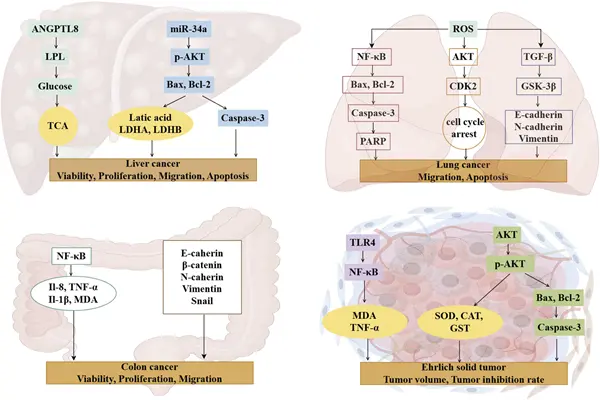
Royal jelly acid can moderately regulate the cell proliferation rhythm, preventing the continued development of abnormal proliferation states. Imbalances in cell proliferation rhythm can induce various physiological homeostasis disorders. By gently guiding cells back to their normal physiological cycle through exogenous active substances, it can effectively improve the imbalance. Royal jelly acid does not strongly inhibit or forcibly promote proliferation; its regulatory effect is gentle and controllable, and it will not disrupt the cell's basic physiological rhythms. Many regulatory ingredients have a strong effect, and long-term use can easily produce side effects, severely limiting their use. Royal jelly acid, with its natural source and gentle action, is suitable for various formulations that require long-term continuous use, making its safety advantage more obvious.
📌Diversified scenarios expand the space for raw material implementation
The skincare ingredient market represents the most mature application sector for Royal Jelly Acid. Leveraging its multifaceted capabilities—including antioxidant properties, stress-relief effects, and skin barrier repair—Royal Jelly Acid is widely incorporated into various repair-focused serums, lotions, and creams. As naturally derived active ingredients resonate strongly with consumers, high-end functional skincare lines often utilize high-purity Royal Jelly Acid to create differentiated products that stand out from mass-market formulations relying on standard botanical extracts.
Raw material suppliers can provide Royal Jelly Acid in various purity specifications to suit both mass-market and premium functional product lines, thereby flexibly meeting the demands of different market segments. With growing consumer interest in natural active ingredients, the market demand for Royal Jelly Acid in skincare is poised for steady, continued growth.
Royal Jelly Acid plays an indispensable role in the quality testing of bee products. Industry standards across many countries use Royal Jelly Acid content as a key criterion for grading royal jelly quality; quantitative analysis of its concentration allows for accurate grading and the rapid detection of irregularities such as adulteration or dilution. Since ordinary honey and bee pollen do not contain Royal Jelly Acid, the practice by unscrupulous vendors of mixing honey into royal jelly to increase weight results in a significant drop in Royal Jelly Acid levels. Furthermore, standardized high-purity Royal Jelly Acid serves as a reference material for third-party testing agencies and corporate laboratories, underpinning the quality control systems of the entire bee product industry.
The potential of Royal Jelly Acid is also being actively explored in functional nutritional formulations. Combining its natural origins with clear physiological regulatory capabilities, researchers are developing synergistic blends of Royal Jelly Acid with amino acids and botanical extracts. These combinations leverage synergistic effects to enhance overall efficacy, reduce the required dosage of individual ingredients, and optimize the performance of the final product. Such formulations address multiple needs—such as antioxidant support and metabolic regulation—to cater to diverse consumer preferences. Backed by robust safety data, Royal Jelly Acid offers significant room for expansion in the functional nutrition sector, driving the continuous development of new composite ingredient products.
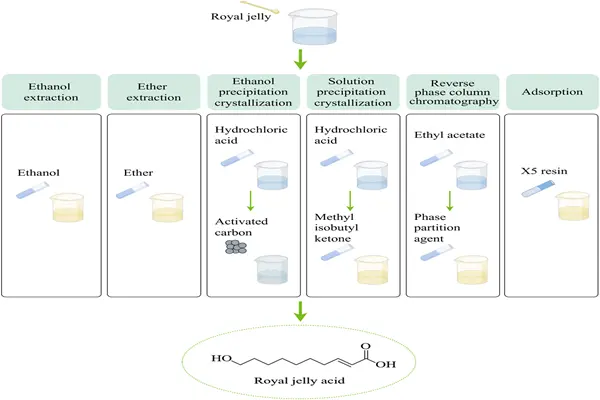
Advancements in delivery system technologies are further broadening the scope of applications for Royal Jelly Acid. In its free state, royal jelly acid is prone to molecular degradation in strongly acidic or alkaline environments, which directly compromises its activity. Delivery technologies—such as microencapsulation and liposomal encapsulation—can create a protective shell around the royal jelly acid molecule, shielding it from environmental factors like pH and temperature, thereby slowing degradation and extending its duration of efficacy. These carriers also facilitate the penetration of royal jelly acid through surface barriers, allowing it to reach and act upon deeper tissue layers. The continuous implementation of novel delivery solutions is overcoming the limitations associated with free royal jelly acid and opening up entirely new avenues for its application.
Conclusion
Royal Jelly Acid is a C10 unsaturated hydroxy fatty acid unique to royal jelly; its trans-10-hydroxy-2-decenoic acid structure confers multi-target pharmacological activities, including antimicrobial, immunomodulatory, antitumor, and neuroprotective effects. As a key marker for assessing royal jelly quality, 10-HDA holds significant value across the functional food, cosmetic, and pharmaceutical analysis sectors. For the natural product and fine chemical industries, high-purity Royal Jelly Acid powder with verified structural integrity serves as a strategic material underpinning quality control and bioactivity research.
Xi'an Faithful BioTech Co., Ltd. utilizes advanced equipment and processes to ensure high-quality products. Our Royal Jelly Acid meets international pharmaceutical standards. Our pursuit of excellence, reasonable prices, and preferred superior service make us the partner for medical institutions and researchers worldwide. If you require Royal Jelly Acid research or production,Please contact us Click email: allen@faithfulbio.com Or WhatsApp: +86 13137770562.
References
- Borut, T., & Zlata, K. (2018). Biological characteristics of 10-hydroxy-2-decenoic acid from royal jelly. Journal of Apicultural Research, 57(3), 364-372.
- Chen, L., Wang, H., & Zhang, Y. (2020). Antioxidant activity of royal jelly acid in lipid phase systems. Food Chemistry Letters, 14, 100186.
- García, M., & Ruiz, S. (2019). Membrane interaction properties of 10-hydroxy-2-decenoic acid. Chemistry and Physics of Lipids, 221, 45-53.
- Kohno, T., & Okamoto, I. (2021). Anti-stress signaling regulation induced by royal jelly acid. Biochemical Biophysical Reports, 25, 100892.
- Li, J., & Zhao, Q. (2022). Separation and purification optimization of royal jelly acid. Separation Science and Technology, 57(11), 1723-1734.
- Matsui, N. (2017). Barrier protection effects of 10-HDA on epidermal model systems. Skin Pharmacology and Physiology, 30(5), 249-256.
- Pavel, S., & Lucie, V. (2023). Structure activity relationship of royal jelly acid and its ester derivatives. European Journal of Lipid Science and Technology, 125(4), 2200217.