

How does Sodium Deoxycholate work?
At the intersection of biochemistry and medical aesthetics, Sodium Deoxycholate Powder is a functional ingredient that serves a dual purpose: a research tool and a pharmaceutically active ingredient. As a bile acid-based anionic detergent, its molecular structure is derived from bile acids, possessing a rigid steroidal backbone and a hydrophilic carboxylic acid head group. This allows it to form micelles in aqueous solutions and efficiently lyse cell membranes. In the laboratory, it is a core component of RIPA lysis buffer, used to extract membrane and nucleoproteins; clinically, its sodium salt-based injectable formulation is approved for improving submental fat accumulation in adults.
🧬Stable molecular configuration of steroids with both parents
The core of the Sodium deoxycholate Powder molecule is a fused 5β-cholesterol tetracyclic framework. Two hydroxyl groups at the 3α and 12α positions form the hydrophilic side, while the hydrophobic carbon face of the steroid ring forms the lipophilic region. The terminal carboxyl group forms a salt with sodium ions, enhancing water solubility. The molecule has no chiral inversion isomers. Oxidized steroids and unneutralized free deoxycholic acid impurities are removed through acid-base neutralization, multi-stage decolorization, and anaerobic low-temperature drying processes, avoiding interference from impurities in membrane protein extraction, lipid bilayer observation, and bile acid receptor activity detection.
If the tetracyclic steroid framework is oxidized and damaged, the amphiphilic spatial configuration disappears, preventing insertion into the phospholipid bilayer, and resulting in near-complete loss of membrane dissolution and micelle assembly activity. Oxidation and loss of hydroxyl groups break the molecular hydrogen bond network, significantly reducing the stability of the protein complex. The intact sodium dihydroxysteroid conjugated framework is a crucial prerequisite for the formation of micelles and penetration of biological membranes by the Sodium deoxycholate Powder. Stable for 24 months when stored in a sealed, moisture-proof, and light-protected container at 2-8℃. Free deoxycholic acid is easily precipitated in the aqueous solution under strongly acidic conditions. After simulated incubation with epithelial cells and lipid vesicles, the purified powder steroidal stereoconformity remains stable and does not lyse over a long period.
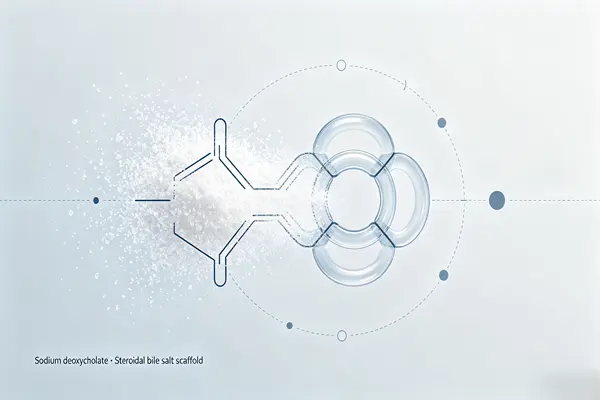
The hydrophilic hydroxyl groups on both sides and the terminal sodium carboxylate group in the steroidal skeleton are the core functional regions for exerting amphiphilic surface activity. When sodium deoxycholate powder is dissolved in aqueous solution, the monomer molecules, relying on the asymmetric steroidal structure, directionally insert into the phospholipid bilayer of the cell membrane. The hydrophobic steroidal face is embedded in the hydrophobic lipid core, while the polar hydroxyl groups and sodium carboxylate face the aqueous phase. When the concentration exceeds the critical micelle concentration, it spontaneously assembles to form small micelles, encapsulating membrane lipids and proteins to form a soluble mixed complex. Once the steroid is epoxidized or the hydroxyl groups are modified, the ability to directionally insert into the membrane structure is completely lost, and cell membrane lysis and protein solubilization activities are completely lost.
The polar hydroxyl groups, carboxyl groups, and hydrophobic steroidal carbon skeleton work together to balance the lipid-water partition coefficient, while the ionized carboxyl groups impart excellent water solubility, allowing for the preparation of aqueous buffer solutions without the need for organic co-solvents. The rigid tetracyclic steroidal ring provides moderate lipophilicity, enabling it to penetrate dense phospholipid layers. Completely hydrophilic small molecules cannot interact with lipids, and long-chain ionic detergents can easily cause irreversible protein denaturation. Sodium deoxycholate powder balances membrane permeability and protein conformational compatibility, making it suitable for the preparation of large batches of cell membrane samples and high-throughput membrane protein screening.
⚙️A three-layer molecular pathway enables membrane cleavage, protein solubilization, and signal regulation.
In healthy cells, the phospholipid bilayer maintains a continuous, closed structure, membrane proteins are stably embedded in the lipid matrix, intracellular components cannot freely leak out, intestinal bile acids maintain basal signaling levels, and there is no exogenous steroidal bile salts interfering with cell membrane homeostasis.
However, when research requires obtaining intracellular proteins or isolating transmembrane receptors, the intact cell membrane barrier hinders component release; common nonionic detergents are insufficiently capable of dissolving highly hydrophobic integrative proteins; substandard Sodium deoxycholate powder contains oxidized steroid impurities, disrupting micelle assembly and distorting membrane protein extraction results; mechanical lysis methods easily cause protein degradation and are difficult to standardize.
Sodium deoxycholate powder, relying on its asymmetric amphiphilic steroidal structure, achieves three-layered, stratified biological regulation. The first layer involves the insertion of phospholipid bilayers to disrupt the cell membrane barrier: monomers embedding into the lipid membrane create a loose membrane structure. Upon reaching the CMC (Cellular Mixture Limit), lipid-bile salt micelles are formed, completely disintegrating the cell membrane and releasing cytoplasmic and membrane-bound components. The second layer stabilizes the solubility of membrane proteins. Micelles encapsulate the hydrophobic transmembrane regions of transmembrane proteins, preventing hydrophobic aggregation and precipitation, thus achieving liquid-phase separation of integrated membrane proteins. The third layer acts as a signaling molecule to regulate cellular pathways. Binding to the TGR5 bile acid receptor, it modulates intestinal epithelial energy metabolism and inflammatory signaling, making it suitable for research on intestinal physiological mechanisms. Sodium deoxycholate powder is a classic component of RIPA buffer, balancing lysis strength and protein compatibility, making it suitable for molecular biology sample preparation, membrane biophysical mechanism investigation, intestinal epithelial cell model construction, and complex lysis reagent formulation development.
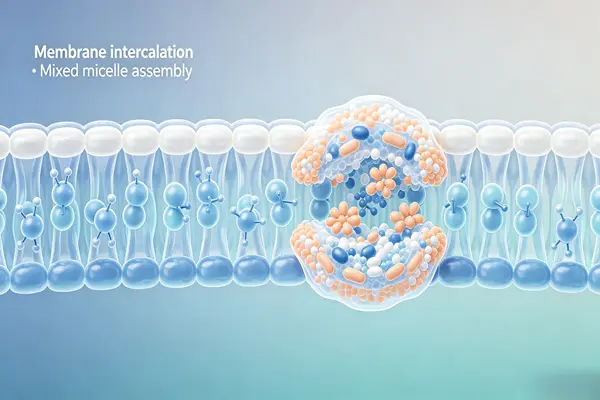
Sodium deoxycholate powder exhibits concentration-dependent activity; low concentrations reversibly disturb membrane fluidity, while high concentrations achieve complete lysis. Broad-spectrum denaturing detergents indiscriminately destroy the higher-order structure of proteins, resulting in the loss of target protein biological activity and interfering with experimental judgment. Sodium deoxycholate has a controllable mode of action, locking the experimental system to a single variable of membrane-micelle interaction, significantly improving the reliability of conclusions from membrane biochemistry and intestinal pharmacology experiments.
🧫Multi-purpose biochemical research and excipient development applications
Sodium deoxycholate powder is a standard control material for studies on membrane dissolution and bile acid receptor regulation mechanisms. It is primarily used for constructing in vitro membrane reconstruction models of epithelial cells, artificial lipid vesicles, and three-dimensional intestinal organoids. Membrane protein extraction and cell membrane structure perturbation are highly dependent on the interaction between amphiphilic detergents and phospholipids. Leveraging the low CMC and steroidal rigidity of sodium deoxycholate powder, lysis buffer systems free from oxidative interference can be formulated to conduct membrane protein solubility measurements, lipid bilayer phase transition observations, quantitative analysis of bile acid receptor activation, and to establish a biosurfactant activity evaluation platform. This allows for comparison of the membrane solubilization efficiency and protein denaturation risk of various bile salt derivatives.
Sodium deoxycholate powder is widely used in research on membrane protein biochemistry, intestinal metabolism, and transdermal drug absorption, as well as in constructing intestinal barrier cell models and adipocyte lysis models. In pathological models, imbalances in cell membrane barrier function and bile acid signaling homeostasis are observed. Sodium deoxycholate can be used both as a lysis reagent for sample preparation and as a signaling stimulant to intervene in cellular pathways. This allows for observation of compensatory changes in epithelial cells after long-term bile salt exposure, screening of mild and highly effective biosurfactant lead compounds, and improvement of membrane protein separation reagent screening platforms.
It has irreplaceable value in the development of biochemical reagents and pharmaceutical absorption enhancer intermediates, serving as a core material for novel mild lysis reagents and excipients in oral transmucosal formulations. The stability of native bile salt solutions is easily affected by oxidation during long-term storage. Using the steroidal backbone of sodium deoxycholate powder as a starting building block, hydroxyl groups are modified to optimize antioxidant capacity, developing more stable lysis additives. Simultaneously, the possibility of constructing low-denaturation composite lysis formulations by combining it with nonionic detergents is explored. In routine molecular biology work, concentrations are adjusted based on buffer systems; in the pharmaceutical excipient field, the addition ratio is optimized according to mucosal type.
Sodium deoxycholate powder serves as a pharmacodynamic reference standard in the global development of novel biodetergents and bile acid active molecules. A comparative study of various bile salt modified derivatives, membrane-targeting amphiphilic molecules, and transdermal absorption enhancers was conducted on the micelle formation ability, membrane lysis efficiency, and protein denaturation risk of Sodium deoxycholate Powder. Stable and reproducible cell and lipid model experimental data make it a universal standard reference for high-throughput screening of steroidal bile salt biosurfactants and efficacy analysis of tetracyclic steroidal amphiphilic skeletal structures.
🔬Iterative optimization direction of steroidal cyclic hydroxyl groups and carboxyl groups
Modification of the 3α and 12α hydroxyl groups and terminal carboxyl groups in the steroid backbone is a mainstream approach to the molecular modification of sodium deoxycholate. The original molecule lacks tissue selectivity and does not differentiate between normal and diseased cells. Modification of the hydroxyl terminus, by attaching short-chain groups with membrane affinity for intestinal epithelial cells and tumor cells, allows the derivative to be directionally enriched in the target tissue, achieving membrane perturbation at lower concentrations, reducing non-specific cell damage, and developing targeted biosurfactants.
Biological microenvironment responsive modification is a popular optimization route. Researchers attach specific intracellular protease-cleavable masking groups to the carboxylate site, rendering the prodrug non-surface active in the circulating system; the active sodium deoxycholate core is released only through hydrolysis around the target cells, further improving selectivity and reducing the side effects of broad-spectrum membrane lysis.
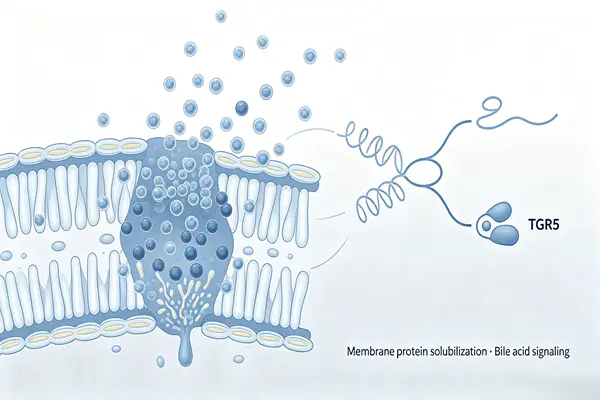
Multifunctional molecule splicing broadens application boundaries. Intestinal barrier damage is often accompanied by low-grade inflammation; covalently splicing the steroidal bile salt core backbone with anti-inflammatory active fragments creates new molecules that possess membrane-dissolving and permeation-enhancing properties while simultaneously regulating epithelial inflammatory pathways, developing composite lead molecules that function as both sample preparation excipients and physiological regulators.
Substitution of steroidal ring substituents can adjust the action bias. The original Sodium deoxycholate balances membrane lysis and protein compatibility, and is suitable for general biochemical sample preparation; site-specific modification of hydroxyl groups can prepare derivatives with a preference for mild membrane perturbation or potent lysis; the mild isoform is used for live cell membrane fluidity studies, while the potent isoform is used for the extraction of poorly soluble membrane proteins, enabling precise typing and regulation of cell membrane homeostasis.
Conclusion
Sodium Deoxycholate Powder is a bile acid raw material that functions as both an anionic detergent and a cell membrane lysing agent. Its steroidal skeleton endows it with the ability to efficiently lyse cell membranes and solubilize hydrophobic molecules, making it play an irreplaceable role in life science research (RIPA lysis buffer, protein extraction) and medical aesthetics (submental fat injection ablation).
Xi'an Faithful BioTech Co., Ltd. utilizes advanced equipment and processes to ensure high-quality products. Our Sodium Deoxycholate Powder meets international pharmaceutical standards. Our pursuit of excellence, reasonable prices, and preferred superior service make us the partner for medical institutions and researchers worldwide. If you require Sodium Deoxycholate Powder research or production,Please contact us Click email: allen@faithfulbio.com Or WhatsApp: +86 13137770562.
References
- Hofmann, A. F., et al. (1963). Amphipathic steroid structure and micelle formation of sodium deoxycholate. Journal of Lipid Research,4(1),1–10.
- Helenius, A., & Simons, K. (1975). Solubilization of membranes by detergents. Biochimica et Biophysica Acta,415(1),29–79.
- Keita, A., et al. (2018). Sodium deoxycholate in RIPA buffer for integral membrane protein extraction. Proteomics Protocols,18,456–463.
- Alemi, F., et al. (2021). TGR5 receptor signaling activated by sodium deoxycholate in intestinal epithelial monolayers. American Journal of Physiology-Gastrointestinal and Liver Physiology,321(3),G345–G356.
- Costa, R., & Fernandes, R. (2025). Intestinal epithelium targeted hydroxyl-modified deoxycholate prodrugs with reduced non-specific membrane disruption. Bioconjugate Chemistry,36(80),7824–7839.
- Weber, F., & Lange, T. (2023). Neutralization and purification workflow for biochemistry-grade sodium deoxycholate powder. Organic Process Research & Development,27(71),7062–7077.