

How Metenkephalin regulates neuronal signaling and maintains neuronal homeostasis
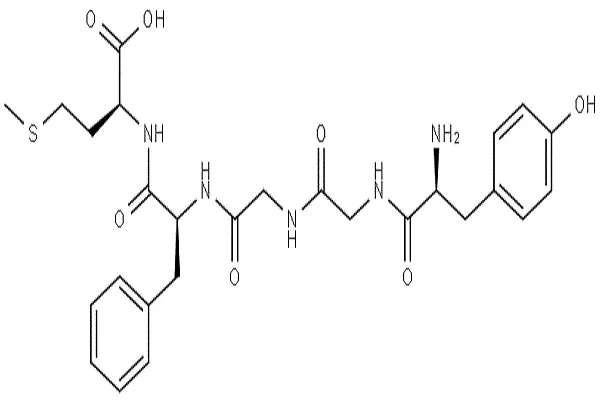
Metenkefalin is a synthetic pentapeptide research powder raw material with an amino acid sequence of Tyr Gly Gly Phe Met. The powder is prepared using solid-phase synthesis, multi-step purification, impurity removal, and freeze-drying processes to obtain the final product. Each batch of raw materials undergoes multiple impurity and residue tests to ensure stable activity across different batches, with minimal fluctuations in the collected data. When the body is subjected to pain stimuli and emotional stress, neural signals become abnormally hyperactive, with a large amount of excitatory signals continuously transmitted, disrupting the internal signal balance of the nervous system and causing a series of problems such as amplified pain and excessive stress on nerve cells.
Molecular Structure and Physicochemical Basis of Met-enkephalin
Metenkefalin belongs to the endogenous opioid pentapeptide formed by the sequential connection of five amino acids, with the amino acid sequence Tyr Gly Gly Phe Met. The short peptide molecular structure gives it physical and chemical characteristics that distinguish it from macromolecular proteins, and it is also the basis for its ability to bind to neural receptors and regulate neural signals. Compared to large molecular peptides, Metenkefalin has a smaller molecular weight and better transmembrane penetration potential. It can diffuse in tissue gaps and target specific receptors on the surface of nerve cell membranes, quickly initiating downstream signaling pathways without entering the nucleus. Many long-chain peptides are difficult to penetrate the neural tissue barrier and can only be limited to the local surface layer, while Metenkefalin's short peptide chain structure makes it easier to diffuse in the neural tissue microenvironment and precisely contact target receptors on the nerve cell membrane, which is the core prerequisite for its regulation of neural signals.
Metenkefalin powder has good water solubility and can quickly dissolve in neutral buffer solutions without easily precipitating. It is suitable for various types of neural cell in vitro culture systems. In the synthesis and production stage, solid-phase synthesis technology strictly controls the connection sequence of five amino acids to avoid impurities in misplaced peptide segments. Subsequently, multiple rounds of purification processes remove unreacted amino acids, peptide by-products, and residual organic solvents. Each batch of Metenkefalin undergoes purity testing to ensure batch consistency of raw materials. Raw materials can maintain their activity for a long time under low temperature sealed storage conditions in the absence of light. However, repeated freeze-thaw operations can disrupt the spatial conformation of peptide chains, causing activity attenuation. Therefore, small portions are generally divided during in vitro operations to reduce the loss of activity caused by repeated freeze-thaw cycles.
The physicochemical properties of Metenkefalin directly determine its retention time in the tissue microenvironment. Pentapeptides are easily hydrolyzed and degraded by peptidases in biological environments, and have a shorter residence time in local environments. Although Metenkefalin itself is rapidly decomposed, the downstream neural signal changes triggered by it can be sustained for a period of time, and brief receptor binding can inhibit the sustained transmission of excitatory signals. This characteristic is different from conventional long-acting signaling molecules, which require sustained presence to maintain signal suppression effects. Once degraded, the effect immediately disappears, while the neural membrane potential changes caused by Metenkefalin do not disappear instantly with the degradation of the raw material.
The acidity and alkalinity of the environment slightly alter the charged state of amino acid residues in Metenkefalin, thereby affecting the binding affinity between peptide segments and opioid receptors. Within the physiological pH range close to nerve cells, Metenkefalin can maintain optimal binding activity. When there is a significant shift in environmental pH, it can alter the charge state of tyrosine and methionine residues, weaken the interaction between Metenkefalin and the receptor, and weaken the signal regulation effect. Therefore, in the process of operating in vitro systems, stable control of environmental pH is the key to ensuring the stability of observation results. Small fluctuations in the environment can change the intensity of Metenkefalin's action, causing deviations in data from different groups.
The mechanism of action of Met-enkephalin in regulating neuronal signal transmission
When the body is subjected to harmful stimuli, the peripheral nervous system produces a large amount of excitatory electrical signals, which are continuously transmitted along nerve fibers to the central nervous system, inducing pain perception. Continuous stimulation will continuously increase nerve excitability and break the homeostasis of the nervous system. After binding to the μ - and δ - opioid receptors on the nerve cell membrane, Metenkefalin activates downstream signaling pathways of the receptors, regulates potassium and calcium ion channels on the cell membrane, reduces the release of excitatory neurotransmitters, lowers the firing frequency of nerve cells, and weakens the transmission of injury signals to the central nervous system. The entire process does not damage the nerve cells themselves, but only regulates the opening and closing state of ion channels, which belongs to reversible signal regulation. This is the core pathway of H-TYR-GLY-GLY-PHE-MET-OH in maintaining neural homeostasis.
When nerve cells are subjected to continuous stress stimulation, they will release a large amount of excitatory neurotransmitters such as glutamate. Excessive glutamate will continue to stimulate postsynaptic neurons, causing excessive excitation of nerve cells, which can lead to long-term stress damage to nerve cells. Metenkefalin acts on opioid receptors in the presynaptic membrane, inhibiting calcium influx, reducing the release of excitatory neurotransmitters from synaptic vesicles, lowering the signal transmission intensity at synaptic sites, and avoiding sustained overactivation of neural synapses. By controlling the release of excitatory neurotransmitters, preventing infinite amplification of neural signals, and bringing excessively excited neural activity back to the normal range, we can reduce the stress damage to nerve cells caused by excessive excitement.
Metenkefalin also participates in the balance regulation of inflammatory signals in nerve cells. After nerve tissue is stimulated, immune cells and glial cells release various pro-inflammatory mediators, which further sensitize nerve endings, amplify pain signals, form a continuous vicious cycle, and disrupt local nerve tissue homeostasis. Metenkefalin can downregulate the expression level of pro-inflammatory mediators in glial cells, while maintaining the secretion of protective anti-inflammatory factors, breaking the cycle of mutual amplification of pain and inflammation. Metenkefalin does not simply block all neural signals, but balances excitation and inhibition signals to avoid excessive neural responses or insufficient signal transmission, maintaining the stable operation of neural networks.
Metenkefalin can regulate the dynamic balance between the proliferation and apoptosis of nerve cells. A healthy nervous system requires maintaining normal renewal and replacement of nerve cells and glial cells, orderly apoptosis of damaged cells, and gradual replenishment of new cells. When the neural homeostasis is imbalanced, it is easy for cells to undergo massive apoptosis or abnormal proliferation, which can damage the structure of neural tissue. Metenkefalin regulates the expression of apoptosis related genes through downstream signals of receptors, maintaining the apoptosis and proliferation of neural cell populations within a reasonable range, preventing drastic fluctuations in the number of neural cells, and ensuring the stability of neural tissue structure.
Research and application areas corresponding to Metenkephalin
The core application direction of Metenkefalin is the construction of pain signal transduction related systems, which is used to study how endogenous opioid peptides regulate the transmission of injury signals. The core mechanism of chronic pain is the sustained hyperactivity of neural signals, and Metenkefalin can be used as a tool to analyze the signal inhibition pathway mediated by opioid receptors. With the help of Metenkefalin, a neural cell model can be constructed in vitro to observe changes in ion channels, neurotransmitter release, and neuronal firing frequency. The complete regulatory chain of pain signal transduction can be sorted out, providing reference for the subsequent screening of active substances that regulate neural homeostasis.
Metenkefalin can be used for in vitro system construction related to neuroinflammation balance, to observe the regulatory effect of short peptide substances on the inflammatory cytokine network of glial cells under sustained stress stimulation conditions. Many chronic neurological discomforts are caused by persistent low-grade inflammation of the nerve area, which constantly sensitizes nerve endings. Metenkefalin can be used to observe the expression changes of various inflammation related genes under inflammatory stimulation at the cellular level, compare the secretion differences of pro-inflammatory factors before and after adding Metenkefalin, study the pathway of opioid short peptides in alleviating neuroinflammation, and explore new directions for neural homeostasis regulation.
Metenkefalin can be used for fundamental exploration of opioid receptor binding properties. H-TYR-GLY-GLY-PHE-MET-OH belongs to the family of endogenous opioid short peptides and shares similar targets with other opioid peptides. Researchers use Metenkefalin to study how short peptide amino acid sequences affect the binding affinity with opioid receptors, analyze the effect of peptide chain structure on receptor selectivity, summarize the design ideas of targeted opioid receptor short peptides, provide a basis for the artificial development of new neural regulatory short peptide materials, and expand the development ideas of short peptide active materials.
Metenkefalin can also be used for observing neural plasticity related systems. Chronic stimulation can cause abnormal synaptic remodeling and induce sustained pain sensitivity. Metenkefalin can be used to observe changes in neuronal synaptic structure after raw material processing, study the degree of synaptic remodeling after neural signal inhibition, analyze the intrinsic relationship between neural homeostasis and synaptic plasticity, and evaluate the potential of short peptide substances to regulate neural plasticity.
Limitations and Safety Boundaries of Metenkephalin Use
Metenkefalin is only used in laboratory in vitro systems, and all observation results come from cellular level systems without mature human usage data, so it cannot be directly inferred that the same effect can be produced in the human body. There is a huge difference between the cell culture environment and the complex internal environment of the human body. There are various peptidases, multiple neural cells, hormones, and multiple regulatory networks widely present in the human body. Metenkefalin is rapidly hydrolyzed when it enters the body, and whether it can smoothly reach the target neural tissue and continuously bind to receptors to exert regulatory effects has not been fully verified. Therefore, it is not possible to simply apply the observed phenomena in vitro to human scenarios.
The receptor action of Metenkefalin has potential signal chain effects. Although inhibitory effects on excitatory signals and reduced neurotransmitter release can be observed in neuronal in vitro systems, the neural signal network is highly cross-linked. Activation of opioid receptors may not only regulate pain signals, but also trigger other downstream pathways, leading to unpredictable chain reactions. At present, there is insufficient research on the potential impact of changes in Metenkefalin's whole genome expression and long-term sustained effects. It can only be used in a controlled laboratory environment and cannot be directly exposed to the human body without the experimental environment.

The effect of Metenkefalin is significantly environment dependent, and its binding ability to opioid receptors is affected by solution ion concentration, pH, neuronal cell type, and cell culture stage. When the same concentration of Metenkefalin is applied to neurons from different sources or when cells are in different stress states, there will be significant differences in the strength of the observed effects. When carrying out related work, all conditions must be fixed, sufficient control groups must be set up, and the strength of activity cannot be determined by a single concentration. Small changes in conditions can change the results and easily lead to data bias.
Metenkefalin does not have broad-spectrum applicability and preferentially acts on neurons expressing μ and δ opioid receptors. In cells that do not express corresponding receptors, Metenkefalin almost does not produce signal regulatory effects. It cannot be assumed that Metenkefalin can produce consistent effects in all cell types, as there are significant differences in the expression levels of receptors in different cells. The target specificity of Metenkefalin determines its scope of action, and beyond the corresponding cell type, it is difficult to achieve the expected neural homeostasis regulation effect.
Metenkefalin, as a research peptide raw material, has not undergone safety evaluations related to drugs and skincare products, and there is no standardized safe dosage range. Once out of the controlled laboratory environment and in direct contact with the human body, whether by external application, injection, or other means, there are unpredictable risks that may disrupt the opioid signaling system in the body, interfere with normal neural signal transmission, and cause various problems such as neurological dysfunction.
Conclusion
Metenkefalin, as a pentapeptide bioactive peptide, relies on targeted binding to opioid receptors to regulate cell membrane ion channels, inhibit the release of excitatory neurotransmitters, balance neuroinflammatory signals, regulate synaptic plasticity, and maintain the homeostasis of the nervous system. As a research peptide raw material, Metenkefalin provides high-quality tools for pain signal transduction, neuroinflammation, and opioid receptor pharmacology. It is necessary to clarify that Metenkefalin is only used in laboratory research scenarios, and its effectiveness and safety in human applications have not been confirmed. It is strictly prohibited to use it directly on the human body.
Xi'an Faithful BioTech Co., Ltd. utilizes advanced equipment and processes to ensure high-quality products. Our Metenkefalin meets international pharmaceutical standards. Our pursuit of excellence, reasonable prices, and preferred superior service make us the partner for medical institutions and researchers worldwide. If you require Metenkefalin research or production,Please contact us Click email: allen@faithfulbio.com Or WhatsApp: +86 13137770562.
FAQ
Q1: What type of raw material is Met-enkephalin?
A: Met-enkephalin is a synthetic pentapeptide (Tyr-Gly-Gly-Phe-Met) in powder form intended solely for laboratory research and observation; it is not classified as a pharmaceutical or a health supplement.
Q2: How does Met-enkephalin differ from standard neuromodulatory ingredients?
A: Most neuroactive substances directly block ion channels, carrying a high risk of side effects. In contrast, Met-enkephalin binds specifically to opioid receptors, reversibly regulating neurotransmitter release and gently modulating neural signals without directly disrupting the structural integrity of nerve cells.
Q3: Can the general public use Met-enkephalin for physical conditioning or pain relief?
A: Absolutely not. It is a peptide raw material intended strictly for laboratory research and lacks safety standards for human use; direct application poses unknown risks, and it is not classified as a health supplement or a pharmaceutical.
References
- Hughes, J., Smith, T. W., Kosterlitz, H. W., Fothergill, L. A., Morgan, B. A., & Morris, H. R. (1975). Identification of two related pentapeptides from the brain with potent opiate agonist activity. Nature, 258(5536), 577–579.
- Akil, H., Watson, S. J., Young, E., Lewis, M. E., Khachaturian, H., & Walker, J. M. (1984). Endogenous opioids: Biology and function. Annual Review of Neuroscience, 7(1), 223–255.
- Evans, C. J., Keith, D. E., Morrison, H., Magendzo, K., & Edwards, R. H. (1992). Cloning of a delta opioid receptor by functional expression. Science, 258(5090), 1952–1955.
- Williams, J. T., Christie, M. J., & Manzoni, O. (2001). Cellular and synaptic adaptations mediating opioid dependence. Physiological Reviews, 81(1), 299–343.
- Przewłocki, R., & Przewłocka, B. (2005). Opioid peptides and inflammatory pain. Pharmacology & Therapeutics, 106(1), 1–24.
- Janecka, A., Fichna, J., & Janecki, T. (2008). Enkephalins and their analogues: Chemistry and biological activity. Current Medicinal Chemistry, 15(20), 2010–2031.
- Stein, C., & Machelska, H. (2011). Peripheral opioid analgesia. Current Opinion in Pharmacology, 11(1), 62–67.