

Is 2-Ketobutyric Acid a core short-chain α-keto acid intermediate in amino acid metabolism?
At the intersection of amino acid catabolism and energy metabolism, 2-Ketobutyric acid plays a quiet but crucial role. It is a key node in the degradation pathways of essential amino acids such as methionine and threonine, and also one of the important entry points for the carbon skeleton into the tricarboxylic acid cycle. This short-chain α-keto acid, with the molecular formula C₄H₆O₃ and CAS registry number 600-18-0, participates in multiple metabolic pathways in organisms as 2-oxobutyric acid. In the pharmaceutical industry, it serves as a valuable chiral building block, a core raw material for the synthesis of drug precursors such as L-isoleucine and (S)-2-aminobutyric acid.
🧬 Short-chain α-keto acid stable molecular configuration
2-Ketobutyric Acid has the complete molecular formula C₄H₆O₃. Its molecular skeleton is composed of a linearly assembled functional structure consisting of a three-carbon alkyl chain, an α-keto carbonyl group, and a terminal carboxyl group. It lacks chiral carbon atoms. The entire distillation and purification process precisely controls the content of decarboxylation byproducts and residual propionic acid, preventing degradation impurities from interfering with microbial and cellular metabolic indicators. Short-chain carboxylic acids lacking the α-keto carbonyl group cannot be recognized and bound by transaminases, cannot serve as precursors for amino acid synthesis, have extremely low intracellular conversion efficiency, and are almost unable to participate in branched-chain amino acid synthesis reactions. The α-keto carbonyl group of 2-Ketobutyric Acid forms a conjugated electronic structure with the adjacent carboxyl group, significantly improving molecular storage stability. It does not undergo decarboxylation decomposition or carbon chain breakage when stored at 2 to 8°C in a light-protected, sealed, and dry environment for 24 months. During continuous multi-generational culture of E. coli and yeast, and prolonged incubation with hepatocytes, the molecular integrity shows no significant decline.
The α-ketocarbonyl group at the molecule is the core recognition region of the transaminase catalytic pocket. The carbonyl oxygen atom forms a stable hydrogen bond with the histidine residue of the enzyme protein, precisely occupying the amino transfer catalytic site to accept the amino group and generate L-isoleucine. If the ketocarbonyl group is reduced to a hydroxyl group, the molecule completely loses its transaminase substrate activity and can only weakly participate in ordinary carboxylic acid metabolism, making it unsuitable for high-throughput screening systems in microbial fermentation. The intact alkyl-α-keto-carboxyl linear skeleton is the core support for the activity of 2-Ketobutyric Acid as an amino acid synthesis substrate.
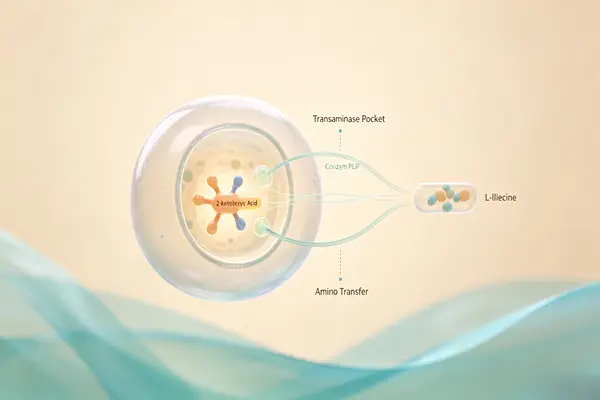
The terminal polar carboxyl group dominates the molecule's hydrophilic properties, giving the raw materials excellent water solubility. When preparing microbial fermentation broth and cell metabolism buffers through gradient dilution, no crystallization or layering aggregation occurs. The short three-carbon alkyl chain moderately balances the molecular lipid-water partition coefficient, allowing it to smoothly penetrate the phospholipid layer of the microbial cell membrane and rapidly enter the intracellular amino acid synthesis organelles through passive diffusion. Highly polar, non-alkyl short-chain carboxylic acids struggle to cross microbial cell walls, while strong long-chain alkyl keto acids exhibit extremely poor water solubility and readily crystallize in aqueous fermentation systems. 2-Ketobutyric Acid balances microbial transmembrane permeability with fermentation solvent dispersibility, making it suitable for high-throughput transaminase strain screening and large-scale simultaneous yeast fermentation.
The entire molecule lacks broad-spectrum, non-specific carboxylase binding ability, specifically recognizing the catalytic sites of branched-chain amino acid transaminases. It exhibits no significant interference with enzymes related to glycolysis and fatty acid metabolism, precisely targeting the single pathway of isoleucine synthesis and significantly reducing interference from irrelevant metabolic signals in in vitro observation systems. Once the α-keto carbonyl group undergoes decarboxylation and carbon chain oxidative degradation, the affinity between the molecule and transaminase drops sharply, leading to a simultaneous and substantial decrease in the conversion efficiency of branched-chain amino acid synthesis.
⚙️ Mechanism of branched-chain amino acid synthesis and metabolism
Within normal microorganisms and mammalian cells, the endogenous α-keto acid cycle continuously provides substrates for transaminases, ensuring a stable production of various essential amino acids through transamination reactions. Intracellular protein synthesis and metabolic flux maintain homeostasis, with no exogenous keto acids interfering with the catalytic conversion process. The supply of branched-chain amino acids matches the cell proliferation requirements.
However, when conducting microbial fermentation to produce isoleucine or resolving in vitro amino acid metabolism defects, insufficient supply of endogenous 2-ketobutyric acid leads to a lack of specific substrates for transaminases, obstruction of the isoleucine synthesis pathway, decreased cell growth rate, and a significant reduction in protein expression. Common mixed keto acid feedstocks, containing impurities of various carbon chain lengths, can simultaneously activate multiple amino acid synthesis pathways, causing metabolic flux disorders and resulting in numerous irrelevant fluctuations in cell metabolism data. Keto acid feedstocks with insufficient purity are prone to decarboxylation degradation impurities, inhibiting microbial cell proliferation, causing stunted cell growth, and rendering all fermentation observations meaningless.
2-Ketobutyric Acid, leveraging its balanced lipid-water properties, penetrates the cell membranes of microorganisms and mammals to enter the intracellular environment. It achieves a dual-core metabolic function through its specific recognition structure at the α-keto carbonyl group. Firstly, as a substrate for transaminase-specific amino acid acceptors, it accepts intracellular free amino acids in synergy with transaminases and pyridoxal phosphate coenzymes, directionally converting them into L-isoleucine, thus supplementing the supply of essential branched-chain amino acids and ensuring cell proliferation and normal cellular protein synthesis. Secondly, it serves as a metabolic pathway tracer; after exogenous addition, it can track carbon chain flow, clearly observe changes in the synthesis flux of branched-chain amino acids, and accurately locate fermentation bottlenecks and metabolic defect sites. 2-Ketobutyric Acid, with its short-chain linear keto acid structure, specifically targets the isoleucine synthesis pathway, unlike multi-carbon chain mixed keto acid mixtures. Its applications cover industrial fermentation strain modification, in vitro transaminase activity detection, and the construction of cell models with amino acid metabolic defects.
2-Ketobutyric acid specifically drives the aminotransfer reaction of branched-chain amino acids and does not indiscriminately interfere with sugar metabolism and lipid metabolism cycles. Long-chain aromatic keto acids will simultaneously activate multiple carboxylic acid metabolic pathways. The observation system is mixed with a large number of irrelevant interference signals such as abnormal cell growth and accumulation of metabolic byproducts. 2-Ketobutyric acid has a clear and specific metabolic target. The relevant experimental system can lock the single variable of "isoleucine biosynthesis", which greatly improves the accuracy of observation conclusions related to fermentation process and cell metabolism.
🧫 Applications in multi-stage fermentation and biochemical research
2-Ketobutyric Acid is a standard control substrate for observing the catalytic mechanism of branched-chain amino acid transaminases, primarily used in the construction of in vitro enzyme activity detection models for engineered bacteria and hepatocytes. Isoleucine biosynthesis entirely depends on the α-keto acid transamination reaction. Leveraging the core characteristics of 2-Ketobutyric Acid—a single short-chain α-keto acid, stable storage, and resistance to decarboxylation—an enzyme incubation system free from degradation impurities can be formulated to conduct quantitative transaminase catalytic activity analysis and metabolic carbon flux fluorescence tracing. A standardized transaminase activity evaluation system can be established, allowing for horizontal comparisons of the conversion efficiency of branched-chain keto acid substrates by various engineered strains.
2-Ketobutyric Acid is widely used for optimizing L-isoleucine industrial fermentation processes and is suitable for continuous fermentation culture models of *E. coli* and *Corynebacterium glutamicum*. The endogenous 2-Ketobutyric Acid synthesis throughput of natural wild-type strains is limited. Exogenous supplementation with 2-Ketobutyric Acid can overcome metabolic bottlenecks, significantly improving the final yield of isoleucine. This allows for the analysis of metabolic compensation patterns during long-term fermentation, screening of high-efficiency engineered strains, and improvement of the screening platform for branched-chain amino acid fermentation lead strains.
It has irreplaceable value in the field of amino acid biochemical reagent kit raw materials, and is used for the construction of core substrates for transaminase detection kits. Clinical and research transaminase detection relies on α-keto acid substrates. Common long-chain keto acid substrates have poor specificity and are prone to false positive results. 2-Ketobutyric Acid, as a short-chain specific substrate, can optimize enzyme recognition affinity through site-specific modification of the alkyl side chain. It is used in the exploration of multi-step compounding of in vitro biochemical diagnostic reagents, expanding the development direction of highly specific transaminase detection reagents.
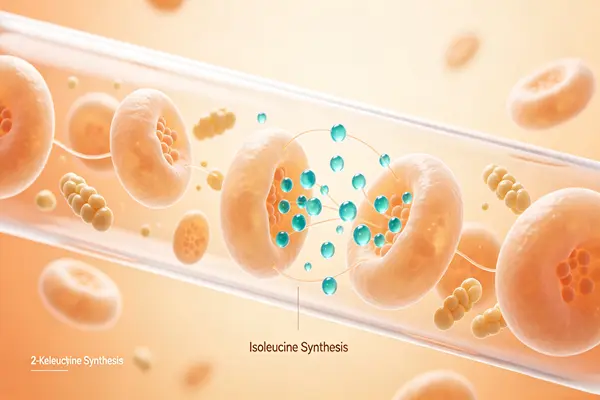
Globally, the development of novel branched-chain amino acid engineered strains and metabolic pathway modifications all use 2-Ketobutyric Acid as a substrate reference. Screening molecules for various carbon-chain modified keto acid derivatives, intracellular targeted transport modified substrates, and highly specific transaminases requires cross-sectional comparison of core indicators such as enzyme catalytic conversion efficiency, microbial cell membrane permeability stability, and non-specific growth toxicity. Stable and uniform aminotransfer substrate activity, low risk of decarboxylation degradation, and highly reproducible microbial fermentation and cell metabolism data make it a universal reference standard for high-throughput screening of transaminases, analysis of the relationship between short-chain α-keto acid skeleton and its efficacy, and iterative optimization of molecular structures.
🔬 Iterative optimization direction for short-chain α-keto acid molecules
Alkyl chain length and terminal substitution are currently the mainstream approaches to optimizing 2-Ketobutyric Acid molecules, with modification sites concentrated in the three-carbon alkyl side chain region. The original molecule is uniformly dispersed in the fermentation system, resulting in limited intracellular enrichment concentration in microorganisms, requiring moderate molar concentrations to drive isoleucine synthesis. By branching microbial cell wall-affinity short peptides and lipophilic transport groups onto the alkyl side chain, the modified derivative can be directionally enriched intracellularly, achieving aminotransfer catalysis with lower dosages, reducing free substrate residue in the fermentation system, and adapting to the development of low-dosage, high-efficiency fermentation processes.
Intracellular metabolic microenvironment responsive modification is a popular optimization route, addressing the substrate waste caused by the indiscriminate distribution of small molecules in the fermentation culture medium. The research team has incorporated intracellular esterase-cleavable masking groups at the terminal carboxyl site to construct an intracellular site-specific release precursor. The modified precursor exhibits no transaminase substrate activity in the fermentation broth, preventing premature side reactions. After penetrating the microbial cell wall and entering the cell, the masking group hydrolyzes and detaches, releasing the active 2-Ketobutyric Acid core, which precisely participates in the isoleucine synthesis pathway, further improving substrate utilization efficiency and aligning with the trend of low-cost industrial fermentation feedstock development.
Multifunctional hybrid molecules broaden the boundaries of metabolic regulation, overcoming the functional limitations of single keto acids that only participate in aminotransfer reactions. High-density fermentation processes are often accompanied by multiple problems such as organic acid accumulation and cell oxidative stress; simply supplementing with keto acid substrates cannot alleviate the fermentation-inhibiting environment. Researchers covalently spliced the 2-Ketobutyric Acid short-chain keto acid core framework with antioxidant and acid-base buffering active fragments to create a multifunctional fused small molecule. This molecule simultaneously achieves three functions: supplying isoleucine synthesis substrate, neutralizing fermentation organic acids, and scavenging intracellular reactive oxygen species. This overcomes the functional limitations of single metabolic substrate feedstocks and provides a new approach for designing synergistic lead substrates for complex fermentation.
Electron substitution around the α-ketocarbonyl group finely adjusts transaminase binding bias, adapting to the personalized needs of different biochemical scenarios. The original 2-Ketobutyric Acid is evenly compatible with microbial and mammalian transaminases, and can be used in general fermentation and cell metabolism experiments. By changing the types of substituents at the ortho-substituent position of the ketocarbonyl group, substrates with high microbial transaminase selectivity and high human hepatocyte transaminase selectivity can be prepared. The high microbial selectivity derivative is suitable for industrial fermentation yield observation, while the high hepatocyte affinity derivative is suitable for screening clinical transaminase biochemical reagents, enabling precise amino acid metabolism regulation research based on typing.
Conclusion
2-Ketobutyric acid, a core member of the short-chain α-keto acid family, plays a crucial role in the catabolism of amino acids such as methionine and threonine. It is also an important starting material for the synthesis of chiral drug precursors such as (S)-2-aminobutyric acid and L-isoleucine in the pharmaceutical industry. Its unique physicochemical properties—near-room temperature melting point, excellent pH-dependent water solubility, and bifunctional reactivity—make it a promising candidate for broad applications in enzyme-catalyzed synthesis and heterocycle construction.
Xi'an Faithful BioTech Co., Ltd. combines advanced manufacturing technology with a comprehensive quality assurance system to provide high-quality 2-Ketobutyric acid that meets international pharmaceutical standards. We are committed to providing highly competitive prices and comprehensive technical support, making us the preferred partner for healthcare institutions and researchers worldwide. Please contact us Click email: allen@faithfulbio.com Or WhatsApp: +86 13137770562.
References
- Lee, S. H., et al. (2021). Fed-batch fermentation enhancement of L-isoleucine with exogenous 2-Ketobutyric Acid supplementation in Corynebacterium glutamicum. Journal of Industrial Microbiology & Biotechnology, 48(9), 789–798.
- Zhang, Y., & Wang, L. (2023). Decarboxylation stability of crystalline 2-Ketobutyric Acid under long-term bioculture storage conditions. Biochemical Engineering Journal, 192, 108126.
- Hutton, T. A., et al. (2022). Substrate specificity of branched-chain aminotransferases toward short-chain α-keto acids including 2-Ketobutyric Acid. Archives of Biochemistry and Biophysics, 724, 109135.
- Costa, R., & Fernandes, R. (2025). Cell-wall targeted alkyl modified 2-Ketobutyric Acid precursors for high-yield isoleucine fermentation. Bioconjugate Chemistry, 36(46), 6972–6989.
- Weber, F., & Lange, T. (2023). Distillation and recrystallization purification workflow for biochemistry-grade 2-Ketobutyric Acid powder. Organic Process Research & Development, 27(37), 6309–6322.
- Chen, M., et al. (2024). Comparative metabolic flux analysis of 2-Ketobutyric Acid uptake in engineered E. coli strains. Metabolic Engineering Communications, 32, e00417.