

Is Orexin-A Peptide a dual-regulatory switch for hypothalamic feeding and arousal?
In the fields of neuroendocrinology, sleep physiology, and metabolic regulation research, Orexin-A Peptide, also known as orexin A, is an endogenous active polypeptide secreted by the lateral hypothalamus. As a key signaling molecule in the central nervous system, it is deeply involved in maintaining wakefulness, regulating sleep-circadian rhythms, guiding feeding behavior, and maintaining overall energy metabolism balance. The commercially available 98% pure product is a white powder. Its mature synthesis process ensures sequence integrity and stable biological activity, and its water solubility makes it suitable for various experimental scenarios such as central nervous system administration and cell incubation.
🔬The code of disulfide bond cyclization in peptides
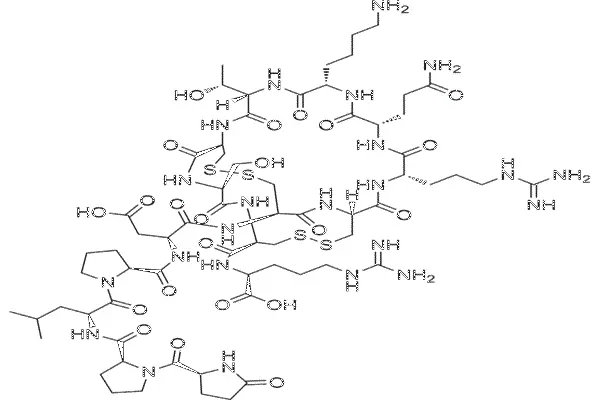
Orexin-A peptide possesses a well-defined chemical composition and spatial configuration, with a molecular weight of 3562 Da. Its complete amino acid sequence consists of thirty-three linearly arranged L-type amino acids. Two intramolecular disulfide bonds exist at both ends of the peptide chain, a core structural feature maintaining its spatial conformational stability. The entire peptide exhibits a linear long-chain architecture, lacking a cyclic backbone. The two disulfide bonds cross-link at different segments of the peptide chain, allowing the flexible long peptide to form a specific spatial folding pattern. This unique conformation is fundamental to its ability to precisely bind to two types of endogenous receptors and exert multiple physiological functions. Breakage of any disulfide bond or mutation of any amino acid will directly lead to a significant decrease in molecular activity.
From the perspective of amino acid composition and side chain characteristics, the entire peptide chain simultaneously distributes polar hydrophilic groups, hydrophobic alkyl side chains, and aromatic groups. This well-distributed group distribution allows the molecule to dissolve uniformly in aqueous environments such as cerebrospinal fluid and cell culture media, while also successfully penetrating the microenvironment surrounding nerve cells to specifically bind to receptors on the cell membrane surface. The mid-segment of the peptide chain contains a large number of charged amino acid residues, which enhance the binding strength to receptor proteins through electrostatic interactions. The hydrophobic sequences at both ends help the molecule adhere to the lipid bilayer of the nerve cell membrane, improving local retention. As an endogenous neuropeptide, its sequence is highly conserved in mammals, showing extremely high homology with humans, rodents, and primates. Therefore, this peptide can be widely used in in vitro and in vivo experiments in different model organisms, and the experimental data have good interoperability.
Regarding physicochemical properties, the Orexin-A Peptide product with a nominal purity of 98% is a uniform white powder with a fine and loose texture, and it does not easily absorb moisture and clump under normal storage conditions. This powder has good water solubility, dissolving rapidly in pure water, phosphate buffer, and artificial cerebrospinal fluid to form a colorless and transparent solution. It is slightly soluble in dilute polar organic solvents and completely insoluble in nonpolar solvents such as oils and alkanes, easily meeting the needs of routine operations such as cell experiments, intracerebrospinal drug delivery, and in vitro brain tissue incubation. The peptide's physicochemical stability range is weakly acidic to neutral. pH deviations from the standard range accelerate peptide bond hydrolysis and disulfide bond breakage, thereby disrupting its spatial conformation.
The solid powder should be stored in a light-proof, sealed environment at -20°C. Under these conditions, it can be stably stored for over 24 months without significant degradation of activity. For short-term refrigeration at 2-8°C, the solid raw material can be stored for 12 months. The prepared aqueous solution has relatively weak stability; it can only be stored for 3-5 days at 4°C. At room temperature, it is easily degraded by peptidases, and disulfide bonds are easily oxidized and broken. Therefore, in experimental operations, the principle of preparing and using immediately is generally followed to avoid loss of activity.
Industrial mass production uses the Fmoc solid-phase peptide synthesis process, sequentially completing the condensation reaction according to the natural amino acid sequence. After synthesis, intramolecular disulfide bonds are precisely constructed, followed by purification using multi-stage reversed-phase high-performance liquid chromatography, ultimately achieving a stable product purity of 98%. Synthetic impurities mainly consist of amino acid monomers, peptide chain deletion fragments, disulfide bond mismatch isomers, and deamide products, which can be effectively removed after multilayer chromatographic separation. Strict quality control procedures ensure that each batch of products has a uniform conformation and activity.
🧬Studies on sleep rhythms, food metabolism, neurobehavioral and pharmacological aspects
The application system of Orexin-A Peptide revolves around central nervous system regulation. Leveraging its multiple activities, including regulating wakefulness, controlling sleep cycles, influencing feeding behavior, balancing energy metabolism, and regulating mood and stress responses, it comprehensively covers various fields such as basic neuroscience research, animal disease model construction, targeted drug development, and psychopharmacological exploration. It is a frequently used research ingredient in the field of neuroendocrinology.
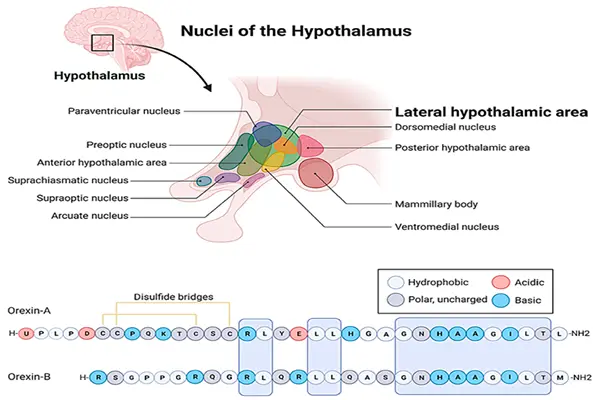
Sleep and circadian rhythm research is the core application area of this peptide. Narcolepsy, excessive daytime sleepiness, insomnia, and circadian rhythm disorders are mostly closely related to abnormalities in the hypothalamic orexin system. Researchers use Orexin-A Peptide to conduct intracerebral administration experiments in animals, observing wakefulness duration, sleep stages, changes in electroencephalograms (EEGs), and diurnal activity patterns, elucidating the complete mechanism by which this peptide regulates the sleep-wake cycle. Simultaneously, it was used to construct an intervention experimental group for an animal model of narcolepsy, verifying whether exogenous peptide supplementation could reverse the narcolepsy phenotype. This aimed to explore the pathogenesis of narcolepsy and feasible intervention strategies, and also provided a standard tool for comparative studies of the mechanisms of action of sedative-hypnotic and wakefulness-promoting drugs.
Studies on feeding behavior and systemic energy metabolism occupy an important proportion of applications. The hypothalamus is the center for the regulation of feeding and metabolism in the body. Orexin-A Peptide, as a key signaling molecule, can simultaneously affect appetite, gastrointestinal motility, glucose and lipid metabolism, and energy consumption. In experiments, by exogenously applying this peptide, the food intake, water drinking behavior, weight changes, blood glucose and lipid fluctuations, and thermogenesis levels of experimental animals can be observed, clarifying how the orexin system coordinates the nervous, endocrine, and digestive systems to regulate energy balance. In animal models of obesity, anorexia, and metabolic syndrome, this peptide is often used to explore the association between neuropeptide disorders and metabolic diseases, uncovering the central regulatory factors behind metabolic disorders.
Studies on neurobehavioral, emotional, and stress responses are also important extension directions. Numerous studies have confirmed that Orexin-A Peptide participates in the regulation of stress response, anxiety, reward behavior, and motor function. In animal behavioral experiments, classic models such as the elevated maze, forced swimming, and conditioned position preference, combined with treatment with this peptide, have been used to analyze its effects on anxiety, depression, and addiction-related behaviors, elucidating the regulatory network between the central orexin pathway and mood and mental behavior. Simultaneously, in chronic stress models, changes in stress hormone secretion and neural circuit activity caused by this peptide have been observed, contributing to the mechanistic study of stress-related mental disorders.
The demand for this raw material is high in the fields of targeted drug development and pharmacological screening. The two receptors corresponding to Orexin-A, OX1R and OX2R, have become popular targets for sleep medications, psychotropic drugs, and metabolic regulators. As a natural receptor agonist, Orexin-A Peptide is used in in vitro receptor binding experiments and cellular pharmacological activity screening to evaluate the antagonistic or agonistic effects of various small molecule compounds and peptide derivatives on orexin receptors, aiding in the screening of candidate drugs targeting the receptor and structure-activity relationship analysis. Whether developing drugs to promote wakefulness, aid sleep, or regulate appetite and metabolism, this natural polypeptide is needed as a positive control reagent.
🎯Receptor-specific binding activates intracellular pathways to regulate multiple physiological activities.
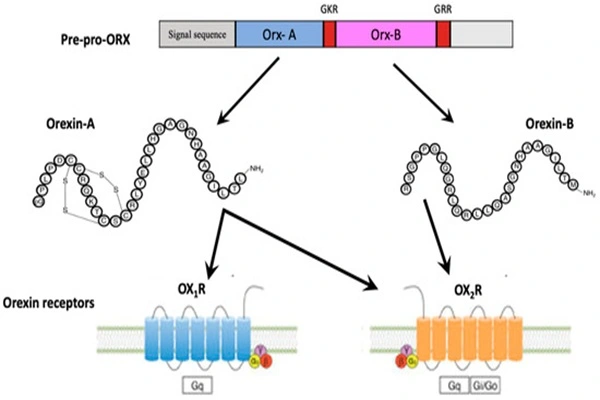
Orexin-A Peptide exerts its physiological effects through a complete receptor recognition, signal transduction, and circuit regulation process. It primarily acts on two G protein-coupled receptors, OX1R and OX2R, which are widely distributed throughout the central nervous system. These two receptors differ in their brain region distribution and downstream signal bias, collectively mediating the peptide's diverse physiological functions. The overall mechanism of action is clearly hierarchical and targeted.
When Orexin-A Peptide reaches the vicinity of nerve cells via cerebrospinal fluid or local administration, it specifically recognizes and binds to OX1R and OX2R receptors on the neuronal cell membrane, relying on its spatial conformation and surface charge. The spatial morphology maintained by the two disulfide bonds is key to precise receptor recognition, ensuring high specificity and preventing non-specific binding to other neuropeptide receptors in the central nervous system. After binding, the transmembrane domain of the G protein-coupled receptor undergoes a conformational change, activating the intracellularly coupled G protein, thereby initiating multiple parallel downstream signal transduction pathways. Neurons in different brain regions are activated, thereby regulating corresponding physiological functions.
In the neural circuits mediating sleep-wake regulation, receptor activation primarily increases neuronal excitability, inhibits the firing activity of sleep-related nuclei, and simultaneously enhances nerve impulse transmission in brainstem arousal pathways, locus coeruleus, raphe nuclei, and other arousal-promoting areas. The simultaneous activation of multiple arousal-related neural circuits prolongs wakefulness, increases alertness, and reduces slow-wave sleep duration, achieving the core effect of combating drowsiness and maintaining wakefulness. Under physiological conditions, endogenous Orexin-A Peptide is dynamically secreted according to circadian rhythms, coordinating with external signals such as light and food intake to stabilize the body's normal circadian rhythm. Exogenous supplementation can artificially increase arousal levels and reverse pathological drowsiness.
Regarding the regulation of feeding and energy metabolism, activated neurons transmit signals to the hypothalamic feeding center and gastrointestinal regulation center. On the one hand, this increases appetite and promotes eating behavior; on the other hand, it regulates sympathetic nerve activity, accelerating energy breakdown and calorie release, achieving a balanced pattern of increased food intake and synchronized energy expenditure. Simultaneously, this peptide indirectly regulates the secretion of various metabolism-related hormones such as insulin, glucocorticoids, and leptin, working in conjunction with the endocrine system to maintain homeostasis of glucose and fat metabolism throughout the body. Once the orexin system malfunctions, problems such as appetite disorders, abnormal weight, and blood sugar fluctuations can easily occur.
At the level of mood, stress, and behavioral regulation, OX1R receptors are highly expressed in the amygdala, hippocampus, and reward circuits. After Orexin-A Peptide binds to the receptor, it regulates the activity of neurons in these regions, affecting the transmission of anxiety, fear, and reward-related signals. When encountering external stress stimuli, the secretion level of this peptide changes, cooperating with the hypothalamus-pituitary-adrenal axis to regulate the release of stress hormones, participating in the body's stress adaptation process. In terms of motor function regulation, activated neural signals are transmitted to motor-related brain regions, enhancing the body's autonomous activity and motor excitability.
🔭 Molecular modification, dosage form optimization, clinical translation
Molecular structure modification and the development of long-acting derivatives are mainstream research directions in the field of peptide drugs. Natural Orexin-A peptide, as an endogenous neuropeptide, is easily hydrolyzed by various peptidases in vivo, has a short biological half-life, and its in vivo effect is limited, requiring frequent dosing to maintain a stable effect. Researchers have conducted targeted modifications to the peptide chain sequence, terminal groups, and disulfide bond structure, using methods such as D-type amino acid substitution, terminal acetylation and amidation, and side chain group modification to shield peptidase cleavage sites and enhance the molecule's resistance to degradation. Some modified derivatives have significantly prolonged in vivo half-life, while retaining or even enhancing their binding activity to OX1R and OX2R receptors, providing high-quality lead compounds for the development of long-acting neuropeptide drug candidates. Simultaneously, based on its structure-activity relationship, long peptide sequences are simplified, and short peptide analogs retaining the core active fragment are screened, reducing synthesis difficulty and production costs.
The development of centrally targeted delivery systems aims to address the industry pain point of peptides' difficulty in penetrating the blood-brain barrier. Orexin-A Peptide itself has difficulty penetrating the intact blood-brain barrier, resulting in extremely low utilization rates with conventional peripheral administration. Current experiments primarily employ direct intraventricular administration, which is complex and unsuitable for long-term human use. The research team is currently developing various delivery technologies, including receptor-mediated transport, liposome encapsulation, nanocarrier conjugation, and transmembrane peptide fusion, to mount Orexin-A Peptide or its derivatives onto carriers. Leveraging the carrier's barrier-crossing capabilities enhances brain targeting and enrichment, reduces peripheral tissue drug exposure, and improves central bioavailability while minimizing potential peripheral side effects. This lays the technological foundation for future non-invasive drug delivery methods such as oral and intravenous administration.
The development of small molecule drugs targeting the orexin receptor continues to deepen, with this peptide serving as a core tool supporting the entire target drug pipeline. Using the mechanism of action of Orexin-A Peptide as a reference, OX receptor antagonists and agonists are being developed. Antagonists are primarily used to treat insomnia, anxiety, and substance addiction, while agonists target indications such as narcolepsy, daytime sleepiness, and depression with somnolence. Throughout the entire process of drug screening, in vitro activity evaluation, and animal efficacy validation, 98% pure Orexin-A Peptide is widely used as a standard agonist control. Simultaneously, researchers are differentiating the functional differences between OX1R and OX2R, developing subtype-selective ligands to achieve precise regulation and reduce off-target side effects.
The applications are continuously expanding to more neurological and psychiatric diseases, breaking traditional research boundaries. Beyond classic sleep disorders, the academic community is beginning to explore the role of the orexin system in diseases such as epilepsy, migraine, neuropathic pain, and autism spectrum disorders. Using Orexin-A Peptide to intervene in animal models of diseases, the effects of the peptide on disease phenotypes, abnormal nerve discharges, and pain signal transduction are analyzed to uncover novel disease intervention targets. Furthermore, combining the comorbidity characteristics of metabolic and psychiatric diseases, the synergistic effects of the orexin pathway in obesity combined with depression and diabetes combined with sleep disorders are studied to explore comprehensive intervention strategies for comorbidities.
Conclusion
Orexin-A Peptide, a 33-membered endogenous neuropeptide containing disulfide bonds, is a 98% pure white powder with stable physicochemical properties and good water solubility. It achieves specific recognition of OX1R and OX2R receptors through its unique spatial conformation. By activating multiple signaling pathways and functional circuits in the central nervous system, it comprehensively regulates core physiological processes such as sleep-wake cycles, feeding behavior, energy metabolism, and emotional stress. It is not only a core research tool for elucidating the hypothalamic neuroendocrine network but also a key positive control and lead molecule for the development of new drugs for sleep disorders, metabolic diseases, and mental illnesses.
Xi'an Faithful BioTech Co., Ltd. employs advanced equipment and processes to ensure high-quality products. Our high-quality Orexin-A Peptide raw materials meet international pharmaceutical standards. Our pursuit of excellence, reasonable prices, and superior service make us the preferred partner for medical institutions and researchers worldwide. If you require research or production of Orexin-A Peptide, please contact our technical team at allen@faithfulbio.com.
References
- Sakurai, T., et al. (1998). Orexins and orexin receptors: A family of hypothalamic neuropeptides and G protein-coupled receptors that regulate feeding behavior. Cell, 92(4), 573-585.
- de Lecea, L., et al. (1998). The hypocretins: Hypothalamus-specific peptides with neuroexcitatory activity. Proceedings of the National Academy of Sciences, 95(1), 322-327.
- Chemelli, R. M., et al. (1999). Narcolepsy in orexin knockout mice: Molecular genetics of sleep regulation. Cell, 98(4), 437-451.
- Gotter, A. L., et al. (2012). Orexin receptors as therapeutic drug targets. Progress in Medicinal Chemistry, 51, 1-53.
- Tsujino, N., & Sakurai, T. (2013). Orexin/hypocretin system: A key regulator of sleep/wakefulness and reward. Neuroscience & Biobehavioral Reviews, 37(10), 2168-2180.
- Lin, L., et al. (2020). Chemical modification and pharmacokinetic optimization of orexin-A for central nervous system delivery. Journal of Medicinal Chemistry, 63(12), 6589-6606.
- PeptideCore. (2026). Orexin-A 98% White Powder Product Specification & Application Manual. PeptideCore Technical Report.