

Is raw dopamine HCl powder a core vasoactive drug for emergency resuscitation?
Raw Dopamine HCl powder is a catecholamine emergency drug ingredient. The finished product is an off-white crystalline powder. Based on the characteristic chemical configuration of the benzene ring with a dihydroxyl group at the ortho position and an ethylamine side chain forming a salt, it sequentially stimulates dopamine receptors, β1 receptors, and α-adrenergic receptors. It regulates myocardial contractility and peripheral vascular tone according to the dosage. It is a core raw material for clinical anti-shock injection preparations. At the same time, it serves as a neuropharmacological labeling reagent and an intermediate synthesis starting material, occupying an essential raw material position in the cardiovascular emergency drug industry chain.
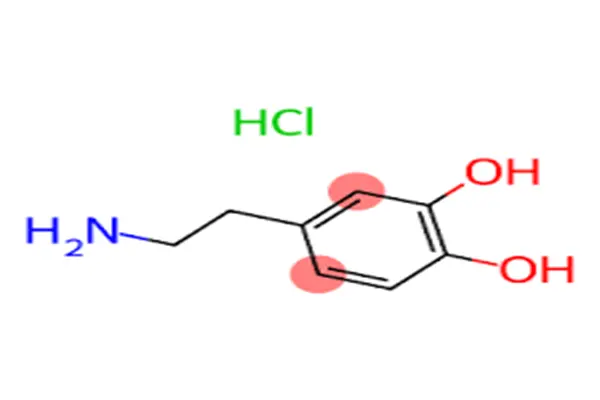
⚛️Characteristic skeleton of catechol ethylamine hydrochloride
Raw Dopamine HCl powder has the molecular formula C₈H₁₁NO₂・HCl and a molecular weight of 189.64. The complete molecule consists of three parts: a 1,2-catechol aromatic ring, an ethyl carbon chain, and a terminal primary amine group. The primary amine combines with hydrogen chloride via protonation to form pharmaceutical-grade hydrochloride. The two adjacent phenolic hydroxyl groups on the benzene ring are key polar sites for receptor binding. The ethyl carbon chain acts as a flexible linker, ensuring the molecule can flexibly fit the protein cavities of different receptor subtypes.
The paired ortho- and ortho-hydroxyl groups on the benzene ring possess strong polar hydrogen bonding capabilities, enabling them to form multi-point hydrogen bond associations with amino acid residues within D1 and D2 dopamine receptors. This forms the structural basis for low-dose preferential targeting of renal and mesenteric vascular dopamine receptors. The hydroxyl groups are also inherently prone to oxidation; exposure to air and light will gradually oxidize and turn brown. Therefore, industrial raw materials are stored in sealed, light-protected warehouses throughout the entire process, and antioxidant excipients are added during the formulation preparation stage to stabilize the structure.
The two-carbon ethyl chain in the middle acts as a hydrophobic linker, appropriately widening the distance between the benzene ring and the terminal ammonium salt group, optimizing the molecular spatial extension. The small-span alkyl structure allows the drug to bind to dopamine receptors, and after increasing the dosage, it can also embed into the β1 myocardial receptor binding pocket. Further increasing the dosage allows it to match the hydrophobic region of the α receptor, achieving the structural basis for selective switching of tertiary receptors. The free primary amine's water solubility is significantly improved after salt formation with hydrochloric acid, and the active pharmaceutical ingredient is readily soluble in pure water, perfectly meeting the requirements of aqueous formulation production for injections.
The physicochemical properties are determined by the synergistic effect of salt bonds and dihydroxyl groups. Refined pharmaceutical-grade Raw Dopamine HCl powder is a uniform, loose, white crystalline powder, readily soluble in purified water, almost insoluble in non-polar solvents, with a melting point between 241 and 245 degrees Celsius, and undergoes a decomposition reaction upon heating. Industrial purification relies on a water-isopropanol low-temperature recrystallization process to remove residual norepinephrine impurities and phenolic oxidation byproducts from the synthesis process. The final product's HPLC effective content is consistently controlled above 99.0%, and heavy metals and residual solvents all meet ICH injectable grade API quality control standards.
Under normal temperature, cool, dark, and sealed storage conditions, the physicochemical properties of the raw material can be maintained for two years. High temperature and alkaline environments will accelerate the oxidation of phenolic hydroxyl groups and the dissociation of hydrochloride. In alkaline systems, free alkali will precipitate and the color will deepen. Therefore, the raw material should avoid contact with acid and alkali packaging materials throughout the transportation and storage process. The unique core structure of catechol ethylamine salt is a distinctive chemical feature that distinguishes this product from similar catecholamine raw materials such as adrenaline and noradrenaline.
🎯Graded activation of multiple receptors enables stratified blood flow regulation
Raw Dopamine Hcl powder pharmacological action relies on a dose-dependent multi-receptor graded activation pathway. Different infusion doses sequentially target dopamine receptors, cardiac β1 receptors, and peripheral α receptors, altering the physiological state of visceral, myocardial, and systemic peripheral blood vessels in a segmented manner. This addresses hemodynamic disturbances caused by various types of shock. It takes effect within five minutes of intravenous infusion, is rapidly metabolized in vivo by MAO and COMT enzymes, has a plasma half-life of only two minutes, and its effects dissipate rapidly after discontinuation, facilitating real-time adjustment of dosing rates and monitoring of vital signs in clinical practice.
During the low-dose administration phase, the drug preferentially and selectively stimulates D1 dopamine receptors distributed in the kidneys, mesentery, and coronary arteries. Receptor activation leads to relaxation of visceral vascular smooth muscle, a simultaneous increase in renal artery blood flow, and improved glomerular filtration efficiency, resulting in a steady increase in urine output and sodium excretion. This optimizes organ perfusion in shock without significantly altering heart rate and systemic blood pressure, providing pharmacological support for the preferred dosing range in shock complicated by oliguria.
Medium-dose range medications, while continuously activating D receptors, simultaneously target β1-adrenergic receptors on myocardial cell membranes, promoting the release of endogenous norepinephrine from sympathetic nerve endings. This dual pathway enhances myocardial contractility, significantly increasing stroke volume and improving blood supply to systemic tissues. At this dose, peripheral blood vessels in the skin and skeletal muscle are not yet activated and constricted by α receptors, resulting in a gradual change in overall peripheral circulatory resistance. This is specifically suitable for symptomatic treatment of low-output shock induced by cardiogenic heart failure and myocardial infarction.
High-dose infusion leads to a large number of molecules occupying α receptor binding sites in peripheral blood vessels throughout the body, inducing smooth muscle contraction in the skin and peripheral vascular system. Peripheral circulatory resistance increases rapidly, with systolic and diastolic blood pressure rising simultaneously. This is used for severe hypotensive shock induced by severe infection and massive hemorrhage, compensating for the insufficient pressure-raising effect of the first two dose ranges. However, long-term high-dose use can easily cause excessive vasoconstriction in the extremities, inducing insufficient blood supply to the extremities, coldness, and local tissue necrosis. Clinically, real-time monitoring of blood pressure and peripheral circulation is necessary to adjust the infusion rate.
The complete set of graded receptor agonist action logic gives this product flexible and adjustable emergency value. With its differentiated performance of protecting the kidneys with low doses, strengthening the heart with medium doses, and raising blood pressure with high doses, it covers the entire range of clinical scenarios from mild organ hypoperfusion to severe refractory shock. It is also the core mechanism of action of an essential emergency raw material in emergency departments and ICUs for nearly half a century.
🧬Emergency treatment preparation production and multi-field pharmaceutical application
The industrial production of injectable formulations is the core industrial application of Raw Dopamine HCl powder. Pharmaceutical companies use refined injection-grade raw materials, combined with water for injection, antioxidants, and buffer salts, to prepare concentrated injection solutions. These are then diluted clinically for intravenous infusion. Alternatively, lyophilization can be used to prepare sterile powder for injection, used for various shock syndromes induced by myocardial infarction, severe trauma, sepsis, post-cardiac surgery, and renal failure. It is the first-line clinical treatment for hypotension and oliguric shock that cannot be corrected after blood volume replenishment. It is also used for refractory congestive heart failure unresponsive to digitalis and diuretics, improving cardiac function indicators through its cardiotonic effect.
Compound emergency infusion formulations continue to expand the application scenarios of raw materials. The industry combines Raw Dopamine HCl powder with glucose and electrolytes to produce finished bagged infusions, eliminating the need for intravenous dilution and preparation in medical institutions, simplifying emergency resuscitation medication processes, and shortening waiting times for critically ill patients. These pre-prepared infusions continue to drive large-scale, routine procurement demand for raw materials, making it one of the key high-volume product categories for global infusion companies.
Pharmacological laboratory calibration and in vitro screening are key applications of high-purity raw materials. Calibration-grade raw dopamine HCl powder serves as a positive control in dopamine receptor pharmacological tests, enabling the construction of in vitro receptor binding screening models. It is used for the initial screening of novel sympathomimetic amines and dopamine receptor modulator lead compounds. Simultaneously, it serves as an external standard for liquid chromatography, used for the sampling and calibration of dopamine hydrochloride injections on the market, ensuring the quality of marketed drugs.
Veterinary emergency drugs are gradually expanding into downstream consumption channels. Veterinary drug manufacturers use pharmaceutical-grade raw materials to formulate veterinary injections for the treatment of traumatic shock, septicemia-induced hypotension, and acute heart failure in livestock. These are suitable for emergency administration in critically ill cattle, sheep, dogs, and cats, expanding the application boundaries of the entire dual-use (human and veterinary) raw material industry chain and opening up stable consumption channels for non-human pharmaceutical raw materials.
The extended applications of fine chemicals and biochemical intermediates are steadily being implemented. This product serves as a starting intermediate for the biosynthesis of norepinephrine and epinephrine, and is used for the large-scale preparation of biochemical reagents. At the same time, it is added in trace amounts to the in vitro culture system of nerve cells to regulate the activity of cellular dopamine receptors, support the conduct of basic neurophysiological experiments, and further enrich the diversified application scenarios of raw materials.
🔭Formulation optimization and in-depth expansion of application boundaries
Global optimization efforts surrounding Raw Dopamine Hcl powder focus on five key areas: development of long-acting sustained-release targeted formulations, iterative green synthesis processes, organ-targeted excipient formulations, derivative core modification, and the development of non-intravenous dosage forms. These efforts aim to overcome the limitations of traditional intravenous infusion alone, optimizing drug safety and ease of administration.
Development of organ-targeted liposome injections continues to advance. Using phospholipid carriers to encapsulate Raw Dopamine Hcl powder, renal-targeted liposomes are prepared. Leveraging the ability of liposomes to accumulate in renal microvessels, this increases local drug concentration in renal tissue at the same dosage, reduces peripheral vasoconstriction caused by systemic free drug, and optimizes drug safety in patients with shock and renal injury. The development of such targeted formulations will revolutionize traditional whole-blood distribution drug delivery methods.
Green and environmentally friendly synthetic routes are gradually replacing traditional high-pollution processes. Existing synthetic routes resulted in the discharge of large amounts of phenol-containing wastewater and strong acid waste liquid. A novel bio-enzyme-catalyzed hydroxylation process for phenethylamine has been implemented, completing the introduction of the ortho-dihydroxyl group in a mild aqueous environment. This significantly reduces the use of organic solvents and the amount of waste discharged, while simultaneously improving the yield of refined raw materials. This has helped domestically produced Raw Dopamine HCl powder successfully pass the GMP certification for injectable active pharmaceutical ingredients in Europe and the United States, opening up export channels for emergency drug raw materials overseas.
The refinement of multi-target combination formulations continues to be implemented. Focusing on the ratio adjustment of this product with dobutamine and norepinephrine, synergistic dosing ratios for different types of refractory shock have been identified. Leveraging the complementary mechanisms of cardiotonic and vasoconstrictive effects, individualized dosing regimens for severe septic shock have been optimized, reducing the risk of limb ischemia caused by excessively high doses of a single raw material, and expanding the market space for compound emergency preparations.
Non-intravenous formulation development breaks through the limitations of drug delivery routes, exploring nasal spray and transdermal patch formulations. By utilizing penetration-enhancing excipients, the efficiency of raw material absorption across mucous membranes and skin is improved, overcoming the inherent limitations of oral administration and intravenous infusion. This approach holds promise for future pre-hospital emergency care of mild hypotension, eliminating the need for intravenous puncture and significantly improving the convenience of pre-hospital emergency medication.
The development of novel catecholamine derivatives involves fine-tuning the core structure. Modifying the benzene ring side chain substituents on the existing catechol ethylamine backbone optimizes the receptor subtype selectivity of the derivative. This allows for the screening of novel renal-protective lead molecules that target only the renal D receptor and have no α-receptor agonist side effects. Leveraging a mature core structure shortens the early-stage development cycle of next-generation anti-shock drugs and strengthens the foundation for the research and development of catecholamine emergency raw materials.
Conclusion
Raw Dopamine Hcl powder relies on the unique chemical skeleton of catechol combined with ethyl primary amine to form a salt. It achieves graded renal protection, cardiotonic and blood pressure-raising emergency effects through dose-dependent graded activation of multiple receptors. It has firmly established itself as an essential raw material for clinical anti-shock drugs worldwide, covering the entire chain of applications including human emergency injections, pre-prepared compound infusions, veterinary emergency drugs, pharmacological calibration reagents and biochemical intermediates.
As a leading supplier of Raw Dopamine Hcl powder, we understand the critical importance of supply chain stability in a competitive market. Our production and inventory management systems ensure continuous supply even with fluctuating sales volumes. Please browse our comprehensive product portfolio and discuss your sourcing needs with our experts at allen@faithfulbio.com.
References
- Goldberg, L. I. (1972). Cardiovascular and renal actions of dopamine: potential clinical applications. Pharmacological Reviews, 24(1), 1–29.
- Rajfer, S. I., et al. (1984). Dopamine-induced renal vasodilation in congestive heart failure. Circulation, 69(3), 534–539.
- Juárez Olguín, H., et al. (2016). The role of dopamine and its dysfunction as a consequence of oxidative stress. Oxidative Medicine and Cellular Longevity, 2016, 9730467.
- Vincent, J. L. (2008). Dopamine in shock: an update on its clinical use. Critical Care Medicine, 36(8), 2385–2393.
- Zhang, L., et al. (2023). Green enzymatic synthesis route optimization for pharmaceutical grade dopamine hydrochloride powder. Journal of Industrial Chemistry Research, 62(31), 11892–11901.