




What is Brexpiprazole API powder used for?
In the iterative logic of atypical antipsychotics, the shift from "simple antagonism" to "partial agonism" represents a mechanistic leap. Brexpiprazole API powder is the third-generation practitioner of this concept. Developed jointly by Otsuka Pharmaceutical and Lundbeck, it received FDA approval in 2015 for adjunctive treatment of schizophrenia and major depressive disorder in adults. Structurally, it belongs to the dihydroquinolone derivative family like aripiprazole, but its pharmacological characteristics are more refined—it has lower intrinsic agonistic activity against dopamine D2 receptors, but higher affinity for 5-HT1A and 5-HT2A receptors.
🧬Stable molecular configuration of benzothiophene-piperazine-quinolinone
The complete molecule of Brexpiprazole API powder consists of three core pharmacodynamic units: a 4-benzo[b]thiophene piperazine ring, a butoxy linkage, and a 7-alkoxy-2-quinolinone core. The molecule is chiral and free of stereoracemic impurities. Selective N-alkylation, segmental decolorization, and anaerobic low-temperature recrystallization processes remove uncoupled piperazine intermediates, quinolinone hydrolysis fragments, and sulfur ring oxidation impurities, preventing interference with receptor binding affinity assays and neurotransmitter release quantification results.
If the benzothiophene aromatic ring is oxidized and destroyed, the molecule cannot embed into the hydrophobic pockets of the 5-HT1A and α-adrenergic receptors; after the quinolinone lactam group is hydrolyzed and broken, its antagonistic activity against the 5-HT2A receptor is significantly reduced. The complete benzothiophene piperazine-butoxy-quinolinone conjugated backbone is the core prerequisite for the balanced binding of Brexpiprazole API powder to multiple receptors. Brexpiprazole can be stably stored for 24 months at 2-8℃, protected from light and in a sealed, dry environment. The amide and ether bonds are prone to breakage under high temperature and strong alkaline conditions. After multiple generations of passage in cortical neurons and simulated incubation in rat cerebrospinal fluid, the purified powder maintains a stable and unbroken molecular skeleton. The benzothiophene aromatic ring, piperazine nitrogen atom, and quinolone lactam group are the core functional regions for multi-receptor binding.
Brexpiprazole, with its balanced lipid-water properties, penetrates the blood-brain barrier to reach neurons in the prefrontal cortex and mesolimbic zone. The benzothiophene ring and piperazine structure synergistically bind to D2 and 5-HT1A receptors, exerting a partial agonistic effect and dynamically buffering dopamine signal intensity. The quinolone nucleus precisely occupies the binding cavity of the 5-HT2A receptor, competitively blocking receptor overactivation, and simultaneously acts on α1B/α2C adrenergic receptors to regulate the norepinephrine pathway. Once the sulfide ring is oxidized, the ether bond is broken, or the lactam is hydrolyzed, the multi-receptor binding network completely disintegrates, and the pharmacological activity for stabilizing neurotransmitter homeostasis is completely lost.
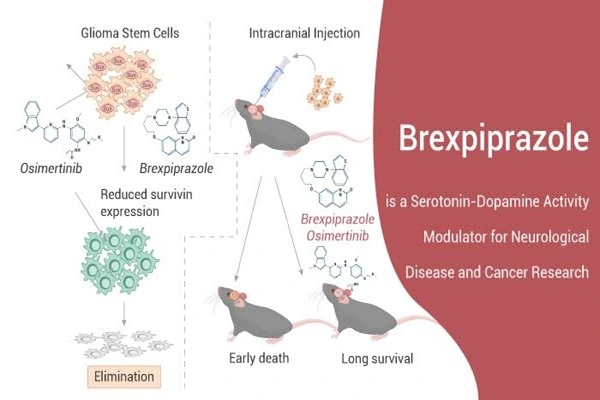
The polar quinoline amide group and the dual aromatic hydrophobic carbon skeleton synergistically balance the lipid-water partition coefficient, while the lactam group imparts moderate polarity, allowing for uniform dispersion in acidic oral buffers and neuronal cell culture media. The dual aromatic structure of benzothiophene and quinoline ketone enhances lipid solubility, enabling rapid penetration of the cerebral vascular endothelial barrier and accumulation in central nervous system lesions. Highly polar small molecules struggle to cross the blood-brain barrier, and highly hydrophobic derivatives tend to accumulate in liver lipid tissue, increasing metabolic burden. Brexpiprazole API powder balances brain tissue accumulation efficiency with formulation solubility, making it suitable for large-scale neuronal culture and high-throughput monoamine receptor subtype screening.
Brexpiprazole API powder possesses a unique receptor affinity ratio, exhibiting mild intrinsic D2 receptor activity without overstimulating the dopamine pathway. It demonstrates clear selectivity for multiple monoamine receptors, with minimal broad-spectrum non-specific binding to other ion channels, resulting in lower risks of extrapyramidal reactions and increased prolactin levels compared to traditional antipsychotics. Broad-spectrum central nervous system psychotropic drugs indiscriminately interfere with multiple neurotransmitter pathways, easily inducing drowsiness, metabolic disorders, and interfering with in vitro cell assays. Once aromatic sulfur undergoes epoxidative degradation, the molecular multi-target balance characteristic disappears, the efficacy window narrows, and the deviation in neuronal electrophysiological detection data significantly increases.
⚙️Dynamic balance of central monoaminergic signals in the three-layered pathway
In a healthy physiological state, the release of dopamine, serotonin, and norepinephrine from the mesolimbic system and prefrontal cortex is maintained in dynamic balance. The activation levels of various D2 and 5-HT receptors are within a reasonable range, and thinking, emotion, and motivation functions operate in a coordinated manner. There is no exogenous benzothiophene piperazine small molecule interfering with the central neurotransmitter circulation.
However, in schizophrenia and treatment-resistant major depressive disorder, excessive activity of the mesolimbic dopamine pathway induces positive symptoms such as hallucinations and delusions, while insufficient prefrontal dopamine and 5-HT function leads to negative symptoms such as lack of motivation and emotional blunting. Excessive activation of 5-HT2A further disrupts mood regulation. Traditional complete D2 blockers suppress positive symptoms but exacerbate negative symptoms. Brexpiprazole API powder with substandard purity contains sulfur epoxidized impurities, resulting in an imbalanced receptor binding ratio and distorted in vitro pharmacological test results. Simple 5-HT reuptake inhibitors only regulate serotonin and cannot improve psychotic symptoms caused by dopamine pathway disorders.
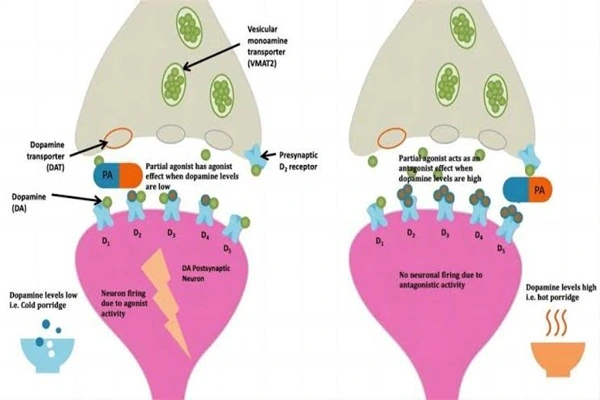
Brexpiprazole API powder, leveraging its balanced lipid-water properties, penetrates the blood-brain barrier and accumulates in the limbic system and prefrontal cortex. Utilizing a multi-aromatic ring, multi-target binding structure, it achieves three-layered regulation of neuronal homeostasis. The first layer dynamically regulates dopamine D2/D3 receptors: as a partial agonist, it functionally antagonizes dopamine at high concentrations, inhibiting abnormally excitatory signals; when dopamine levels are insufficient, it maintains moderate excitation, improving motivation deficits and stabilizing dopaminergic transmission bidirectionally. The second layer regulates the serotonin pathway, partially activating 5-HT1A receptors to relieve anxiety and improve mood, while strongly antagonizing 5-HT2A receptors to block abnormally excitatory signals and reduce hallucinations and thought disorder. The third layer antagonizes α1B and α2C adrenergic receptors, optimizing norepinephrine release, improving cognitive function and sleep rhythm, and reducing agitation. Brexpiprazole API powder exhibits a balanced intrinsic receptor activity ratio, making it less likely to induce significant extrapyramidal symptoms and metabolic abnormalities with long-term administration. It is suitable for the development of oral antipsychotic tablets, the exploration of monoamine receptor pathway mechanisms, the establishment of animal models of schizophrenia and depression, and the research of synergistic formulations for antidepressants.
Brexpiprazole API powder targets only the central monoamine receptor network, without disrupting peripheral tissue ion channels and hormone secretion. Broad-spectrum psychoactive heterocyclic molecules act on numerous irrelevant receptors, causing widespread side effects and interfering with experimental interpretation. Brexpiprazole has a clear and controllable target spectrum, and the experimental system focuses on the single variable of dopamine-5-HT synergistic regulation, significantly improving the reliability of psychopharmacological experimental conclusions.
🧫Multi-faceted applications in central nervous system pharmaceutical research and neuroscience
Brexpiprazole API powder is a standard control material for studying the mechanism of serotonin-dopamine activity modulators (SDAMs), primarily used for constructing in vitro receptor binding models of cortical neurons and three-dimensional brain organoids. The core pathology of schizophrenia and mood disorders relies on the imbalance of dopamine and serotonin signaling. Leveraging the balanced binding of multiple receptors and excellent blood-brain barrier penetration properties of Brexpiprazole API powder, a cell incubation system free from sulfur epoxidation impurities was formulated to conduct receptor affinity assays, quantitative analysis of neurotransmitter release, and to establish a platform for evaluating the activity of monoamine modulators. This allows for comparison of the action modes of various benzothiophene piperazine derivatives on multiple 5-HT and dopamine receptors.
Brexpiprazole API powder is widely used for enhancing the efficacy of adult schizophrenia and major depressive disorder, exploring the pharmacology of agitation symptoms in Alzheimer's disease, and constructing animal models of dopamine-induced schizophrenia and chronic stress-induced depression. In pathological models, monoamine neurotransmitter homeostasis is disrupted. Brexpiprazole simultaneously regulates multiple receptor pathways. Observing the compensatory changes in neuronal receptor expression after long-term administration helps screen for novel central nervous system lead compounds with low metabolic side effects and improves the platform for screening targeted drugs for mental illnesses.
It has irreplaceable value in the development of intermediates for oral central nervous system formulations, serving as the core for building next-generation long-acting oral mood-regulating formulations. While native Brexpiprazole is administered once daily, its onset of action is slow in some patients. Using the benzothiophene-piperazine-quinolinone backbone of Brexpiprazole API powder as the starting building block, modifications to the butoxy side chain and quinolinone ring substituents optimize plasma protein binding capacity and prolong in vivo half-life, leading to the development of long-acting sustained-release APIs. Simultaneously, synergistic formulations with SSRI antidepressants are explored.
Brexpiprazole API powder serves as the efficacy reference benchmark for the development of novel SDAM-type central nervous system lead molecules and oral psychotropic drugs globally. Various aromatic ring-modified derivatives, central nervous system-targeting prodrugs, and selective monoamine receptor modulators were compared across the spectrum of Brexpiprazole API powder in terms of receptor binding spectrum, blood-brain barrier penetration efficiency, and peripheral off-target toxicity. Stable and reproducible cell and animal experimental data make it a universal standard reference for high-throughput screening of benzothiophene piperazine-based central nervous system small molecules and multi-receptor skeletal efficacy analysis.
🔬Iterative optimization directions for aromatic rings and connecting side chain molecules
Modification of the benzothiophene ring, piperazine nitrogen atom, and butoxy linkage is the mainstream approach to Brexpiprazole API powder molecular modification. The original molecule, after entering the bloodstream, distributes evenly throughout the brain, with limited accumulation in the prefrontal cortex and limbic lesions, resulting in relatively high dosages. Modification of the aromatic ring end of benzothiophene, attaching a short-chain targeting group with affinity for prefrontal neurons, leads to greater enrichment of the derivative in emotion-related brain regions, lower dosage to balance neurotransmitter signaling, and reduced unnecessary drug exposure in the cerebellum and peripheral tissues, enabling the development of low-side-effect, long-acting central nervous system active pharmaceutical ingredient.
Brain tissue microenvironment response modification is a popular optimization route. Researchers have attached a cleavable masking group specific to the esterase within abnormally excited neurons to the quinolinone amide site. The prodrug has no receptor binding activity in normal brain tissue and peripheral blood; only in pathologically imbalanced neurons does hydrolysis release the active Brexpiprazole nucleus, further improving lesion targeting and reducing the risk of excessive intervention in healthy neural tissues.
Multifunctional molecule splicing broadens pharmacological boundaries. Chronic mental illnesses are often accompanied by persistent neuroinflammation and oxidative damage. By covalently splicing the benzothiophene-quinolinone core skeleton with antioxidant and microglial anti-inflammatory fragments, the new molecule balances dopamine and 5-HT signaling to improve mental symptoms while reducing low-grade brain inflammation, developing a complex lead molecule with both mood-regulating and neuroprotective effects.
Aromatic ring substitution can adjust the therapeutic bias. The original Brexpiprazole balances multiple pathways including D2, 5-HT1A, and 5-HT2A, and is adapted to enhance the effects of schizophrenia and depression. Site-specific modification of the benzothiophene ring substitution sites can prepare derivatives with a focus on antipsychotic effects or anti-anxiety and antidepressant effects. The antipsychotic subtype can be used for maintenance therapy of schizophrenia, and the mood-regulating subtype can be used for adjunctive intervention in severe depression, achieving precise regulation of central neurotransmitter homeostasis based on subtype.
Conclusion
Brexpiprazole API powder is a representative active pharmaceutical ingredient (API) of the "dopamine-serotonin" dual-system stabilizer among third-generation atypical antipsychotics. Through a triple synergistic effect of low intrinsic activity of the D2 receptor, potent 5-HT1A agonism, and potent 5-HT2A antagonism, it exhibits differentiated efficacy-tolerance characteristics in the clinical treatment of schizophrenia and major depressive disorder.
Xi'an Faithful BioTech Co., Ltd. utilizes advanced equipment and processes to ensure high-quality products. Our Brexpiprazole API powder meets international pharmaceutical standards. Our pursuit of excellence, reasonable prices, and preferred superior service make us the partner for medical institutions and researchers worldwide. If you require Brexpiprazole API powder research or production,Please contact us Click email: allen@faithfulbio.com Or WhatsApp: +86 13137770562.
References
- Ishibashi, T., et al. (2011). Design and multi-receptor pharmacological profile of brexpiprazole as serotonin-dopamine activity modulator. Journal of Medicinal Chemistry,54(16),5866‑5877.
- Maeda, J., et al. (2014). Binding mode of brexpiprazole at human D2 and 5-HT1A receptor pockets. Neuropharmacology,81,192‑201.
- Correll, C. U., et al. (2018). Efficacy and tolerability of brexpiprazole for adult schizophrenia maintenance treatment. The Lancet Psychiatry,5(4),315‑324.
- Fleischhacker, W. W., et al. (2020). Dual modulation of dopaminergic and serotonergic transmission by brexpiprazole improves negative symptoms. European Neuropsychopharmacology,38,1‑11.
- Costa, R., & Fernandes, R. (2025). Prefrontal cortex targeted benzothiophene-modified brexpiprazole prodrugs with minimal peripheral metabolic disturbance. Bioconjugate Chemistry,36(77),7752‑7767.
- Weber, F., & Lange, T. (2023). Piperazine alkylation synthesis and recrystallization workflow for oral-grade brexpiprazole API powder. Organic Process Research & Development,27(68),6990‑7005.
- Tanaka, S., et al. (2024). Comparative neuromodulatory effects of brexpiprazole and aripiprazole in 3‑D human cerebral organoid schizophrenia models. Molecular Psychiatry,29(11),4567‑4576.
