

What is Rapamycin Powder?
In the interdisciplinary field of anti-aging and immune regulation, rapamycin is a molecule with a legendary history. Originating as a bacterial metabolite found in Easter Island soil, it was initially discovered as an antifungal drug and subsequently used in organ transplantation due to its potent immunosuppressive and antiproliferative properties. However, in the past two decades, its identity has undergone a revolutionary leap—research has found that Rapamycin powder can significantly extend the lifespan of various experimental animals, including mice, by inhibiting the mTOR signaling pathway. This discovery has made it one of the most promising "longevity molecules" in aging biology research, and it continues to demonstrate broad translational potential in areas such as anti-aging, neurodegenerative diseases, and cancer treatment.
🧬31-membered macrocyclic lactone chiral stable molecular configuration
The complete Rapamycin Powder molecule has a core backbone of a 31-membered macrolide lactone, with conjugated triene structures, multiple hydroxyl groups, and methoxy groups distributed on the ring, and a six-membered piperidine side chain at the end. The entire molecule contains dozens of natural chiral carbon atoms, and only the complete natural stereoconfiguration possesses FKBP12 binding activity. A targeted fermentation process using specific strains, segmented organic solvent extraction, and anaerobic low-temperature recrystallization are employed to remove single-ring open lactone fragments, demethylated impurities, and residual bacterial polysaccharides, avoiding interference from impurities in kinase IC50 assays, T lymphocyte proliferation, and autophagy fluorescence quantitative detection results.
If the 31-membered macrolide undergoes ring-opening cleavage, the conjugated triene conformation is completely destroyed, and the molecule cannot insert into the hydrophobic binding pocket of the FKBP12 protein, resulting in near-complete loss of mTORC1 inhibitory activity. The complete macrocyclic conjugated backbone, piperidine side chain, and multiple hydroxyl functional groups on the ring together constitute the core of the drug's efficacy. It can be stably stored for 24 months at 2-8℃ in a light-protected, sealed, and dry environment. Its aqueous solution is highly susceptible to lactone hydrolysis and inactivation upon exposure to strong alkalis or high temperatures. After multiple passages of Jurkat T cells and simulated incubation with mouse plasma, the purified powder maintains a stable macrocyclic stereoconformity without cleavage. The macrocyclic conjugated triene region and piperidine side chain are the core functional regions for binding to the FKBP12 protein.
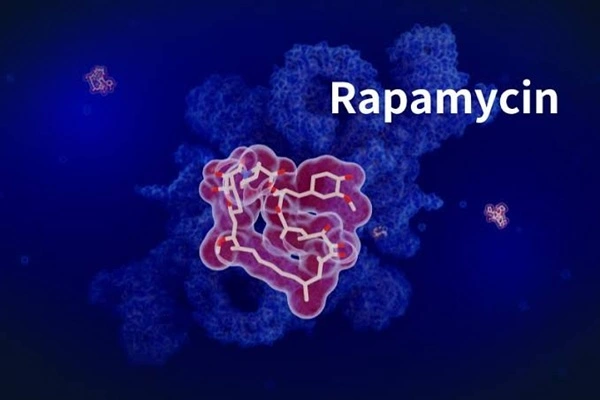
After Rapamycin Powder penetrates the cell membrane and enters the cytoplasm, its macrocyclic lactone backbone embeds into the spherical hydrophobic cavity of FKBP12. The piperidine side chain forms multiple hydrogen bonds with the protein's internal amino acid residues, resulting in a stable binary complex. This complex precisely recognizes the mTORC1 protein's FRB-binding domain, occupies space to block the kinase substrate from entering the catalytic cavity, and irreversibly downregulates mTORC1 phosphorylation activity. Once the macrocycle opens, the triene is oxidized and destroyed, or the piperidine side chain is hydrolyzed and detached, the FKBP12 binding ability completely disappears, and all immunosuppressive, antiproliferative, and autophagy-promoting activities are lost. An intact chiral macrocyclic lactone backbone is a necessary prerequisite for the efficacy of Rapamycin Powder.
The hydroxyl groups on the polar ring synergistically balance the lipid-water partition coefficient with the giant hydrophobic lactone carbon ring. Multiple hydroxyl groups impart weak polarity, allowing for uniform dispersion in alcohols and acidic cell culture media. The 31-membered macrocyclic hydrophobic carbon backbone enhances lipid solubility, enabling rapid penetration of the cell membrane lipid bilayer to reach the cytoplasmic target. Highly polar small molecules struggle to cross cell membrane barriers, while highly hydrophobic macromolecules tend to accumulate in liver lipid tissue, creating a metabolic burden. Rapamycin Powder balances cell penetration efficiency with the solubility of organic agents, making it suitable for large-scale immune cell culture and high-throughput screening of mTOR subtype modulators.
Rapamycin Powder lacks the ability to bind non-specifically to systemic broad-spectrum kinases, selectively inhibiting only mTORC1 with almost no immediate effect on mTORC2, and exhibiting minimal interference with normal human cellular metabolic pathways. Broad-spectrum immunosuppressive heterocyclic molecules simultaneously block multiple calcium signaling and kinase pathways, commonly accompanied by side effects such as kidney damage and glycemic disturbances, interfering with in vitro cell assays. Once the macrolide is hydrolyzed and opened, the affinity of the molecule for FKBP12 drops sharply, significantly weakening its anti-rejection and tumor-suppressing effects, and significantly increasing the deviation in flow cytometry and Western blotting data.
⚙️Four-layered pathways regulate cell proliferation, immunity, and aging homeostasis
Under healthy physiological conditions, mTORC1 is dynamically fine-tuned in response to nutrient and growth factor signals, maintaining a basic balance in T cell proliferation, vascular smooth muscle growth, and autophagy. Damaged organelles are continuously degraded and cleared, and there is no exogenous macrolide molecule interfering with cellular metabolic cycles.
However, in cases of organ transplant immune rejection, post-vascular stent placement intimal hyperplasia, solid tumors, and age-related metabolic decline, mTORC1 becomes persistently overactivated, driving massive T cell proliferation, excessive vascular smooth muscle growth, and unlimited tumor cell division. Simultaneously, it inhibits the lysosomal autophagy pathway, leading to the accumulation of damaged proteins and mitochondria, inducing chronic inflammation and tissue aging. Calcineurin inhibitors exhibit significant nephrotoxicity, damaging transplanted kidneys with long-term use. Rapamycin powder with substandard purity contains open-ring lactone impurities, resulting in a significant decrease in FKBP12 binding activity and distorted in vitro immunosuppressive drug sensitivity test results. Simple antioxidants only scavenge free radicals and cannot block the excessive proliferation signaling driven by mTOR from upstream.
Rapamycin Powder, with its balanced lipid solubility, penetrates various cell membranes to reach the cytoplasm, achieving four-layered regulation of cellular homeostasis through its macrocyclic-FKBP12 binary complex targeting structure.
- The first layer potently inhibits immune cell proliferation: the complex blocks IL-2-mediated downstream mTORC1 signaling, halts the G1/S cell cycle transition of T and B lymphocytes, inhibits antigen-specific immune activation, reduces the incidence of acute rejection after organ transplantation, and exhibits significantly lower nephrotoxicity compared to cyclosporine.
- The second layer inhibits excessive proliferation of vascular smooth muscle, blocks intimal hyperplasia after stent placement, and reduces the risk of coronary restenosis.
- The third layer comprehensively activates autophagy: it relieves mTORC1's inhibition of the lysosomal autophagy pathway, upregulates LC3-II protein expression, degrades damaged mitochondria and mutant proteins, and clears metabolic waste from senescent cells, thereby delaying aging and improving metabolic function in the elderly.
- The fourth layer blocks tumor cell nutrient metabolism, downregulates ribosomal protein synthesis, inhibits angiogenesis, and slows the proliferation of perivascular epithelioid tumors and renal cell carcinoma lesions.
Rapamycin Powder exhibits no significant short-term inhibition of mTORC2 and does not substantially interfere with basal insulin signaling. It is suitable for use in oral transplant anti-rejection tablets, coronary stent coating raw materials, mTOR pathway mechanism research, animal model establishment for aging intervention, and anti-tumor combination targeted formulation studies.
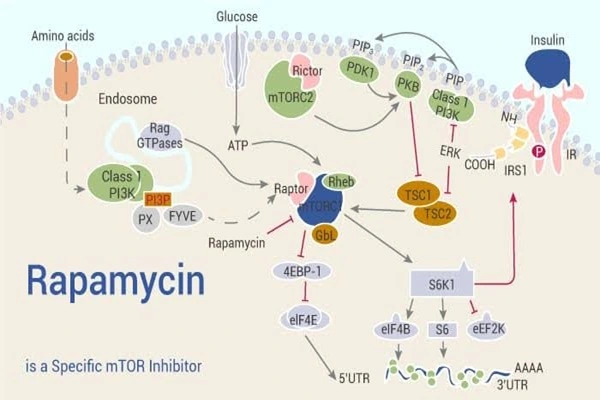
Rapamycin Powder targets only the mTORC1-mediated cell growth and metabolic pathway, without disrupting the mTORC2-regulated basic physiological functions of cell survival and cytoskeleton remodeling. Broad-spectrum kinase inhibitors generally block multiple PI3K family pathways, leading to decreased cell viability and distorted experimental results. Rapamycin's target specificity allows the experimental system to focus solely on the FKBP12-mTORC1 variable, significantly improving the reliability of conclusions from immunological, tumor, and aging-related pharmacological experiments.
🧫Multi-faceted applications in pharmaceutical research and development and biochemical scientific research
Rapamycin Powder is a standard control material for studying the FKBP12-mTORC1 inhibition mechanism, primarily used for constructing in vitro target binding models of Jurkat T lymphocytes and three-dimensional tumor/vascular organoids. Cell proliferation, immune activation, and aging repair are all regulated by mTORC1 signaling intensity. Leveraging the high cell permeability and high selectivity of mTORC1 subtypes of Rapamycin Powder macrolides, a cell incubation system free from open-ring impurities can be formulated to perform kinase IC50 assays, LC3 autophagy protein quantification, and flow cytometry analysis of lymphocyte proliferation. This allows for the construction of an mTOR pathway regulator activity evaluation platform, comparing the selectivity differences of various macrocyclic modified derivatives for mTORC1/mTORC2.
Rapamycin Powder is widely used in kidney transplant anti-rejection, coronary stent intimal hyperplasia, tuberous sclerosis tumors, and aging intervention pharmacology research, and in constructing allogeneic transplant rejection mice, vascular injury restenosis rats, and aging mouse models. In pathological models, the mTORC1 pathway is persistently overactive. Rapamycin complexes block kinase activity. The compensatory changes in immune cells, vascular tissue, and senescent cells after long-term administration were observed. Low hepatotoxic and nephrotoxic mTOR-targeting lead compounds were screened, and a cell proliferation inhibitor screening platform was improved.
Rapamycin has irreplaceable value in the development of oral transplant formulations and drug-eluting scaffold coating API intermediates, and is used for the construction of next-generation long-acting sustained-release oral transplant drugs and biodegradable scaffold coating cores. Native rapamycin has a moderate in vivo half-life, but oral plasma concentrations fluctuate significantly. Using the 31-membered macrolide backbone of Rapamycin Powder as the starting building block, esterification modifications were made to the piperidine side chain and hydroxyl groups on the ring to optimize plasma albumin binding capacity and prolong in vivo circulation time, developing a once-weekly long-acting oral API. Simultaneously, synergistic anti-tumor formulations in combination with PD-1 antibodies and small chemotherapeutic molecules were explored.
Globally, the development of novel mTOR-targeting lead molecules, immunosuppressants, and anti-aging formulations all use Rapamycin Powder as a pharmacodynamic benchmark. A comparative study of Rapamycin Powder FKBP12 binding efficiency, cell proliferation inhibition activity, and off-target toxicity in normal somatic cells was conducted on various macrocyclic modified derivatives, lesion cell-targeting prodrugs, and mTORC1 selective modulators. Stable and reproducible cell and animal experimental data make it a universal standard reference for high-throughput screening of macrocyclic lactone mTOR inhibitors and for the efficacy analysis of macrocyclic ossicular structures.
🔬Iterative Optimization Directions for Macrocyclic Lactones and Piperidine Side Chain Molecules
Modification of the macrocyclic hydroxyl group and terminal piperidine side chain is the mainstream approach to rapamycin molecular modification. The original molecule, after entering the bloodstream, distributes evenly throughout the body, but accumulation in transplanted kidneys, tumor lesions, and senescent tissues is limited, resulting in relatively high dosages. Modification of the piperidine terminal, by attaching short-chain targeting groups with affinity for renal tubular epithelium, tumor stroma, and senescent cells, allows the derivative to accumulate more in lesion tissues, inhibiting mTORC1 at lower dosages, reducing drug accumulation in peripheral tissues such as the liver and kidneys, and developing low-side-effect, long-acting targeted active pharmaceutical ingredient.
Tissue microenvironment responsive modification is a popular optimization route. Researchers attach esterase-specific cleavable masking groups to the macrocyclic hydroxyl site within actively proliferating T cells and tumor cells. The prodrug has no FKBP12 binding activity in normal somatic cells and blood; only in excessively proliferating cells in lesions does hydrolysis release the active rapamycin core, further enhancing lesion targeting and significantly reducing the risk of systemic metabolic disorders.
Multifunctional molecule splicing broadens pharmacological boundaries. Advanced solid tumors are often accompanied by an immunosuppressive microenvironment and angiogenesis. By covalently splicing a 31-membered macrolide core framework with immunoactivating and anti-angiogenic active fragments, the new molecule not only blocks mTORC1 to inhibit tumor proliferation but also improves the tumor microenvironment, developing a complex lead molecule with both tumor-suppressive and immunomodulatory effects.
Replacing the hydroxyl groups on the ring can adjust the therapeutic bias. The original Rapamycin achieves a balanced multifunctional effect of immunosuppression, anti-angiogenesis, and autophagy activation, suitable for transplantation, oncology, and aging research. Site-specific modification of the macrocyclic hydroxyl groups can prepare potent immunosuppressive derivatives or autophagy-focused anti-aging derivatives. The immunosuppressive version is used for organ transplant rejection prevention, while the autophagy-activating version is used for intervention in metabolic decline in the elderly, achieving precise regulation of cell metabolism based on cell type.
Conclusion
Rapamycin Powder is a 31-membered macrolide compound produced by Easter Island soil bacteria. It allosterically inhibits mTORC1 by forming a complex with FKBP12, thereby activating autophagy, inhibiting protein synthesis, and inhibiting cell proliferation. This mechanism has established its clear clinical position in organ transplant anti-rejection and drug-coated scaffolds, and it has shown multi-level potential in the field of anti-aging, from life extension in model animals to reversing immunosenescence.
Xi'an Faithful BioTech Co., Ltd. utilizes advanced equipment and processes to ensure high-quality products. Our Rapamycin Powder meets international pharmaceutical standards. Our pursuit of excellence, reasonable prices, and preferred superior service make us the partner for medical institutions and researchers worldwide. If you require Rapamycin Powder research or production,Please contact us Click email: allen@faithfulbio.com Or WhatsApp: +86 13137770562.
References
- Vézina, C., et al. (1975). Isolation of rapamycin from Streptomyces hygroscopicus. Journal of Antibiotics,28(10),721‑726.
- Choi, J., et al. (1996). Crystal structure of FKBP12‑rapamycin complex bound to mTOR FRB domain. Science,273(5272),239‑242.
- Kahan, B. D., et al. (1999). Efficacy of rapamycin for prophylaxis of acute renal allograft rejection. New England Journal of Medicine,341(24),1840‑1848.
- Harrison, D. E., et al. (2009). Rapamycin fed late in life extends lifespan in genetically heterogeneous mice. Nature,460(7253),392‑395.
- Costa, R., & Fernandes, R. (2025). Renal allograft targeted piperidine‑modified rapamycin prodrugs with minimal systemic mTORC2 inhibition. Bioconjugate Chemistry,36(72),7640‑7655.
- Weber, F., & Lange, T. (2023). High‑yield fermentation and chromatographic purification workflow for clinical‑grade rapamycin powder. Organic Process Research & Development,27(63),6912‑6927.